
 A SCHOLARLY BOOK REPOSITORY
533 start with A start with A
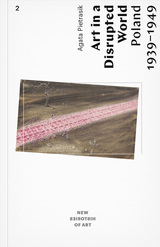
Employing an accessible, essayistic style, Pietrasik offers a new look at life in the ten years following the outbreak of World War II and features artists—including Marian Bogusz, Jadwiga Simon-Pietkiewicz, and Józef Szajna—whose work has not yet found substantial audiences in the English-speaking world. Her reading of the art and artists of this period strives to capture their autonomous artistic language and poses critical questions about the ability of traditional art history writing to properly accommodate artworks created in direct response to traumatic experiences.
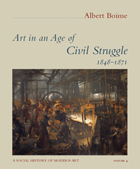
Tracing the various movements of realism through the major metropolitan centers of Europe and America, Boime strikingly evokes the milieus that shaped the lives and works of Gustave Courbet, Edouard Manet, Émile Zola, Honoré Daumier, Walt Whitman, Abraham Lincoln, and the earliest photographers, among countless others. In doing so, he spearheads a powerful new way of reassessing how art emerges from the welter of cultural and political events and the artist’s struggle to interpret his surroundings. Boime supports this multifaceted approach with a wealth of illustrations and written sources that demonstrate the intimate links between visual culture and social change. Culminating at the transition to impressionism, Art in an Age of Civil Struggle makes historical sense of a movement that paved the way for avant-garde aesthetics and, more broadly, of how a particular style emerges at a particular moment.
This volume focuses on the astonishing range of art forms currently understood to fall within the broad category of Romanticism. Drawing on visual media and popular imagery of the time, this generously illustrated work examines the art of Romanticism as a reaction to the social and political events surrounding it. Boime reinterprets canonical works by such politicized artists as Goya, Delacroix, Géricault, Friedrich, and Turner, framing their work not by personality but by its sociohistorical context. Boime's capacious approach and scope allows him to incorporate a wide range of perspectives into his analysis of Romantic art, including Marxism, social history, gender identity, ecology, structuralism, and psychoanalytic theory, a reach that parallels the work of contemporary cultural historians and theorists such as Edward Said, Pierre Bourdieu, Eric Hobsbawm, Frederic Jameson, and T. J. Clark.
Boime ultimately establishes that art serves the interests and aspirations of the cultural bourgeoisie. In grounding his arguments on their work and its scope and influence, he elucidates how all artists are inextricably linked to history. This book will be used widely in art history courses and exert enormous influence on cultural studies as well.
Now that art is getting its due. Art in Chicago is a magisterial account of the long history of Chicago art, from the rupture of the Great Fire in 1871 to the present, Manierre Dawson, László Moholy-Nagy, and Ivan Albright to Chris Ware, Anne Wilson, and Theaster Gates. The first single-volume history of art and artists in Chicago, the book—in recognition of the complexity of the story it tells—doesn’t follow a single continuous trajectory. Rather, it presents an overlapping sequence of interrelated narratives that together tell a full and nuanced, yet wholly accessible history of visual art in the city. From the temptingly blank canvas left by the Fire, we loop back to the 1830s and on up through the 1860s, tracing the beginnings of the city’s institutional and professional art world and community. From there, we travel in chronological order through the decades to the present. Familiar developments—such as the founding of the Art Institute, the Armory Show, and the arrival of the Bauhaus—are given a fresh look, while less well-known aspects of the story, like the contributions of African American artists dating back to the 1860s or the long history of activist art, finally get suitable recognition. The six chapters, each written by an expert in the period, brilliantly mix narrative and image, weaving in oral histories from artists and critics reflecting on their work in the city, and setting new movements and key works in historical context. The final chapter, comprised of interviews and conversations with contemporary artists, brings the story up to the present, offering a look at the vibrant art being created in the city now and addressing ongoing debates about what it means to identify as—or resist identifying as—a Chicago artist today. The result is an unprecedentedly inclusive and rich tapestry, one that reveals Chicago art in all its variety and vigor—and one that will surprise and enlighten even the most dedicated fan of the city’s artistic heritage.
Part of the Terra Foundation for American Art’s year-long Art Design Chicago initiative, which will bring major arts events to venues throughout Chicago in 2018, Art in Chicago is a landmark publication, a book that will be the standard account of Chicago art for decades to come. No art fan—regardless of their city—will want to miss it.
Scott MacDonald's Art in Cinema presents complete programs presented by the legendary society; dozens of previously unavailable letters between Stauffacher, his collaborators, and filmmakers including Maya Deren, Hans Richter, Vincent Minelli, and Man Ray; a reprint of the society's original catalog, which features essays by Henry Miller and others; and a wide range of other remarkable historical documents.
A companion to Cinema 16 (Temple), a documentary history of the first west coast film society, Art in Cinema provides cineastes, students, teachers, and scholars with extensive and fascinating documentation of one of the most important film societies in American history. Together or separately, the books provide an indispensable reference source for the beginning of this country's love affair with independent film.
Art in Context is a systematic, historically situated, and historically evidenced attempt to demonstrate the importance of considering contexts that will, in the vast majority of cases, increase the aesthetic experience. While focusing on distance, detachment, aestheticism, art for art’s sake, and formalism can at times be instructive and interesting, such approaches risk missing the larger and often central issue of the piece.
Based on the findings of philosophers and critics, and on artwork throughout
history, Art in Context provides a solid foundation for understanding and valuing a work of art in perspective as well as within the particular world in which it exists.
Leo Tolstoy’s and Vladimir Nabokov’s radically opposed aesthetic worldviews emanate from a shared intuition—that approaching a text skeptically is easy, but trusting it is hard
Two figures central to the Russian literary tradition—Tolstoy, the moralist, and Nabokov, the aesthete—seem to have sharply conflicting ideas about the purpose of literature. Tatyana Gershkovich undermines this familiar opposition by identifying a shared fear at the root of their seemingly antithetical aesthetics: that one’s experience of the world might be entirely one’s own, private and impossible to share through art.
Art in Doubt: Tolstoy, Nabokov, and the Problem of Other Minds reconceives the pair’s celebrated fiction and contentious theorizing as coherent, lifelong efforts to reckon with the problem of other people’s minds. Gershkovich demonstrates how the authors’ shared yearning for an impossibly intimate knowledge of others formed and deformed their fiction and brought them through parallel logic to their rival late styles: Tolstoy’s rustic simplicity and Nabokov’s baroque complexity. Unlike those authors for whom the skeptical predicament ends in absurdity or despair, Tolstoy and Nabokov both hold out hope that skepticism can be overcome, not by force of will but with the right kind of text, one designed to withstand our impulse to doubt it. Through close readings of key canonical works—Anna Karenina, The Kreutzer Sonata, Hadji Murat, The Gift, Pale Fire—this book brings the twin titans of Russian fiction to bear on contemporary debates about how we read now, and how we ought to.

Examining a broad range of works, van Alphen—a renowned art historian and cultural theorist—demonstrates how art serves a socially constructive function by actually experimenting with the parameters of thought. Employing work from artists as diverse as Picasso, Watteau, Francis Bacon, Marlene Dumas, and Matthew Barney, he shows how art confronts its viewers with the "pain points" of cultural experience-genocide, sexuality, diaspora, and transcultural identity-and thereby transforms the ways in which human existence is conceived. Van Alphen analyzes how art visually "thinks" about these difficult cultural issues, tapping into an understudied interpretation of art as the realm where ideas and values are actively created, given form, and mobilized. In this way, van Alphen's book is a work of art in itself as it educates us in a new mode of thought that will forge equally new approaches and responses to the world.

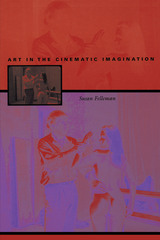
Bringing an art historical perspective to the realm of American and European film, Art in the Cinematic Imagination examines the ways in which films have used works of art and artists themselves as cinematic and narrative motifs. From the use of portraits in Vertigo to the cinematic depiction of women artists in Artemisia and Camille Claudel, Susan Felleman incorporates feminist and psychoanalytic criticism to reveal individual and collective perspectives on sex, gender, identity, commerce, and class.
Probing more than twenty films from the postwar era through contemporary times, Art in the Cinematic Imagination considers a range of structurally significant art objects, artist characters, and art-world settings to explore how the medium of film can amplify, reinvent, or recontextualize the other visual arts. Fluently speaking across disciplines, Felleman's study brings a broad array of methodologies to bear on questions such as the evolution of the "Hollywood Love Goddess" and the pairing of the feminine with death on screen.
A persuasive approach to an engaging body of films, Art in the Cinematic Imagination illuminates a compelling and significant facet of the cinematic experience.
In the Soviet Union, as in the West, Marina Tsvetaeva (1892-4941) is acknowledged to be one of the great Russian poets of the century, along with Mandelstam, Pasternak and Akhmatova. Overnight sensation and oft-times pariah, Tsvetaeva was a poet of extraordinary intensity whose work continues to be discovered by new readers. Yet, while she is considered to be one of the major influences on modern Soviet poetry, few know of her consummate gifts as a writer of prose. These select essays, most of which have never been available in translation before, display the dazzlingly original prose style and the powerful, dialogic voice of a poet who would like to make art’s mystery accessible without diminishing it.
The essays provide incomparable insight on poetry, the poetic process, and what it means to be a poet. The volume offers, among many fascinating topics, a celebration of the poetry of Pasternak and reflections on the lives and works of other Russian poets, such as Mandelstam, Mayakovsky, and Zhukovsky. Included in this richly diverse collection are the essays “The Poet on the Critic,” which earned Tsvetaeva the enmity of many, Art in the Light of Conscience, a spirited defense of poetry, and The Poet and Time, seen by many scholars as providing the key to understanding Tsvetaeva’s work. The immense power and originality of Tsvetaeva’s language captured by Angela Livingstone’s superb translation of the essays along with twelve of Tsvetaeva’s poems on related themes, is testimony to why the Tsvetaevan revival in the Soviet Union and interest in the West continue to gain momentum as the centenary of her birth approaches. The volume is made complete by the addition of an elegant introduction by the translator, a chronology of Tsvetaeva’s life, and an index of contemporary poets and writers mentioned in the essays.
“Good poetry is always better than prose,” Tsvetaeva wrote. Prose as good as hers, however, is rare and few have done as much as she to explore the processes of creation and the feelings of the exceptionally creative person in the ordinary world.
In her funny, idiosyncratic, and propulsive new novel, Art Is Everything, Yxta Maya Murray offers us a portrait of a Chicana artist as a woman on the margins. L.A. native Amanda Ruiz is a successful performance artist who is madly in love with her girlfriend, a wealthy and pragmatic actuary named Xōchitl. Everything seems under control: Amanda’s grumpy father is living peacefully in Koreatown; Amanda is about to enjoy a residency at the Guggenheim Museum in New York and, once she gets her NEA, she’s going to film a groundbreaking autocritical documentary in Mexico.
But then everything starts to fall apart when Xōchitl’s biological clock begins beeping, Amanda’s father dies, and she endures a sexual assault. What happens to an artist when her emotional support vanishes along with her feelings of safety and her finances? Written as a series of web posts, Instagram essays, Snapchat freakouts, rejected Yelp reviews, Facebook screeds, and SmugMug streams-of-consciousness that merge volcanic confession with eagle-eyed art criticism, Art Is Everything shows us the painful but joyous development of a mid-career artist whose world implodes just as she has a breakthrough.
In the face of a great work of art, we so often stand mute, struck dumb. Is this a function—perhaps the first and foremost—of aesthetic experience? Or do we lack the words to say what we feel? Countering current assumptions that art is valued only according to taste or ideology, Peter de Bolla gives a voice—and vocabulary—to the wonder art can inspire. Working toward a better understanding of what it is to be profoundly moved by a work of art, he forces us to reconsider the importance of art works and the singular nature and value of our experience of them.
In many ways a "practical aesthetics," Art Matters proceeds by way of example. Through chapters attending to three works of art—Barnett Newman's painting Vir Heroicus Sublimis, pianist Glenn Gould's second recording of Bach's Goldberg Variations, and William Wordsworth's poem "We Are Seven"—de Bolla plots a personal history of aesthetic experience that opens up the general forms of art appreciation. His book invites us to a closer encounter with art, and to a deeper appreciation and clearer expression of what such an encounter might hold.
In this volume, liberally seasoned with period illustrations, Yoshinobu Hakutani has collected and annotated a rich selection of Theodore Dreiser's pre-fame writings on the cultural milieu of his day.
In these brief essays, Dreiser sallies into the vibrant world of creative work in turn-of-the-century America. He inspects the eccentric and revealing paraphernalia of artists' studios, probes the work habits of writers, and goes behind the scenes in the popular song-writing business, where this week's celebrity is next week's has-been. He profiles famous figures and introduces numerous women artists, novelists, and musicians, including the prolific and tireless Amelia Barr (mother of fourteen children and author of thirty-two novels), the illustrator Alice B. Stephens, and the opera singer Lillian Nordica. Hakutani's notes provide biographical detail on dozens of now-obscure individuals mentioned by Dreiser.
From prehistory to the present, the Indigenous peoples of the Andes have used a visual symbol system—that is, art—to express their sense of the sacred and its immanence in the natural world. Many visual motifs that originated prior to the Incas still appear in Andean art today, despite the onslaught of cultural disruption that native Andeans have endured over several centuries. Indeed, art has always been a unifying power through which Andeans maintain their spirituality, pride, and culture while resisting the oppression of the dominant society.
In this book, Mary Strong takes a significantly new approach to Andean art that links prehistoric to contemporary forms through an ethnographic understanding of Indigenous Andean culture. In the first part of the book, she provides a broad historical survey of Andean art that explores how Andean religious concepts have been expressed in art and how artists have responded to cultural encounters and impositions, ranging from invasion and conquest to international labor migration and the internet. In the second part, Strong looks at eight contemporary art types—the scissors dance (danza de tijeras), home altars (retablos), carved gourds (mates), ceramics (ceramica), painted boards (tablas), weavings (textiles), tinware (hojalateria), and Huamanga stone carvings (piedra de Huamanga). She includes prehistoric and historic information about each art form, its religious meaning, the natural environment and sociopolitical processes that help to shape its expression, and how it is constructed or performed by today’s artists, many of whom are quoted in the book.
The Art of Accompanying and Coaching was first published in 1965. Minnesota Archive Editions uses digital technology to make long-unavailable books once again accessible, and are published unaltered from the original University of Minnesota Press editions.
Kurt Adler, former conductor and chorus master of the Metropolitan Opera, provides a comprehensive guide to musical accompanying and coaching, based in his extensive experience, which will be helpful, if not indispensable, to music teachers, students, coaches, accompanists, orchestral and choral conductors, and performing vocal and instrumental artists.
The first part of the book gives the historical and technical background of the subject and explains in detail the mechanics of string instruments, piano, celeste, organ, harmonium, and voice. The next section offers a thorough guide to the singing diction of five languages— Italian, Latin, French, German, and English. The author continues with a discussion of the elements of musical style, describing, with the use of ample musical illustrations, tempo, rhythm, dynamics, phrasing and articulation, and ornamentation. This section closes with an analysis of the German lied style and the French art song style.
Mr. Adler goes on to synthesize the various elements of accompanying and coaching. He stresses the importance of psychological and spiritual rapport between accompanists and artist and shows ways of achieving this. He explains the differences and similarities among opera, oratorio, and song coaching. In a section on program arranging, he offers advice about planning concerts of various kinds, citing examples of programs given by outstanding artists. He writes about particular aspects of accompanying — self accompanying, the difference between piano accompanying and soloistic piano playing, and accompanying for singers, instrumentalists, and dancers. In conclusion, he describes the qualities of an ideal accompanist and the rewards derived from excellence in performance.
University and college music departments, schools of music, choral groups, voice teachers, singers, pianists, and other musicians will find the book of inestimable value, either as a text or as a reference work. It will be especially helpful to pianists who aspire to become accompanists.

THIS EDITION HAS BEEN REPLACED BY A NEWER EDITION..
From the awesome grandeur of the great pyramids to the delicacy of a face etched on an amulet, the spellbinding power of the art of ancient Egypt persists to this day. This beautifully illustrated book conducts us through the splendors of this world, great and small, and into the mysteries of its fascination in its day as well as in our own. What did art, and the architecture that housed it, mean to the ancient Egyptians? Why did they invest such vast wealth and effort in its production? These are the puzzles Gay Robins explores as she examines the objects of Egyptian art--the tombs and wall paintings, the sculpture and stelae, the coffins, funerary papyri, and amulets--from its first flowering in the Early Dynastic period to its final resurgence in the time of the Ptolemies.
Spanning three thousand years, her book offers a thorough and delightfully readable introduction to the art of ancient Egypt even as it provides insight into questions that have long perplexed experts and amateurs alike. With remarkable sensitivity to the complex ways in which historical, religious, and social changes are related to changes in Egyptian art, she brings out the power and significance of the image in Egyptian belief and life. Her attention to the later period, including Ptolemaic art, shows for the first time how Egyptian art is a continuous phenomenon, changing to meet the needs of different times, right down to the eclipse of ancient Egyptian culture. In its scope, its detail, and its eloquent reproduction of over 250 objects from the British Museum and other collections in Europe, the United States, and Egypt, this volume is without parallel as a guide to the art of ancient Egypt.

From the awesome grandeur of the Great Pyramids to the delicacy of a face etched on an amulet, the spellbinding power of ancient Egyptian art persists to this day. Spanning three thousand years, this beautifully illustrated history offers a thorough and delightfully readable introduction to the artwork even as it provides insight into questions that have long engaged experts and amateurs alike. In its scope, its detail, and its eloquent reproduction of over 250 objects, Gay Robins’s classic book is without parallel as a guide to the art of ancient Egypt.
This eagerly awaited new edition includes many new color photographs and a fully revised and updated bibliography.
By focusing on the provincial tales as they were originally conceived--as a narrative cycle--Thompson is able to recover intertextual references that reveal Hawthorne's preoccupation with framing strategies and variations on authorial presence. The author shows how Hawthorne deliberately constructs sentimental narratives, only to deconstruct them. Thompson's analysis provides a new aesthetic context for understanding the whole shape of Hawthorne's career as well as the narrative, ethical, and historical issues within individual works.
Revisionary in its view of one of America's greatest authors, The Art of Authorial Presence also offers invaluable insight into the problems of narratology and historiography, ethics and psychology, romanticism and idealism, and the cultural myths of America.
The Art of Being a Parasite is an extensive collection of these and other wonderful and weird stories that illuminate the ecology and evolution of interactions between species. Claude Combes illustrates what it means to be a parasite by considering every stage of its interactions, from invading to reproducing and leaving the host. An accessible and engaging follow-up to Combes's Parasitism, this book will be of interest to both scholars and nonspecialists in the fields of biodiversity, natural history, ecology, public health, and evolution.
Born in 1950s Australia, McDonald was placed in an oral deaf school when she was five. There, she was trained to communicate only in spoken English. Afterwards, she attended mainstream schools where she excelled with speechreading and hard work. Her determination led to achievements that proved her to be “the deaf girl that had made good.” Yet, despite her constant focus on fitting in the hearing world, McDonald soon realized that she missed her deaf schoolmates and desired to explore her closed-off feelings about being deaf.
When she reconnected with her friends, one urged her to write about her experiences to tell all about “the Forgotten Generation, the orally-raised deaf kids that no one wants to talk about.” In writing her memoir, McDonald did learn to reconcile her deaf-self with her “hearing-deaf” persona, and she realized that the art of being deaf is the art of life, the art of love.
Through interpretation of a wide array of historical sources—including descriptions of public rituals, accounts of indigenous rebellions, idolatry trials, legal petitions, court cases, land disputes, and indigenous pictorial histories—Yannakakis weaves together an elegant narrative that illuminates political and cultural struggles over the terms of local rule. As cultural brokers, native intermediaries at times reconciled conflicting interests, and at other times positioned themselves in opposing camps over the outcome of municipal elections, the provision of goods and labor, landholding, community ritual, the meaning of indigenous “custom” in relation to Spanish law, and representations of the past. In the process, they shaped an emergent “Indian” identity in tension with other forms of indigenous identity and a political order characterized by a persistent conflict between local autonomy and colonial control. This innovative study provides fresh insight into colonialism’s disparate cultures and the making of race, ethnicity, and the colonial state and legal system in Spanish America.
The Art of Being is a powerful account of how the literary form of the novel reorients philosophy toward the meaning of existence. Yi-Ping Ong shows that for Kierkegaard, Sartre, and Beauvoir, the form of the novel in its classic phase yields the conditions for reconceptualizing the nature of self-knowledge, freedom, and the world. Their discovery gives rise to a radically new poetics of the nineteenth- and twentieth-century realist novel.
For the existentialists, a paradox lies at the heart of the novel. As a work of art, the novel exists as a given totality. At the same time, the capacity of the novel to compel belief in the free and independent existence of its characters depends on the absence of any perspective from which their lives may be viewed as a consummated whole. At stake in the poetics of the novel are the conditions under which knowledge of existence is possible. Ong’s reframing of foundational debates in novel theory takes us beyond old dichotomies of mind and world, interiority and totality, and form and mimesis. It illuminates existential dimensions of novelistic realism overlooked by empirical and sociological approaches.
Bringing together philosophy, novel theory, and intellectual history with groundbreaking readings of Tolstoy, Eliot, Austen, James, Flaubert, and Zola, The Art of Being reveals how the novel engages in its very form with philosophically rich notions of self-knowledge, freedom, authority, world, and the unfinished character of human life.
A richly illustrated collection of essays on visual biblical interpretation
For centuries Christians have engaged their sacred texts as much through the visual as through the written word. Yet until recent decades, the academic disciplines of biblical studies and art history largely worked independently. This volume bridges that gap with the interdisciplinary work of biblical scholars and art historians. Focusing on the visualization of biblical characters from both the Old and New Testaments, essays illustrate the potential of such collaboration for a deeper understanding of the Bible and its visual reception. Contributions from Ian Boxall, James Clifton, David B. Gowler, Jonathan Homrighausen, Heidi J. Hornik, Jeff Jay, Christine E. Joynes, Yohana A. Junker, Meredith Munson, and Ela Nuțu foreground diverse cultural contexts and chronological periods for scholars and students of the Bible and art.
Showing how poetics provides a path for building new imagined possibilities
Drawing together a robust corpus of contemporary USAmerican poetry, The Art of Breaking Worlds explores social and political breaks: disasters, failures, and disruptions that simultaneously constitute and fracture the world. These breaks range from unsuccessful political movements and acts of resistance to mass incarceration and biopolitical violence, from anti-Black racism to the infrastructural catastrophes of climate collapse. Paul Jaussen shows how poetry responds to such disasters by incorporating public-facing genres and discourses into its literary practice, thereby rewriting into aesthetic form the public languages used to perpetuate or contain that rupture. This poetic integration of public language thus generates a third space, located between the rhetorical and the aesthetic, a literary practice of both world-breaking and world-making that transforms existing genres while also creating newly imagined modes of collectivity. Grounded in contemporary theory and close readings of works by poets such as Claudia Rankine, Juliana Spahr, and Ilya Kaminsky, this book proposes that these dynamics require a distinctive critical poetics, one simultaneously attuned to discourses of struggle and discourses of art, modeling a fresh approach to the relationship between politics and literature.
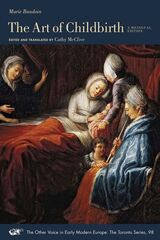
In 1671, Marie Baudoin (1625–1700), head midwife and governor of the Hôtel-Dieu of Clermont-Ferrand, sent a treatise on the art of childbirth to her powerful Parisian patron, Dr. Vallant. The story of how Baudoin’s knowledge and expertise as a midwife came to be expressed, recorded, and archived raises the question: Was Baudoin exceptional because she was herself extraordinary, or because her voice has reached us through Vallant’s careful archival practices? Either way, Baudoin’s treatise invites us to reconsider the limits of what we thought we knew midwives “could be and do” in seventeenth-century France. Grounding Marie Baudoin’s text in a microanalysis of her life, work, and the Jansenist network between Paris and Clermont-Ferrand, this book connects historiographies of midwifery, Jansenism, hospital administration, public health, knowledge and record-keeping, and women’s work, underscoring both Baudoin’s capabilities and the archival accidents and intentions behind the preservation of her treatise in a letter.
"[This] books should be read by all those interested in Chinese poetry."—Achilles Fang, Poetry
"[This is] a significant contribution to the understanding and appreciation of Chinese poetry, lucidly presented in a way that will attract a wide audience, and offering an original synthesis of Chinese and Western views that will stimulate and inspire students of poetry everywhere."—Hans H. Frankel, Harvard Journal of Asiatic Studies
"This is a book which can be recommended without reservation to anyone who wants to explore the world of Chinese poetry in translation."—James R. Hightower, Journal of Asian Studies
An accomplished architect and urbanist goes back to the roots of what makes cities attractive and livable, demonstrating how we can restore function and beauty to our urban spaces for the long term.
Nearly everything we treasure in the world’s most beautiful cities was built over a century ago. Cities like Prague, Paris, and Lisbon draw millions of visitors from around the world because of their exquisite architecture, walkable neighborhoods, and human scale. Yet a great deal of the knowledge and practice behind successful city planning has been abandoned over the last hundred years—not because of traffic, population growth, or other practical hurdles, but because of ill-considered theories emerging from Modernism and reactions to it.
The errors of urban design over the last century are too great not to question. The solutions being offered today—sustainability, walkability, smart and green technologies—hint at what has been lost and what may be regained, but they remain piecemeal and superficial. In The Art of Classic Planning, architect and planner Nir Haim Buras documents and extends the time-tested and holistic practices that held sway before the reign of Modernism. With hundreds of full-color illustrations and photographs that will captivate architects, planners, administrators, and developers, The Art of Classic Planning restores and revitalizes the foundations of urban planning.
Inspired by venerable cities like Kyoto, Vienna, and Venice, and by the great successes of L’Enfant’s Washington, Haussmann’s Paris, and Burnham’s Chicago, Buras combines theory and a host of examples to arrive at clear guidelines for best practices in classic planning for today’s world. The Art of Classic Planning celebrates the enduring principles of urban design and invites us to return to building beautiful cities.
The Art of Creative Research helps writers take this natural inclination to explore and observe and turn it into a workable—and enjoyable—research plan. It shows that research shouldn’t be seen as a dry, plodding aspect of writing. Instead, it’s an art that all writers can master, one that unearths surprises and fuels imagination. This lends authenticity to fiction and poetry as well as nonfiction.
Philip Gerard distills the process into fundamental questions: How do you conduct research? And what can you do with the information you gather? He covers both in-person research and work in archives and illustrates how the different types of research can be incorporated into stories, poems, and essays using examples from a wide range of writers in addition to those from his own projects. Throughout, Gerard brings knowledge from his seasoned background into play, drawing on his experiences as a reporter and a writer of both fiction and nonfiction. His enthusiasm for adventure is infectious and will inspire writers to step away from the keyboard and into the world.
“Research can take you to that golden intersection where the personal meets the public, the private crosses the universal, where the best literature lives,” Gerard writes. With his masterly guidance, anyone can become an expert in artful investigation.
The editors have provided what James himself emphasized in his literary criticism—the text's context. Each selection is framed by an editorial commentary and notes which give its biographical, bibliographical, and critical background and cite other references in James' work to the topic discussed. This framework, along with the editors' introduction, gives the reader a sense of the place of these pieces in the history of criticism.
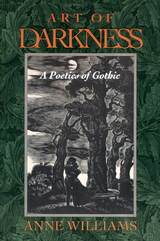
Building on the psychoanalytic and feminist theory of Julia Kristeva, Williams argues that Gothic conventions such as the haunted castle and the family curse signify the fall of the patriarchal family; Gothic is therefore "poetic" in Kristeva's sense because it reveals those "others" most often identified with the female. Williams identifies distinct Male and Female Gothic traditions: In the Male plot, the protagonist faces a cruel, violent, and supernatural world, without hope of salvation. The Female plot, by contrast, asserts the power of the mind to comprehend a world which, though mysterious, is ultimately sensible. By showing how Coleridge and Keats used both Male and Female Gothic, Williams challenges accepted notions about gender and authorship among the Romantics. Lucidly and gracefully written, Art of Darkness alters our understanding of the Gothic tradition, of Romanticism, and of the relations between gender and genre in literary history.

In order to both demystify and complicate our understanding of the practice of graffiti writing, this book pushes past the narrative that links the origins of graffiti to criminal gangs and instead offers a detailed portrait of graffiti as a rich urban culture with its own rules and practices. To do so, it examines the cultural history of graffiti in Philadelphia from the early 1970s onward and explores what it is like to be a graffiti writer in the city today. Ultimately, Tyson Mitman aims to humanize graffiti writers and to show that what they do is not merely destructive or puerile, but, rather, adds something important to the urban experience that is a conscious and deliberate act on the part of its practitioners.
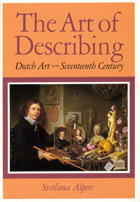
"There is no doubt that thanks to Alpers's highly original book the study of the Dutch masters of the seventeenth century will be thoroughly reformed and rejuvenated. . . . She herself has the verve, the knowledge, and the sensitivity to make us see familiar sights in a new light."—E. H. Gombrich, New York Review of Books
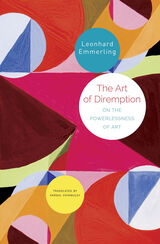
One of the most astonishing aspects of the discourse on contemporary art is the firm and unwavering belief that art has the power to transform society for the better. There seems to be a consensus around the idea that art, especially visual art, is greatly suited to addressing all manner of social, political, economic, ecological, and other imbalances. Celebrated as a powerful remedy for social grievances, art finds its justification in the service it seems to provide to society.
But as art historian Leonhard Emmerling contends in this timely volume, this presumptuous heroism shows willful blindness towards art’s subjugation to contradictions inherent in social relations. He argues that the narrative of the power of art has its specific history. In trying to reconstruct this history in Art of Diremption, he discovers instead art’s fundamental powerlessness as the foundation for art’s political relevance. Art is weak, argues Emmerling. It, therefore, requires an ethics of weakness, which rejects the discourse of impact and power to enable a politics of art containing the permanence of reflection, the unreliability of thought, and the emergence of form as the event of the new. With a meticulously studied and well-argued case about the “powerlessness of art,” Art of Diremption will be an important contribution to the field of art, aesthetics, and philosophy.
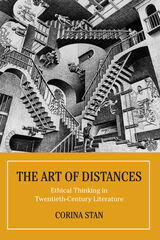
In The Art of Distances, Corina Stan identifies an insistent preoccupation with interpersonal distance in a strand of twentieth-century European and Anglophone literature that includes the work of George Orwell, Paul Morand, Elias Canetti, Iris Murdoch, Walter Benjamin, Annie Ernaux, Günter Grass, and Damon Galgut. Specifically, Stan shows that these authors all engage in philosophical meditations, in the realm of literary writing, on the ethical question of how to live with others and how to find an ideal interpersonal distance at historical moments when there are no obviously agreed-upon social norms for ethical behavior.
Bringing these authors into dialogue with philosophers such as Michel de Montaigne, Ralph Waldo Emerson, Friedrich Nietzsche, Sigmund Freud, Helmuth Plessner, Martin Heidegger, Jean-Luc Nancy, Emmanuel Levinas, Peter Sloterdijk, Guillaume le Blanc, and Pierre Zaoui, Stan shows how the question of the right interpersonal distance became a fundamental one for the literary authors under consideration and explores what forms and genres they proposed in order to convey the complexity of this question. Albeit unknowingly, she suggests, they are engaged in fleshing out what Roland Barthes called “a science, or perhaps an art, of distances.”
The Art of Eastern India, 300–800 was first published in 1980. Minnesota Archive Editions uses digital technology to make long-unavailable books once again accessible, and are published unaltered from the original University of Minnesota Press editions.
Though scholars have extensive knowledge of the art that flourished during Pala rule in Eastern India (ca. 800-1200), little is known about Eastern Indian art during the preceding 500 years. This half-millennium includes the period of the Gupta dynasty and the two centuries that bridge Gupta and Pala rule, when no single dynasty long maintained control of Eastern India. In this study, Frederick M. Asher challenges arthistorical assumptions about Pala art — that it is a new school virtually without links to earlier art 00 by demonstrating that sculpture during the Gupta period and the subsequent three centuries evolved along lines that connect it with Pala art. In so doing, he draws attention to important sculptures, most of them never previously studied, that tell us not only about an unexplored period in Indian art but also about broader aspects of the cultural history and geography of Eastern India.
Asher's work is based on field research in Bihar, West Bengal, and Bangladesh. There he gave special attention to the sites of once-flourishing Buddhist monasteries and to Hindu images still worshipped in village India. The author's photographs of the bronze, terra cotta, and stone sculptures, and his detailed text, provide a virtual catalogue raisonne of the known works of the period.
Asher's analyses of the images and his attributions of dates to them are based upon close attention to artistic style and iconography, and the study of dynastic and social history, contemporary travelers' reports, and religious history. Drawing together these diverse strands of information, he describes the evolution of art forms over a long period in which there was little apparent historic unity. John M. Rosenfield, professor of art history at Harvard University and author of The Art of the Kushans, says, of The Art of Eastern India,"The scholarship is scrupulously detailed and careful . . . [The book] is in the finest tradition of classical scholarship, and will be consulted or several generations."
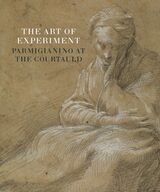
Accompanying an exhibition at London’s Courtauld Gallery, this stunning catalog presents works by the Renaissance artist Girolamo Francesco Maria Mazzola, better known as Parmigianino (1503–1540).
Fundamentally a draftsman at heart, Parmigianino drew relentlessly during his relatively short life, and around a thousand of his drawings have survived. The Courtauld’s collection comprises twenty-four sheets. In preparation for the catalog, new photography and technical examinations have been carried out on all the works, revealing two new drawings that were previously unknown, hidden underneath their historic mounts. They have also helped to better identify connections between some of the drawings and the finished paintings for which they were conceived. This stunning illustrated catalog presents the whole Courtauld collection and sheds light on an artist who approached every technique with unprecedented freedom and produced innovative works that are still admired by artists and collectors today.
To say that the entirety of human experience can be a novelist’s theme is to voice an absurdity. But, as Peter Swiggart convincingly argues, Faulkner’s work can be viewed as an extraordinary attempt to transform the panorama of man’s social experience into thematic material. Faulkner’s two-dimensional characters, his rhetorical circumlocutions, and his technical experiments are efforts to achieve a dramatic focus upon material too unwieldy, at least in principle, for any kind of fictional condensation.
Faulkner makes use of devices of stylization that apply to virtually every aspect of his successful novels. For example, the complex facts of Southern history and culture are reduced to the scale of a simplified and yet grandiose social mythology: the degeneration of the white aristocracy, the rise of Snopesism, and the white Southerner’s gradual recognition of his latent sense of racial guilt. Within Faulkner’s fictional universe, human psychology takes the form of absolute distinctions between puritan and nonpuritan characters, between individuals corrupted by moral rationality and those who are simultaneously free of moral corruption and social involvement. In this way Faulkner is able to create the impression of a comprehensive treatment of important social concerns and universal moral issues.
Like Henry James, he makes as much as he can of clearly defined dramatic events, until they seem to echo the potential complexity and depth of situations outside the realm of fiction. When this technique is successful the reader is left with the impression that he knows a Faulkner character far better than he could know an actual person. At the same time, the character retains the atmosphere of complexity and mystery imposed upon it by Faulkner’s handling of style and structure.
This method of characterization reflects Faulkner’s simplifications of experience and yet suggests the inadequacy of any rigid interpretation of actual behavior. The reader is supplied with special eyeglasses through which the tragedy of the South, as well as humanity’s general inhumanity to itself, can be viewed in a perspective of simultaneous mystery and symbolic clarity.
In this his eighth collection of poetry (and fifth with Four Way Books), Prufer’s career-spanning talent for estranging the familiar—and also for recording the unthinkable with eerie directness—recurs, enhanced and transformed by the collection’s meta-level attention to the role of fiction in our civic lives. Prufer describes, often through personae, a near future, tracing there the political gambit of Fake News and the role of the imagination in our self-understanding (whether it’s cogent or delusional). Via both satire and direct address (to the point of reader-squeamishness), Prufer aims to understand the ugly-casual atmosphere of our often racialized, pervasive distrust. The Art of Fiction fundamentally understands that fictions are deployed to divide us, and they work: they get under our skin. Prufer powerfully explores the roles of imagination and art in how we explain ourselves to ourselves.
"We live in an Enquirer, reality television–addled world, a world in which most college students receive their news from the Daily Show and discourse via text message," assert Charles Blackstone and Jill Talbot. "Recently, two nonfiction writers have been criticized for falsifying memoirs. Oprah excoriated James Frey on her show; Nasdijj was impugned by Sherman Alexie in Time. Is our next trend in literature to lock down such boundaries among the literati? Or should we address the fictionalizing of nonfiction, the truth of fiction?"
The Art of Friction surveys the borderlands where fiction and nonfiction intersect, commingle, and challenge genre lines. It anthologizes nineteen creative works by contemporary, award-winning writers including Junot Díaz, Jonathan Safran Foer, Thomas Beller, Bernard Cooper, Wendy McClure, and Terry Tempest Williams, who also provide companion pieces in which they comment on their work. These selections, which place short stories and personal essays (and hybrids of the two) side by side, allow readers to examine the similarities and differences between the genres, as well as explore the trends in genre overlap.
Functioning as both a reader and a discussion of the craft of writing, The Art of Friction is a timely, essential book for all writers and readers who seek the truthfulness of lived experience through (non)fictions.
In the field of negotiation theory, the Harvard Project’s Getting to Yes and Donald Trump’s The Art of the Deal occupy polar opposition locations on a spectrum considering distributive and integrative negotiation theories. The Art of Getting More Back in Diplomacy offers case studies from international negotiations in which the author participated that can help illustrate the tactics and theories of each type of negotiation and to make students in law, business, and other fields into better negotiators. Among the case studies are lessons drawn from negotiating denuclearization with North Korea, political reconciliation in Libya, human rights improvements in China, Israel-Palestinian peace processes, and UN negotiations over surveillance, privacy, atrocities prevention, LGBTI rights, and other fundamental freedoms. By illustrating these lessons, The Art of Getting More Back in Diplomacy strengthens the tools that students and teachers of negotiations should have in their negotiating toolbox. Perhaps most importantly, Richardson provides concrete examples of how a negotiator is likely to Get More Back for their clients if they deploy these tactics, rather than having them used against the negotiator.
The Art of Good Manners ranges broadly across topics including courtship, children’s behavior, and civilized conversation before taking the reader through each course at a dinner party, where readers are reminded to neither gurgle the soup nor to make haste with the fruit course since “to peel an orange, apple or pear with a fruit knife and fork requires some practice.”
Charmingly presented, The Art of Good Manners is by turns humorously old-fashioned and timeless, and it makes the perfect gift for all who miss this elegant bygone era.

Public administration has evolved into an extraordinarily complex form of governance employing traditional bureaucracy, quasi-government public organizations, and collaborative networks of nongovernmental organizations. Analyzing and improving government performance—a matter of increasing concern to citizens, elected officials, and managers of the organizations themselves—has in turn become a much more fraught undertaking. Understanding the new complexities calls for new research approaches.
The Art of Governance presents a fresh palette of research based on a new framework of governance that was first developed by coeditor Laurence E. Lynn, Jr., with Carolyn J. Heinrich, and Carolyn J. Hill in their book, Improving Governance: A New Logic for Empirical Research. That book identified how the relationships among citizens, legislatures, executive and organizational structures, and stakeholders interact, in order to better diagnose and solve problems in public management.
This volume takes that relational concept into new realms of conceptualization and application as it links alternative institutional and administrative structures to program performance in different policy areas and levels of government. Collectively, the contributors begin to paint a new picture of how management matters throughout the policy process. They illuminate how, at different levels of an organization, leadership and management vary—and explore both the significance of structural systems and the importance of alternative organizational forms for the implementation of public policies.
The Art of Governance shows that effective governance is much more complex than paint-by-number. But if the variety of forms and models of governance are analyzed using advanced theories, models, methods, and data, important lessons can be applied that can lead us to more successful institutions.
"Funny . . . profound. . . . It is hard to resist the closing chapters, which celebrate the freedom from constraint and ambition, the permission to be crotchety, the joy of memory and perspective that come with age."—William March, Tampa Tribune
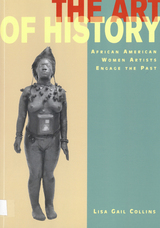
“This important study is the first to confront head-on the avoidance of the visual that has plagued black studies in the United States. The Art of History opens the often hermetic world of black visual culture to a much broader realm in which questions central to contemporary feminism, black studies, and cultural theory are brought to bear.”—Judith Wilson, University of California, Irvine
“The Art of History is an important book that expands the significance of visual culture to African American studies debates. It provides cogent and insightful explorations of the work of contemporary African American women artists. Scholars and general readers alike are sure to be compelled by this original and innovative study.”—Valerie Smith, author of Not Just Race, Not Just Gender: Black Feminist Readings
In this lively and engaging book, Lisa Gail Collins examines the work of contemporary African American women artists. Her study comes at a time when an unprecedented number of these artists—photographers, filmmakers, painters, installation and mixed-media artists—have garnered the attention and imagination of the art-viewing public.
To better understand the significance of this particular historical moment in American visual arts, Collins focuses on four “problems” that recur when these artists confront their histories: the documentation of truth; the status of the black female body; the relationship between art and cultural contact and change; and the relationship between art and black girlhood. By examining the social and cultural histories which African American women artists engage, Collins illuminates a dialogue between past and present imagemakers.
The Art of History is a major contribution to the study of American visual culture. It will be of use to both scholars and students in art history, African American studies, American studies, and women’s studies.
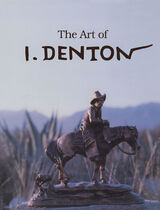
The remarkable detail and subtly stylized lines characterizing the artistry of celebrated woodcarver Ivan Denton are in abundant evidence in this beautifully illustrated volume of The Art of I. Denton. Behind each carving presented here, is its story from a piece of wood to a work of art, told in the words of Mr. Denton himself.
This is, in fact, a tour guided by Ivan Denton covering the best of his efforts, his love for the wood, and the process which turns a craftsman into an artist. As he says in describing his work: “Art exists only when you share it. When a tree falls in the woods, in school they said, ‘This tree doesn’t make a noise if someone doesn’t hear it.’ Because, you know, the sound waves don’t bump against the eardrum . . . The idea of not being able to get rid of a piece is basically the concept of an amateur. Not only does a professional need the money, and not only does he need his ego flattered, it’s just that the art doesn’t really exist until it’s shared. That’s an even deeper joy than the ego.”
Chosen from collections across the country, these pieces represent the masterworks from one of a disappearing breed of artisans. But The Art of I. Denton is more than a document of our cultural heritage, it is a tribute to the man and his art.
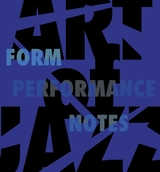
This catalogue documents the exhibition Art of Jazz, a collaborative installation at the Ethelbert Cooper Gallery of African & African American Art with one section (“Form”) installed at the Harvard Art Museum. The book explores the intersection of the visual arts and jazz music, and presents a visual feast of full color plates of artworks, preceded by a series of essays.
“Form,” curated by Suzanne Preston Blier and David Bindman in the teaching gallery of the Harvard Art Museum, ushers in a dialogue between visual representation and jazz music, showcasing artists’ responses to jazz. “Performance,” also curated by Blier and Bindman, guides us through a rich collection of books, album covers, photographs, and other ephemera installed at the Cooper Gallery. “Notes,” curated by Cooper Gallery director Vera Ingrid Grant, fills five of the gallery’s curatorial spaces with contemporary art that illustrates how late twentieth- and early twenty-first century artists hear, view, and engage with jazz.
Visual artists represented in “Form” include Matisse, Jackson Pollock, Romare Bearden, and Stuart Davis. “Performance” includes art by Hugh Bell, Carl Van Vechten, and Romare Bearden; additional album cover art by Joseph Albers, Ben Shahn, Andy Warhol, and the Fisk Jubilee Singers; and posters and photographs of Josephine Baker and Lena Horne. “Notes” includes art by Cullen Washington, Norman Lewis, Walter Davis, Lina Viktor, Petite Noir, Ming Smith, Richard Yarde, Christopher Myers, Whitfield Lovell, and Jason Moran.
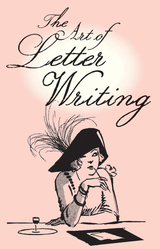
The Art of Letter Writing provides more than fifty examples of well-crafted correspondence that will lend confidence whether one needs to break off an engagement, accept an invitation to a country house weekend, complain about a courier, or write to a countess.
Charmingly presented, The Art of Good Letter Writing is by turns humorously old-fashioned and timeless, and it makes the perfect gift for all who miss this elegant bygone era.
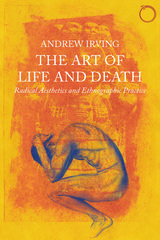
Encompassing twenty years of working alongside persons living with HIV/AIDS in New York, Irving documents the radical but often unspoken and unvoiced transformations in perception, knowledge, and understanding that people experience in the face of death. By bringing an “experience-near” ethnographic focus to the streams of inner dialogue, imagination, and aesthetic expression that are central to the experience of illness and everyday life, this monograph offers a theoretical, ethnographic, and methodological contribution to the anthropology of time, finitude, and the human condition. With relevance well-beyond the disciplinary boundaries of anthropology, this book ultimately highlights the challenge of capturing the inner experience of human suffering and hope that affect us all—of the trauma of the threat of death and the surprise of continued life.
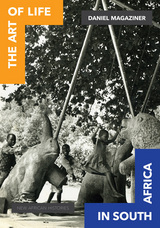
From 1952 to 1981, South Africa’s apartheid government ran an art school for the training of African art teachers at Indaleni, in what is today KwaZulu-Natal. The Art of Life in South Africa is the story of the students, teachers, art, and politics that circulated through a small school, housed in a remote former mission station. It is the story of a community that made its way through the travails of white supremacist South Africa and demonstrates how the art students and teachers made together became the art of their lives.
Daniel Magaziner radically reframes apartheid-era South African history. Against the dominant narrative of apartheid oppression and black resistance, as well as recent scholarship that explores violence, criminality, and the hopeless entanglements of the apartheid state, this book focuses instead on a small group’s efforts to fashion more fulfilling lives for its members and their community through the ironic medium of the apartheid-era school.
There is no book like this in South African historiography. Lushly illustrated and poetically written, it gives us fully formed lives that offer remarkable insights into the now clichéd experience of black life under segregation and apartheid.
Autobiographical literature especially reveals the processes by which writers convert their own historical experience into fictional form and suggests how literary forms function in life. This volume defines an original theory of autobiographical writing and provides intriguing analyses of major American works of literature.
The Art of Life examines the transformation of history into literature in Walden, "Song of Myself," Henry James's Prefaces, The Education of Henry Adams, Paterson, and the poetry of Frank O'Hara. These works are approached as events in themselves and are analyzed as conversions of form and history, fiction and fact, and even aesthetics and politics. Thus the work of literature is set in the total experience of living, and the writer is seen not only as an artist but also as a person in a historical, political, and cultural environment. As well as a creator of literature, the writer is viewed as a social, psychological, and biological being.
Chapters on the narcissistic economy of Walden, the mythicizing of history and personality in "Song of Myself," the self-conscious relation that makes the Prefaces of Henry James the autobiography of an artist. the comic perspective of The Education of Henry Adams, and the radical innovation of Paterson and O'Hara's poetry provide new readings of major American works. Each chapter contains some distinct critical insight which not only contributes to, but can be relished apart from, the book's overarching theoretical argument.
The Art of Life is a sophisticated theoretical discussion of autobiography with rich psychological, philosophical, and cultural ramifications.

With The Art of Living in Avant-Garde Paris, Rachel Silveri takes a fresh look at the desire to unify art and life, an ambition long regarded as foundational to the European historical avant-gardes. She reveals how many early twentieth-century artists saw their own everyday lives—their bodies, identities, and relationships—as a type of creative material and a central component to their avant-garde practice. These artists abandoned traditional forms of artmaking and venues of art viewing, instead aspiring to integrate art with everyday life, creating an “art of living.”
Considering Tristan Tzara’s performances of Dadaist identity, Sonia Delaunay’s simultaneous fashions and self-branding, and the collective endeavor to open and operate the Surrealist Research Bureau, Silveri offers a new narrative about how the artists of interwar Paris developed experiential life practices that resisted dominant forms of “lifestyle” and normative discourses surrounding gender, ethnicity, and office work. This book argues that ethical questions of “How should I live?” and “How should I relate to others?” were as important to the avant-garde as politics, and that aspirations to change the world played out in daily practices of self-making.

Seductive verse.
Ovid (Publius Ovidius Naso, 43 BC–AD 17), born at Sulmo, studied rhetoric and law at Rome. Later he did considerable public service there, and otherwise devoted himself to poetry and to society. Famous at first, he offended the emperor Augustus by his Ars amatoria, and was banished because of this work and some other reason unknown to us, and dwelt in the cold and primitive town of Tomis on the Black Sea. He continued writing poetry, a kindly man, leading a temperate life. He died in exile.
Ovid’s main surviving works are the Metamorphoses, a source of inspiration to artists and poets including Chaucer and Shakespeare; the Fasti, a poetic treatment of the Roman year of which Ovid finished only half; the Amores, love poems; the Ars amatoria, not moral but clever and in parts beautiful; Heroides, fictitious love letters by legendary women to absent husbands; and the dismal works written in exile: the Tristia, appeals to persons including his wife and also the emperor; and similar Epistulae ex Ponto. Poetry came naturally to Ovid, who at his best is lively, graphic and lucid.
The Loeb Classical Library edition of Ovid is in six volumes.
“In Naples, there are more singers than there are unemployed people.” These words echo through the neomelodica music scene, a vast undocumented economy animated by wedding singers, pirate TV, and tens of thousands of fans throughout southern Italy and beyond. In a city with chronic unemployment, this setting has attracted hundreds of aspiring singers trying to make a living—or even a fortune. In the process, they brush up against affiliates of the region’s violent organized crime networks, the camorra. In The Art of Making Do in Naples, Jason Pine explores the murky neomelodica music scene and finds himself on uncertain ground.
The “art of making do” refers to the informal and sometimes illicit entrepreneurial tactics of some Neapolitans who are pursuing a better life for themselves and their families. In the neomelodica music scene, the art of making do involves operating do-it-yourself recording studios and performing at the private parties of crime bosses. It can also require associating with crime boss-impresarios who guarantee their success by underwriting it with extortion, drug trafficking, and territorial influence. Pine, likewise “making do,” gradually realized that the completion of his ethnographic work also depended on the aid of forbidding figures.
The Art of Making Do in Naples offers a riveting ethnography of the lives of men who seek personal sovereignty in a shadow economy dominated, in incalculable ways, by the camorra. Pine navigates situations suffused with secrecy, moral ambiguity, and fears of ruin that undermine the anthropologist’s sense of autonomy. Making his way through Naples’s spectacular historic center and outer slums, on the trail of charmingly evasive neomelodici singers and unsettlingly elusive camorristi, Pine himself becomes a music video director and falls into the orbit of a shadowy music promoter who may or may not be a camorra affiliate.
Pine’s trenchant observations and his own improvised attempts at “making do” provide a fascinating look into the lives of people in the gray zones where organized crime blends into ordinary life.

An elegant medieval guide to verse composition and rhetoric, presented in a new authoritative edition and English translation.
The Art of Making Verses, Ars versificatoria, was composed by the thirteenth-century English poet and teacher Gervase of Melkley, who studied under John de Hauville. He belongs to a select company of French and English scholastic poets including not only de Hauville but also Alan of Lille and Bernardus Silvestris. The educational treatise was probably begun around 1200 and completed in 1220.
Gervase departs from established critical texts on poetry by Matthew of Vendôme and Geoffrey of Vinsauf; instead, he seeks to teach the art of verse in an entirely new way. The method outlined in Ars versificatoria instructs elementary students how to compose in three progressively more difficult modes: literal but still artful language, metaphor, and irony or paradox.
This edition presents a new and improved Latin edition based on the manuscripts, a new translation into English, and thorough annotation of the most original of the medieval Latin treatises on poetry.
In this book, Berliner provides insight into the communities of study, performance, and worship that surround mbira. He chronicles how master player Cosmas Magaya and his associates have developed their repertory and practices over more than four decades, shaped by musical interaction, social and political dynamics in Zimbabwe, and the global economy of the music industry. At once a detailed exposition of the music’s forms and practices, it is also an indispensable historical and cultural guide to mbira in a changing world.
Together with Berliner and Magaya's compendium of mbira compositions, Mbira’s Restless Dance, The Art of Mbira breaks new ground in the depth and specificity of its exploration of an African musical tradition, and in the entwining of the authors’ collaborative voices. It is a testament to the powerful relationship between music and social life—and the rewards of lifelong musical study, performance, and friendship.
The Art of Mechanical Reproduction weaves a rich history of the experimental networks in which artists as diverse as Paul Klee, Hans Bellmer, Ellsworth Kelly, Robert Smithson, Gerhard Richter, Chris Marker, and Tacita Dean have worked, and it shows for the first time how extensively technological innovations of the moment have affected their work. Original and broad-ranging, The Art of Mechanical Reproduction challenges some of the most respected and entrenched criticism of the past several decades—and allows us to think about these artists anew.
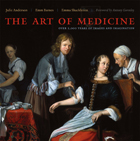
Since ancient times people have depended on medical practitioners to enhance life, to treat illness and injuries, and to help reduce pain and suffering. The scientifically based discipline that we know today stands beside diverse traditions, belief systems, and bodies of medical knowledge that have evolved in fascinating ways across cultures and continents. Throughout this history, successive generations have created artistic representations of these varied aspects of medicine, illustrating instruction manuals, documenting treatments, and creating works of art that enable individuals to express their feelings and ideas about medicine, health, and illness. From ancient wall paintings and tomb carvings to sculpture, installations, and digitally created artworks, the results are extraordinary and pay tribute to how medicine has affected our lives and the lives of our ancestors.
Drawing on the remarkable holdings of the Wellcome Collection in London, The Art of Medicine offers a unique gallery of rarely seen paintings, artifacts, drawings, prints, and extracts from manuscripts and manuals to provide a fascinating visual insight into our knowledge of the human body and mind, and how both have been treated with medicine. Julie Anderson, Emm Barnes, and Emma Shackleton take readers on a fascinating visual journey through the history of medical practice, exploring contemporary biomedical images, popular art, and caricature alongside venerable Chinese scrolls, prehistoric Mesoamerican drawings, paintings of the European Renaissance, medieval Persian manuscripts, and more. The result is a rare and remarkable visual account of what it was and is to be human in sickness and health.


MacDonald examines memes from feminist, queer, antiracist, and anticapitalist accounts on Instagram, as well as how meme genres and themes shift when they travel across different platforms and subcultures. By considering memes as a medium, she sheds light on how they operate within contemporary digital culture as a beacon for online public discourse that pushes against dominant norms.
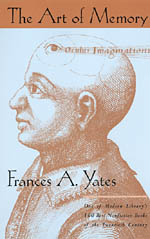
In this classic study of how people learned to retain vast stores of knowledge before the invention of the printed page, Frances A. Yates traces the art of memory from its treatment by Greek orators, through its Gothic transformations in the Middle Ages, to the occult forms it took in the Renaissance, and finally to its use in the seventeenth century. This book, the first to relate the art of memory to the history of culture as a whole, was revolutionary when it first appeared and continues to mesmerize readers with its lucid and revelatory insights.
Pí chová closely analyzes two novels by each author: the first written in exile (Nabokov's Mary and Kundera's The Book of Laughter and Forgetting) and a later, pivotal novel in each writer's career (Nabokov's The Gift and Kundera's The Unbearable Lightness of Being). In all four texts, these authors explore how the kaleidoscope of personal and cultural memory confronts a fragmented and untenable present, contrasting the lives of fictional é migré s who fail to bridge the gap between past and present with those é migré s whose rich artistic vision allows them to transcend the trials of homelessness.
By juxtaposing these novels and their authors, Pí chová provides a unique perspective on each writer's vast appeal and success. She finds that in the work of Nabokov and Kundera, the most successful exiles express a vision that transcends both national and temporal boundaries.
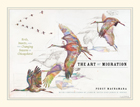
As the only artist in residence at the Field Museum, Peggy Macnamara has a unique vantage point for studying these patterns and capturing their distinctive traits. Her magnificent watercolor illustrations capture flocks, movement, and species-specific details. The illustrations are accompanied by text from museum staff and include details such as natural histories, notable features for identification, behavior, and how species have adapted to environmental changes. The book follows a gentle seasonal sequence and includes chapters on studying migration, artist’s notes on illustrating wildlife, and tips on the best ways to watch for birds and insects in the Chicago area.
A perfect balance of science and art, The Art of Migration will prompt us to marvel anew at the remarkable spectacle going on around us.
A world-leading military strategist and an IDF insider explain the improbable success of the Israeli armed forces.
When the Israel Defense Forces was established in May 1948, it was small, poorly equipped, and already at war. Lacking sufficient weaponry or the domestic industrial base to produce it, the newborn military was forced to make do with whatever it could get its hands on. That spirit of improvisation carried the IDF to a decisive victory in the First Arab-Israeli War.
Today the same spirit has made the IDF the most powerful military in the Middle East and among the most capable in the world. In The Art of Military Innovation, Edward N. Luttwak and Eitan Shamir trace the roots of this astounding success. What sets the IDF apart, they argue, is its singular organizational structure. From its inception, it has been the world’s only one-service military, encompassing air, naval, and land forces in a single institutional body. This unique structure, coupled with a young officer corps, allows for initiative from below. The result is a nimble organization inclined toward change rather than beholden to tradition.
The IDF has fostered some of the most significant advances in military technology of the past seventy years, from the first wartime use of drones to the famed Iron Dome missile defense system, and now the first laser weapon, Iron Beam. Less-heralded innovations in training, logistics, and human resources have been equally important. Sharing rich insights and compelling stories, Luttwak and Shamir reveal just what makes the IDF so agile and effective.
“Rich with rare detail, much of it a result of the authors’ access to the IDF’s inner sanctums and their intimate knowledge of grand strategy and military history.” –Wall Street Journal
A world-leading military strategist and an IDF insider explain the improbable success of the Israeli armed forces.
When the Israel Defense Forces was established in 1948, the emerging Jewish state lacked sufficient weaponry and the capacity to produce it. Forced to make do, the IDF relied on a spirit of improvisation.
Today that same spirit has secured the IDF a place among the world’s most powerful militaries. In The Art of Military Innovation, Edward Luttwak and Eitan Shamir trace the roots of this astounding success. What sets the IDF apart, they argue, is its structure. From its inception, it has been the world’s only one-service military, with air, naval, and land forces collected in a single institutional body. This unique architecture, coupled with a youthful officer corps, encourages initiative from below. The result is a nimble organization inclined toward change.
The IDF has fostered significant technological advances, from the first wartime use of drones to the famed Iron Dome missile defense system, and now the first laser weapon, Iron Beam. Less-heralded innovations in training, logistics, and human resources have been equally important. Sharing rich insights and compelling stories, Luttwak and Shamir reveal just what makes the IDF so agile and effective.
"A provocative perspective on the cultural implications of political and social protest."—Library Journal
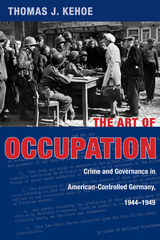
The literature describing social conditions during the post–World War II Allied occupation of Germany has been divided between seemingly irreconcilable assertions of prolonged criminal chaos and narratives of strict martial rule that precluded crime. In The Art of Occupation, Thomas J. Kehoe takes a different view on this history, addressing this divergence through an extensive, interdisciplinary analysis of the interaction between military government and social order.
Focusing on the American Zone and using previously unexamined American and German military reports, court records, and case files, Kehoe assesses crime rates and the psychology surrounding criminality. He thereby offers the first comprehensive exploration of criminality, policing, and both German and American fears around the realities of conquest and potential resistance, social and societal integrity, national futures, and a looming threat from communism in an emergent Cold War. The Art of Occupation is the fullest study of crime and governance during the five years from the first Allied incursions into Germany from the West in September 1944 through the end of the military occupation in 1949. It is an important contribution to American and German social, military, and police histories, as well as historical criminology.
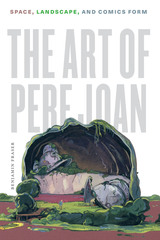
Born in Mallorca, Pere Joan Riera (known professionally as Pere Joan) thrived in the underground comics world, beginning in the mid-1970s with the self-published collections Baladas Urbanas and MuŽrdago, both of which were released almost immediately after the death of the dictator Francisco Franco and Spain's transition to democracy. The first monograph in English on a comics artist from Spain, The Art of Pere Joan takes a topographical approach to reading comics, applying theories of cultural and urban geography to Pere Joan’s treatment of space and landscape in his singular body of work.
Balancing this goal with an exploration of specific works by Pere Joan, Benjamin Fraser demonstrates that looking at the thematic, structural, and aesthetic originality of the artist's landscape-driven work can help us begin to newly understand the representational properties of comics as a spatial medium. This in-depth examination reveals the resonance between the cultural landscapes of Mallorca and Pere Joan's metaphorical approach to both rural and urban environments in comics that weave emotional, ecological, and artistic strands in revolutionary ways.
The enduring fascination of Plato's dialogues rests not only on the dazzling range of his arguments and opinions, but also on the extraordinary richness of his literary style. The great Greek philosopher captures the imagination and stimulates the curiosity of his readers through his expert use of the techniques devised by the rhetoricians and the poets of his time: Plato, the critic of art and poetry, shows himself a consummate artist.
This book is not a study of Plato's philosophy, but a contribution to the literary interpretation of the dialogues, through analysis of their formal structure, characterization, language, and imagery. Among the dialogues considered in these interrelated essays are some of Plato's most admired and influential works, including Gorgias, the Symposium, the Republic and Phaedrus. Special attention is paid to the personality of Socrates, Plato's remarkable mentor, and to his interaction with the other characters in the dialogues. The author also discusses particular problems such as the sources for our knowledge of Socrates, the origins of the dialogue form, Plato's use of myth, and the "totalitarianism" of the Republic.This combination of sympathetic literary criticism and exact historical scholarship makes The Art of Plato a valuable contribution to the study of one of the greatest of all Greek writers.
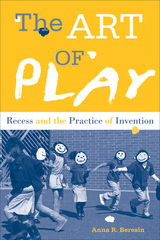
What can the art of play teach us about the art of play? Showcasing the paintings of more than one hundred Philadelphia public elementary school children, folklorist Anna Beresin’s innovative book, The Art of Play, presents images and stories that illustrate what children do at recess, and how it makes them feel.
Beresin provides a nuanced, child-centered discussion of the intersections of play, art, and learning. She describes a widespread institutionalized fear of play and expressive art, and the transformative power of simple materials like chalk and paint. Featuring more than 150 paintings and a dozen surreal photographs of masked children enjoying recess, The Art of Play weaves together the diverse voices of kids and working artists with play scholarship.
This book emerged from Recess Access, a service-learning project that donated chalk, ropes, balls, and hoops to nine schools in different sections of Philadelphia. A portion of the proceeds of The Art of Play will support recess advocacy.
Capturing the little-known early history of Knopf, The Art of Prestige explores the origins of the company's rise to success during the Jazz Age, when Alfred and Blanche established themselves as literary impresarios on both sides of the Atlantic. Drawing on key archival documents from all phases of the publishing process, Amy Root Clements reconstructs the turning points and rhetorical exchanges that made Knopf's initial books noteworthy, from the acquisitions process to design, consumer marketing, and bookselling.
Lasting cornerstones of the young firm include alliances with pivotal figures in the world of graphic arts and book production and with European publishers who brought numerous Nobel Prize winners to the Borzoi list during the company's first fifteen years. Other featured luminaries include the American authors Willa Cather, Dashiell Hammett, and Langston Hughes. The Art of Prestige also examines Alfred Knopf's ancestry, up-bringing, and formal education at Columbia, as well as his apprenticeships with Frank Nelson Doubleday and Mitchell Kennerley—factors that would influence his business decisions for years to come.
The result is a portrait of innovative branding that seamlessly merged book production with book promotion in a literary landscape that was ripe for transformation.
In the eighteenth century, New Spaniards (colonial Mexicans) so lauded their nuns that they developed a local tradition of visually opulent portraits, called monjas coronadas or “crowned nuns,” that picture their subjects in regal trappings at the moment of their religious profession and in death. This study identifies these portraits as markers of a vibrant and changing society that fused together indigenous and Euro-Christian traditions and ritual practices to construct a new and complex religious identity that was unique to New Spain.
To discover why crowned-nun portraits, and especially the profession portrait, were in such demand in New Spain, this book offers a pioneering interpretation of these works as significant visual contributions to a local counter-colonial discourse. James M. Córdova demonstrates that the portraits were a response to the Spanish crown’s project to modify and modernize colonial society—a series of reforms instituted by the Bourbon monarchs that threatened many nuns’ religious identities in New Spain. His analysis of the portraits’ rhetorical devices, which visually combined Euro-Christian and Mesoamerican notions of the sacred, shows how they promoted local religious and cultural values as well as client-patron relations, all of which were under scrutiny by the colonial Church. Combining visual evidence from images of the “crowned nun” with a discussion of the nuns’ actual roles in society, Córdova reveals that nuns found their greatest agency as Christ’s brides, a title through which they could, and did, challenge the Church’s authority when they found it intolerable.
A second edition of the classic introduction to arts in social movements, fully updated and now including Black Lives Matter, Occupy Wall Street, and new digital and social media forms of cultural resistance
The Art of Protest, first published in 2006, was hailed as an “essential” introduction to progressive social movements in the United States and praised for its “fluid writing style” and “well-informed and insightful” contribution (Choice Magazine). Now thoroughly revised and updated, this new edition of T. V. Reed’s acclaimed work offers engaging accounts of ten key progressive movements in postwar America, from the African American struggle for civil rights beginning in the 1950s to Occupy Wall Street and Black Lives Matter in the twenty-first century.
Reed focuses on the artistic activities of these movements as a lively way to frame progressive social change and its cultural legacies: civil rights freedom songs, the street drama of the Black Panthers, revolutionary murals of the Chicano movement, poetry in women’s movements, the American Indian Movement’s use of film and video, anti-apartheid rock music, ACT UP’s visual art, digital arts in #Occupy, Black Lives Matter rap videos, and more.
Through the kaleidoscopic lens of artistic expression, Reed reveals how activism profoundly shapes popular cultural forms. For students and scholars of social change and those seeking to counter reactionary efforts to turn back the clock on social equality and justice, the new edition of The Art of Protest will be both informative and inspiring.
The shape of this critical tracing begins, however, in the middle of his career with The Gay Science andmoves on to Thus Spoke Zarathustra, which Nietzsche believed was the central work of his life. It then revalues Ecce Homo, Nietzsche’s final autobiographical statement about his life and career, and concludes with a comparative analysis of two works from the beginning and end of that career: respectively, The Birth of Tragedy and The Anti-Christ. O’Hara’s highly original study, which uses Badiou’s theory of the truth-event as a guide, will surely provoke larger conversations across many disciplines.

For the Muslim faithful, the familiar sound of the Qurʾanic recitation is the predominant and most immediate means of contact with the Word of God. Heard day and night, on the street, in taxis, in shops, in mosques, and in homes, the sound of recitation is far more than the pervasive background music of daily life in the Arab world. It is the core of religious devotion, the sanctioning spirit of much cultural and social life, and a valued art form in its own right. Participation in recitation, as reciter or listener, is itself an act of worship, for the sound is basic to a Muslim’s sense of religion and invokes a set of meanings transcending the particular occasion.
For the most part, Westerners have approached the Qurʾan much as scriptural scholars have studied the Bible, as a collection of written texts. The Art of Reciting the Qurʾan aims at redirecting that focus toward a deeper understanding of the Qurʾan as a fundamentally oral phenomenon. By examining Muslim attitudes toward the Qurʾan, the institutions that regulate its recitation, and performer-audience expectations and interaction, Kristina Nelson, a trained Arabist and musicologist, casts new light on the significance of Qurʾanic recitation within the world of Islam. Her landmark work is of importance to all scholars and students of the modern Middle East, as well as ethnomusicologists, anthropologists, linguists, folklorists, and religious scholars.
"The historical aspect of this book is splendid, but where it excels is in its fearless and thought-provoking critical judgements. . . . it will lead both beginners and experts to new joys."—David Ekserdjian, Times Literary Supplement

The political and cultural fantasy of home as a retreat from the pressures of the world first emerged in the U.S. alongside two major nineteenth-century literary movements: Romanticism and domestic fiction. Upending accepted gendered narratives from this period, The Art of Retreat posits that these movements originated from a domestic culture already in transition, in which home was frequently a more complicated site of self-interested pleasure, coerced labor, creole social reproduction, homosocial intimacy, bachelor whimsy, petty tyranny, racial abuse, and transgender capacity. The early national periodicals, sketches, and novels examined here lend themselves to this interpretation. Hankins argues that the literary tradition emerging from these decades—one that aligned creative genius with domestic retreat—reminds us that a politics that appeals to private feeling must reckon with new interpretations of labor, kinship, and reform in exchange for the promise of consensual citizenship.
Published by Bucknell University Press. Distributed worldwide by Rutgers University Press.
In this innovative work, James Meyer turns to art criticism, theory, memoir, and fiction to examine the fascination with the long sixties and contemporary expressions of these cultural memories across the globe. Meyer draws on a diverse range of cultural objects that reimagine this revolutionary era stretching from the 1950s to the 1970s, including reenactments of civil rights, antiwar, and feminist marches, paintings, sculptures, photographs, novels, and films. Many of these works were created by artists and writers born during the long Sixties who were driven to understand a monumental era that they missed. These cases show us that the past becomes significant only in relation to our present, and our remembered history never perfectly replicates time past. This, Meyer argues, is precisely what makes our contemporary attachment to the past so important: it provides us a critical opportunity to examine our own relationship to history, memory, and nostalgia.

Persuasion analyzed.
Aristotle (384–322 BC), the great Greek thinker, researcher, and educator, ranks among the most important and influential figures in the history of philosophy, theology, and science. He joined Plato’s Academy in Athens in 367 and remained there for twenty years. After spending three years at the Asian court of a former pupil, Hermeias, where he married Pythias, one of Hermeias’ relations, and living for a time at Mytilene, he was appointed by Philip of Macedon in 343/2 to become tutor of his teenaged son, Alexander. After Philip’s death in 336, Aristotle became head of his own school, the Lyceum at Athens, whose followers were known as the Peripatetics. Because of anti-Macedonian feeling in Athens after Alexander’s death in 323, Aristotle withdrew to Chalcis in Euboea, where he died in 322.
Aristotle wrote voluminously on a broad range of subjects analytical, practical, and theoretical, but nearly all the works that he prepared for publication are lost; extant are lecture-materials, notes, and memoranda, some spurious. Rhetoric, a manual for public speakers, was probably composed while Aristotle was still at the Academy and Isocrates was still alive. Instead of the sophistic and Isocratean method of imitating model speeches, Aristotle devised a systematic method based in dialectic, on which he had recently written the first manual. The goal of rhetoric is to find the available means of persuasion for any given case using argument, the character of the speaker, and the emotions of the audience. Rhetoric, he says, is “a kind of offshoot from dialectic and the study of character, which is justly called the science of politics.”
This edition of Aristotle’s Rhetoric, which replaces the original Loeb edition by J. H. Freese, supplies a Greek text based on that of Rudolf Kassel, a fresh translation, and ample annotation fully current with modern scholarship.
READERS
Browse our collection.
PUBLISHERS
See BiblioVault's publisher services.
STUDENT SERVICES
Files for college accessibility offices.
RECENTLY PUBLISHED


UChicago Accessibility Resources
home | accessibility | search | about | contact us
BiblioVault ® 2001 - 2026
The University of Chicago Press