
 A SCHOLARLY BOOK REPOSITORY
10 start with A start with A
In the first comprehensive study of plays written for male characters only, Robert Vorlicky offers a new theory that links cultural codes governing gender and the conventions determining dramatic form. Act Like a Manlooks at a range of plays, including those by O'Neill, Albee, Mamet, Baraka, and Rabe as well as new works by Philip Kan Gotanda, Alonzo Lamont, and Robin Swados, to examine how dialogue within these works reflects the social codes of male behavior and inhibits individualization among men.
Plays in which women are absent are often characterized by the location of a male "other"—a female presence who distances himself from the dominant, impersonal masculine ethos and thereby becomes a facilitator of personal communication. The potential authority of this figure is so powerful that its presence becomes the primary determinant of the quality of men's interaction and of the range of male subjectivities possible. This formulation becomes the basis of an alternative theory of American dramatic construction, one that challenges traditional dramaturgical notions of realism.
The book will appeal to scholars and students interested in drama, gender, race, sexuality, and American culture, as well as playwrights, teachers of playwrights, and artistic directors. It includes an extensive bibliography of more than four hundred male-cast plays and monodramas, the first such compilation and one that points to further research into a previously unexplored area.
Acting Jewish documents this history, looking at the work of Jewish writers, directors, and actors in the American entertainment industry with particular attention to the ways in which these artists offer behavioral models for Jewish-American audiences. The book spans the period from 1947 to the present and takes a close look at some of America's favorite plays (Death of a Salesman, Fiddler on the Roof, Angels in America), films (Gentleman's Agreement, AnnieHall), and television shows (The Goldbergs, Seinfeld), identifying a double-coding by which performers enact, and spectators read, Jewishness in contemporary performance-and, by extension, enact and read other minority identities. The book thus explores and illuminates the ever-changing relationship between Jews and mainstream American culture.
"Fascinating and original . . . Bial's command of sources is impressive, and his concept of 'double-coding' is convincing . . . the book should have no trouble finding a large audience."
-Barbara Grossman, author of Funny Woman: The Life and Times of Fanny Brice
One of the few books of its kind, Acting Up and Getting Down brings together seven African American literary voices that all have a connection to the Lone Star state. Covering Texas themes and universal ones, this collection showcases often-overlooked literary talents to bring to life inspiring facets of black theatre history.
Capturing the intensity of racial violence in Texas, from the Battle of San Jacinto to a World War I–era riot at a Houston training ground, Celeste Bedford Walker’s Camp Logan and Ted Shine’s Ancestors provide fascinating narratives through the lens of history. Thomas Meloncon’s Johnny B. Goode and George Hawkins’s Br’er Rabbit explore the cultural legacies of blues music and folktales. Three unflinching dramas (Sterling Houston’s Driving Wheel, Eugene Lee’s Killingsworth, and Elizabeth Brown-Guillory’s When the Ancestors Call) examine homosexuality, a death in the family, and child abuse, bringing to light the private tensions of intersections between the individual and the community.
Supplemented by a chronology of black literary milestones as well as a playwrights’ canon, Acting Up and Getting Down puts the spotlight on creative achievements that have for too long been excluded from Texas letters. The resulting anthology not only provides new insight into a regional experience but also completes the American story as told onstage.
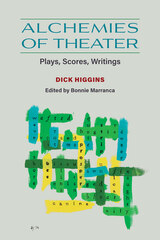
Alchemies of Theater brings together a broad selection of Higgins’s writings and theater-related work, much of it unpublished or long out of print, including plays and performance scores, drawings, and writings on theater and performance. As this book demonstrates, Higgins deconstructed the drama long before it became a project of theater; undercut the traditional roles of author and director; created what is now considered “devised” theater; pioneered the use of media in theater, writing the first electronic opera; and was a precursor in deconstruction and “postdramatic” avant-garde traditions. His Intermedia manifesto offered a sweeping view of interdisciplinarity—in effect, a new arts ecology.
Is theater really dead? Does the theater, as its champions insist, really provide a more intimate experience than film? If so, how have changes in cinematic techniques and technologies altered the relationship between stage and film? What are the inherent limitations of representing three-dimensional spaces in a two-dimensional one, and vice versa?
American Drama in the Age of Film examines the strengths and weaknesses of both the dramatic and cinematic arts to confront the standard arguments in the film-versus-theater debate. Using widely known adaptations of ten major plays, Brietzke seeks to highlight the inherent powers of each medium and draw conclusions not just about how they differ, but how they ought to differ as well. He contrasts both stage and film productions of, among other works, David Mamet’s Glengarry Glen Ross, Sam Shepard’s True West, Edward Albee’s Who’s Afraid of Virginia Woolf, Margaret Edson’s Wit, Tony Kushner’s Angels in America, Tennessee Williams’s Cat on a Hot Tin Roof, Arthur Miller’s Death of a Salesman, and August Wilson’s The Piano Lesson. In reading the dual productions of these works, Brietzke finds that cinema has indeed stolen much of theater’s former thunder, by making drama more intimate, and visceral than most live events.
But theater is still vital and matters greatly, Brietzke argues, though for reasons that run counter to many of the virtues traditionally attributed to it as an art form, such as intimacy and spontaneity. Brietzke seeks to revitalize perceptions of theater by challenging those common pieties and offering a new critical paradigm, one that champions spectacle and simultaneity as the most, not least, important elements of drama.

Chapters look at how theatre, film, and popular culture linked the Chinese immigrant and opium smoking; the early attacks on doctors for their part in the creation of addicts; the legislation of addiction as a criminal condition; the comic portrayals of addiction; the intersection of Black, jazz, and drug cultures through cabaret performance; and the linkage between narcotic inebriation and artistic inspiration. The American Pipe Dream creates active connections between these case studies, demonstrating how this history has influenced our contemporary understanding, treatment, and legislation of drug use and addiction.
American Political Plays after 9/11 is a diverse collection of bold, urgent, and provocative plays that respond to the highly charged, post 9/11 political landscape. Sparked by the terrorist attacks of September 11, 2001, and subsequently fueled by a series of controversial events—the Iraq war, the passing and enforcement of the U.S.A. Patriot Act, and the revelation of torture and other scandals at the Abu Ghraib prison—American political theater is currently experiencing a surge in activity. The plays in this collection include The Guys by Anne Nelson, At the Vanishing Point by Naomi Iizuka, The Venus de Milo Is Armed by Kia Corthron, Back of the Throat by Yusseff El Guindi, Three Nights in Prague by Allan Havis, and Question 27, Question 28 by Chay Yew.
The characters range from a New York City fire captain trying to respectfully memorialize eight of his lost comrades, to the citizens of a hog-killing Louisville neighborhood who poignantly exemplify the underside of the economic crisis, to an Arab American citizen being harshly (and possibly unfairly) interrogated by two officers as a “person of interest.” Though not all of the plays deal explicitly with the Al Qaeda attacks, they collectively reveal themes of sorrow and anxiety, moral indignation, alarmist self-preservation, and economic and social insecurity stemming from the United States’ fairly sudden shift from cold war superpower to vulnerable target.
The lively introduction by Allan Havis includes a brief history of political theater in the United States, an extensive discussion about how theater communities responded to 9/11, and an informative analysis of the six plays in the book. A collection of dramatic material framed by this significant historical event, AmericanPolitical Plays after 9/11 will be indispensable for theater and cultural studies scholars and students.
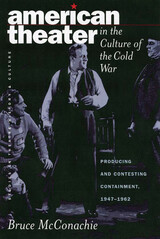
McConachie reconstructs these cognitive processes by relying on scripts, set designs, reviews, memoirs, and other evidence. After establishing his theoretical framework, he focuses on three archtypal figures of containment significant in Cold War culture, Empty Boys, Family Circles, and Fragmented Heroes. McConachie uses a range of plays, musicals, and modern dances from the dominant culture of the Cold War to discuss these figures, including The Seven Year Itch, Cat on a Hot Tin Roof; The King and I,A Raisin in the Sun, Night Journey, and The Crucible. In an epilogue, he discusses the legacy of Cold War theater from 1962 to 1992.
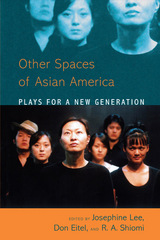
Asian American plays provide an opportunity to think about how racial issues are engaged through theatrical performance physical contact, bodily labor, and fleshly desire as well as through the more standard elements of plot, setting, characterization, staging, music, and action.
Asian American Plays for a New Generation showcases seven exciting new plays that dramatize timely themes that are familiar to Asian Americans. The works variously address immigration, racism, stereotyping, identity, generational tensions, assimilation, and upward mobility as well as post-9/11 paranoia, racial isolation, and adoptee experiences.
Each of these works engages directly and actively with Asian American themes through performance to provide an important starting point for building relationships, raising political awareness, and creating active communities that can foster a sense of connection or even rally individuals to collective action.
READERS
Browse our collection.
PUBLISHERS
See BiblioVault's publisher services.
STUDENT SERVICES
Files for college accessibility offices.
RECENTLY PUBLISHED



UChicago Accessibility Resources
home | accessibility | search | about | contact us
BiblioVault ® 2001 - 2026
The University of Chicago Press