
 A SCHOLARLY BOOK REPOSITORY
287 start with B start with B

The Economist, Best Books of 2024
The Times, Best Ideas Books of 2024
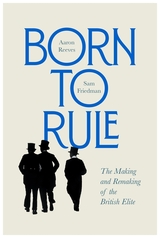
A uniquely data-rich analysis of the British elite from the Victorian era to today: who gets in, how they get there, what they like and look like, where they go to school, and what politics they perpetuate.
Are Britain’s power brokers a conservative chumocracy, born to privilege and anointed at Eton and Oxford? Or is a new progressive elite emerging with different values and political instincts? In search of answers, Aaron Reeves and Sam Friedman scrutinized the profiles of over 125,000 members of the British elite from the late 1890s to today. At the heart of this meticulously researched study is the historical database of Who’s Who, but Reeves and Friedman also mined genealogical records, examined probate data, and interviewed over 200 leading figures from a wide range of backgrounds to uncover who runs Britain.
What they found is that there is less movement at the top than we think. Yes, there has been some progress on including women and Black and Asian Brits, but those born into the top 1 percent are just as likely to get into the elite today as they were 125 years ago. What has changed is how elites present themselves. Today’s elite pedal hard to convince us they are perfectly ordinary.
Why should we care? Because the elites we have affect the politics we get. While scholars have long proposed that the family you are born into, and the schools you attend, leave a mark on the exercise of power, the empirical evidence has been thin—until now.


Diaspora communities have formed in North America (especially in St. Louis), Europe, and Australia because of war and displacement, and have themselves become a considerable topic of study spanning the disciplines of anthropology, migration studies, political science, memory studies, conflict and security studies, psychology, and geography.
This volume seeks to illuminate how Bosnian migrant and diaspora scholars are contributing to the development of Bosnian Studies. The authors included in this volume are either writing from their (new) home bases in Australia, Austria, Canada, Switzerland, the United Kingdom, and the United States, among others, or they have returned to Bosnia after a period of migration. Their chapters have distinct entry points of inquiry, demonstrating how scholars have integrated Bosnia as a theme across the range of disciplines in which they are situated. The selections included in the volume range from literary analysis to personal memoirs of the conflict, from studies of heritage and identity to political science analysis of diaspora voting, to genocide studies and questions of (or lack of) ethics in the growing field of Bosnian Studies.
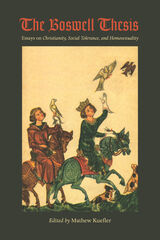
The essays in this magnificent volume examine a variety of aspects of Boswell's interpretation of events in the development of sexuality from Classical Antiquity through the Middle Ages, including a Roman emperor's love letters to another man; suspicions of sodomy among medieval monks, knights, and crusaders; and the gender-bending visions of Christian saints and mystics. Also included are discussions of Boswell's career, including his influence among gay and lesbian Christians and his role in academic debates between essentialists and social constructionists.
Elegant and thought-provoking, this collection provides a fitting twenty-fifth anniversary tribute to the incalculable influence of Christianity, Social Tolerance, and Homosexuality and its author.

Throughout his life, James Boswell struggled to fashion a clear account of himself, but try as he might, he could not reconcile the truths of his era with those of his religious upbringing. Boswell’s Enlightenment examines the conflicting credos of reason and faith, progress and tradition that pulled Boswell, like so many eighteenth-century Europeans, in opposing directions. In the end, the life of the man best known for writing Samuel Johnson’s biography was something of a patchwork affair. As Johnson himself understood: “That creature was its own tormentor, and I believe its name was BOSWELL.”
Few periods in Boswell’s life better crystallize this internal turmoil than 1763–1765, the years of his Grand Tour and the focus of Robert Zaretsky’s thrilling intellectual adventure. From the moment Boswell sailed for Holland from the port of Harwich, leaving behind on the beach his newly made friend Dr. Johnson, to his return to Dover from Calais a year and a half later, the young Scot was intent on not just touring historic and religious sites but also canvassing the views of the greatest thinkers of the age. In his relentless quizzing of Voltaire and Rousseau, Hume and Johnson, Paoli and Wilkes on topics concerning faith, the soul, and death, he was not merely a celebrity-seeker but—for want of a better term—a truth-seeker. Zaretsky reveals a life more complex and compelling than suggested by the label “Johnson’s biographer,” and one that 250 years later registers our own variations of mind.
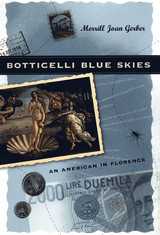
When writer Merrill Joan Gerber is invited to join her husband, a history professor, as he takes a class of American college students to study in Florence, Italy, she feels terrified at the idea of leaving her comforts, her friends, and her aged mother in California. Her husband tries to assure her that her fear of Italy—and her lack of knowledge of the Italian language—will be offset by the discoveries of travel. "I can’t tell you exactly what will happen, but something will. And it will all be new and interesting." Botticelli Blue Skies is the tale of a woman who readily admits to fear of travel, a fear that many experience but are embarrassed to admit. When finally she plunges into the new adventure, she describes her experiences in Florence with wit, humor, and energy.
Instead of sticking to the conventional tourist path, Gerber follows her instincts. She makes discoveries without tour guides droning in her ear and reclaims the travel experience as her own, taking time to shop in a thrift shop, eat in a Chinese restaurant that serves "Dragon chips," make friends with her landlady who turns out to be a Countess, and visit the class of a professor at the university. She discovers a Florence that is not all museums and wine. With newfound patience and growing confidence, Gerber makes her way around Florence, Venice, and Rome. She visits famous places and discovers obscure ones—in the end embracing all that is Italian. Botticelli Blue Skies (accompanied by the author’s own photographs) is an honest, lyrical, touching account of the sometimes exhausting, often threatening, but always enriching physical and emotional challenge that is travel.
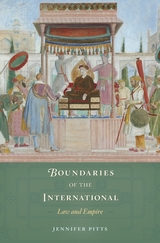
It is commonly believed that international law originated in relations among European states that respected one another as free and equal. In fact, as Jennifer Pitts shows, international law was forged at least as much through Europeans’ domineering relations with non-European states and empires, leaving a legacy still visible in the unequal structures of today’s international order.
Pitts focuses on the eighteenth and nineteenth centuries, the great age of imperial expansion, as European intellectuals and administrators worked to establish and justify laws to govern emerging relationships with non-Europeans. Relying on military and commercial dominance, European powers dictated their own terms on the basis of their own norms and interests. Despite claims that the law of nations was a universal system rooted in the values of equality and reciprocity, the laws that came to govern the world were parochial and deeply entangled in imperialism. Legal authorities, including Emer de Vattel, John Westlake, and Henry Wheaton, were key figures in these developments. But ordinary diplomats, colonial administrators, and journalists played their part too, as did some of the greatest political thinkers of the time, among them Montesquieu and John Stuart Mill.
Against this growing consensus, however, dissident voices as prominent as Edmund Burke insisted that European states had extensive legal obligations abroad that ought not to be ignored. These critics, Pitts shows, provide valuable resources for scrutiny of the political, economic, and legal inequalities that continue to afflict global affairs.
The big economic story of our times is not the Great Recession. It is how China and India began to embrace neoliberal ideas of economics and attributed a sense of dignity and liberty to the bourgeoisie they had denied for so long. The result was an explosion in economic growth and proof that economic change depends less on foreign trade, investment, or material causes, and a whole lot more on ideas and what people believe.
Or so says Deirdre N. McCloskey in Bourgeois Dignity, a fiercely contrarian history that wages a similar argument about economics in the West. Here she turns her attention to seventeenth- and eighteenth-century Europe to reconsider the birth of the industrial revolution and the rise of capitalism. According to McCloskey, our modern world was not the product of new markets and innovations, but rather the result of shifting opinions about them. During this time, talk of private property, commerce, and even the bourgeoisie itself radically altered, becoming far more approving and flying in the face of prejudices several millennia old. The wealth of nations, then, didn’t grow so dramatically because of economic factors: it grew because rhetoric about markets and free enterprise finally became enthusiastic and encouraging of their inherent dignity.
An utterly fascinating sequel to her critically acclaimed book The Bourgeois Virtues, Bourgeois Dignity is a feast of intellectual riches from one of our most spirited and ambitious historians—a work that will forever change our understanding of how the power of persuasion shapes our economic lives.
Why? Most economists—from Adam Smith and Karl Marx to Thomas Piketty—say the Great Enrichment since 1800 came from accumulated capital. McCloskey disagrees, fiercely. “Our riches,” she argues, “were made not by piling brick on brick, bank balance on bank balance, but by piling idea on idea.” Capital was necessary, but so was the presence of oxygen. It was ideas, not matter, that drove “trade-tested betterment.” Nor were institutions the drivers. The World Bank orthodoxy of “add institutions and stir” doesn’t work, and didn’t. McCloskey builds a powerful case for the initiating role of ideas—ideas for electric motors and free elections, of course, but more deeply the bizarre and liberal ideas of equal liberty and dignity for ordinary folk. Liberalism arose from theological and political revolutions in northwest Europe, yielding a unique respect for betterment and its practitioners, and upending ancient hierarchies. Commoners were encouraged to have a go, and the bourgeoisie took up the Bourgeois Deal, and we were all enriched.
Few economists or historians write like McCloskey—her ability to invest the facts of economic history with the urgency of a novel, or of a leading case at law, is unmatched. She summarizes modern economics and modern economic history with verve and lucidity, yet sees through to the really big scientific conclusion. Not matter, but ideas. Big books don’t come any more ambitious, or captivating, than Bourgeois Equality.
The music of Johannes Brahms is deeply colored, Daniel Beller-McKenna shows, by nineteenth-century German nationalism and by Lutheran religion. Focusing on the composer's choral works, the author offers new insight on the cultural grounding for Brahms's music.
Music historians have been reluctant to address Brahms's Germanness, wary perhaps of fascist implications. Beller-McKenna counters this tendency; by giving an account of the intertwining of nationalism, politics, and religion that underlies major works, he restores Brahms to his place in nineteenth-century German culture. The author explores Brahms's interest in the folk element in old church music; the intense national pride expressed in works such as the Triumphlied; the ways Luther's Bible and Lutheranism are reflected in Brahms's music; and the composer's ideas about nation building. The final chapter looks at Brahms's nationalistic image as employed by the National Socialists, 1933-1945, and as witnessed earlier in the century (including the complication of rumors that Brahms was Jewish).
In comparison to the overtly nationalist element in Wagner's music, the German elements in Brahms's style have been easy to overlook. This nuanced study uncovers those nationalistic elements, enriching our understanding both of Brahms's art and of German culture.


Looking beyond statistics and economic cycles, Perry investigates the human impact of unemployment. He uncovers the experience of being jobless from the perspective of those who lived through it, their employers and their communities. He uses oral history, memoirs, literary accounts, and newspaper articles to reveal the reality of unemployment.
Perry argues that the scale of the crisis has been minimised by historians who have tended to emphasise that prolonged unemployment was the problem of the distressed fringe.
Finally, Perry argues that the lessons of the 1930s have direct relevance today since the structural problems of industrial capitalism remain inherent.

"Camporesi is as much a poet as a historian. . . . His appeal is to the senses as well as to the mind. . . . Fascinating in its details and compelling in its overall message."—Vivian Nutton, Times Literary Supplement
"It is not often that an academic monograph in history is also a book to fascinate the discriminating general reader. Bread of Dreams is just that."—Kenneth McNaught, Toronto Star
"Not religion but bread was the opiate of the poor, Mr. Camporesi argues. . . . Food has always been a social and mythological construct that conditions what we vainly imagine to be matters of personal taste. Our hunger for such works should tell us that food is not only good but essential to think and to read as if our lives depended on it, which they do."—Betty Fussell, New York Times Book Review
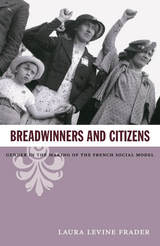
Frader’s analysis moves between the everyday lives of ordinary working women and men and the actions of national policymakers, political parties, and political movements, including feminists, pro-natalists, and trade unionists. In the years following World War I, the many women and an increasing number of immigrant men in the labor force competed for employment and pay. Family policy was used not only to encourage reproduction but also to regulate wages and the size of the workforce. Policies to promote married women’s and immigrants’ departure from the labor force were more common when jobs were scarce, as they were during the Depression. Frader contends that gender and ethnicity exerted a powerful and unacknowledged influence on French social policy during the Depression era and for decades afterward.

Drawing the discussion of Brexit beyond Britain, Benjamin Martill, Uta Staiger, and a team of twenty-eight contributors explore the consequences for Europe and the European Union. Marshaling the perspectives and methodologies of a diverse range of disciplines, the contributors chart the likely effects of Brexit on institutional relations, law, political economy, foreign affairs, democratic governance, and the idea of Europe itself. While the contributors at times offer divergent predictions for the future of Europe after Brexit, they share the conviction that careful analysis is in needed—now more than ever—if we are to understand what lies ahead.
Brexit and Beyond is the first book to focus on the broader consequences of Brexit, and its clear, comprehensive, and trenchant analysis will be invaluable to understanding the complex effects.

A Marginal Revolution Best Book of the Year
Winner of the Shulman Book Prize
A noted expert on Russian energy argues that despite Europe’s geopolitical rivalries, natural gas and deals based on it unite Europe’s nations in mutual self-interest.
Three decades after the fall of the Berlin Wall and the breakup of the Soviet empire, the West faces a new era of East–West tensions. Any vision of a modern Russia integrated into the world economy and aligned in peaceful partnership with a reunited Europe has abruptly vanished.
Two opposing narratives vie to explain the strategic future of Europe, one geopolitical and one economic, and both center on the same resource: natural gas. In The Bridge, Thane Gustafson, an expert on Russian oil and gas, argues that the political rivalries that capture the lion’s share of media attention must be viewed alongside multiple business interests and differences in economic ideologies. With a dense network of pipelines linking Europe and Russia, natural gas serves as a bridge that unites the region through common interests.
Tracking the economic and political role of natural gas through several countries—Russia and Ukraine, the United Kingdom, Germany, the Netherlands, and Norway—The Bridge details both its history and its likely future. As Gustafson suggests, there are reasons for optimism, but whether the “gas bridge” can ultimately survive mounting geopolitical tensions and environmental challenges remains to be seen.
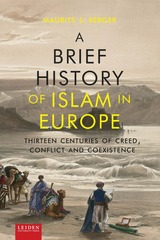
Maurits S. Berger focuses in particular on the transformations that the figure of the Muslim and the image of Islam have undergone in the European mind. Conqueror, Antichrist, scholar, benign ruler, corsair, tradesman, fellow citizen—the Muslim has been all of those and more, and even today, as Muslims make up a substantial portion of Europe’s citizenry, they remain all too often a source of undeserved anxiety for ordinary people and politicians alike. Through Berger’s clear prose and incisive analysis, the story of Islam and Europe is seen as one of interaction and mutual influence rather than perpetual antagonism.
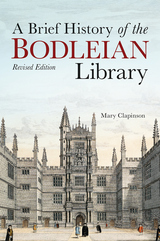
How did a library founded over four hundred years ago grow to become the world-renowned institution it is today, home to over thirteen million items? From its foundation by Sir Thomas Bodley in 1598 to the opening of the Weston Library in 2015, this illustrated account shows how the Library’s history has been involved with the British monarchy and political events throughout the centuries. The history of the Library is also a history of collectors and collections, and this book traces the story of major donations and purchases, making use of the Library’s own substantial archives to show how it came to house key items such as early confirmations of the Magna Carta, Shakespeare’s First Folio, and the manuscript of Jane Austen’s earliest writings, among many others.
This revised edition brings the history of the Bodleian Library up to the present moment. Beautifully illustrated with prints, portraits, manuscripts, and archival material, this book is essential reading for anyone interested in the history of libraries and collections.
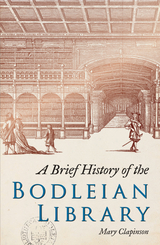
A Brief History of the Bodleian Library takes readers through the Library’s history, from its founding in 1602 by Sir Thomas Bodley to the present day. Along the way, the book traces the development of the Library’s incomparable collection, complete with details that reveal the eccentricities of those who have helped shape it, including Bodley himself, who conceived of the Library as a “republic of the learned,” and King George VI, who inadvertently delayed the opening of the New Bodleian in 1946 when he broke the key in the lock. Covering the major moments in the Library’s history and with a great many fun facts—How did the Library come to own not one of Shakespeare’s First Folios but two?—the book also apprises readers of its present concerns, including the building of individual subject libraries across Oxford, the use of underground passages, and the perennial search for more space.
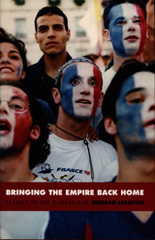
In Bringing the Empire Back Home, the inventive cultural historian Herman Lebovics provides a riveting account of how intense disputes about what it means to be French have played out over the past half-century, redefining Paris, the regions, and the former colonies in relation to one another and the world at large. In a narrative populated with peasants, people from the former colonies, museum curators, former colonial administrators, left Christians, archaeologists, anthropologists, soccer players and their teenage fans, and, yes, leading government officials, Lebovics reveals contemporary French society and cultures as perhaps the West’s most important testing grounds of pluralism and assimilation. A lively cultural history, Bringing the Empire Back Home highlights not only the political significance of France’s efforts to synthesize the regional, national, European, ethnic postcolonial, and global but also the chaotic beauty of the endeavor.
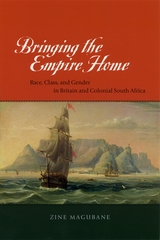
Bringing the Empire Home tracks colonial images of blackness from South Africa to England and back again to answer questions such as these. Before the mid-1800s, black Africans were considered savage to the extent that their plight mirrored England's internal Others—women, the poor, and the Irish. By the 1900s, England's minority groups were being defined in relation to stereotypes of black South Africans. These stereotypes, in turn, were used to justify both new capitalist class and gender hierarchies in England and the subhuman treatment of blacks in South Africa. Bearing this in mind, Zine Magubane considers how marginalized groups in both countries responded to these racialized representations.
Revealing the often overlooked links among ideologies of race, class, and gender, Bringing the Empire Home demonstrates how much black Africans taught the English about what it meant to be white, poor, or female.
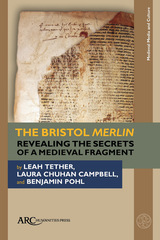
The discovery of seven manuscript fragments of the Old French Suite Vulgate du Merlin in a set of early printed books in the Bristol Central Library hit global headlines in 2019. This book contains a comprehensive study of these fascinating Arthurian fragments.
Beginning with an extensive contextual history, the authors reveal details of the fragments’ origin, their importation to England, and their subsequent journey to a waste pile in a bookbinder’s workshop, where they would be incorporated into the bindings of a four-volume edition of the works of Jean Gerson in the early sixteenth century. A full enquiry into the provenance of these host volumes sets out the possible routes from the bookbinder’s workshop to their final home in Bristol Central Library.
Using multi-spectral imaging to read the damaged sections of text, the authors also provide a full edition and translation of the narrative contained in the fragments.
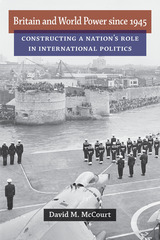
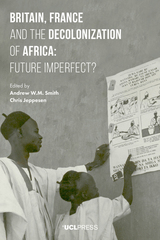

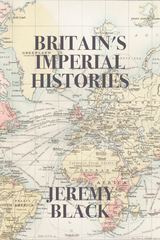
Military historian Jeremy Black continues his review of the global context of martial conflict and spatial conquest into the modern era (16th–20th centuries), focusing on the British empire and its lasting effect on this landscape. Black offers a representation of the "imperial experience" that is eye-opening for a generation of readers who associate this with a strictly negative connotation. But the notion of an empire is not understood at all if this is true. Indeed, not only is there "no one type of empire, no prototype," the basis of empire is much more 'order' than it is 'invasion.' Furthermore, reflecting on the unavoidable cultural and sociological symbiosis and transfer, Black makes the case that in all instances of influence and encounter, sameness between peoples never results. But how does one distinguish influence from control? What are the long-term benefits among peoples? "To many today, empire might seem obvious: governors with ostrich-feathers in their colonial garb ruling non-White peoples; but this scarcely describes the situation across time and place."
Why did the European empires ultimately fall? When approaching this question, Britain's Imperial Histories proposes that the perspective of "making and remaking of the international system" be made distinct from the "rational pursuit of power and wealth and the use of technology." As seen in earlier work, Black's brilliance is centered in his capacity to incorporate the complexity of war and its battles in his assessments, while never neglecting the fact that wars themselves have specific and broad contexts that must be read thoroughly.
Another highlight of the present work includes more insight into the British-American relationship and American political identity. "If the British empire is blamed for many of the aspects of modernization and globalization, is also serves as a way of offering historical depth to a critique of American power." Yet he is also adept at drawing in Asia into the study and does so with uncommon acumen. This book provides an approach to history that has been neglected, especially in the New World, and connects the present to the past with a kind of hermeneutical responsibility that has been of late abandoned.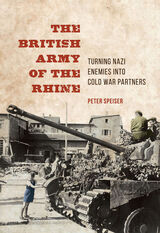
Peter Speiser charts the BAOR's fraught transformation from occupier to ally by looking at the charged nexus where British troops and their families interacted with Germany's civilian population. Examining the relationship on many levels, Speiser ranges from how British mass media representations of Germany influenced BAOR troops to initiatives taken by the Army to improve relations. He also weighs German perceptions, surveying clashes between soldiers and civilians and comparing the popularity of the British services with that of the other occupying powers. As Speiser shows, the BAOR's presence did not improve the relationship between British servicemen and the German populace, but it did prevent further deterioration during a crucial and dangerous period of the early Cold War.
An incisive look at an under-researched episode, The British Army of the Rhine sheds new light on Anglo-German diplomatic, political, and social relations after 1945, and evaluates their impact on the wider context of European integration in the postwar era.

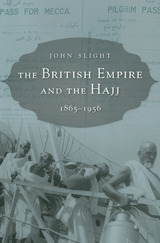
The British Empire at its height governed more than half the world’s Muslims. It was a political imperative for the Empire to present itself to Muslims as a friend and protector, to take seriously what one scholar called its role as “the greatest Mohamedan power in the world.” Few tasks were more important than engagement with the pilgrimage to Mecca.
Every year, tens of thousands of Muslims set out for Mecca from imperial territories throughout Africa, the Middle East, and Asia, from the Atlantic Ocean to the South China Sea. Men and women representing all economic classes and scores of ethnic and linguistic groups made extraordinary journeys across waterways, deserts, and savannahs, creating huge challenges for officials charged with the administration of these pilgrims. They had to balance the religious obligation to travel against the desire to control the pilgrims’ movements, and they became responsible for the care of those who ran out of money. John Slight traces the Empire’s complex interactions with the Hajj from the 1860s, when an outbreak of cholera led Britain to engage reluctantly in medical regulation of pilgrims, to the Suez Crisis of 1956. The story draws on a varied cast of characters—Richard Burton, Thomas Cook, the Begums of Bhopal, Lawrence of Arabia, and frontline imperial officials, many of them Muslim—and gives voice throughout to the pilgrims themselves.
The British Empire and the Hajj is a crucial resource for understanding how this episode in imperial history was experienced by rulers and ruled alike.
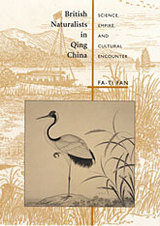
In the eighteenth and nineteenth centuries, Western scientific interest in China focused primarily on natural history. Prominent scholars in Europe as well as Westerners in China, including missionaries, merchants, consular officers, and visiting plant hunters, eagerly investigated the flora and fauna of China. Yet despite the importance and extent of this scientific activity, it has been entirely neglected by historians of science.
This book is the first comprehensive study on this topic. In a series of vivid chapters, Fa-ti Fan examines the research of British naturalists in China in relation to the history of natural history, of empire, and of Sino-Western relations. The author gives a panoramic view of how the British naturalists and the Chinese explored, studied, and represented China's natural world in the social and cultural environment of Qing China.
Using the example of British naturalists in China, the author argues for reinterpreting the history of natural history, by including neglected historical actors, intellectual traditions, and cultural practices. His approach moves beyond viewing the history of science and empire within European history and considers the exchange of ideas, aesthetic tastes, material culture, and plants and animals in local and global contexts. This compelling book provides an innovative framework for understanding the formation of scientific practice and knowledge in cultural encounters.
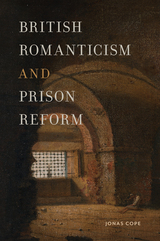
In eighteenth-century Britain, criminals were routinely whipped, branded, hanged, or transported to America. Only in the last quarter of the century—with the War of American Independence and legal and sociopolitical challenges to capital punishment—did the criminal justice system change, resulting in the reformed prison, or penitentiary, meant to educate, rehabilitate, and spiritualize even hardened felons. This volume is the first to explore the relationship between historical penal reform and Romantic-era literary texts by luminaries such as Godwin, Keats, Byron, and Austen. The works examined here treat incarceration as ambiguous: prison walls oppress and reinforce the arbitrary power of legal structures but can also heighten meditation, intensify the imagination, and awaken the conscience. Jonas Cope skillfully traces the important ideological work these texts attempt: to reconcile a culture devoted to freedom with the birth of the modern prison system that presents punishment as a form of rehabilitation.
Published by Bucknell University Press. Distributed worldwide by Rutgers University Press.
The performance of the British economy in the critical decades before 1914 is the subject of much scholarly debate. This first modern history of the British shipbuilding industry between 1870 and 1914 examines activities and attitudes of the shipbuilders in the context of this controversy over the quality of British entrepreneurship.
The authors consider the effectiveness of marketing practices, the rate of technological change, the degree to which ever-scarcer natural resources impose a constraint on growth, the general economic rationality of entrepreneurs, and, above all, the consequences of management decisions. After carefully weighing all evidence, the authors conclude that the general level of managerial performance was high, and in contrast to other sectors of heavy industry, British shipbuilders were able to maintain their dominant position.

Nine Rare and Fascinating First-Person Profiles of Soldiers Who Fought for the British Crown
Much has been written about the colonists who took up arms during the American Revolution and the army they created. Far less literature, however, has been devoted to their adversaries. The professional soldiers that composed the British army are seldom considered on a personal level, instead being either overlooked or inaccurately characterized as conscripts and criminals. Most of the British Redcoats sent to America in defense of their government’s policies were career soldiers who enlisted voluntarily in their late teens or early twenties. They came from all walks of British life, including those with nowhere else to turn, those aspiring to improve their social standing, and all others in between. Statistics show that most were simply hardworking men with various amounts of education who had chosen
the military in preference to other occupations. Very few of these soldiers left writings from which we can learn their private motives and experiences.
British Soldiers, American War: Voices of the American Revolution is the first collection of personal narratives by British common soldiers ever assembled and published. Author Don N. Hagist has located first-hand accounts of nine soldiers who served in America in the 1770s and 1780s. In their own words we learn of the diverse population—among them a former weaver, a boy who quarelled with his family, and a man with wanderlust—who joined the army and served tirelessly and dutifully, sometimes faithfully and sometimes irresolutely, in the uniform of their nation. To accompany each narrative, the author provides a contextualizing essay based on archival research giving background on the soldier and his military service. Taken as a whole these true stories reveal much about the individuals who composed what was, at the time, the most formidable fighting force in the world.
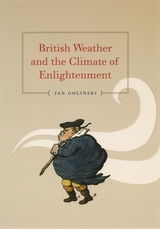
Enlightenment inquiries into the weather sought to impose order on a force that had the power to alter human life and social conditions. British Weather and the Climate of Enlightenment reveals how a new sense of the national climate emerged in the eighteenth century from the systematic recording of the weather, and how it was deployed in discussions of the health and welfare of the population. Enlightened intellectuals hailed climate’s role in the development of civilization but acknowledged that human existence depended on natural forces that would never submit to rational control.
Reading the Enlightenment through the ideas, beliefs, and practices concerning the weather, Jan Golinski aims to reshape our understanding of the movement and its legacy for modern environmental thinking. With its combination of cultural history and the history of science, British Weather and the Climate of Enlightenment counters the claim that Enlightenment progress set humans against nature, instead revealing that intellectuals of the age drew characteristically modern conclusions about the inextricability of nature and culture.

European media is experiencing a paradoxical form of growth: as media outlets surge and new technologies develop, major broadcasting companies are consolidating like never before. In Broadcasters and Citizens in Europe, an esteemed group of contributors look at what this paradox might mean for the European community. Are broadcasting audiences better informed than they were twenty years ago? And how has the advent of the European Union changed media practices? This essential volume explores a new media world in the context of a continent in flux.
Offering a tantalizing look behind lodge doors, The Brotherhood of Freemason Sisters unveils a complex culture of discretion in which Freemasons simultaneously reveal some truths and hide others. Women—one of Freemasonry’s best-kept secrets—are often upper class and highly educated but paradoxically antifeminist, and their self-cultivation through the Masonic path is an effort to embrace the deeply gendered ideals of fraternity. Mahmud unravels this contradiction at the heart of Freemasonry: how it was at once responsible for many of the egalitarian concepts of the Enlightenment and yet has always been, and in Italy still remains, extremely exclusive. The result is not only a thrilling look at an unfamiliar—and surprisingly influential—world, but a reevaluation altogether of the modern values and ideals that we now take for granted.
Brothers and Strangers traces the history of German Jewish attitudes, policies, and stereotypical images toward Eastern European Jews, demonstrating the ways in which the historic rupture between Eastern and Western Jewry developed as a function of modernism and its imperatives. By the 1880s, most German Jews had inherited and used such negative images to symbolize rejection of their own ghetto past and to emphasize the contrast between modern “enlightened” Jewry and its “half-Asian” counterpart. Moreover, stereotypes of the ghetto and the Eastern Jew figured prominently in the growth and disposition of German anti-Semitism. Not everyone shared these negative preconceptions, however, and over the years a competing post-liberal image emerged of the Ostjude as cultural hero. Brothers and Strangers examines the genesis, development, and consequences of these changing forces in their often complex cultural, political, and intellectual contexts.
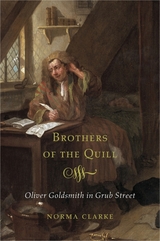
Oliver Goldsmith arrived in England in 1756 a penniless Irishman. He toiled for years in the anonymity of Grub Street—already a synonym for impoverished hack writers—before he became one of literary London’s most celebrated authors. Norma Clarke tells the extraordinary story of this destitute scribbler turned gentleman of letters as it unfolds in the early days of commercial publishing, when writers’ livelihoods came to depend on the reading public, not aristocratic patrons. Clarke examines a network of writers radiating outward from Goldsmith: the famous and celebrated authors of Dr. Johnson’s “Club” and those far less fortunate “brothers of the quill” trapped in Grub Street.
Clarke emphasizes Goldsmith’s sense of himself as an Irishman, showing that many of his early literary acquaintances were Irish émigrés: Samuel Derrick, John Pilkington, Paul Hiffernan, and Edward Purdon. These writers tutored Goldsmith in the ways of Grub Street, and their influence on his development has not previously been explored. Also Irish was the patron he acquired after 1764, Robert Nugent, Lord Clare. Clarke places Goldsmith in the tradition of Anglo-Irish satirists beginning with Jonathan Swift. He transmuted troubling truths about the British Empire into forms of fable and nostalgia whose undertow of Irish indignation remains perceptible, if just barely, beneath an equanimous English surface.
To read Brothers of the Quill is to be taken by the hand into the darker corners of eighteenth-century Grub Street, and to laugh and cry at the absurdities of the writing life.

Guérin’s travels took him across the countryside and into the cities of Germany. He describes with extraordinary clarity, for example, his encounters with large groups of unemployed workers in Berlin and the spectacle of Goering presiding over the Reichstag. Staying in youth hostels, Guérin met individuals representing a range of various groups and movements, including the Wandervögel, leftist brigades, Hitler Youth, and the strange, semicriminal sexual underground of the Wild-frei. Devoting particular attention to the cultural politics of fascism and the lure of Nazism for Germany’s disaffected youth, he describes the seductive rituals by which the Nazis were able to win over much of the population. As Robert Schwartzwald makes clear in his introduction, Guérin’s interest in Germany at this time was driven, in part, by a homoerotic component that could not be stated explicitly in his published material. This excellent companion essay also places The Brown Plague within a broad historical and literary context while drawing connections between fascism, aesthetics, and sexuality.
Informed by an epic view of class struggle and an admiration for German culture, The Brown Plague, a notable primary source in the literature of modern Europe, provides a unique view onto the rise of Nazism.

During the seventeenth century, sea raiders known as buccaneers controlled the Caribbean. Buccaneers were not pirates but privateers, licensed to attack the Spanish by the governments of England, France, and Holland. Jon Latimer charts the exploits of these men who followed few rules as they forged new empires.
Lacking effective naval power, the English, French, and Dutch developed privateering as the means of protecting their young New World colonies. They developed a form of semi-legal private warfare, often carried out regardless of political developments on the other side of the Atlantic, but usually with tacit approval from London, Paris, and Amsterdam. Drawing on letters, diaries, and memoirs of such figures as William Dampier, Sieur Raveneau de Lussan, Alexander Oliver Exquemelin, and Basil Ringrose, Jon Latimer portrays a world of madcap adventurers, daredevil seafarers, and dangerous rogues.
Piet Hein of the Dutch West India Company captured, off the coast of Cuba, the Spanish treasure fleet, laden with American silver, and funded the Dutch for eight months in their fight against Spain. The switch from tobacco to sugar transformed the Caribbean, and everyone scrambled for a quick profit in the slave trade. Oliver Cromwell’s ludicrous Western Design—a grand scheme to conquer Central America—fizzled spectacularly, while the surprising prosperity of Jamaica set England solidly on the road to empire. The infamous Henry Morgan conducted a dramatic raid through the tropical jungle of Panama that ended in the burning of Panama City.
From the crash of gunfire to the billowing sail on the horizon, Latimer brilliantly evokes the dramatic age of the buccaneers.

Mádi’s family donated the entire collection of her diaries to the US Holocaust Memorial Museum. This edition transcribes a selection of Mádi’s writings focusing on the period of March 1944 to November 1945, from the Nazi invasion and occupation of Hungary, through the Battle of Budapest, to the ensuing Soviet occupation. While bearing witness to the catastrophe in Hungary, Mádi hid a Jewish family in her small flat from October 1944 to February 1945. She received a posthumous Righteous among Nations Medal from Yad Vashem, the World Holocaust Remembrance Center.
Editorial commentary by James W. Oberly situates Mádi’s observations, and a critical introduction by the Holocaust scholar András Lénárt outlines the wider sociopolitical context in which her diaries gain meaning.
Buffalo Bill in Bologna reveals that the process of globalizing American mass culture began as early as the mid-nineteenth century. In fact, by the end of World War I, the United States already boasted an advanced network of culture industries that served to promote American values. Rydell and Kroes narrate how the circuses, amusement parks, vaudeville, mail-order catalogs, dime novels, and movies developed after the Civil War—tools central to hastening the reconstruction of the country—actually doubled as agents of American cultural diplomacy abroad. As symbols of America's version of the "good life," cultural products became a primary means for people around the world, especially in Europe, to reimagine both America and themselves in the context of America's growing global sphere of influence. Paying special attention to the role of the world's fairs, the exporting of Buffalo Bill's Wild West show to Europe, the release of The Birth of a Nation, and Woodrow Wilson's creation of the Committee on Public Information, Rydell and Kroes offer an absorbing tour through America's cultural expansion at the turn of the century. Buffalo Bill in Bologna is thus a tour de force that recasts what has been popularly understood about this period of American and global history.

Nineteenth-century Europe saw an unprecedented rise in the number of synagogues. Building a Public Judaism considers what their architecture and the circumstances surrounding their construction reveal about the social progress of modern European Jews. Looking at synagogues in four important centers of Jewish life—London, Amsterdam, Paris, and Berlin—Saskia Coenen Snyder argues that the process of claiming a Jewish space in European cities was a marker of acculturation but not of full acceptance. Whether modest or spectacular, these new edifices most often revealed the limits of European Jewish integration.
Debates over building initiatives provide Coenen Snyder with a vehicle for gauging how Jews approached questions of self-representation in predominantly Christian societies and how public manifestations of their identity were received. Synagogues fused the fundamentals of religion with the prevailing cultural codes in particular locales and served as aesthetic barometers for European Jewry’s degree of modernization. Coenen Snyder finds that the dialogues surrounding synagogue construction varied significantly according to city. While the larger story is one of increasing self-agency in the public life of European Jews, it also highlights this agency’s limitations, precisely in those places where Jews were thought to be most acculturated, namely in France and Germany.
Building a Public Judaism grants the peculiarities of place greater authority than they have been given in shaping the European Jewish experience. At the same time, its place-specific description of tensions over religious tolerance continues to echo in debates about the public presence of religious minorities in contemporary Europe.

Building the Cold War examines the architectural means by which the Hilton was written into the urban topographies of the major cities of Europe and the Middle East as an effective representation of the United States. Between 1953 and 1966, Hilton International built sixteen luxury hotels abroad. Often the Hilton was the first significant modern structure in the host city, as well as its finest hotel. The Hiltons introduced a striking visual contrast to the traditional architectural forms of such cities as Istanbul, Cairo, Athens, and Jerusalem, where the impact of its new architecture was amplified by the hotel's unprecedented siting and scale. Even in cities familiar with the Modern, the new Hilton often dominated the urban landscape with its height, changing the look of the city. The London Hilton on Park Lane, for example, was the first structure in London that was higher than St. Paul's cathedral.
In his autobiography, Conrad N. Hilton claimed that these hotels were constructed for profit and for political impact: "an integral part of my dream was to show the countries most exposed to Communism the other side of the coin—the fruits of the free world." Exploring everything the carefully drafted contracts for the buildings to the remarkable visual and social impact on their host cities, Wharton offers a theoretically sophisticated critique of one of the Cold War's first international businesses and demonstrates that the Hilton's role in the struggle against Communism was, as Conrad Hilton declared, significant, though in ways that he could not have imagined.
Many of these postwar Hiltons still flourish. Those who stay in them will learn a great deal about their experience from this new assessment of hotel space.

Building the Urban Environment is a comparative study of the contestation among planners, policymakers, and the grassroots over the production and meaning of urban space. Award-winning historian Harold Platt presents case studies of seven cities, including Rotterdam, Chicago, and Sao Paulo, to show how, over time, urban life created hybrid spaces that transformed people, culture, and their environments.
As Platt explains, during the post-1945 race to technological modernization, policymakers gave urban planners of the International Style extraordinary influence to build their utopian vision of a self-sustaining “organic city.” However, in the 1960s, they faced a revolt of the grassroots. Building the Urban Environment traces the rise and fall of the Modernist planners during an era of Cold War, urban crisis, unnatural disasters, and global restructuring in the wake of the oil-energy embargo of the ’70s.
Ultimately, Platt provides a way to measure different visions of the postwar city against actual results in terms of the built environment, contrasting how each city created a unique urban space.
Through the prism of the lives of Leon Blum, Albert Camus, and Raymond Aron, Judt examines pivotal issues in the history of contemporary French society—antisemitism and the dilemma of Jewish identity, political and moral idealism in public life, the Marxist moment in French thought, the traumas of decolonization, the disaffection of the intelligentsia, and the insidious quarrels rending Right and Left. Judt focuses particularly on Blum's leadership of the Popular Front and his stern defiance of the Vichy governments, on Camus's part in the Resistance and Algerian War, and on Aron's cultural commentary and opposition to the facile acceptance by many French intellectuals of communism's utopian promise. Severely maligned by powerful critics and rivals, each of these exemplary figures stood fast in their principles and eventually won some measure of personal and public redemption.
Judt constructs a compelling portrait of modern French intellectual life and politics. He challenges the conventional account of the role of intellectuals precisely because they mattered in France, because they could shape public opinion and influence policy. In Blum, Camus, and Aron, Judt finds three very different men who did not simply play the role, but evinced a courage and a responsibility in public life that far outshone their contemporaries.
"An eloquent and instructive study of intellectual courage in the face of what the author persuasively describes as intellectual irresponsibility."—Richard Bernstein, New York Times

Winner of the J. Russell Major Prize, American Historical Association
Winner of the David H. Pinkney Prize, Society for French Historical Studies
Winner of the JDC–Herbert Katzki Award, National Jewish Book AwardsWinner of the American Library in Paris Book Award
A Choice Outstanding Academic Title of the Year
Headlines from France suggest that Muslims have renewed an age-old struggle against Jews and that the two groups are once more inevitably at odds. But the past tells a different story. The Burdens of Brotherhood is a sweeping history of Jews and Muslims in France from World War I to the present.
“Katz has uncovered fascinating stories of interactions between Muslims and Jews in France and French colonial North Africa over the past 100 years that defy our expectations…His insights are absolutely relevant for understanding such recent trends as rising anti-Semitism among French Muslims, rising Islamophobia among French Jews and, to a lesser degree, rising rates of aliyah from France.”
—Lisa M. Leff, Haaretz
“Katz has written a compelling, important, and timely history of Jewish/Muslim relations in France since 1914 that investigates the ways and venues in which Muslims and Jews interacted in metropolitan France…This insightful, well-researched, and elegantly written book is mandatory reading for scholars of the subject and for those approaching it for the first time.”
—J. Haus, Choice
In uneasy partnership at the helm of the modern state stand elected party politicians and professional bureaucrats. This book is the first comprehensive comparison of these two powerful elites. In seven countries—the United States, Great Britain, France, Germany, Sweden, Italy, and the Netherlands—researchers questioned 700 bureaucrats and 6OO politicians in an effort to understand how their aims, attitudes, and ambitions differ within cultural settings.
One of the authors’ most significant findings is that the worlds of these two elites overlap much more in the United States than in Europe. But throughout the West bureaucrats and politicians each wear special blinders and each have special virtues. In a well-ordered polity, the authors conclude, politicians articulate society’s dreams and bureaucrats bring them gingerly to earth.

The contributors show that, contrary to descriptions by the Western media, the roots of the warring lie not in ancient Balkan hatreds but rather in a specific set of sociopolitical circumstances that occurred after the death of Tito and culminated at the end of the Cold War. In bringing together these essays, Serbian-born sociologist Jasminka Udovicki and Village Voice Washington correspondent James Ridgeway provide essential historical background for understanding the turmoil in Croatia, Bosnia, and Kosovo and expose the catalytic role played by the propaganda of a powerful few on all sides of what eventually became labeled an ethnic dispute.
Burn This House offers a poignant, informative, and fully up-to-date explication of the continuing Balkan tragedy.
Contributors. Sven Balas, Milan Milosevi´c Branka Prpa-Jovanovi´c, James Ridgeway, Stipe Sikavica, Ejub Stitkovac, Mirko Tepavac, Ivan Torov, Jasminka Udovicki, Susan Woodward
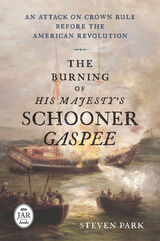
Between the Boston Massacre in 1770 and the Boston Tea Party in 1773—a period historians refer to as “the lull”—a group of prominent Rhode Islanders rowed out to His Majesty’s schooner Gaspee,which had run aground six miles south of Providence while on an anti-smuggling patrol. After threatening and shooting its commanding officer, the raiders looted the vessel and burned it to the waterline. Despite colony-wide sympathy for the June 1772 raid, neither the government in Providence nor authorities in London could let this pass without a response. As a result, a Royal Commission of Inquiry headed by Rhode Island governor Joseph Wanton zealously investigated the incident. In The Burning of His Majesty’s Schooner Gaspee: An Attack on Crown Rule Before the American Revolution, historian Steven Park reveals that what started out as a customs battle over the seizure of a prominent citizen’s rum was soon transformed into the spark that re-ignited Patriot fervor. The significance of the raid was underscored by a fiery Thanksgiving Day sermon given by a little-known Baptist minister in Boston. His inflammatory message was reprinted in several colonies and was one of the most successful pamphlets of the pre-Independence period. The commission turned out to be essentially a sham and made the administration in London look weak and ineffective. In the wake of the Gaspee affair, Committees of Correspondence soon formed in all but one of the original thirteen colonies, and later East India Company tea would be defiantly dumped into Boston Harbor.

The evidence is everywhere: fundamentalist reading can stir passions and provoke violence that changes the world. Amid such present-day conflagrations, this illuminating book reminds us of the sources, and profound consequences, of Christian fundamentalism in the sixteenth century.
James Simpson focuses on a critical moment in early modern England, specifically the cultural transformation that allowed common folk to read the Bible for the first time. Widely understood and accepted as the grounding moment of liberalism, this was actually, Simpson tells us, the source of fundamentalism, and of different kinds of persecutory violence. His argument overturns a widely held interpretation of sixteenth-century Protestant reading--and a crucial tenet of the liberal tradition.
After exploring the heroism and achievements of sixteenth-century English Lutherans, particularly William Tyndale, Burning to Read turns to the bad news of the Lutheran Bible. Simpson outlines the dark, dynamic, yet demeaning paradoxes of Lutheran reading: its demands that readers hate the biblical text before they can love it; that they be constantly on the lookout for unreadable signs of their own salvation; that evangelical readers be prepared to repudiate friends and all tradition on the basis of their personal reading of Scripture. Such reading practice provoked violence not only against Lutheranism's stated enemies, as Simpson demonstrates; it also prompted psychological violence and permanent schism within its own adherents.
The last wave of fundamentalist reading in the West provoked 150 years of violent upheaval; as we approach a second wave, this powerful book alerts us to our peril.
In 1650, Archbishop James Ussher of Armagh joined the long-running theological debate on the age of the earth by famously announcing that creation had occurred on October 23, 4004 B.C. Although widely challenged during the Enlightenment, this belief in a six-thousand-year-old planet was only laid to rest during a revolution of discovery in the late eighteenth and early nineteenth centuries. In this relatively brief period, geologists reconstructed the immensely long history of the earth-and the relatively recent arrival of human life. Highlighting a discovery that radically altered existing perceptions of a human's place in the universe as much as the theories of Copernicus, Darwin, and Freud did, Bursting the Limits of Time is a herculean effort by one of the world's foremost experts on the history of geology and paleontology to sketch this historicization of the natural world in the age of revolution.
Addressing this intellectual revolution for the first time, Rudwick examines the ideas and practices of earth scientists throughout the Western world to show how the story of what we now call "deep time" was pieced together. He explores who was responsible for the discovery of the earth's history, refutes the concept of a rift between science and religion in dating the earth, and details how the study of the history of the earth helped define a new branch of science called geology. Rooting his analysis in a detailed study of primary sources, Rudwick emphasizes the lasting importance of field- and museum-based research of the eighteenth and nineteenth centuries.
Bursting the Limits of Time, the culmination of more than three decades of research, is the first detailed account of this monumental phase in the history of science.
During the 1920s, the "black decade" of British steel, nearly everyone agreed that the industry's revival depended on replacing obsolete equipment and instituting modern technologies that would increase production and decrease costs. Despite consensus, these goals were not reached and, even after wartime and postwar reconstruction needs were met, the industry continued its steady decline. Steven Tolliday advances three hypotheses for this stagnation.
First, the problems of British steel, Tolliday suggests, were embedded in the structures of individual firms and of the industry as a whole—both unchanged since the prosperous years of the nineteenth century—and after World War I fractured by conflicting interests (share holders, managers, family members, bankers, creditors). Second, the two external institutions that might have enforced reorganization and modernization—the banking system and the government—were overcautious, had complex and contradictory goals, and lacked the management skills to exploit their potential financial leverage. Third, the many attempts at reform by banks and government collapsed because these establishments, like the industry itself, were constrained by traditions and antiquated structural rigidities.
This excellent example of a new direction in business history—analysis of a given industry by conveying the interaction of technology, markets, companies, financial institutions, and government—brings many important theoretical questions into focus and also contributes substantially to the scrutiny of specific problems, such as why the British economy appears to be in irrevocable decline.
”A major achievement of American scholarship and in the first rank of those which have been transforming our view of French history during the last twenty years.“ —New York Review of Books
A great book about an even greater book is a rare event in publishing. Robert Darnton’s history of the Encyclopédie is such an occasion. The author explores some fascinating territory in the French genre of histoire du livre, and at the same time he tracks the diffusion of Enlightenment ideas. He is concerned with the form of the thought of the great philosophes as it materialized into books and with the way books were made and distributed in the business of publishing. This is cultural history on a broad scale, a history of the process of civilization.
In tracing the publishing story of Diderot’s Encyclopédie, Darnton uses new sources—the papers of eighteenth-century publishers—that allow him to respond firmly to a set of problems long vexing historians. He shows how the material basis of literature and the technology of its production affected the substance and diffusion of ideas. He fully explores the workings of the literary market place, including the roles of publishers, book dealers, traveling salesmen, and other intermediaries in cultural communication. How publishing functioned as a business, and how it fit into the political as well as the economic systems of prerevolutionary Europe are set forth. The making of books touched on this vast range of activities because books were products of artisanal labor, objects of economic exchange, vehicles of ideas, and elements in political and religious conflict.
The ways ideas traveled in early modern Europe, the level of penetration of Enlightenment ideas in the society of the Old Regime, and the connections between the Enlightenment and the French Revolution are brilliantly treated by Darnton. In doing so he unearths a double paradox. It was the upper orders in society rather than the industrial bourgeoisie or the lower classes that first shook off archaic beliefs and took up Enlightenment ideas. And the state, which initially had suppressed those ideas, ultimately came to favor them. Yet at this high point in the diffusion and legitimation of the Enlightenment, the French Revolution erupted, destroying the social and political order in which the Enlightenment had flourished.
Never again will the contours of the Enlightenment be drawn without reference to this work. Darnton has written an indispensable book for historians of modern Europe.
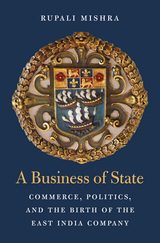
At the height of its power around 1800, the English East India Company controlled half of the world’s trade and deployed a vast network of political influencers at home and abroad. Yet the story of the Company’s beginnings in the early seventeenth century has remained largely untold. Rupali Mishra’s account of the East India Company’s formative years sheds new light on one of the most powerful corporations in the history of the world.
From its birth in 1600, the East India Company lay at the heart of English political and economic life. The Company’s fortunes were determined by the leading figures of the Stuart era, from the monarch and his privy counselors to an extended cast of eminent courtiers and powerful merchants. Drawing on a host of overlooked and underutilized sources, Mishra reconstructs the inner life of the Company, laying bare the era’s fierce struggles to define the difference between public and private interests and the use and abuse of power. Unlike traditional accounts, which portray the Company as a private entity that came to assume the powers of a state, Mishra’s history makes clear that, from its inception, the East India Company was embedded within—and inseparable from—the state.
A Business of State illuminates how the East India Company quickly came to inhabit such a unique role in England’s commercial and political ambitions. It also offers critical insights into the rise of the early modern English state and the expansion and development of its nascent empire.

While By Touch Alone features the writing and ideas of an understudied community of nineteenth-century blind authors, innovators, and activists, it also engages the work of sighted authors such as George Eliot and Rudyard Kipling to explore the culture-wide effects of reading by touch. The emergence of a new category of readers who did not rely on sight to read prompted sighted people to reimagine blindness and adopt more progressive attitudes toward blind people. In our own era, one characterized by the increasing digitization of our reading lives, Vanessa Warne’s exploration positions scholars and blind readers to navigate present-day developments and shape the future of their reading lives. A carefully contextualized study of how reading by touch shaped Victorian culture, By Touch Alone adds new chapters to the history of disability and reading.
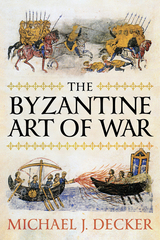
The Byzantine Art of War explores the military history of the thousand-year empire of the eastern Mediterranean, Byzantium. Throughout its history the empire faced a multitude of challenges from foreign invaders seeking to plunder its wealth and to occupy its lands, from the deadly Hunnic hordes of Attila, to the Arab armies of Islam, to the western Crusaders bent on carving out a place in the empire or its former lands. In order to survive the Byzantines relied on their army that was for centuries the only standing, professional force in Europe. Leadership provided another key to survival; Byzantine society produced a number of capable strategic thinkers and tacticians—and several brilliant ones. These officers maintained a level of professionalism and organization inherited and adapted from Roman models. The innovations of the Byzantine military reforms of the sixth century included the use of steppe nomad equipment and tactics, the most important of which was the refinement of the Roman mounted archer. Strategy and tactics evolved in the face of victory and defeat; the shock of the Arab conquests led to a sharp decline in the number and quality of imperial forces. By the eighth and ninth centuries Byzantine commanders mastered the art of the small war, waging guerrilla campaigns, raids, and flying column attacks that injured the enemy but avoided the decisive confrontation the empire was no longer capable of winning. A century later they began the most sustained, glorious military expansion of their history. This work further sketches the key campaigns, battles, and sieges that illustrate Byzantine military doctrine, vital changes from one era to another, the composition of forces and the major victories and defeats that defined the territory and material well-being of its citizens. Through a summary of their strategies, tactics, and innovations in the tools of war, the book closes with an analysis of the contributions of this remarkable empire to world military history.
This introductory booklet on Byzantine coinage, first published in 1982, has been updated and expanded to include a description of the creation of the coin collection at Dumbarton Oaks. This new edition marks the completion of the five volume series Catalogue of the Byzantine Coins in the Dumbarton Oaks Collection.
The booklet covers phases of the coinage, gold, silver, and copper coinage, types and inscriptions, and ruler representations. Tables of values corresponding with various times in the empire’s history, a list of Byzantine emperors, and a glossary are also provided.
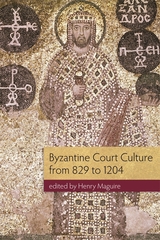
The imperial court in Constantinople has been central to the outsider’s vision of Byzantium. However, in spite of its fame in literature and scholarship, there have been few attempts to analyze the Byzantine court in its entirety as a phenomenon. The studies in this volume aim to provide a unified composition by presenting Byzantine courtly life in all its interconnected facets.
One important theme that unites these studies is the attention paid to describing the effects of a change in the social makeup of the court during this period and the reflection of these changes in art and architecture. These changes in social composition, mentality, and material culture of the court demonstrate that, as in so many other aspects of Byzantine civilization, the image of permanence and immutability projected by the forms of palace life was more apparent than real. As this new work shows, behind the golden facade of ceremony, rhetoric, and art, there was constant development and renewal.


The Byzantine Empire centered at the city of Constantinople grew from a small Greek colonial village into the capital of the Eastern Roman empire. Ultimately, Byzantium represented what remained of Roman power in late antiquity. Established as the seat of Constantine the Great in 328 AD, the empire grew and matured over the centuries, reaching its pinnacle in the sixth century during the reign of Justinian and his loyal general, Belisarius. In the process of empire building, Byzantium battled the Goths, the Germanic tribes, the Persians, the Lombards, and ultimately the Islamic armies of the Near East. Byzantium remained a buffer against Muslim expansion, and by the time the remnants of the empire and the city of Constantinople were finally conquered by the Ottomans in the fourteenth century, European states to the west were able to resist any further encroachment.
In tracing the empire’s history from its humble beginnings through its ascendancy and final decay, distinguished historian Charles W. C. Oman blends his engaging narrative style with his impeccable command of primary source material. Here, Oman dispels the misconception that the Byzantine court was one plagued by corruption and intrigue—a canard that added “Byzantine” to the English language; instead, Byzantium was one of the most stable governments of late antiquity. Never before reprinted in paperback, The Byzantine Empire is a model of concise popular scholarship.
Only in the last decade has much serious attention been paid to the Byzantine garden, so indirect is the mass of information, both in literature and the visual arts, that is available for scholars. Byzantine Garden Culture, based on papers delivered at a colloquium at Dumbarton Oaks, is the first book devoted to the subject.
Individual essays discuss Byzantine conceptions of paradise, the textual evidence for monastic horticulture, animal and game parks, herbs in medicinal pharmacy, and the famous illustrated copy of Dioskorides’s herbal manual in Vienna. An opening chapter explores questions and observations from the point of view of a non-Byzantine garden historian, and the closing chapter suggests possible directions for future scholarship in the field.
Although Byzantium is known to history as the Eastern Roman Empire, scholars have long claimed that this Greek Christian theocracy bore little resemblance to Rome. Here, in a revolutionary model of Byzantine politics and society, Anthony Kaldellis reconnects Byzantium to its Roman roots, arguing that from the fifth to the twelfth centuries CE the Eastern Roman Empire was essentially a republic, with power exercised on behalf of the people and sometimes by them too. The Byzantine Republic recovers for the historical record a less autocratic, more populist Byzantium whose Greek-speaking citizens considered themselves as fully Roman as their Latin-speaking “ancestors.”
Kaldellis shows that the idea of Byzantium as a rigid imperial theocracy is a misleading construct of Western historians since the Enlightenment. With court proclamations often draped in Christian rhetoric, the notion of divine kingship emerged as a way to disguise the inherent vulnerability of each regime. The legitimacy of the emperors was not predicated on an absolute right to the throne but on the popularity of individual emperors, whose grip on power was tenuous despite the stability of the imperial institution itself. Kaldellis examines the overlooked Byzantine concept of the polity, along with the complex relationship of emperors to the law and the ways they bolstered their popular acceptance and avoided challenges. The rebellions that periodically rocked the empire were not aberrations, he shows, but an essential part of the functioning of the republican monarchy.
Why does medieval Rome look so, for lack of a better word, Byzantine? Why do its monuments speak an aesthetic of the medieval East? And just how do we quantify that Byzantine aesthetic or even the word “Byzantine”?
This book seeks to consider the ways in which the artistic styles and iconographies generally associated with the eastern medieval tradition had a life in the West and, in many cases, were just as western as they were eastern. Rome’s medieval monuments are a fundamental part of the history of the East, a history that says more about a cross- cultural exchange and interconnected “Romes” than difference and separation.
Each chapter follows the political and theological relationships between the East and the West chronologically, exploring the socio-political exchanges as they manifest in the visual language of the monuments that defined the medieval landscape of Rome.
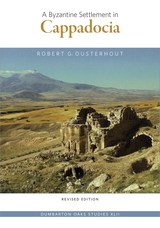
Following its initial publication in 2005, A Byzantine Settlement in Cappadocia has become a seminal work in interpreting the rich material remains of Byzantine Cappadocia. In the first systematic site survey from the region, at the settlement known as Çanlı Kilise in Western Cappadocia, the careful mapping and documentation of rock-cut and masonry architecture and its decoration led to a complete reexamination of the place of Cappadocia within the larger framework of Byzantine social and cultural developments. This revised edition builds upon its predecessor with an updated preface, a new bibliography, and a new master map of the Çanlı Kilise site.
Based on four seasons of fieldwork, Ousterhout challenges the commonly accepted notion that the rock-cut settlements of Cappadocia were primarily monastic. He proposes instead that the settlement at Çanlı Kilise was a town, replete with mansions, hovels, barns, stables, storerooms, cisterns, dovecotes, wine presses, fortifications, places of refuge, churches, chapels, cemeteries, and a few monasteries—that is, features common to most Byzantine communities. A Byzantine Settlement in Cappadocia has led to a rethinking of such sites and to a view of Cappadocia as an untapped resource for the study of material culture and daily life within the Byzantine Empire.
Through a series of remarkably detailed composite portraits, an international collection of distinguished scholars has created a startlingly clear vision of the Byzantines and their social world. Paupers, peasants, soldiers, teachers, bureaucrats, clerics, emperors, and saints—all are vividly and authentically presented in the context of ordinary Byzantine life. No comparable volume exists that so fascinatingly recovers from the past the men and women of Byzantium, their culture and their lifeways, and their strikingly modern worldview.

Stamatopoulos undertakes the first systematic comparison of the dominant ethnic historiographic models and divergences elaborated by Greek, Bulgarian, Serbian, Albanian, Romanian, Turkish, and Russian intellectuals with reference to the ambiguous inheritance of Byzantium. The title alludes to the seminal work of Nicolae Iorga in the 1930s, Byzantium after Byzantium, that argued for the continuity between the Byzantine and the Ottoman empires. Rival Balkan nationalisms engaged in a “war of interpretation” as to the nature of Byzantium, assuming different positions of adoption or rejection of its imperial model and leading to various schemes of continuity in each national historiographic canon.
Stamatopoulos discusses what Byzantium represented for nineteenth-, and twentieth-century scholars and how their perceptions related to their treatment of the imperial model: whether a different perception of the medieval Byzantine period prevailed in the Greek national center as opposed to Constantinople; how nineteenth-century Balkan nationalists and Russian scholars used Byzantium to invent their own medieval period (and, by extension, their own antiquity); and finally, whether there exist continuities or discontinuities in these modes of making ideological use of the past.
Byzantium is much more than a sourcebook. The running commentary reflects the most recent scholarly research in Byzantine studies and places each translated source in its precise historical context. Through the use of both primary sources and commentary, Geanakoplos has represented in all its richness and complexity one of the world's great civilizations. There is no comparable book on Byzantine history and civilization in any language.
READERS
Browse our collection.
PUBLISHERS
See BiblioVault's publisher services.
STUDENT SERVICES
Files for college accessibility offices.
RECENTLY PUBLISHED





UChicago Accessibility Resources
home | accessibility | search | about | contact us
BiblioVault ® 2001 - 2025
The University of Chicago Press