
 A SCHOLARLY BOOK REPOSITORY
9 start with B start with B

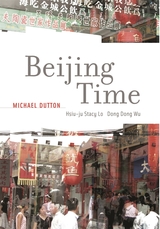
“Where is the market?” inquires the tourist one dark, chilly morning. “Follow the ghosts,” responds the taxi driver, indicating a shadowy parade of overloaded tricycles. “It’s not called the ghost market for nothing!” And indeed, Beijing is nothing if not haunted. Among the soaring skyscrapers, choking exhaust fumes, nonstop traffic jams, and towering monuments, one discovers old Beijing—newly styled, perhaps, but no less present and powerful than in its ancient incarnation. Beijing Time conducts us into this mysterious world, at once familiar and yet alien to the outsider.
The ancient Chinese understood the world as enchanted, its shapes revealing the mythological order of the universe. In the structure and detail of Tian’anmen Square, the authors reveal the city as a whole. In Beijing no pyramids stand as proud remnants of the past; instead, the entire city symbolizes a vibrant civilization. From Tian’anmen Square, we proceed to the neighborhoods for a glimpse of local color—from the granny and the young police officer to the rag picker and the flower vendor. Wandering from the avant-garde art market to the clock towers, from the Monumental Axis to Mao’s Mausoleum, the book allows us to peer into the lives of Beijingers, the rules and rituals that govern their reality, and the mythologies that furnish their dreams. Deeply immersed in the culture, everyday and otherworldly, this anthropological tour, from ancient cosmology to Communist kitsch, allows us to see as never before how the people of Beijing—and China—work and live.

Everyone “knows” the Maasai as proud pastoralists who once dominated the Rift Valley from northern Kenya to central Tanzania.
But many people who identity themselves as Maasai, or who speak Maa, are not pastoralist at all, but farmers and hunters. Over time many different people have “become” something else. And what it means to be Maasai has changed radically over the past several centuries and is still changing today.
This collection by historians, archaeologists, anthropologists and linguists examines how Maasai identity has been created, evoked, contested, and transformed from the time of their earliest settlement in Kenya to the present, as well as raising questions about the nature of ethnicity generally.

Through her in-depth ethnography of two repair and rehabilitation centers operating in Ethiopia, Hannig takes the reader deep into a world inside hospital walls, where women recount stories of loss and belonging, shame and delight. As she chronicles the lived experiences of fistula patients in clinical treatment, Hannig explores the danger of labeling “culture” the culprit, showing how this common argument ignores the larger problem of insufficient medical access in rural Africa. Beyond Surgery portrays the complex social outcomes of surgery in an effort to deepen our understanding of medical missions in Africa, expose cultural biases, and clear the path toward more effective ways of delivering care to those who need it most.

Black, French, and African is the first biography in English of the extraordinary poet, politician and intellectual Léopold Sédar Senghor. As a prizewinning poet in French, Senghor was the first African to be elected to the Académie Française for his contribution to French culture; as a statesman, he was the first president of independent Senegal from 1961 to 1980, a nation still among the most democratic in Africa; as an intellectual, he was an originator of the theory of Négritude—a term that to him meant “the manner of self-expression of the black character, the black world, black civilization”—and a leader of West African independence.
Through her sleuthing, interviewing, and ferreting out details over a period of years, Janet Vaillant has drawn a captivating multi-dimensional portrait of this unusual man. She introduces us to Senghor the child, through descriptions of his family, the traditional culture of the Serer people of Senegal, and the system of French colonialism that gave him his contradictory sense of “place”; then to Senghor the young man, as he pursued his academic and literary education in Paris of the late 1920s. Finally, she moves on to his involvement in this special fraternity of “men of color” that crystallized in Paris in the mid 1930s and that fostered the theory of Negritude for which Senghor became such an articulate spokesman.
Senghor’s biography contributes to an understanding of postindependence African leadership as well as French and African-American intellectual history and literature. Vaillant examines links between his personal experience, his political work, and his poetry, and the effects of his political ideology on state-building. She also provides us with larger context in which Senghor worked—his debts and contributions to the writing and thinking of blacks in America and France, and his importance as a leader of a colonized people dealing with the industrialized West.

Travel in Tokugawa Japan was officially controlled by bakufu and domainal authorities via an elaborate system of barriers, or sekisho, and travel permits; commoners, however, found ways to circumvent these barriers, frequently ignoring the laws designed to control their mobility. In this study, Constantine Vaporis challenges the notion that this system of travel regulations prevented widespread travel, maintaining instead that a “culture of movement” in Japan developed in the Tokugawa era.
Using a combination of governmental documentation and travel literature, diaries, and wood-block prints, Vaporis examines the development of travel as recreation; he discusses the impact of pilgrimage and the institutionalization of alms-giving on the freedom of movement commoners enjoyed. By the end of the Tokugawa era, the popular nature of travel and a sophisticated system of roads were well established. Vaporis explores the reluctance of the bakufu to enforce its travel laws, and in doing so, beautifully evokes the character of the journey through Tokugawa Japan.


Drawing from years of research and a rich array of sources, Cooper accounts for how school fires stoke a national conversation about the limited means for ordinary Kenyans, and especially youth, to peacefully influence the governance of their own lives. Further, Cooper argues that Kenyan students’ actions challenge the existing complacency with the globalized agenda of “education for all,” demonstrating that submissive despondency is not the only possible response to the failed promises of education to transform material and social inequalities.
READERS
Browse our collection.
PUBLISHERS
See BiblioVault's publisher services.
STUDENT SERVICES
Files for college accessibility offices.
RECENTLY PUBLISHED




UChicago Accessibility Resources
home | accessibility | search | about | contact us
BiblioVault ® 2001 - 2025
The University of Chicago Press