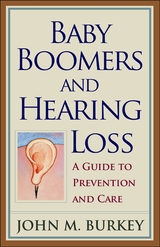
front cover of Baby Boomers and Hearing Loss
Baby Boomers and Hearing Loss
A Guide to Prevention and Care
Burkey, John M
Rutgers University Press, 2006

In Baby Boomers and Hearing Loss, audiologist John Burkey shows readers how they can continue to enjoy youthful living, regardless of whether their hearing abilities are undiminished or severely compromised. In a reassuring and straightforward style, Burkey explains the typical causes of hearing loss, from genetic factors to years of exposure to loud noises, and demystifies the sometimes confusing results of a hearing test. Fortunately, new technologies and advances in medicine have made it easier to detect signs of initial hearing loss and to prevent it from becoming a serious problem.

For those who have already sustained some damage, the author suggests ways to manage daily activities by using a range of techniques, equipment, and medical procedures. His suggestions include minor changes, such as using a vibrating alarm clock rather than one that is sound-based. More dramatic but often highly effective options, including reconstructive surgery, cochlear implants, and bone-anchored hearing aids, are also described. 

In his previous award-winning book, Overcoming Hearing Aid Fears: The Road to Better Hearing, Burkey addressed common fears, concerns, and misconceptions that people have about choosing and using hearing aids. In this second indispensable volume, he offers a comprehensive guide on how to cope with and prevent hearing impairment. For a generation that refuses to slow down or quietly accept limitations, this book is essential reading.


[more]

front cover of Before Their Time
Before Their Time
Mary Stimming
Temple University Press, 1998
Before Their Time is the first work  to present adult children survivors' (defined as eighteen or above at the time of the parent's death) accounts of their loss, grief, and resolution following a parent's suicide. In once section, the book offers the perspectives of sons and daughters on the deaths of mothers; in another, the perspectives of sons and daughters on the  deaths of fathers. In a third section, siblings reflect on the shared loss of their mother.

Each of these survivors faces the  common difficulties associated with losing a loved one by suicide. They also experience difficulties specific to their status as both adult and child. Topics such as the impact of the parent's suicide on adult children's personal and  professional choices, marriages and parenting, sibling and surviving parent relationships are explored with sensitivity and insight. Various coping skills, including humor, are described.

The writers describe feelings of regret and responsibility related to their parent's suicide. They express concern about other family members' vulnerability to suicide. They speak openly about the fears and stresses they face and how they cope with them.

The authors ranged in age from nineteen to thirty-six at the time of the parent's death. Between one and  twenty-five years have passed since that tragedy.

In addition to the first-person narratives, the book includes a resource section with a national listing of  suicide survivor support groups; an overview of existing research on survivors of suicide by John L. McIntosh, past president of the American Association of Suicidology; and  an essay on elderly suicide by David C. Clark, secretary-general, International Association for  Suicide, and  editor-in-chief of Crisis. The book is introduced with a Foreword by Rev. Charles Rubey, founder and director of Loving Outreach to Survivors of Suicide.
[more]


Send via email Share on Facebook Share on Twitter