
 A SCHOLARLY BOOK REPOSITORY
3 start with B start with B

The politics of domestic violence create novel entry points to understanding how, although women may be vulnerable to gender-based violence, they do not necessarily share the same kind of belonging to the state. This means that markers of identity and power, such as gender, nationality, ethnicity, religion and religiosity, and socio-economic and geographic location, matter when it comes to safety and pathways to justice.
The study centers on Israel, where a number of factors bring connections between the cultural politics of the state and domestic violence into stark relief: the presence of a contentious multinational and multiethnic population; competing and overlapping sets of religious and civil laws; a growing gap between the wealthy and the poor; and the dominant presence of a security state in people's everyday lives. The exact combination of these factors is unique to Israel, but they are typical of states with a diverse population in a time of globalization. In this way, the example of Israel offers insights wherever the political and personal impinge on one another.
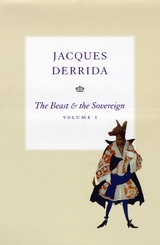
When he died in 2004, Jacques Derrida left behind a vast legacy of unpublished material, much of it in the form of written lectures. With The Beast and the Sovereign, Volume 1, the University of Chicago Press inaugurates an ambitious series, edited by Geoffrey Bennington and Peggy Kamuf, translating these important works into English.
The Beast and the Sovereign, Volume 1 launches the series with Derrida’s exploration of the persistent association of bestiality or animality with sovereignty. In this seminar from 2001–2002, Derrida continues his deconstruction of the traditional determinations of the human. The beast and the sovereign are connected, he contends, because neither animals nor kings are subject to the law—the sovereign stands above it, while the beast falls outside the law from below. He then traces this association through an astonishing array of texts, including La Fontaine’s fable “The Wolf and the Lamb,” Hobbes’s biblical sea monster in Leviathan, D. H. Lawrence’s poem “Snake,” Machiavelli’s Prince with its elaborate comparison of princes and foxes, a historical account of Louis XIV attending an elephant autopsy, and Rousseau’s evocation of werewolves in The Social Contract.
Deleuze, Lacan, and Agamben also come into critical play as Derrida focuses in on questions of force, right, justice, and philosophical interpretations of the limits between man and animal.
READERS
Browse our collection.
PUBLISHERS
See BiblioVault's publisher services.
STUDENT SERVICES
Files for college accessibility offices.
RECENTLY PUBLISHED





UChicago Accessibility Resources
home | accessibility | search | about | contact us
BiblioVault ® 2001 - 2025
The University of Chicago Press