
 A SCHOLARLY BOOK REPOSITORY
2150 start with C start with C







Combining case studies and theoretical discussions, Current Paleoethnobotany presents the first full discussion of the major stages and problems of paleoethnobotanical research, from designing and testing equipment, such as flotation machines, to quantification and interpretation. The volume explores a wide range of issues concerning collection techniques, analytical procedures, and interpretive models that will provide accurate information about past human societies from plant remains. The contributors offer data on specific regions as well as more general background information on the basic techniques of paleoethnobotany for the nonspecialist. Throughout, they explicitly examine the assumptions underlying paleoethnobotanical methods and the ways in which those assumptions affect anthropological and ecological research questions.
Based on a symposium presented at the 1985 meeting of the Society for American Archaeology, Current Paleoethnobotany moves beyond a technique-oriented view of paleoethnobotany to successfully integrate current thinking about both procedures and research goals. The contributors demonstrate the potential value of the field of paleoethnobotany and open the way for further discussion and improvement.
This volume provides the most comprehensive overview of archaeological research into the late Pleistocene and early Holocene occupation of the North American Far West in over a decade. It focuses on the relationship between stemmed and fluted point technologies in the region, which has recently risen to the forefront of debate about the initial settlement of the Americas. Established and early career researchers apply a wide range of analytical approaches to explore chronological, geographical, and technological aspects of these tools and what they reveal about the people who made them. While such interrelationships have intrigued archaeologists for nearly a century, until now they have not been systematically examined together in a single curated volume.
Contributions are organized into three main sections: stemmed point technologies, fluted point technologies, and broader interactions. Topics range from regional overviews of chronologies and technologies to site-level findings containing extensive new data. The culmination of many years of work by dozens of researchers, this volume lays new groundwork for understanding technological innovation, diversity, and exchange among early Indigenous peoples in North America.
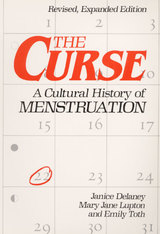
"In its hard headed, richly documented concreteness, it is worth a thousand polemics."
-- New York Times, from a review of the first edition
"The Curse deserves a place in every women's studies library collection."
-- Sharon Golub, editor of Lifting the curse of Menstruation
"A stimulating and useful book, both for the scholarly and the general reader."
-- Paula A. Treichler, co-author of A Feminist Dictionary
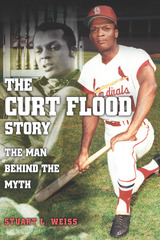
Curt Flood, former star center fielder for the St. Louis Cardinals, is a hero to many for selflessly sacrificing his career to challenge the legality of baseball’s reserve system. Although he lost his case before the Supreme Court, he has become for many a martyr in the eventually successful battle for free agency. Sportswriters and fans alike have helped to paint a picture of Flood as a larger-than-life figure, a portrait that, unhappily, cannot stand closer inspection. This book reveals the real Curt Flood—more man than myth.
Flood stirred up a hornet’s nest by refusing to be traded from the Cardinals to the Philadelphia Phillies after the 1969 season, arguing that Major League Baseball’s reserve system reduced him to the status of bondage. Flood decided to resist a system in which his contract could be traded without his consent and in which he was not at liberty to negotiate his services in an open market. Stuart Weiss examines the man behind the decision, exploring the span of Flood’s life and shedding light on his relationships with those who helped shape his determination to sue baseball and providing a new perspective on the lawsuit that found its way to the U.S. Supreme Court.
Although a superb player, Flood was known to be temperamental and sensitive; in suing Major League Baseball he transformed his grievances against the Cardinals front office into an attack on how the business of big-league ball was conducted. Weiss shows that Flood was far from the stereotypical “dumb jock” but was rather a proud, multifaceted black man in a business run by white moguls. By illuminating Flood’s private side, rarely seen by the public, he reveals how Flood misled a gullible press on a regular basis and how his 1971 memoir, The Way It Is, didn’t tell it the way it really was.
Drawing on previously untapped sources, Weiss examines more fully and deeply than other writers the complexities of Flood’s decision to pursue his lawsuit—and demonstrates that the picture of Flood as a martyr for free agency is a myth. He suggests why, of all the players traded or sold through the years, it was Flood who brought this challenge. Weiss also explains how Flood’s battle against the reserve system cannot be understood in isolation from the personal experiences that precipitated it, such as his youth in a dysfunctional home, his troubled first marriage, his financial problems, and his unwavering commitment to the Cardinals.
The Curt Flood Story is a realistic account of an eloquent man who presented a warm, even vulnerable, face to the public as well as to friends, while hiding his inner furies. It shows that Flood was neither a hero nor a martyr but a victim of unique circumstances and his own life.
“I here and there o’heard a Coxcomb cry,
Ah, rot—’tis a Woman’s Comedy.”
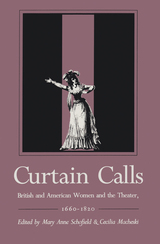
Thus Aphra Behn ushers in a new era for women in the British Theatre (Sir Patient Fancy, 1678). In the hundred years that were to follow—and exactly those years that Curtain Calls examines—women truly took the theater world by storm.
For each woman who chose a career in the theater world of the eighteenth century, there is a unique tale of struggle, insult, success, good or bad fortune, disaster, seduction, or fame. Whether acting, writing, reviewing, or stage managing, women played a major, if frequently unacknowledged, role in the history of the theater from the late seventeenth through the early nineteenth centuries. From Alpha Behn’s earliest plays through the glorious celebrity of Sara Siddons, women molded the taste of the age and carved out in the theater one of the few available opportunities for independence and renown.
Not all the women who tried succeeded, of course, and even the best faced opposition as they challenged the male stronghold of playwriting and theater managing. Curtain Calls maps the new territory as these pioneering women staked it for their own; it chronicles their lives, their triumphs, and their losses.
We begin with Aphra Behn, whose first play was staged in 1670, and conclude in the early decades of the nineteenth century with Inchbald and Siddons. The one hundred and fifty years encompassed by their lives contain the careers of dozens of lesser–known women, a network, as Dr. Johnson would have it, encompassing both talent and tribulation.
Contributors include: Edward Langhans, Linda R. Payne, Pat Rogers, Maureen e. Mulvihill, Deborah Payne, Betty Rizzo, Ellen Donkin, Frances M. Kavenik, Jessica Munns, nancy Cotton, Edna L. Steevs, Doreen Saar, Jean B. Kern, Katherine M. Rogers, Constance Clark, William J. Burling, Judith Phillips Stanton, Douglas Butler, Rose Zimbardo, and the editors.

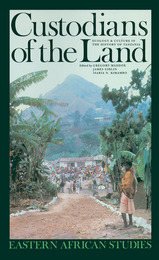
Farming and pastoral societies inhabit ever-changing environments. This relationship between environment and rural culture, politics and economy in Tanzania is the subject of this volume which will be valuable in reopening debates on Tanzanian history.
In his conclusion, Isaria N. Kimambo, a founding father of Tanzanian history, reflects on the efforts of successive historians to strike a balance between external causes of change and local initiative in their interpretations of Tanzanian history.
He shows that nationalist and Marxist historians of Tanzanian history, understandably preoccupied through the first quarter-century of the country's post-colonial history with the impact of imperialism and capitalism on East Africa, tended to overlook the initiatives taken by rural societies to transform themselves.
Yet there is good reason for historians to think about the causes of change and innovation in the rural communities of Tanzania, because farming and pastoral people have constantly changed as they adjusted to shifting environmental conditions.
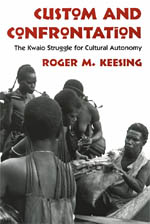
"A major contribution to the ethnography and history of Malaita and Melanesia, and to the growing literature on cultural resistance. But above all, his humane and painful analysis of the meeting of peoples living in different worlds and constructing their agendas and moralities on incommensurate—and apparently equally arbitrary—principles, represents a major contribution and challenge to anthropological thought, addressing the basic issue of what it is to be human."—Fredrik Barth


Originally published in 1989, this ground-breaking ethnographic exploration of tattooing—and the art world surrounding it—covers the history, anthropology and sociology of body modification practices; the occupational experience of the tattooist; the process and social consequences of becoming a tattooed person; and the prospects of "serious" tattooing becoming an accepted art form. Curiously, despite the greater prevalence of tattoos and body modification in today’s society, there is still a stigma of deviance associated with people who get or ink tattoos.
Retaining the core of the original book, this revised and expanded edition offers a new preface by the author and a new chapter focusing on the changes that have occurred in the tattoo world. A section on the new scholarly literature that has emerged, as well as the new modes of body modification that have come into vogue are included along with a new gallery of photographs that shows some splendid examples of contemporary tattoo art. A directory of artists' websites invites readers to discover the range of work being done around the world—from “suits” (full body tattoos) to skulls.
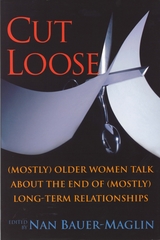
Although breakups—whether celebrity or everyday—are a constant source of fascination, surprisingly little attention has been given to women who are cut loose in their later years. This is a book about (mostly) long-term relationships that have come apart. Each woman involved, the majority of whom are over sixty, tells of her experience through journal entries, essays, poetry, or stories. Although in many senses they have been abandoned, they have also been set free, untethered, and, for some, liberated sexually, mentally, or emotionally.
The book is divided into two major sections. The pieces in the first part are personal narratives. Among the varied voices, we hear from women in both heterosexual and same-sex relationships who have been left by their partners or who have decided to leave them. In the second section, the contributors look at being left and leaving from psychological, sociological, economic, sexual, medical, anthropological, and literary perspectives. Other essays explore the shared experiences of specific classes of women, such as single women, widows, or abandoned daughters.
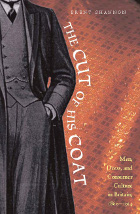
The English middle class in the late nineteenth century enjoyed an increase in the availability and variety of material goods. With that, the visual markers of class membership and manly behavior underwent a radical change. In The Cut of His Coat: Men, Dress, and Consumer Culture in Britain, 1860–1914, Brent Shannon examines familiar novels by authors such as George Eliot, Anthony Trollope, Thomas Hughes, and H. G. Wells, as well as previously unexamined etiquette manuals, period advertisements, and fashion monthlies, to trace how new ideologies emerged as mass-produced clothes, sartorial markers, and consumer culture began to change.
While Victorian literature traditionally portrayed women as having sole control of class representations through dress and manners, Shannon argues that middle-class men participated vigorously in fashion. Public displays of their newly acquired mannerisms, hairstyles, clothing, and consumer goods redefined masculinity and class status for the Victorian era and beyond.
The Cut of His Coat probes the Victorian disavowal of men’s interest in fashion and shopping to recover men’s significant role in the representation of class through self-presentation and consumer practices.
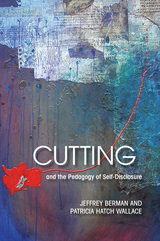
Cutting, a form of self-mutilation, is a growing problem in the United States, especially among adolescent females. It is regarded as self-destructive behavior, yet paradoxically, people who cut themselves generally do not wish to die but to find relief from unbearable psychological pain.
Cutting and the Pedagogy of Self-Disclosure is the first book to explore how college students write about their experiences as cutters. The idea behind the book arose when Patricia Hatch Wallace, a high school English teacher, wrote a reader-response diary for a graduate course taught by Professor Jeffrey Berman in which she revealed for the first time that she had cut herself twenty years earlier. At Berman's suggestion, Wallace wrote her Master's thesis on cutting. Not long after she finished her thesis, two students in Berman's expository writing course revealed their own experiences as cutters. Their disclosures encouraged several students in another writing class to share their own cutting stories with classmates. Realizing that so many students were writing about the same phenomenon, Berman and Wallace decided to write a book about a subject that is rarely discussed inside or outside the classroom.
In Part 1, Wallace discusses clinical and theoretical aspects of cutting and then applies these insights to several memoirs and novels, including Susanna Kaysen's Girl, Interrupted, Caroline Kettlewell's Skin Game, and Patricia McCormick's Cut. The motivation behind Wallace's research was the desire to learn more about herself, and she reads these stories through her own experience as a cutter. In Part 2, Berman focuses on the pedagogical dynamics of cutting: how undergraduate students write about cutting, how their writings affect classmates and teachers, and how students who cut themselves can educate everyone in the classroom about a problem that has personal, psychological, cultural, and educational significance.
"A thoughtful and engaging contribution to the field that will have a sustained and lasting impact on the way feminist performance is defined and understood, as well as on how feminist histories and historiographies continue to challenge and transform the larger field of performance."
---Charlotte Canning, The University of Texas at Austin
"Harding forcefully challenges and destabilizes the male-centered Eurocentric genealogy of the avant-garde, which he claims is an uncontested, linear, positivistic history, unproblematized by theory. Then he argues that this gendered biased version of the European avant-garde is carried over into American historiography . . . A forceful case for a revisionist history."
---Daniel Gerould, The City University of New York Graduate Center
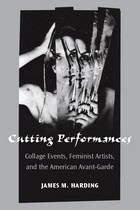
Cutting Performances challenges four decades' worth of scholarship on the American avant-garde by offering a provocative reconceptualization of the history of avant-garde performance along feminist lines. Focusing on five women artists (Elsa von Freytag-Loringhoven, Gertrude Stein, Yoko Ono, Carolee Schneemann, and Valerie Solanas) whose performance aesthetics made prominent use of collage techniques, James M. Harding sheds light on the cultural history of the avant-garde and the role that experimental women artists played in that history. He investigates the prominent position that collage technique occupied within the artists' performance aesthetic, and the decisively feminist inflection that their work gives to collage as a mode of avant-garde expression. The radical juxtapositions in their works produce the powerful effects of making the familiar strange and establishing contexts from which new understandings may emerge.
Harding examines the performative dimensions of collage in experimental, feminist redefinitions of the literary, graphic, and theatrical arts, filling a void in a scholarly discourse that, while ostensibly about the vanguard, has lagged well behind other significant theoretical and historiographical currents. Cutting Performances not only challenges assumptions that have governed scholarship on the American avant-garde but also establishes a context to rethink the history of American avant-garde performance along feminist lines. It will appeal to audiences interested in theater history and performance studies as well as those interested in the cultural history of the avant-garde and the role that feminist experimental artists have played in it.
James M. Harding is Professor of English at the University of Mary Washington. His other books include Not the Other Avant-Garde: Transnational Foundations of Avant-Garde Performance (with John Rouse); Restaging the Sixties: Radical Theaters and Their Legacies (with Cindy Rosenthal); and Contours of the Theatrical Avant-Garde: Performance and Textuality.
Illustration: Carolee Schneemann in Eye Body-36 Transformative Actions (1963) Action for camera (Photograph by Erró). Reproduced by permission of Carolee Schneemann.

In this book, Reed Browning re-creates the life of Denton True "Cyclone" Young and places his story in the context of a rapidly changing turn-of-the-century America. Born in rural Ohio, the son of a Civil War veteran, Young learned his trade at a time when only underhand pitching was permitted. When he began his professional career in 1890, pitchers wore no gloves and stood five feet closer to the batter than they do today. By the time he retired in 1911, the game of baseball had evolved into its modern form and claimed unquestioned status as America's "national pastime."
As Browning shows, Young's extraordinary mastery of his craft owed much to his ability to adapt to the changing nature of the game. Endowed with an exceptional fastball, he gradually developed a wide array of deliveries and pitches—all of which he could throw with astonishing control. Yet his success can also be attributed, at least in part, to the rustic values of loyalty, hard work, and fair play that he embraced and embodied, and for which he became renowned among baseball fans of his day.
Cyber-Proletariat brings Marxist analysis to bear on a range of modern informational technologies. The result is a book indispensable to social theorists and hacktivists alike and essential reading for anyone who wants to understand how Silicon Valley shapes the way we live today.

On the one hand, nation-states as well as their affiliated hacking groups like cyber warriors employ hacking as offensive and defensive tools in connection to the cyber activity or inactivity of other nation-states, such as the role of Russian Trolls disseminating disinformation on social media during the US 2016 presidential election. This is regarded as a horizontal flow of political disruption. Sometimes, nation-states, like the UAE, Saudi Arabia, and Bahrain, use hacking and surveillance tactics as a vertical flow (top-bottom) form of online political disruption by targeting their own citizens due to their oppositional or activists’ political views. On the other hand, regular hackers who are often politically independent practice a form of bottom-top political disruption to address issues related to the internal politics of their respective nation-states such as the case of a number of Iraqi, Saudi, and Algerian hackers. In some cases, other hackers target ordinary citizens to express opposition to their political or ideological views which is regarded as a horizontal form of online political disruption. This book is the first of its kind to shine a light on many ways that governments and hackers are perpetrating cyber attacks in the Middle East and beyond, and to show the ripple effect of these attacks.
Through original analyses of national-level surveys and in-depth interviews with residents of Chicago, Krysan and Crowder find that residential stratification is reinforced through the biases and blind spots that individuals exhibit in their searches for housing. People rely heavily on information from friends, family, and coworkers when choosing where to live. Because these social networks tend to be racially homogenous, people are likely to receive information primarily from members of their own racial group and move to neighborhoods that are also dominated by their group. Similarly, home-seekers who report wanting to stay close to family members can end up in segregated destinations because their relatives live in those neighborhoods. The authors suggest that even absent of family ties, people gravitate toward neighborhoods that are familiar to them through their past experiences, including where they have previously lived, and where they work, shop, and spend time. Because historical segregation has shaped so many of these experiences, even these seemingly race-neutral decisions help reinforce the cycle of residential stratification. As a result, segregation has declined much more slowly than many social scientists have expected.
To overcome this cycle, Krysan and Crowder advocate multi-level policy solutions that pair inclusionary zoning and affordable housing with education and public relations campaigns that emphasize neighborhood diversity and high-opportunity areas. They argue that together, such programs can expand the number of destinations available to low-income residents and help offset the negative images many people hold about certain neighborhoods or help introduce them to places they had never considered. Cycle of Segregation demonstrates why a nuanced understanding of everyday social processes is critical for interrupting entrenched patterns of residential segregation.
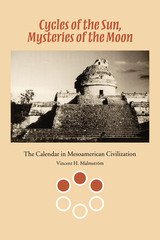
The simple question "How did the Maya come up with a calendar that had only 260 days?" led Vincent Malmström to discover an unexpected "hearth" of Mesoamerican culture. In this boldly revisionist book, he sets forth his challenging, new view of the origin and diffusion of Mesoamerican calendrical systems—the intellectual achievement that gave rise to Mesoamerican civilization and culture.
Malmström posits that the 260-day calendar marked the interval between passages of the sun at its zenith over Izapa, an ancient ceremonial center in the Soconusco region of Mexico's Pacific coastal plain. He goes on to show how the calendar developed by the Zoque people of the region in the fourteenth century B.C. gradually diffused through Mesoamerica into the so-called "Olmec metropolitan area" of the Gulf coast and beyond to the Maya in the east and to the plateau of Mexico in the west.
These findings challenge our previous understanding of the origin and diffusion of Mesoamerican civilization. Sure to provoke lively debate in many quarters, this book will be important reading for all students of ancient Mesoamerica—anthropologists, archaeologists, archaeoastronomers, geographers, and the growing public fascinated by all things Maya.
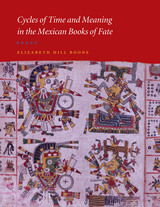
In communities throughout precontact Mesoamerica, calendar priests and diviners relied on pictographic almanacs to predict the fate of newborns, to guide people in choosing marriage partners and auspicious wedding dates, to know when to plant and harvest crops, and to be successful in many of life's activities. As the Spanish colonized Mesoamerica in the sixteenth century, they made a determined effort to destroy these books, in which the Aztec and neighboring peoples recorded their understanding of the invisible world of the sacred calendar and the cosmic forces and supernaturals that adhered to time. Today, only a few of these divinatory codices survive. Visually complex, esoteric, and strikingly beautiful, painted books such as the famous Codex Borgia and Codex Borbonicus still serve as portals into the ancient Mexican calendrical systems and the cycles of time and meaning they encode.
In this comprehensive study, Elizabeth Hill Boone analyzes the entire extant corpus of Mexican divinatory codices and offers a masterful explanation of the genre as a whole. She introduces the sacred, divinatory calendar and the calendar priests and diviners who owned and used the books. Boone then explains the graphic vocabulary of the calendar and its prophetic forces and describes the organizing principles that structure the codices. She shows how they form almanacs that either offer general purpose guidance or focus topically on specific aspects of life, such as birth, marriage, agriculture and rain, travel, and the forces of the planet Venus. Boone also tackles two major areas of controversy—the great narrative passage in the Codex Borgia, which she freshly interprets as a cosmic narrative of creation, and the disputed origins of the codices, which, she argues, grew out of a single religious and divinatory system.
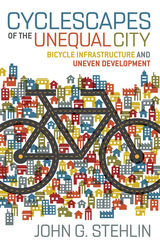
A critical look at the political economy of urban bicycle infrastructure in the United States
Not long ago, bicycling in the city was considered a radical statement or a last resort, and few cyclists braved the inhospitable streets of most American cities. Today, however, the urban cyclist represents progress and the urban “renaissance.” City leaders now undertake ambitious new bicycle infrastructure plans and bike share schemes to promote the environmental, social, and economic health of the city and its residents. Cyclescapes of the Unequal City contextualizes and critically examines this new wave of bicycling in American cities, exploring how bicycle infrastructure planning has become a key symbol of—and site of conflict over—uneven urban development.
John G. Stehlin traces bicycling’s rise in popularity as a key policy solution for American cities facing the environmental, economic, and social contradictions of the previous century of sprawl. Using in-depth case studies from San Francisco, Philadelphia, and Detroit, he argues that the mission of bicycle advocacy has converged with, and reshaped, the urban growth machine around a model of livable, environmentally friendly, and innovation-based urban capitalism. While advocates envision a more sustainable city for all, the deployment of bicycle infrastructure within the framework of the neoliberal city in many ways intensifies divisions along lines of race, class, and space.
Cyclescapes of the Unequal City speaks to a growing interest in bicycling as an urban economic and environmental strategy, its role in the politics of gentrification, and efforts to build more diverse coalitions of bicycle advocates. Grounding its analysis in both regional political economy and neighborhood-based ethnography, this book ultimately uses the bicycle as a lens to view major shifts in today’s American city.
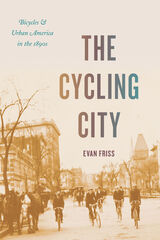
The Cycling City is a sharp history of the bicycle’s rise and fall in the late nineteenth century. In the 1890s, American cities were home to more cyclists, more cycling infrastructure, more bicycle friendly legislation, and a richer cycling culture than anywhere else in the world. Evan Friss unearths the hidden history of the cycling city, demonstrating that diverse groups of cyclists managed to remap cities with new roads, paths, and laws, challenge social conventions, and even dream up a new urban ideal inspired by the bicycle. When cities were chaotic and filthy, bicycle advocates imagined an improved landscape in which pollution was negligible, transportation was silent and rapid, leisure spaces were democratic, and the divisions between city and country were blurred. Friss argues that when the utopian vision of a cycling city faded by the turn of the century, its death paved the way for today’s car-centric cities—and ended the prospect of a true American cycling city ever being built.
Cycling has experienced a renaissance in the United States, as cities around the country promote the bicycle as an alternative means of transportation. In the process, debates about the nature of bicycles—where they belong, how they should be ridden, how cities should or should not accommodate them—have played out in the media, on city streets, and in city halls. Very few people recognize, however, that these questions are more than a century old.
The Cycling City is a sharp history of the bicycle’s rise and fall in the late nineteenth century. In the 1890s, American cities were home to more cyclists, more cycling infrastructure, more bicycle friendly legislation, and a richer cycling culture than anywhere else in the world. Evan Friss unearths the hidden history of the cycling city, demonstrating that diverse groups of cyclists managed to remap cities with new roads, paths, and laws, challenge social conventions, and even dream up a new urban ideal inspired by the bicycle. When cities were chaotic and filthy, bicycle advocates imagined an improved landscape in which pollution was negligible, transportation was silent and rapid, leisure spaces were democratic, and the divisions between city and country were blurred. Friss argues that when the utopian vision of a cycling city faded by the turn of the century, its death paved the way for today’s car-centric cities—and ended the prospect of a true American cycling city ever being built.
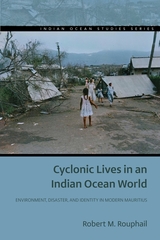
Disasters as historical processes shaping identity, governance, and diasporic memory in colonial and postcolonial Mauritius
In a world marked by increasingly destructive ecological and meteorological upheavals, Cyclonic Lives in an Indian Ocean World offers a historical analysis of how these catastrophes shape people’s understanding of themselves, their collective history, and their relationship to the institutions that govern them. An examination of cyclonic disasters in the multiethnic Indian Ocean island of Mauritius throws into stark relief how deep histories of diasporic identity formation, of imperial governance, and of the informal practices of racial difference making graft onto how everyday people interpret these moments of loss and the futures that emerge in their wake.
Cyclonic Lives shows that disasters are not only events; they are also processes through which people evaluate and rethink the most elemental social and cultural categories that give meaning to their lives. Beginning in the late nineteenth century and continuing until the early postcolonial era, this book tracks, for example, how Mauritians of African descent integrated these disasters into broader collective histories and memories of the Indian Ocean slave trade, how Hindu Indo-Mauritians understood cyclones’ ecological effects as material elements to be accounted for in a broader Hindu diasporic space, and how the late colonial and early postcolonial state built infrastructures—material, conceptual, and financial—to mitigate the threats posed by these storms and ensure their own long-term durability.
The increasing political, social, and economic instability that climate change has already triggered demands that humanists develop analytical geographies and methodologies that shed light on how power can modulate in asymmetrical ways at moments of crisis. If there is one central takeaway from this historical study of this small island in a big ocean, it is that catastrophic events are not things that merely happen to people; they are processes that remake them.
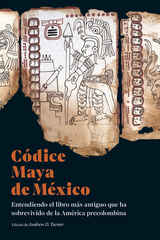
Los antiguos escribas mayas registraban profecías y observaciones astronómicas en las páginas de libros pintados. Aunque la mayoría se perdieron por el desgaste del paso del tiempo o porque fueron destruidos, se sabía que tres códices mayas prehispánicos habían sobrevivido. Sin embargo, en la década de 1960 apareció en México, en circunstancias misteriosas, un cuarto libro diferente a los demás. Después de cincuenta años de debate sobre su autenticidad, investigaciones recientes con análisis científicos e histórico-artísticos de vanguardia, determinaron que el Códice Maya de México (antes conocido como Códice Grolier) es, de hecho, el libro más antiguo del continente americano: al menos doscientos años más antiguo que los demás.
Este volumen ofrece una introducción multifacética a la creación, el descubrimiento, la interpretación y la autenticación científica del Códice Maya de México. Además, un facsímil a todo color y una guía de la iconografía página por página hacen que un amplio público pueda acceder al códice. Otros temas incluyen los usos y la importancia de los libros sagrados en Mesoamérica, el papel de la astronomía en las antiguas sociedades mayas y la continua relevancia del códice para las comunidades mayas contemporáneas.
La publicación de este volumen acompaña la exposición que se exhibirá en el J. Paul Getty Museum ubicado en el Getty Center del 18 de octubre de 2022 al 15 de enero de 2023.
An in-depth exploration of the history, authentication, and modern relevance of Códice Maya de México, the oldest surviving book of the Americas.
Ancient Maya scribes recorded prophecies and astronomical observations on the pages of painted books. Although most were lost to decay or destruction, three pre-Hispanic Maya codices were known to have survived, when, in the 1960s, a fourth book that differed from the others appeared in Mexico under mysterious circumstances. After fifty years of debate over its authenticity, recent investigations using cutting-edge scientific and art historical analyses determined that Códice Maya de México (formerly known as Grolier Codex) is in fact the oldest surviving book of the Americas, predating all others by at least two hundred years.
This volume provides a multifaceted introduction to the creation, discovery, interpretation, and scientific authentication of Códice Maya de México. In addition, a full-color facsimile and a page-by-page guide to the iconography make the codex accessible to a wide audience. Additional topics include the uses and importance of sacred books in Mesoamerica, the role of astronomy in ancient Maya societies, and the codex's continued relevance to contemporary Maya communities.
This volume is published to accompany an exhibition on view at the J. Paul Getty Museum at the Getty Center from October 18, 2022, to January 15, 2023.
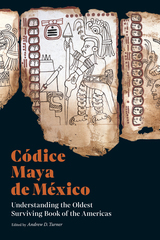
Ancient Maya scribes recorded prophecies and astronomical observations on the pages of painted books. Although most were lost to decay or destruction, three pre-Hispanic Maya codices were known to have survived, when, in the 1960s, a fourth book that differed from the others appeared in Mexico under mysterious circumstances. After fifty years of debate over its authenticity, recent investigations using cutting-edge scientific and art historical analyses determined that Códice Maya de México (formerly known as Grolier Codex) is in fact the oldest surviving book of the Americas, predating all others by at least two hundred years.
This volume provides a multifaceted introduction to the creation, discovery, interpretation, and scientific authentication of Códice Maya de México. In addition, a full-color facsimile and a page-by-page guide to the iconography make the codex accessible to a wide audience. Additional topics include the uses and importance of sacred books in Mesoamerica, the role of astronomy in ancient Maya societies, and the codex's continued relevance to contemporary Maya communities.
This volume is published to accompany an exhibition on view at the J. Paul Getty Museum at the Getty Center from October 18, 2022, to January 15, 2023.
READERS
Browse our collection.
PUBLISHERS
See BiblioVault's publisher services.
STUDENT SERVICES
Files for college accessibility offices.
RECENTLY PUBLISHED




UChicago Accessibility Resources
home | accessibility | search | about | contact us
BiblioVault ® 2001 - 2025
The University of Chicago Press