
 A SCHOLARLY BOOK REPOSITORY
34 start with C start with C
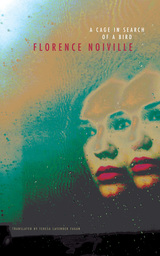
Laura Wilmote is a television journalist living in Paris. Her life couldn’t be better—a stimulating job, a loving boyfriend, interesting friends—until her phone rings in the middle of one night. It is C., an old school friend whom Laura recently helped find a job at the same television station: “My phone rang. I knew right away it was you.”
Thus begins the story of C.’s unrelenting, obsessive, incurable love/hatred of Laura. She is convinced that Laura shares her love, but cannot—or will not—admit it. C. begins to dress as Laura, to make her friends and family her own, and even succeeds in working alongside Laura on the unique program that is Laura’s signature achievement. The obsession escalates, yet is artfully hidden. It is Laura who is perceived as the aggressor at work, Laura who appears unwell, Laura who is losing it. Even Laura’s adoring boyfriend begins to question her. Laura seeks the counsel of a psychiatrist who diagnoses C. with De Clérambault syndrome—she is convinced that Laura is in love with her. And worse, the syndrome can only end in one of two ways: the death of the patient, or that of the object of the obsession.
A Cage in Search of a Bird is the gripping story of two women caught in the vise of a terrible delusion. Florence Noiville brilliantly narrates this story of obsession and one woman’s attempts to escape the irrational love of another—an inescapable, never-ending love, a love that can only end badly.
Friederike Mayröcker has no time. Not for summary and memory, not for excessive reviewing and reasoning, and certainly not for storytelling. She doesn’t even have time for life itself—unless it’s writing. What counts, in her view, is only the poetry and “the echoic inventions” of a life that lasted for almost a century, which is preserved in her writings.
Widely considered one of the most important European poets of the twentieth and twenty-first centuries, Mayröcker passed away in 2021 at the age of ninety-six. On the outside, her life may be subject to the impertinence of the finitude of all human existence. But on the inside, and in its transformation into the eternal moment, life only becomes richer and richer in forms of experience. In radically concentrated language and compellingly beautiful images, Mayröcker presents in this cahier a life that follows only one maxim: “Not just what is written, but existence, too, must be poetic.”

The sixty-four poems in A Calligraphy of Days reflect Krzysztof Siwczyk’s wide-ranging and variegated style. Born in 1977, Siwczyk has lived most of his life in the Silesian city of Gliwice. In 1995, he became a wunderkind of the Polish poetry scene with his debut volume Wild Kids, an edgy and unsentimental narrative of youthful tribulations and urban malaise during Poland’s transition from communism to capitalism. Siwczyk’s poems careen down the page at great speed, relying on clever turns of phrase or an idea that illuminates a larger meaning. As in calligraphy, a meandering subterranean process connects meaning and memory, thought and verse. Teased to the surface, words and images emerge in rapid, terse, and precise bursts.
Throughout his career, Siwczyk has never ceased to challenge our sense of who we are—changing course multiple times in the process. Following several volumes full of expansive lines, his most recent works offer spare meditations on illness and grief. Clipped and understated, these post-Holocaust poems address our inability to speak of death and tragedy.
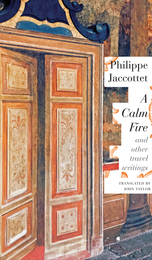
Ultimately, whether in his native Swiss Alps or among the cedars of Lebanon, the same question pervades Philippe Jaccottet’s work: How should we live? More than a simple palliative to a depressing news cycle, Calm Fire captures a true sense of place by celebrating and pondering ways of life through the immersive experience of travel.
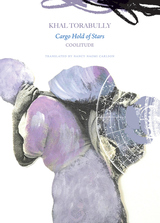
An arresting, musical ode to the forgotten voyages and resilient identities of indentured peoples.
Cargo Hold of Stars gives voice to the millions of indentured men and women, mostly from India and China, who were brought to Mauritius between 1849 and 1923. Kept in close quarters in the ship’s cargo hold, many died; most never returned home. Here, Khal Torabully introduces the concept of “Coolitude,” echoing Aimé Césaire’s “Negritude” to imbue the term with profound dignity, pride, and a resilient cultural identity. Stating that ordinary language could not capture these diverse voices, Torabully develops a new “poetics of Coolitude”: a French peppered with Mauritian Creole, brilliant wordplay, and neologisms.
The humor in these linguistic acrobatics only underscores the violence in which these poems are steeped. Deftly translated by Nancy Naomi Carlson, Cargo Hold of Stars is the song of an uprooting, destruction, and reconstruction. Yet it also celebrates setting down roots, conjuring an ideal homeland of fraternity and reconciliation in which bodies, memories, and languages mingle—a compelling odyssey defining the essence of humankind.
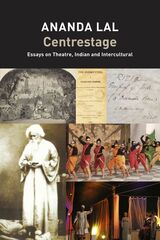
In Centrestage, theater scholar Ananda Lal presents a compelling collection of essays encompassing over thirty years of research, reflection, and firsthand engagement with performance. From the emergence of Indian drama in English in the mid-nineteenth century to the diverse and sometimes contentious plays of the twenty-first century, Lal explores a two-hundred-year trajectory of Indian and intercultural theater with clarity and insight. The first part of the volume examines Indian theater history, proceeding from the colonial era to the contemporary scene in Kolkata and current theater pedagogy in India. The second part delves into the provocative world of intercultural theater, interrogating global academic representations of Indian performance and the work of such celebrated directors as Peter Brook and Tim Supple.
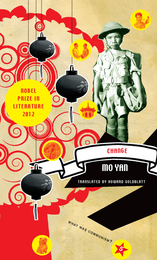
In Change, Mo Yan, the 2012 Nobel Laureate in Literature, personalizes the political and social changes in his country over the past few decades in this novella disguised as autobiography—or vice-versa. Unlike most historical narratives from China, which are pegged to political events, Change is a representative of “people’s history,” a bottom-up rather than top-down view of a country in flux. By moving back and forth in time and focusing on small events and everyday people, Mo Yan breathes life into history by describing the effects of larger-than-life events on the average citizen.
“Through a mixture of fantasy and reality, historical and social perspectives, Mo Yan has created a world reminiscent in its complexity of those in the writings of William Faulkner and Gabriel García Márquez, at the same time finding a departure point in old Chinese literature and in oral tradition.”— Nobel Committee for Literature

As the last great female impersonator of Bengali theater, Chapal Bhaduri—known as Chapal Rani—once held audiences spellbound in the jatra tradition, where men became goddesses and heroines. But when women finally took their place on stage, Chapal found himself exiled from the world he had ruled. In this groundbreaking biography, Sandip Roy captures the rise and fall of a performer whose art was inseparable from his identity.
Told in Chapal’s own voice and interwoven with evocative fictional vignettes, Chapal Rani, the Last Queen of Bengal brings to life Kolkata’s golden age of theater and the resilience of a man who refused to disappear. Through decades of research and deeply personal interviews, Roy crafts a moving portrait of gender and belonging.
Previously available only in India, this hugely successful novel was adapted into a film, winning great critical acclaim and commercial success. Anita Nair’s evocative translation from Malayalam brings this tale of love and longing, a classic of Indian literature, to a new audience.
Ariel Magnus leaves no stone unturned in his efforts to learn more about his grandfather and the country to which he emigrated in the 1930s. Chess with My Grandfather is a playful, genre-shifting novel combining tales of international espionage, documentary evidence, and family lore. In this extraordinary book, Magnus blends fact and fiction in a delirious exploration of a dark period of history, family, identity, the power of art and literature and, of course, the fascinating world of chess.
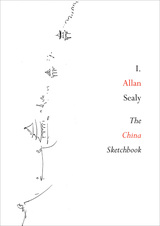
Sealy is known for both his fiction and his travelogue From Yukon to Yukatan: A Western Journey. This facsimile edition of The China Sketchbook, however, adds a special dimension to a travel narrative—the sketches and scribbles give readers a more immediate and unrestrained insight into the mind of a very fine writer and chart an unusual and quirky travel diary.
What happens when a passage from the world of light to the world of darkness opens onto a new chapter of life? A retrospective account of a pioneering Indian artist who continued to paint after losing his eyesight.
Benode Behari Mukherjee (1904–1980) was one of the most influential and highly regarded artists in the history of modern Indian art. Chitrakar brings together four broadly autobiographical pieces written by Benode Behari after he lost his eyesight in the summer of 1957. The Artist is a selective reminiscence recapturing various pictures from the years of his childhood, apprenticeship, and maturity, up to the time he became blind. Master of the Household is a candid and complex fictionalized account of his struggle to come to terms with his blindness and continue making art. The Creator is a simple, but telling, parable about the vanity of inordinate ambition. Finally, Art Quest outlines his philosophy of art and the basic elements of his work.
In the sensitive and empathetic hands of K. G. Subramanyan, once his student and later himself a major figure in the Indian art scene, this translation, appearing for the first time in English, is a precious and timeless document.
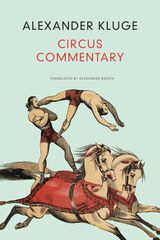
The circus has fascinated Alexander Kluge ever since he was a child, and his devotion to it has been preserved throughout his cinematic output and his most recent literary work. In the circus, he finds both the shadow image of work and the epitome of human excellence, from love to war to revolution. As surfaces onto which utopias are projected, these elaborate performances offer a tangible representation of developments within civilization, with its nearly infinite possibilities and sometimes inevitable crashes—from the excited roar of the crowd to death on the floor of the ring.
In Circus Commentary, Kluge’s montage of modernities moves back and forth through time and space, expressing his unique mix of fictional and non-fictional reports, histories, and stories through semantic fields, images, and film sequences inserted in the book via QR codes. We encounter a broad panorama of perplexed artists and sophisticated surgeons cavorting alongside fighter pilots, sans-culottes drunk with dreams of omnipotence, and, most importantly, animals—to whose superhuman performances, this book creates a lasting memorial.
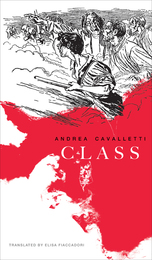
Class, by Andrea Cavalletti, is a striking montage of diverse materials—Marx and Jules Verne, Benjamin and Gabriel Tarde. In it, Cavalletti asks whether the untimely concept of class is once again thinkable. Faced with new pogroms and state racism, he challenges us to imagine a movement that would unsettle and eventually destroy the crowd.
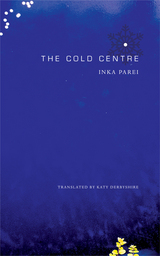
Written in Parei’s characteristically precise prose, The Cold Centre is a timely reminder of how we react to accidents—nuclear and otherwise— and a bleakly realistic description of East Berlin before the Wall fell. Its tight and dizzying structure keeps readers on the edge of their seats as the narrator tries to solve his mystery.
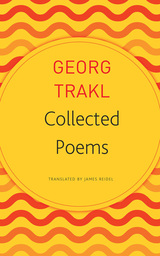
In a refreshing contrast to previous translated collections of Trakl’s work, James Reidel is mindful of how the poet himself wished to be read, emphasizing the order and content of the verses to achieve a musical effect. Trakl’s verses were also marked by allegiance to both the nineteenth and twentieth centuries, a fact which Reidel honors with impressive research into the historicity of the poet’s language.
Collected Poems gathers Trakl’s early, middle, and late work, ranging widely, from his haunting prose pieces to his darkly beautiful poems documenting the first bloody weeks of World War I on the Eastern Front.
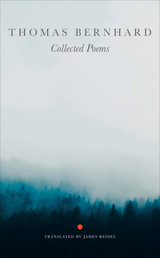
Beloved Austrian writer Thomas Bernhard (1931–89) began his career in the early 1950s as a poet. Over the next decade, Bernhard wrote thousands of poems and published four volumes of intensely wrought and increasingly personal verse, with such titles as On Earth and in Hell, In Hora Mortis, and Under the Iron of the Moon. Bernhard’s early poetry, bearing the influence of Georg Trakl, begins with a deep connection to his Austrian homeland. As his poems saw publication and recognition, Bernhard seemed always on the verge of joining the ranks of Ingeborg Bachmann, Paul Celan, and other young post-war poets writing in German. During this time, however, his poems became increasingly more obsessive, filled with undulant self-pity, counterpointed by a defamatory, bardic voice utterly estranged from his country, all of which resulted in a magisterial work of anti-poetry—one that represents Bernhard’s own harrowing experience with his leitmotif of success and failure, which makes his fiction such a pleasure. There is much to be found in these pages for Bernhard fans of every stripe.
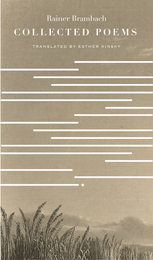
Marked by his disregard for material values, a profound engagement with the landscape of the Upper Rhine, and a lasting commitment to humanity, Brambach’s poems are direct, unadorned, and free of pomp or ideology. His quiet images conjure up landscapes, small rural scenes, and interiors of bars and cafes. Brambach was, above all, an observer whose poems provide insights of deceptive simplicity that form a poetic essence confirming the significance of this author’s voice. This collection of poems, masterfully translated by noted writer and poet Esther Kinsky, represents the first major English translation of a significant European poet.
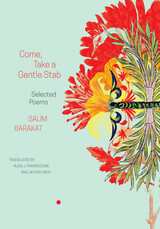
Although Salim Barakat is one of the most renowned and respected contemporary writers in Arabic letters, he remains virtually unknown in the English-speaking world. This first collection of his poetry in English, representing every stage of his career, remedies that startling omission. Come, Take a Gentle Stab features selections from his most acclaimed works of poetry, including excerpts from his book-length poems, rendered into an English that captures the exultation of language for which he is famous.
A Kurdish-Syrian man, Barakat chose to write in Arabic, the language of cultural and political hegemony that has marginalized his people. Like Paul Celan, he mastered the language of the oppressor to such an extent that the course of the language itself has been compelled to bend to his will. Barakat pushes Arabic to a point just beyond its linguistic limits, stretching those limits. He resists coherence, but never destroys it, pulling back before the final blow. What results is a figurative abstraction of struggle, as alive as the struggle itself. And always beneath the surface of this roiling water one can glimpse the deep currents of ancient Kurdish culture.
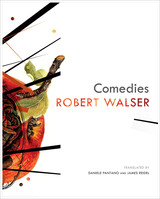
Few writers have ever experienced such a steady rise in their reputation and public profile as Swiss writer Robert Walser (1878–1956) has seen in recent years. As more of his previously little-known work has been translated into English, readers have discovered a unique writer whose off-kilter sensibility and innovations in form are perfectly suited to our fragmented, distracted, bewildering era.
The short plays presented here, inspired by the German theater Walser enjoyed in his youth, while never meant to be performed, present scenes, characters, and situations that comment on the brutality of fairy tales, the impossibilities of love, the dark fate of the Christ child (and Walser himself), and more. At the same time, like all of Walser’s work they are shot through with a humor that is wholly genuine despite its shades of darkness. Gathering all of Walser’s plays, as well as his later, fragmentary dramatic writings, Comedies will be celebrated by the many devoted fans of this lately rediscovered master.
Born to Chinese-Cambodian parents in France, Jean-Baptiste Phou has pursued a diverse artistic career since 2008. Through his public views and artistic works, he has focused mainly on the experiences of Asians in France. Up until now, he’s always been careful not to raise issues of sexuality—in particular, his homosexuality.
In this searing memoir, Phou faces his fears and shame to examine the role his ethnic origin has played in the construction of his sexual identity and his romantic relationships in a predominantly white environment. An astute observer of the various ways in which his body has been perceived, Phou explores how these perceptions have shaped his relationship with himself and others. How does a marginalized person develop emotionally and build, reclaim, and express their sexuality? Drawing on various works of history, sociology, gender studies, literature, and popular culture, Phou sensitively examines various strategies developed in response to this question.
Being gay in a largely straight world is difficult but being Asian within this sexual minority can be a doubly oppressive experience. Coming Out of My Skin deftly tackles this challenge and aspires for a reconciliation that can empower people of sexual and racial minorities to joyfully inhabit their bodies.
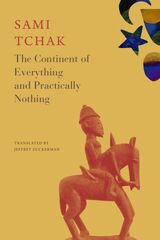
A Togolese novel that delivers a rich, intimate portrait of a scholar whose life is inextricably bound to Africa.
For the French ethnologist Maurice Boyer, Africa isn't just a place; it’s a mirage, an enigma, a mirror reflecting his desires and doubts. The fieldwork he undertook in Tèdi, Togo, where he lived for years among the Tem people and tried to understand their customs and rituals, has left him with questions that have lingered: Who was a friend and who was a foe? Which stories were true and which were illusions? As decades pass and the roles of Aurélie, his wife, and Safi, his former student, begin to shift, Boyer finds himself wrestling not only with his own choices but with the legacy of knowledge itself.
Through the lens of this profound postcolonial quest, Sami Tchak explores Africa’s rich, complex reality through this intimate story of a scholar reconsidering his own understanding of culture, ethnology, and history. The Continent of Everything and Practically Nothing asks whether assembling more data can truly capture the complexity of a continent, and explores how academic ambition, history, and emotion shape how we understand the world, and how we live in it.
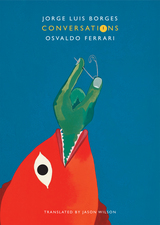
The Argentine short-story writer, essayist, poet and translator, contributed immensely to twentieth-century literature, and more specifically to the genres of magical realism and fantasy. As he progressively lost his sight—he became completely blind by the age of fifty-five—the darkness behind his eyelids held enchanting imagery that translated into rich symbolism in his work. The inner workings of his curious mind are seen vividly in his conversations with Ferrari, and there’s not a subject on which he doesn’t cast surprising new light. As in his tale “The Other,” where two Borgeses meet up on a bench beside the River Charles, this is a dialogue between a young poet and the elder teller of tales where all experience floats in a miracle that defies linear time.
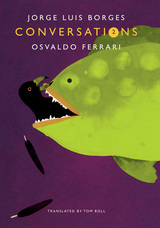
In Conversations: Volume 2, Borges and Ferrari engage in a dialogue that is both improvisational and frequently humorous as they touch on subjects as diverse as epic poetry, detective fiction, Buddhism, and the moon landing. With his signature wit, Borges offers insight into the philosophical basis of his stories and poems, his fascination with religious mysticism, and the idea of life as a dream. He also dwells on more personal themes, including the influence of his mother and father on his intellectual development, his friendships, and living with blindness. These recollections are alive to the passage of history, whether in the changing landscape of Buenos Aires or a succession of political conflicts, leading Borges to contemplate what he describes as his “South American destiny.”
The recurrent theme of these conversations, however, is a life lived through books. Borges draws on the resources of a mental library that embraces world literature—ancient and modern. He recalls the works that were a constant presence in his memory and maps his changing attitudes to a highly personal canon. In the prologue to the volume, Borges celebrates dialogue and the transmission of culture across time and place. These conversations are a testimony to the supple ways that Borges explored his own relation to numerous traditions.
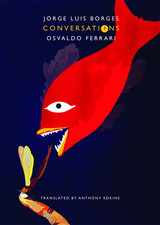
In Conversations: Volume 3, Borges and Ferrari discuss subjects as diverse as film criticism, fantastic literature, science fiction, the Argentinian literary tradition, and the works of writers such as Bunyan, Wilde, Joyce, and Yeats, among others. With his signature wit, Borges converses on the philosophical basis of his writing, his travels, and his fascination with religious mysticism. He also ruminates on more personal themes, including the influence of his family on his intellectual development, his friendships, and living with blindness.
The recurrent theme of these conversations, however, is a life lived through books. Borges draws on the resources of a mental library that embraces world literature, both ancient and modern. He recalls the works that were a constant presence in his memory and maps his changing attitudes to a highly personal canon. These conversations are a testimony to the supple ways that Borges explored his own relation to numerous traditions—the conjunction of his life, his lucidity, and his imagination.
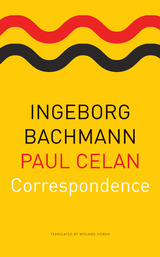
Collected here for the first time in English are their letters written between 1948 and 1961. Their correspondence forms a moving testimony of the discourse of love in the age after Auschwitz, with all the symptomatic disturbances and crises caused by their conflicting backgrounds and their hard-to-reconcile designs for living—as a woman, as a man, as writers. In addition to the almost 200 letters, the volume includes an important exchange between Bachmann and Gisèle Celan-Lestrange, who married Celan in 1951, as well as the letters between Paul Celan and Swiss writer Max Frisch.
“Scarcely more breathlessly and desperately can two lovers ever have struggled for words. Little known among German literary historians, the relationship between these two poets amounts to one of the most dramatic and momentous occurrences in German literature.”—FAZ, on the German edition
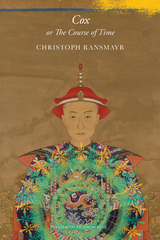
The world’s most powerful man, Qiánlóng, emperor of China, invites the famous eighteenth-century clockmaker Alister Cox to his court in Beijing. There, in the heart of the Forbidden City, the Englishman and his assistants are to build machines that mark the passing of time as a child or a condemned man might experience it and that capture the many shades of happiness, suffering, love, and loss that come with that passing.
Mystified by the rituals of a rigidly hierarchical society dominated by an unimaginably wealthy, god-like ruler, Cox musters all his expertise and ingenuity to satisfy the emperor’s desires. Finally, Qiánlóng, also known by the moniker Lord of Time, requests the construction of a clock capable of measuring eternity—a perpetuum mobile. Seizing this chance to realize a long-held dream and honor the memory of his late beloved daughter, yet conscious of the impossibility of his task, Cox sets to work. As the court is suspended in a never-ending summer, festering with evil gossip about the monster these foreigners are creating, the Englishmen wonder if they will ever escape from their gilded cage. More than a meeting of two men, one isolated by power, the other by grief, this is an exploration of mortality and a virtuoso demonstration that storytelling alone can truly conquer time.
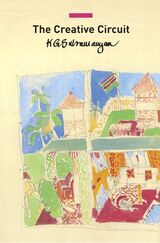
What conception does a modern artist or critic have of contemporary art activity? How do modern artists react to their environment and cultural inheritance? And what general norms of achievement can we think of in the highly heterogeneous art scene of today? In Creative Circuit, K. G. Subramanyan, one of India's most celebrated artists, draws upon his considerable experience as a practicing artist and theoretician to engage with these concerns from a modern Indian perspective.
Through a series of five lectures, Subramanyan critically examines key concepts such as modernity, eclecticism, and nostalgia, which have become integral to contemporary art discourse. He provocatively questions the perceptions, illusions, and emotional motivations driving artistic expression in today's heterogeneous art scene, prompting readers to reconsider established norms of achievement in the context of evolving artistic practices. With over one hundred color illustrations complementing Subramanyan's insightful discourse, Creative Circuit offers a visually engaging exploration of the interplay between tradition and innovation in contemporary art.
Subramanyan played a pivotal role in shaping India’s artistic identity after Independence. Mani-da, as he was fondly called, seamlessly blended elements of modernism with folk expression in his works, spanning paintings, murals, sculptures, prints, set designs, and toys. Beyond his visual artistry, his writings have laid a solid foundation for understanding the demands of art on the individual. In the year of his centenary, Seagull is proud to publish his writings in special new editions.
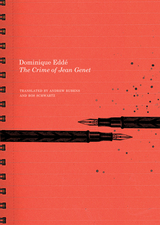
Dominique Eddé met novelist and playwright Jean Genet in the 1970s. And she never forgot him. “His presence,” she writes, “gave me the sensation of icy fire. Like his words, his gestures were full, calculated, and precise. . . . Genet’s movements mimicked the movement of time, accumulating rather than passing.”
This book is Eddé’s account of that meeting and its ripples through her years of engaging with Genet’s life and work. Rooted in personal reminiscences, it is nonetheless much broader, offering a subtle analysis of Genet’s work and teasing out largely unconsidered themes, like the absence of the father, which becomes a metaphor for Genet’s perpetual attack on the law. Tying Genet to Dostoevsky through their shared fascination with crime, Eddé helps us more clearly understand Genet’s relationship to France and Palestine, Judaism, Christianity, Islam, the theater, and even death. A powerful personal account of the influence of one writer on another, The Crime of Jean Genet is also one of the most penetrating explorations yet of Genet’s work and achievement.
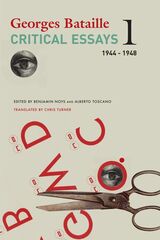
In the aftermath of the Second World War, French thinker and writer Georges Bataille forged a singular path through the moral and political impasses of his age. In 1946, animated by “a need to live events in an increasingly conscious way,” and to reject any compartmentalization of intellectual life, Bataille founded the journal Critique. Adopting the format of the review essay, he surveyed the post-war cultural landscape while advancing his reflections on excess, non-knowledge, and the general economy. Focusing on literature as a mode of sovereign uselessness, he tackled prominent and divisive figures such as Henry Miller and Albert Camus.
In keeping with Critique’s mission to explore the totality of human knowledge, Bataille’s articles did not just focus on the literary but featured important reflections on the science of sexuality, the Chinese Revolution, and historical accounts of drunkenness, among other matters. Throughout, he was attuned to how humanity would deal with the excessive forces of production and destruction it had unleashed, his aim being a way of thinking and living that would inhabit that excess.
This is the first of three volumes collecting Bataille’s post-war essays. Beginning with an article on Nietzsche and fascism written shortly after the liberation of Paris and running to the end of 1948, these texts make available for the first time in English the systematic diversity of Bataille’s post-war thought.
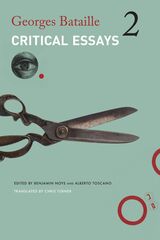
In the aftermath of World War II, French thinker and writer Georges Bataille forged a singular path through the moral and political impasses of his age. In 1946, animated by “a need to live events in an increasingly conscious way,” and to reject any compartmentalization of intellectual life, Bataille founded the journal Critique. Continuing the publication of his postwar writings, this second book in a three-volume collection of Bataille’s work collects his essays and reviews from the years 1949 to 1951.
In this period of intellectual isolation and intense reflection, Bataille developed and refined his genealogy of morality through a sustained reflection on the fate of the sacred in the modern world. He offered a critique of the limits of existing morality, especially in its denial of excess, while sketching the lineaments of a new hyper-morality. Bataille’s wide-ranging reflections are true to the intellectual mission of Critique, which he founded as a space open to the broadest considerations of the present. As well as discussing significant figures like Samuel Beckett, André Gide, and René Char, Bataille also offers fascinating reflections on American politics, Nazism, existentialism, materialism, and play.
The connecting thread in these diverse essays remains Bataille’s concern with the extremes of human experience and the possibilities of transcending the limits of societies founded on utility and restraint. His writings remain a provocative incitement to rethink the boundaries we impose on expression and existence.
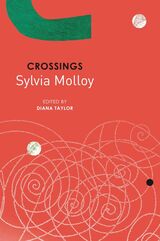
In Crossings, Sylvia Molloy embarks on an evocative exploration of the intricate and profound experience of living between languages, cultures, and geographies. A pioneering Argentine writer, fluent in Spanish, English, and French, Molloy inhabited all three languages, shuttling back, forth, and between, aware that each place and each language bring forth a different self.
The short entries that make up “Varied Imagination” and “Living Between Languages”—the two collections gathered in this volume for the first time—revolve around an interrelated set of questions. What makes “home”? Does language make or destabilize a sense of home? How does speaking a language or switching between languages perform one’s place in the world? These vignettes capture the realization that the most seemingly natural things in life—such as home, language, and identity—depend entirely on performance. Each act, each word communicates something, means something, does something to their specific audience; another audience might react quite differently. Molloy wrote, rewrote, edited, and reworked to find the right mix to express the estar entre or “between” that was her life.
In this compelling volume, Molloy’s reflections on the fluidity of identity and the transient nature of home resonate deeply, prompting readers to contemplate the profound connections between language, place, memory, and lived experience.
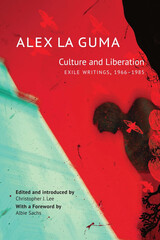
This volume spans La Guma’s political and literary life in exile through accounts of his travels to Algeria, Lebanon, Vietnam, Soviet Central Asia, and elsewhere, along with his critical assessments of Paul Robeson, Nadine Gordimer, Maxim Gorky, Alexander Solzhenitsyn, and Pablo Neruda, among other writers. The first dedicated collection of La Guma’s exile writing, Culture and Liberation restores an overlooked dimension of his life and work, while opening a window on a wider world of cultural and political struggles in Africa, Asia, and Latin America during the second half of the twentieth century.
READERS
Browse our collection.
PUBLISHERS
See BiblioVault's publisher services.
STUDENT SERVICES
Files for college accessibility offices.
RECENTLY PUBLISHED


UChicago Accessibility Resources
home | accessibility | search | about | contact us
BiblioVault ® 2001 - 2026
The University of Chicago Press