
 A SCHOLARLY BOOK REPOSITORY
26 start with C start with C

The Cancer Stage of Capitalism is a modern classic of critical philosophy and political economy, renowned for its depth and comprehensive research. It provides a step by step diagnosis of the continuing economic collapse in the US and Europe and has had an enormous influence on new visions of economic alternatives.
John McMurtry argues that our world disorder of unending crises is the predictable result of a cancerous economic system multiplying out of all control and destroying ecological, social and organic life - a process he describes as 'global ecogenocide'. In this updated edition he explains the ‘social immune response’ required to fight the ‘macro cancer’, something which has already been shown in developments such as the Occupy movement and the democratic social transformation of Latin America.
In an official global culture increasingly destructive of life, this book shows the necessity and possibility of building a sustainable society based on a universal commitment to life and nature.


A wide-ranging examination of how policies, parties, and labor strength affect inequality in post-industrial societies.
Not all countries are unequal in the same ways or to the same degree. In Challenging Inequality, Evelyne Huber and John D. Stephens analyze different patterns of increasing income inequality in post-industrial societies since the 1980s, assessing the policies and social structures best able to mitigate against the worst effects of market inequality. Combining statistical data analysis from twenty-two countries with a comparative historical analysis of Germany, Spain, Sweden, and the United States, Huber and Stephens identify the factors that drive increases in inequality and shape persistent, marked differences between countries. Their statistical analysis confirms generalizable patterns and in-depth country studies help to further elucidate the processes at work.
Challenging Inequality shows how the combination of globalization and skill-biased technological change has led to both labor market dualization and rising unemployment levels, which in turn have had important effects on inequality and poverty. Labor strength—at both the society level and the enterprise level—has helped to counter rising market income inequality, as has a history of strong human capital spending. The generosity of the welfare state remains the most important factor shaping redistribution, while the consistent power of left parties is the common denominator behind both welfare state generosity and human capital investment.
Simon Pirani investigates the interaction of power, money and people in Russia during the presidencies of Vladimir Putin and his successor Dmitry Medvedev.
Profiling the Putin team, including contingents from the security services and pro-market economic "reformers", Pirani argues that the economic growth it presided over during the oil boom was one-sided. The gap between rich and poor widened. Now the boom is over, inequalities will multiply further. As well as explaining Russia's economic trajectory, the book provides a unique account of the social movements that are working against an increasingly authoritarian government to change Russia for the better.
This is the perfect introduction for undergraduates approaching Russia for the first time and those who wish to know how Russia will change during the economic crisis.

The contributors suggest there is little basis for the radical polycentrism that colors so much contemporary development thought. They focus on how the political capabilities of different societal and state actors develop over time and how their development is influenced by state action and a variety of institutional and other factors. The final chapter draws insightful conclusions about the political limitations and opportunities presented by current international discourse on poverty.
Peter P. Houtzager is a Fellow at the Institute of Development Studies, University of Sussex. He has been a visiting scholar at the Center for Latin American Studies, University of California, Berkeley, visiting lecturer at Stanford University, and lecturer at St. Mary's College. A political scientist with broad training in comparative politics and historical-institutional analysis, he has written extensively on the institutional roots of collective action.
Mick Moore is a Fellow at the Institute of Development Studies, University of Sussex, as well as Director of the Centre for the Future State. He has been a visiting professor at the Massachusetts Institute of Technology. His professional interests include political and institutional aspects of poverty reduction and of economic policy and performance, the politics and administration of development, and good government.
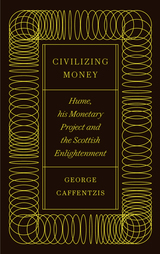
Taking the Scottish Enlightenment philosopher David Hume as its subject, this book breaks new ground in focusing its lens on a little-studied aspect of Hume’s thinking: his understanding of money.
George Caffentzis makes both an intervention in the field of monetary philosophy and into Marxian conceptions of the relation between philosophy and capitalist development. He vividly charts the ways in which Hume’s philosophy directly informed the project of ‘civilizing’ the people of the Scottish Highlands and pacifying the English proletariat in response to the revolts of both groups at the heart of the empire.
Built on careful historical and philosophical detective work, Civilizing Money offers a stimulating and radical political reading of the ways in which Hume’s fundamental philosophical claims performed concrete political functions.
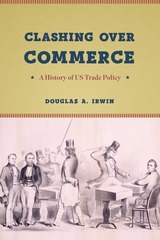
Douglas A. Irwin’s Clashing over Commerce is the most authoritative and comprehensive history of US trade policy to date, offering a clear picture of the various economic and political forces that have shaped it. From the start, trade policy divided the nation—first when Thomas Jefferson declared an embargo on all foreign trade and then when South Carolina threatened to secede from the Union over excessive taxes on imports. The Civil War saw a shift toward protectionism, which then came under constant political attack. Then, controversy over the Smoot-Hawley tariff during the Great Depression led to a policy shift toward freer trade, involving trade agreements that eventually produced the World Trade Organization. Irwin makes sense of this turbulent history by showing how different economic interests tend to be grouped geographically, meaning that every proposed policy change found ready champions and opponents in Congress.
As the Trump administration considers making major changes to US trade policy, Irwin’s sweeping historical perspective helps illuminate the current debate. Deeply researched and rich with insight and detail, Clashing over Commerce provides valuable and enduring insights into US trade policy past and present.
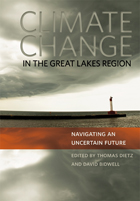
People living in the Great Lakes region are already feeling the effects of a changing climate. Shifts in seasonal temperatures and precipitation patterns could have dramatic impacts on the economy, ecology, and quality of life. In this illuminating and thorough volume, leading scholars address the challenge of preparing for climate change in the region, where decision makers from various sectors—government, agriculture, recreation, and tourism—must increasingly be aware of the need to incorporate climate change into their short- and long-term planning. The chapters in this revealing book, written by some of the foremost climate change scholars in North America, outline the major trends in the climate of the Great Lakes region, how humans might cope with the uncertainty of climate change impacts, and examples of on-the-ground projects that have addressed these issues.
This book situates John Locke’s philosophy of knowledge and his political theory within his engagement in British monetary debates of the 17th and 18th century.
Anchored in extensive archival research, George Caffentzis offers the most expansive reading of Locke’s economic thought to date, contextualizing it within the expansion of capitalist accumulation on a world scale and the universality of money as a medium of exchange.
Updated with a new introduction by Paul Rekret, a new foreword by Harry Cleaver and new material by the author, Clipped Coins, Abused Words, and Civil Government continues to make a significant intervention in contemporary debates around the history of capitalism, colonialism and philosophy.
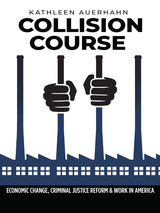
Recently, a widespread consensus has emerged that the era of “mass incarceration” is at an end, reflected in a declining prison population. Criminal justice reforms such as diversion and problem-solving courts, a renewed focus on reentry, and drug policy reform have as their goal keeping more individuals with justice system involvement out of prisons, in the community and subsequently in the labor force, which lacks the capacity to accommodate these additional would-be workers. This poses significant problems for criminal justice practice, which relies heavily on employment as a signal of offenders’ intentions to live a law-abiding lifestyle. The diminished capacity of the economy to utilize the labor of all who have historically been expected to work presents significant challenges for American society. Work, in the American ethos is the marker of success, masculinity and how one “contributes to society.” What are the consequences of ignoring these converging structural trends? This book examines these potential consequences, the meaning of work in American society, and suggests alternative redistributive and policy solutions to avert the collision course of these economic and criminal justice policy trends.

Reveals the deep, historical roots of public distrust in former mining areas in the US, shedding new light on the corrosive feedback loops that persist today.
In Company Towns, Elizabeth Mitchell Elder examines the long-lasting political legacies of mining-company dominance in the Midwest and Appalachia. While the economic consequences of deindustrialization are well-known, Elder shifts the focus to a more insidious problem: the political dysfunction that took root long before the mines shut down.
Drawing on historical and administrative data, Elder shows that the coal industry hindered the growth of local government capacity in the places where it was dominant. Mining companies also engaged in outright corruption to shape local governments, practices which local elites then carried forward. When mining companies withdrew, they left behind not just economic decline, but local governments ill-equipped to govern.
These patterns have had enduring consequences for public life. Elder shows how these historical experiences have fueled a broader cynicism toward government, in which citizens expect little from public institutions and doubt the usefulness of elections. Company Towns underscores the consequences of corporate dominance for state capacity, public opinion, and democratic accountability today.

West reveals how every aspect of the Crater Mountain Wildlife Management Area—including ideas of space, place, environment, and society—was socially produced, created by changing configurations of ideas, actions, and material relations not only in Papua New Guinea but also in other locations around the world. Complicating many of the assumptions about nature, culture, and development underlying contemporary conservation efforts, Conservation Is Our Government Now demonstrates the unique capacity of ethnography to illuminate the relationship between the global and the local, between transnational processes and individual lives.

This book will appeal to policy makers concerned with the management of natural resources as well as to economists, political scientists, and sociologists concerned with collective action problems.
Sara Singleton is Assistant Professor of Political Science, Tulane University.
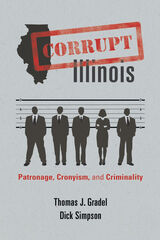
In Corrupt Illinois, veteran political observers Thomas J. Gradel and Dick Simpson take aim at business-as-usual. Naming names, the authors lead readers through a gallery of rogues and rotten apples to illustrate how generations of chicanery have undermined faith in, and hope for, honest government. From there, they lay out how to implement institutional reforms that provide accountability and eradicate the favoritism, sweetheart deals, and conflicts of interest corroding our civic life.
Corrupt Illinois lays out a blueprint to transform our politics from a pay-to-play–driven marketplace into what it should be: an instrument of public good.
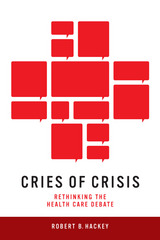
In Cries of Crisis, Robert B. Hackey analyzes media coverage, political speeches, films, and television shows to demonstrate the role that language and symbolism have played in framing the health care debate, shaping policy making, and influencing public perceptions of problems in the health care system. He demonstrates that the idea of crisis now means so many different things to so many different groups that it has ceased to have any shared meaning at all. He argues that the ceaseless talk of “crisis,” without a commonly accepted definition of that term, has actually impeded efforts to diagnose and treat the chronic problems plaguing the American health care system. Instead, he contends, reformers must embrace a new rhetorical strategy that links proposals to improve the system with deeply held American values like equality and fairness.
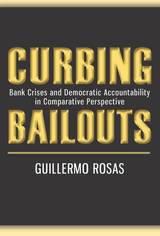
"Rosas's compelling theory and wide-ranging empirical evidence yield a persuasive but surprising conclusion in light of the financial meltdown of 2008–9. In the event of banking crises, not only do elected governments treat taxpayers better and force bankers and their creditors to pay more for their mistakes, but bankers in democracies are more prudent as a consequence . . . essential reading for all interested in the political economy of crisis and in the future of banking regulation."
---Philip Keefer, Lead Economist, Development Research Group, The World Bank
"Rosas convincingly demonstrates how democratic accountability affects the incidence and resolution of banking crises. Combining formal models, case studies, and cutting-edge quantitative methods, Rosas's book represents a model for political economy research."
---William Bernhard, Professor, Department of Political Science, University of Illinois
"When the financial crises of the 1990s hit Asia, Russia, and Latin America, the U.S. scolded them about the moral hazard problems of bailing out the banks. Now, the shoe is on the other foot, with the U.S. struggling to manage an imploding financial sector. Rosas's study of bank bailouts could not be more timely, providing us with both a framework for thinking about the issue and some sobering history of how things go both right and badly wrong. Democratic accountability proves the crucial factor in making sure bailouts are fair, a point that is as relevant for U.S. policy as for an understanding of the emerging markets."
---Stephan Haggard, Krause Professor, Graduate School of International Relations and Pacific Studies, University of California, San Diego
Banking crises threaten the stability and growth of economies around the world. In response, politicians restore banks to solvency by redistributing losses from bank shareholders and depositors to taxpayers, and the burden the citizenry must bear varies from case to case. Whereas some governments stay close to the prescriptions espoused by Sir Walter Bagehot in the nineteenth century that limit the costs shouldered by taxpayers, others engage in generous bank bailouts at great cost to society. What factors determine a government's response?
In this comparative analysis of late-twentieth-century banking crises, Guillermo Rosas identifies political regime type as the determining factor. During a crisis, powerful financial players demand protection of their assets. Rosas maintains that in authoritarian regimes, government officials have little to shield them from such demands and little incentive for rebuffing them, while in democratic regimes, elected officials must weigh these demands against the interests of the voters---that is, the taxpayers. As a result, compared with authoritarian regimes, democratic regimes show a lower propensity toward dramatic, costly bailouts.
Guillermo Rosas is Assistant Professor in the Department of Political Science and Fellow at the Center in Political Economy at Washington University in St. Louis.
READERS
Browse our collection.
PUBLISHERS
See BiblioVault's publisher services.
STUDENT SERVICES
Files for college accessibility offices.
RECENTLY PUBLISHED






UChicago Accessibility Resources
home | accessibility | search | about | contact us
BiblioVault ® 2001 - 2026
The University of Chicago Press