
 A SCHOLARLY BOOK REPOSITORY
11 start with C start with C
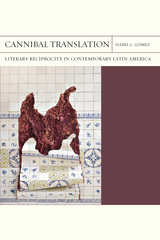
A bold comparative study illustrating the creative potential of translations that embrace mutuality and resist assimilation
Cannibal translators digest, recombine, transform, and trouble their source materials. Isabel C. Gómez makes the case for this model of literary production by excavating a network of translation projects in Latin America that includes canonical writers of the twentieth century, such as Haroldo and Augusto de Campos, Rosario Castellanos, Clarice Lispector, José Emilio Pacheco, Octavio Paz, and Ángel Rama. Building on the avant-garde reclaiming of cannibalism as an Indigenous practice meant to honorably incorporate the other into the self, these authors took up Brazilian theories of translation in Spanish to fashion a distinctly Latin American literary exchange, one that rejected normative and Anglocentric approaches to translation and developed collaborative techniques to bring about a new understanding of world literature.
By shedding new light on the political and aesthetic pathways of translation movements beyond the Global North, Gómez offers an alternative conception of the theoretical and ethical challenges posed by this artistic practice. Cannibal Translation: Literary Reciprocity in Contemporary Latin America mobilizes a capacious archive of personal letters, publishers’ records, newspapers, and new media to illuminate inventive strategies of collectivity and process, such as untranslation, transcreation, intersectional autobiographical translation, and transpeaking. The book invites readers to find fresh meaning in other translational histories and question the practices that mediate literary circulation.
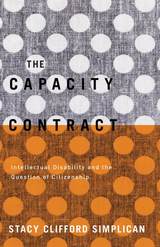
In the first sustained examination of disability through the lens of political theory, The Capacity Contract shows how the exclusion of disabled people has shaped democratic politics. Stacy Clifford Simplican demonstrates how disability buttresses systems of domination based on race, sex, and gender. She exposes how democratic theory and politics have long blocked from political citizenship anyone whose cognitive capacity falls below a threshold level⎯marginalization with real-world repercussions on the implementation of disability rights today.
Simplican’s compelling ethnographic analysis of the self-advocacy movement describes the obstacles it faces. From the outside, the movement must confront stiff budget cuts and dwindling memberships; internally, self-advocates must find ways to demand political standing without reinforcing entrenched stigma against people with profound cognitive disabilities. And yet Simplican’s investigation also offers democratic theorists and disability activists a more emancipatory vision of democracy as it relates to disability⎯one that focuses on enabling people to engage in public and spontaneous action to disrupt exclusion and stigma.
Taking seriously democratic promises of equality and inclusion, The Capacity Contract rejects conceptions of political citizenship that privilege cognitive capacity and, instead, centers such citizenship on action that is accessible to all people.
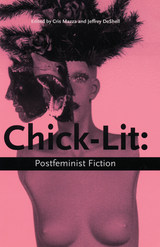
A provocative critique of chick lit’s glossy narratives and their complex relationship with postfeminist ideals.
Chick-Lit: Postfeminist Fiction is the fourth volume in “On the Edge: New Women’s Fiction,” FC2’s ongoing effort to discover new and innovative voices in women’s fiction. Determined to contradict the myth that “women don't write experimental fiction,” Chick-Lit discovers women writers with a fresh and irreverent wit and honesty, but no less powerful in their rendering of human experience.
Chick-Lit collects the original fiction of newly discovered writers, but also the award winning work of notable writers like Carole Maso, Jonis Agee, Stacy Levinne and Carolyn Banks. Marked by innovations in form and point-of-view, the writers in this collection are not satisfied with the terrain commonly referred to as “women’s writing.” Insane asylum sex, board games that control people’s lives, a masochistic pedophile humiliated by his victim, an obese woman paying nickels and quarters for attention from teenage girls, a deranged hair stylist and her disloyal dog, a men's impotence therapy group, a surreal landscape constantly producing the body of a woman's mother: this is writing that shouts, yes, there is such a thing as postfeminist fiction.
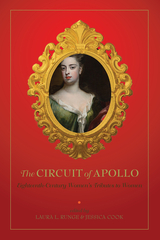
Published by University of Delaware Press. Distributed worldwide by Rutgers University Press.
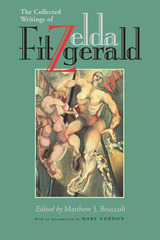
The voice behind the legend—Zelda Fitzgerald in her own words.
Zelda Sayre Fitzgerald has long been perceived as the tragic "other half" of the Scott and Zelda legend. Born in Montgomery, Alabama, the high-spirited tomboy turned flapper was talented in dance, painting, and writing but lived in the shadow of her husband's success. Her writing can be experienced on its own terms in Matthew Bruccoli's meticulously edited The Collected Writings of Zelda Fitzgerald.
The collection includes Zelda's only published novel, Save Me the Waltz, an autobiographical account of the Fitzgeralds' adventures in Paris and on the Riviera; her celebrated farce, Scandalabra; eleven short stories; twelve articles; and a selection of letters to her husband, written over the span of their marriage, that reveals the couple's loving and turbulent relationship.
Zelda Sayre Fitzgerald has long been an American cultural icon. The Collected Writings affirms her place as a writer and as a symbol not only of the Lost Generation but of all generations as she struggled to define herself through her art.
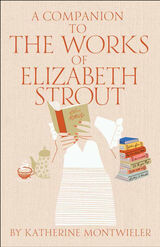
Including an exclusive interview with bestselling American novelist Elizabeth Strout, this groundbreaking study will engage literature scholars and general readers alike.
Written in accessible language, this book is the first to offer a sustained analysis of Elizabeth Strout’s work. A recipient of the Pulitzer Prize and the O. Henry Award, among other accolades, Strout has achieved a vast popular following as well. Amy and Isabelle was made into a television movie; Olive Kitteridge, which sold more than one million copies, was adapted as a miniseries; The Burgess Boys has been optioned for HBO; and My Name Is Lucy Barton was reimagined for the stage in London and on Broadway. Oh William!, the sequel to My Name Is Lucy Barton, appeared in 2021, and Strout’s latest book, Lucy by the Sea, is slated for release in fall 2022.
At the height of her literary powers as a chronicler of American life and particularly the lives of American women, Strout is currently enjoying both commercial and critical success. Her sales and perennial presence on book club lists indicate a tremendous impact on the popular realm and the growing attention to her in academia charts her importance in American letters. This book will satisfy readers looking for a serious, in-depth introduction to Strout’s work, as well as those interested in women’s writing, contemporary fiction, ethics, and literature. It includes a new interview with Strout in which she discusses these issues.
Montwieler traces the evolution of Strout’s voice, themes, and characters, which uniquely address American twenty-first-century feminine perspectives and sensibilities. From classic domestic spats between a mother and daughter to hate crimes aimed at mosques, from sweeping forays into decades past to snapshots of contemporary life, Strout compassionately portrays humanity at its most brutal and its most intimate. Though her canvas is vast, her eye for detail is astute and her ear for nuance is keen. Looking across Strout’s work, Montwieler explores how she portrays the endurance of hope, the complexities of family, the effects of trauma on individuals and communities, the sustaining power of the natural world, and the effects of place on personal and collective character.
Strout’s creations cultivate empathy in her readers, teaching them to be attuned to the suffering of others and to the human need for connection. Across her work and in the new interview included within this book, Strout shows her readers that they are not alone in this impersonal, often violent world. The connection that acknowledges our limitations, our woundedness, our capability to do harm, our remorse, and our recognition of beauty and humor distinguishes Strout’s unique contribution to contemporary American letters.
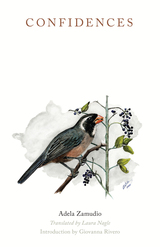
Juan is a Bolivian poet at the turn of the century, visiting the city of Cochabamba and writing letters to his friend Armando about the masked sensuality and hostility he feels seething beneath the placid face of this insular mining town. Antonia is a married woman living in Cochabamba, writing to her friend Gracia about the local gossip—which soon erupts into a scandal that threatens to destroy a family. Contrasting Juan’s letters home with Antonia’s private correspondence to her friend, Confidences tells a story of tragic love and explosive passions, showing how the intimacies that begin behind closed doors spill out into the public sphere.
The only novel written by acclaimed feminist poet Adela Zamudio, Confidences was harshly criticized for not following the conventions of realist literature, but it has since been hailed as a lost classic of Bolivian modernism. Now available in English for the first time, this translation captures the lyrical qualities of Zamudio’s prose as it vividly depicts how sexism, religious dogma, and prejudice prevented women from shaping their own destinies.
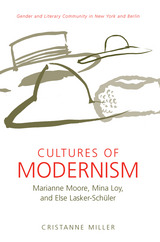
Cultures of Modernism explores how the structure and location of literary communities significantly influence who writes, what they write about, and their openness to formal experimentation. These influences particularly affect women writers. Author Cristanne Miller notes striking patterns of similarity in the concerns and lives of women living in geographically distant centers of modernist production. She looks at three significant poets---the American Marianne Moore, the British expatriate Mina Loy, and the German Else Lasker-Schüler---in the context of cultural, national, and local elements to argue that location significantly affected their performances of subjectivity, gender, race, and religion. The first book of its kind, Cultures of Modernism breaks new ground while it contributes to the ongoing reconception of the modernist period.
"A fascinating, provocative, and genuinely original study of a 'different' modernism in poetry---namely, the Modernism of women poets."
---Marjorie Perloff, Stanford University
"An important and ambitious work that makes major contributions to the fields of gender studies and modernist studies, and to the study of modernist poetry."
---Robin Schulze, Pennsylvania State University
"Offers a welcome corrective to the unreflective critical tendency . . . to make broad claims about the historical experiences and cultural conundrums of 'women,' and particularly 'women writers.' Miller offers tour-de-force comparative readings . . . threading together the world-historical with the personal, poetics with the political, and wielding the instruments of scansion as deftly as a surgeon."
---Modernism/modernity, The Official Journal of the Modernist Studies Association
Cristanne Miller is Edward H. Butler Professor of English and Chair of the English Department at the University of Buffalo, State University of New York.
READERS
Browse our collection.
PUBLISHERS
See BiblioVault's publisher services.
STUDENT SERVICES
Files for college accessibility offices.
RECENTLY PUBLISHED


UChicago Accessibility Resources
home | accessibility | search | about | contact us
BiblioVault ® 2001 - 2025
The University of Chicago Press