
 A SCHOLARLY BOOK REPOSITORY
9 start with C start with C


Cinema without Reflection traces an implicit film theory in Jacques Derrida’s oeuvre, especially in his frequent invocation of the myth of Echo and Narcissus. Derrida’s reflections on the economies of image and sound that reverberate in this story, along with the spectral dialectics of love, mirrors, and poiesis, serve as the basis for a theory of cinema that Derrida perhaps secretly imagined.
Following Derrida’s interventions on Echo and Narcissus across his thought on the visual arts, Akira Mizuta Lippit seeks to return to a theory of cinema adrift in Derrida’s philosophy.
Forerunners is a thought-in-process series of breakthrough digital works. Written between fresh ideas and finished books, Forerunners draws on scholarly work initiated in notable blogs, social media, conference plenaries, journal articles, and the synergy of academic exchange. This is gray literature publishing: where intense thinking, change, and speculation take place in scholarship.
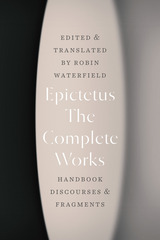
“Some things are up to us and some are not.”
Epictetus was born into slavery around the year 50 CE, and, upon being granted his freedom, he set himself up as a philosophy teacher. After being expelled from Rome, he spent the rest of his life living and teaching in Greece. He is now considered the most important exponent of Stoicism, and his surviving work comprises a series of impassioned discourses, delivered live and recorded by his student Arrian, and the Handbook, Arrian’s own take on the heart of Epictetus’s teaching.
In Discourses, Epictetus argues that happiness depends on knowing what is in our power to affect and what is not. Our internal states and our responses to events are up to us, but the events themselves are assigned to us by the benevolent deity, and we should treat them—along with our bodies, possessions, and families—as matters of indifference, simply making the best use of them we can. Together, the Discourses and Handbook constitute a practical guide to moral self-improvement, as Epictetus explains the work and exercises aspirants need to do to enrich and deepen their lives. Edited and translated by renowned scholar Robin Waterfield, this book collects the complete works of Epictetus, bringing to modern readers his insights on how to cope with death, exile, the people around us, the whims of the emperor, fear, illness, and much more.
CUSTOMER NOTE: THE HARDCOVER IS FOR LIBRARIES AND HAS NO JACKET.
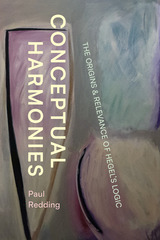
Conceptual Harmonies develops an original account of G. W. F. Hegel’s perplexing Science of Logic from a simple insight: philosophical and mathematical thought have shaped each other since classical times. Situating Science of Logic within the rise of modern mathematics, Redding stresses Hegel’s attention to Pythagorean ratios, Platonic reason, and Aristotle’s geometrically inspired logic. He then explores how later traditions shaped Hegel’s world, through both Leibniz and new forms of algebraic geometry. This enlightening reading recovers an overlooked stream in Hegel’s philosophy that remains, Redding argues, important for contemporary conceptions of logic.

The first English translation of Foucault’s previously lost master’s thesis, itself an original contribution to the study of Hegel’s philosophy.
On June 11, 1949, a twenty-three-year-old Michel Foucault defended his master’s thesis in philosophy at the Sorbonne entitled The Constitution of a Historical Transcendental in Hegel’s “Phenomenology of Spirit.” Long considered a lost holy grail of French philosophy, the thesis was only recently rediscovered, and it is presented here in English for the first time.
In his master’s thesis, Foucault offers an original reading of Hegel that understands “absolute knowing,” the famous but enigmatic final figure of experience in the Phenomenology, as inextricably bound to time, language, and historical experience. Indeed, readers will discover how many of Foucault’s famous later concepts—the historical a priori, the episteme, and the limit-experience—are intimately rooted in his early, intense engagement with Hegel’s philosophy.
An introduction and critical apparatus provided by Hegel scholar Christophe Bouton traces previously unknown connections between the thesis and Foucault’s later masterpieces, particularly History of Madness and The Order of Things. Introducing a fundamental shift in our understanding of Foucault’s intellectual trajectory, this book is an essential text for anyone interested in Foucault, Hegel, and the dramatic evolution of twentieth-century continental philosophy.
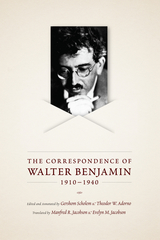
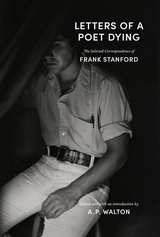
A powerful, mesmerizing collection of letters from one of the most important intellectuals and writers of the twentieth century
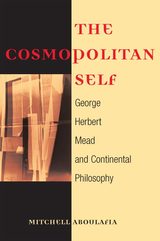
In this incisive commentary, Mitchell Aboulafia examines the relevance of the American pragmatist philosopher George Herbert Mead to current debates on pluralism, universalism, and the fostering of a democratic temper. Addressing the relationship between Mead's notions of self and society and those of important continental thinkers, The Cosmopolitan Self demonstrates that Mead's ideas not only speak to resolving the tension between universalism and pluralism, they do so in a manner that challenges and advances the positions of these continental theoreticians.
Aboulafia examines how Mead's insights illuminate Hannah Arendt's reading of Immanual Kant's third Critique and Jürgen Habermas's understanding of the relationship among communicative action, universality, and individuation. Teasing out strands of agreement and disagreement among Mead and these theorists on topics such as impartiality and good judgment, Aboulafia develops a conception of universalism that is compatible with contemporary notions of pluralism. He also addresses the serious challenge presented to Mead's approach to pluralism by Emmanuel Levinas, who holds that true pluralism, presupposing an irreducible individualism, is fundamentally irreconcilable with universalism.
The Cosmopolitan Self offers a model of the democratically inclined individual who embodies both a capacity to establish common ground with others and a sensitivity to their uniqueness. This important volume appreciably advances the dialogue between continental thought and classical American philosophy.

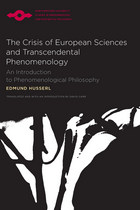
Husserl provides not only a history of philosophy but a philosophy of history. As he says in Part I, "The genuine spiritual struggles of European humanity as such take the form of struggles between the philosophies, that is, between the skeptical philosophies--or nonphilosophies, which retain the word but not the task—and the actual and still vital philosophies. But the vitality of the latter consists in the fact that they are struggling for their true and genuine meaning and thus for the meaning of a genuine humanity."
READERS
Browse our collection.
PUBLISHERS
See BiblioVault's publisher services.
STUDENT SERVICES
Files for college accessibility offices.
RECENTLY PUBLISHED




UChicago Accessibility Resources
home | accessibility | search | about | contact us
BiblioVault ® 2001 - 2026
The University of Chicago Press