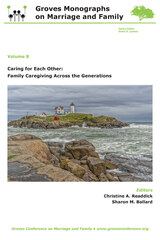
front cover of Caring for Each Other
Caring for Each Other
Family Caregiving Across the Generations: Groves Monographs on Marriage and Family (Volume 8)
Christine A. Readdick
Michigan Publishing Services, 2023
In Maine, 2018, Groves Conference gathered voices from family science and other social sciences, the arts, and history to address the giving and receiving of care within the circle of family life. In this volume, contributors highlight individual, family, and social influences that afford or deter successful family caregiving. Implications from this body of work and thought are derived and offered to lay person, teacher, program developer, researcher, and public policy maker alike.
[more]

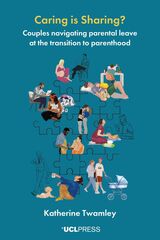
front cover of Caring Is Sharing?
Caring Is Sharing?
Couples Navigating Parental Leave at the Transition to Parenthood
Katherine Twamley
University College London, 2024
An in-depth analysis of new parents’ experiences with parental leave, family care, work, intimacy, and gender equity.

Through a longitudinal qualitative comparative analysis of mixed-sex parent couples in England who do (not) share parental leave post birth of their first child, Caring is Sharing? explores how these couples make parental leave decisions during their transition into parenthood, as well as how these decisions shape their work and family care practices during and after leave. The study shows that men's and women’s visions and practices of family life are rooted in ideals of appropriate intimate relations and negotiated with real and imagined reactions from peers, wider family, and colleagues in a highly gendered UK. In so doing, this book highlights the intersections of intimacy and equality, contributing to debates around the stalled gender revolution and using UK parental leave policies to drive effective change in gender relations and family life.
[more]

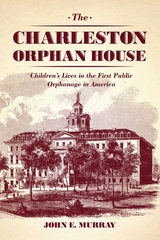
front cover of The Charleston Orphan House
The Charleston Orphan House
Children's Lives in the First Public Orphanage in America
John E. Murray
University of Chicago Press, 2012
The first public orphanage in America, the Charleston Orphan House saw to the welfare and education of thousands of children from poor white families in the urban South. From wealthy benefactors to the families who sought its assistance to the artisans and merchants who relied on its charges as apprentices, the Orphan House was a critical component of the city’s social fabric. By bringing together white citizens from all levels of society, it also played a powerful political role in maintaining the prevailing social order.
 
John E. Murray tells the story of the Charleston Orphan House for the first time through the words of those who lived there or had family members who did. Through their letters and petitions, the book follows the families from the events and decisions that led them to the Charleston Orphan House through the children’s time spent there to, in a few cases, their later adult lives. What these accounts reveal are families struggling to maintain ties after catastrophic loss and to preserve bonds with children who no longer lived under their roofs.
 
An intimate glimpse into the lives of the white poor in early American history, The Charleston Orphan House is moreover an illuminating look at social welfare provision in the antebellum South.
[more]

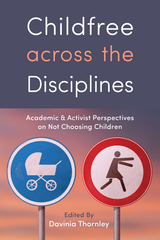
front cover of Childfree across the Disciplines
Childfree across the Disciplines
Academic and Activist Perspectives on Not Choosing Children
Davinia Thornley
Rutgers University Press, 2022

Recently, childfree people have been foregrounded in mainstream media. More than seven percent of Western women choose to remain childfree and this figure is increasing. Being childfree challenges the ‘procreation imperative’ residing at the center of our hetero-normative understandings, occupying an uneasy position in relation to—simultaneously—traditional academic ideologies and prevalent social norms. After all, as Adi Avivi recognizes, "if a woman is not a mother, the patriarchal social order is in danger." This collection engages with these (mis)perceptions about childfree people: in media representations, demographics, historical documents, and both psychological and philosophical models. Foundational pieces from established experts on the childfree choice--Rhonny Dam, Laurie Lisle, Christopher Clausen, and Berenice Fisher--appear alongside both activist manifestos and original scholarly work, comprehensively brought together. Academics and activists in various disciplines and movements also riff on the childfree life: its implications, its challenges, its conversations, and its agency—all in relation to its inevitability in the 21st century. Childfree across the Disciplines unequivocally takes a stance supporting the subversive potential of the childfree choice, allowing readers to understand childfreedom as a sense of continuing potential in who—or what—a person can become.
[more]


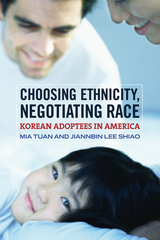
front cover of Choosing Ethnicity, Negotiating Race
Choosing Ethnicity, Negotiating Race
Korean Adoptees in America
Mia Tuan
Russell Sage Foundation, 2011
Transnational adoption was once a rarity in the United States, but Americans have been choosing to adopt children from abroad with increasing frequency since the mid-twentieth century. Korean adoptees make up the largest share of international adoptions—25 percent of all children adopted from outside the United States—but they remain understudied among Asian American groups. What kind of identities do adoptees develop as members of American families and in a cultural climate that often views them as foreigners? Choosing Ethnicity, Negotiating Race is the only study of this unique population to collect in-depth interviews with a multigenerational, random sample of adult Korean adoptees. The book examines how Korean adoptees form their social identities and compares them to native-born Asian Americans who are not adopted. How do American stereotypes influence the ways Korean adoptees identify themselves? Does the need to explore a Korean cultural identity—or the absence of this need—shift according to life stage or circumstance? In Choosing Ethnicity, Negotiating Race, sixty-one adult Korean adoptees—representing different genders, social classes, and communities—reflect on early childhood, young adulthood, their current lives, and how they experience others' perceptions of them. The authors find that most adoptees do not identify themselves strongly in ethnic terms, although they will at times identify as Korean or Asian American in order to deflect questions from outsiders about their cultural backgrounds. Indeed, Korean adoptees are far less likely than their non-adopted Asian American peers to explore their ethnic backgrounds by joining ethnic organizations or social networks. Adoptees who do not explore their ethnic identity early in life are less likely ever to do so—citing such causes as general aversion, lack of opportunity, or the personal insignificance of race, ethnicity, and adoption in their lives. Nonetheless, the choice of many adoptees not to identify as Korean or Asian American does not diminish the salience of racial stereotypes in their lives. Korean adoptees must continually navigate society's assumptions about Asian Americans regardless of whether they chose to identify ethnically. Choosing Ethnicity, Negotiating Race is a crucial examination of this little-studied American population and will make informative reading for adoptive families, adoption agencies, and policymakers. The authors demonstrate that while race is a social construct, its influence on daily life is real. This book provides an insightful analysis of how potent this influence can be—for transnational adoptees and all Americans.
[more]

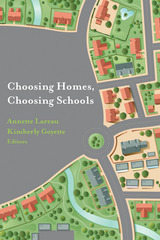
front cover of Choosing Homes, Choosing Schools
Choosing Homes, Choosing Schools
Annette Lareau
Russell Sage Foundation, 2014
A series of policy shifts over the past decade promises to change how Americans decide where to send their children to school. In theory, the boom in standardized test scores and charter schools will allow parents to evaluate their assigned neighborhood school, or move in search of a better option. But what kind of data do parents actually use while choosing schools? Are there differences among suburban and urban families? How do parents’ choices influence school and residential segregation in America? Choosing Homes, Choosing Schools presents a breakthrough analysis of the new era of school choice, and what it portends for American neighborhoods. The distinguished contributors to Choosing Homes, Choosing Schools investigate the complex relationship between education, neighborhood social networks, and larger patterns of inequality. Paul Jargowsky reviews recent trends in segregation by race and class. His analysis shows that segregation between blacks and whites has declined since 1970, but remains extremely high. Moreover, white families with children are less likely than childless whites to live in neighborhoods with more minority residents. In her chapter, Annette Lareau draws on interviews with parents in three suburban neighborhoods to analyze school-choice decisions. Surprisingly, she finds that middle- and upper-class parents do not rely on active research, such as school tours or test scores. Instead, most simply trust advice from friends and other people in their network. Their decision-making process was largely informal and passive. Eliot Weinginer complements this research when he draws from his data on urban parents. He finds that these families worry endlessly about the selection of a school, and that parents of all backgrounds actively consider alternatives, including charter schools. Middle- and upper-class parents relied more on federally mandated report cards, district websites, and online forums, while working-class parents use network contacts to gain information on school quality. Little previous research has explored what role school concerns play in the preferences of white and minority parents for particular neighborhoods. Featuring innovative work from more than a dozen scholars, Choosing Homes, Choosing Schools adroitly addresses this gap and provides a firmer understanding of how Americans choose where to live and send their children to school.
[more]

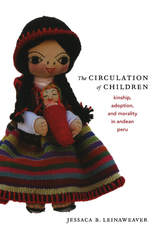
front cover of The Circulation of Children
The Circulation of Children
Kinship, Adoption, and Morality in Andean Peru
Jessaca B. Leinaweaver
Duke University Press, 2008
In this vivid ethnography, Jessaca B. Leinaweaver explores “child circulation,” informal arrangements in which indigenous Andean children are sent by their parents to live in other households. At first glance, child circulation appears tantamount to child abandonment. When seen in that light, the practice is a violation of international norms regarding children’s rights, guidelines that the Peruvian state relies on in regulating legal adoptions. Leinaweaver demonstrates that such an understanding of the practice is simplistic and misleading. Her in-depth ethnographic analysis reveals child circulation to be a meaningful, pragmatic social practice for poor and indigenous Peruvians, a flexible system of kinship that has likely been part of Andean lives for centuries. Child circulation may be initiated because parents cannot care for their children, because a childless elder wants company, or because it gives a young person the opportunity to gain needed skills.

Leinaweaver provides insight into the emotional and material factors that bring together and separate indigenous Andean families in the highland city of Ayacucho. She describes how child circulation is intimately linked to survival in the city, which has had to withstand colonialism, economic isolation, and the devastating civil war unleashed by the Shining Path. Leinaweaver examines the practice from the perspective of parents who send their children to live in other households, the adults who receive them, and the children themselves. She relates child circulation to international laws and norms regarding children’s rights, adoptions, and orphans, and to Peru’s history of racial conflict and violence. Given that history, Leinaweaver maintains that it is not surprising that child circulation, a practice associated with Peru’s impoverished indigenous community, is alternately ignored, tolerated, or condemned by the state.
[more]

front cover of Civil Rights and Intersecting Identities
Civil Rights and Intersecting Identities
Social Movements for Equality and Justice: Groves Monographs on Marriage and Family (Volume 10)
Edited by Eboni Baugh and Carol Johnston
Michigan Publishing Services, 2026

Groves Monographs on Marriage and Family is an edited book series based on the annual meetings of the Groves Conference on Marriage and Family, an interdisciplinary, interprofessional organization of limited invited membership founded in 1934. The Groves Monographs publishes work on the leading edges of theory development and empirical research in the field of family studies. Individual volumes are edited by the chairs of the annual Groves Conferences and include peer-reviewed chapters by the conference presenters and invited authors. Topics are timely and provocative with diverse themes.

Volume 10: Civil Rights and Intersecting Identities: Social Movements for Equality and Justice Society has a tumultuous history with regard to human rights and civil rights. Despite progress, the contemporary revisiting of previously held rights is placing intense pressure on families, individuals, and communities. As family scientists, it is imperative that we respond by learning, engaging, and acting with intentionality. The appropriate response is not to rescue, but to amplify voices and experiences, moving beyond mere allyship. This Monograph, inspired from presentations given at the 2024 Groves Conference on Marriage and Family, will serve to center discussions on the current landscape of social justice movements.
[more]

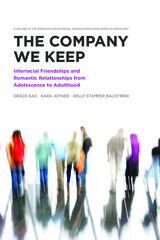
front cover of The Company We Keep
The Company We Keep
Interracial Friendships and Romantic Relationships from Adolescence to Adulthood
Grace Kao
Russell Sage Foundation, 2019
With hate crimes on the rise and social movements like Black Lives Matter bringing increased attention to the issue of police brutality, the American public continues to be divided by issues of race. How do adolescents and young adults form friendships and romantic relationships that bridge the racial divide? In The Company We Keep, sociologists Grace Kao, Kara Joyner, and Kelly Stamper Balistreri examine how race, gender, socioeconomic status, and other factors affect the formation of interracial friendships and romantic relationships among youth. They highlight two factors that increase the likelihood of interracial romantic relationships in young adulthood: attending a diverse school and having an interracial friendship or romance in adolescence.

While research on interracial social ties has often focused on whites and blacks, Hispanics are the largest minority group and Asian Americans are the fastest growing racial group in the United States. The Company We Keep examines friendships and romantic relationships among blacks, whites, Hispanics, and Asian Americans to better understand the full spectrum of contemporary race relations. Using data from the National Longitudinal Study of Adolescent to Adult Health, the authors explore the social ties of more than 15,000 individuals from their first survey responses as middle and high school students in the mid-1990s through young adulthood nearly fifteen years later. They find that while approval for interracial marriages has increased and is nearly universal among young people, interracial friendships and romantic relationships remain relatively rare, especially for whites and blacks. Black women are particularly disadvantaged in forming interracial romantic relationships, while Asian men are disadvantaged in the formation of any romantic relationships, both as adolescents and as young adults. They also find that people in same-sex romantic relationships are more likely to have partners from a different racial group than are people in different-sex relationships. The authors pay close attention to how the formation of interracial friendships and romantic relationships depends on opportunities for interracial contact. They find that the number of students choosing different-race friends and romantic partners is greater in schools that are more racially diverse, indicating that school segregation has a profound impact on young people’s social ties.

Kao, Joyner, and Balistreri analyze the ways school diversity and adolescent interracial contact intersect to lay the groundwork for interracial relationships in young adulthood. The Company We Keep provides compelling insights and hope for the future of living and loving across racial divides.
[more]

front cover of Contemporary Marriage
Contemporary Marriage
Kingsley Davis
Russell Sage Foundation, 1985
This fascinating symposium is based on an assumption that no longer seems to need justification: that the institution of marriage is today experiencing profound changes. But the nature of those changes—their causes and consequences—is very much in need of explication. The experts contributing to this volume bring a wide range of perspectives—sociological, anthropological, economic, historical, psychological, and legal—to the problem of marriage in modern society. Together these essays help illuminate a form of relationship that is both vulnerable and resilient, biological and social, a reflection of and an influence on other social institutions. Contemporary Marriage begins with an important assessment of the revolution in marital behavior since World War II, tracing trends in marriage age, cohabitation, divorce, and fertility. The focus here is primarily on the United States and on idustrial societies in general. Later chapters provide intriguing case studies of particular countries. There is a recurrent interest in the impact on marriage of modernization itself, but a number of essays probe influences other than industrial development, such as strong cultural and historical patterns or legislation and state control. Beliefs and expectations about marriage are explored, and human sexuality and gender roles are also considered as factors in the nature of marriage. Contemporary Marriage offers a rich spectrum of approaches to a problem of central importance. The volume will reward an equally broad spectrum of readers interested in the meaning and future of marriage in our society.
[more]

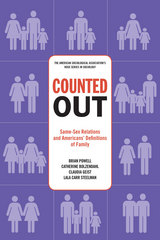
front cover of Counted Out
Counted Out
Same-Sex Relations and Americans' Definitions of Family
Brian Powell
Russell Sage Foundation, 2011
When state voters passed the California Marriage Protection Act (Proposition 8) in 2008, it restricted the definition of marriage to a legal union between a man and a woman. The act's passage further agitated an already roiling national debate about whether American notions of family could or should expand to include, for example, same-sex marriage, unmarried cohabitation, and gay adoption. But how do Americans really define family? The first study to explore this largely overlooked question, Counted Out examines currents in public opinion to assess their policy implications and predict how Americans' definitions of family may change in the future. Counted Out broadens the scope of previous studies by moving beyond efforts to understand how Americans view their own families to examine the way Americans characterize the concept of family in general. The book reports on and analyzes the results of the authors' Constructing the Family Surveys (2003 and 2006), which asked more than 1,500 people to explain their stances on a broad range of issues, including gay marriage and adoption, single parenthood, the influence of biological and social factors in child development, religious ideology, and the legal rights of unmarried partners. Not surprisingly, the authors find that the standard bearer for public conceptions of family continues to be a married, heterosexual couple with children. More than half of Americans also consider same-sex couples with children as family, and from 2003 to 2006 the percentages of those who believe so increased significantly—up 6 percent for lesbian couples and 5 percent for gay couples. The presence of children in any living arrangement meets with a notable degree of public approval. Less than 30 percent of Americans view heterosexual cohabitating couples without children as family, while similar couples with children count as family for nearly 80 percent. Counted Out shows that for most Americans, however, the boundaries around what they define as family are becoming more malleable with time. Counted Out demonstrates that American definitions of family are becoming more expansive. Who counts as family has far-reaching implications for policy, including health insurance coverage, end-of-life decisions, estate rights, and child custody. Public opinion matters. As lawmakers consider the future of family policy, they will want to consider the evolution in American opinion represented in this groundbreaking book. A Volume in the American Sociological Association's Rose Series in Sociology
[more]

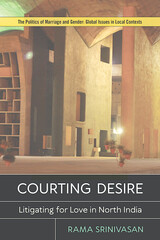
front cover of Courting Desire
Courting Desire
Litigating for Love in North India
Rama Srinivasan
Rutgers University Press, 2020
Inquiries into marital patterns can serve as an effective lens to analyze social structures and material cultures not only on the question of sexuality, but also on the nature of a private citizen’s engagement with state and law. Through ethnographic research in courtrooms, community,and kinship spaces, the author outlines the transformations in material culture and political economy that have led to renewed negotiations on the institution of marriage in North India, especially in legal spaces. Tracing organically evolving notions of sexual consent and legal subjectivity, Courting Desire underlines how non-normative decisions regarding marriage become possible in a region otherwise known for high instances of honor killings and rigid kinship structures. Aspirations for consensual relationships have led to a tentative attempt to forge relationships that are non-normative but grudgingly approved after state intervention. The book traces this nascent and under-explored trend in the North Indian landscape.  
 
[more]

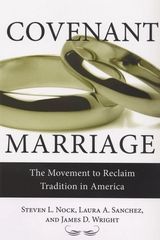
front cover of Covenant Marriage
Covenant Marriage
The Movement to Reclaim Tradition in America
Nock, Steven
Rutgers University Press, 2008
Regardless how you interpret the statistics, the divorce rate in the United States is staggering. But, what if the government could change this? Would families be better off if new public policies made it more difficult for couples to separate?


This book explores a movement that emerged over the past fifteen years, which aims to do just that. Guided by certain politicians and religious leaders who herald marriage as a solution to a range of longstanding social problems, a handful of state governments enacted "covenant marriage" laws, which require couples to choose between a conventional and a covenant marriage. While the familiar type of union requires little effort to enter and can be terminated by either party unilaterally, covenant marriage requires premarital counseling, an agreement bound by fault-based rules or lengthy waiting periods to exit, and a legal stipulation that divorce can be granted only after the couple has received counseling.


Drawing on interviews with over 700 couples-half of whom have chosen covenant unions-this book not only evaluates the viability of public policy in the intimate affairs of marriage, it also explores how growing public discourse is causing men and women to rethink the meaning of marriage.

[more]


Send via email Share on Facebook Share on Twitter