
 A SCHOLARLY BOOK REPOSITORY
15 start with D start with D


"Combining a rich and varied set of theoretical insights with a subtle analysis of the politics of American foreign policy, Defacing Power marks an important contribution toward understanding the power of identity in world politics. Engagingly written and rigorously argued, Steele's challenging analysis is incisive, important, and rewarding."
---Michael C. Williams, Graduate School of Public and International Affairs, University of Ottawa
"Brent Steele's marvelous excavation of the aesthetic dimensions of power is strikingly irreverent, inasmuch as he displays no commitment to ex ante disciplinary or substantive constraints in his quest to disclose those moments of creative action so often overlooked by theories and theorists wedded to the grandiose and the transhistorical. Steele samples and remixes a myriad of sources, arranging them so as to produce a transgressively insightful account of how 'work on the Self,' often condemned as self-indulgent by prior generations of intellectuals, might just point in the direction of a more sustainably secure world."
---Patrick Thaddeus Jackson, School of International Service, American University
"Defacing Power successfully integrates work from Dewey to Morgenthau to Foucault, as well as a wide range of contemporary international relations scholars, in its genealogy of power conceptualizations and characteristics. This book is theoretically sophisticated and serious. It should be of interest to students of international politics, international theory, social theory, and foreign policy."
---Cecelia Lynch, Center for Global Peace and Conflict Studies, University of California, Irvine
Defacing Power investigates how nation-states create self-images in part through aesthetics and how these images can be manipulated to challenge those states' power. Although states have long employed media, such as radio, television, and film, for their own image-making purposes, counterpower agents have also seized upon new telecommunications technologies. Most recently, the Internet has emerged as contested territory where states and other actors wage a battle of words and images.
Moving beyond theory, Brent Steele illustrates his provocative argument about the vulnerability of power with examples from recent history: the My Lai Massacre and the Tet Offensive, September 11 and the al-Qaeda communiqués, the atrocities at Fallujah and Abu Ghraib, and the U.S. response to the Asian tsunami of December 2004. He demonstrates how a nation-state---even one as powerful as the United States---comes to feel threatened not only by other nation-states or terrorist organizations but also by unexpected events that challenge its self-constructed image of security. At the same time, Steele shows that as each generation uses available media to create and re-create a national identity, technological innovations allow for the shifting, upheaval, and expansion of the cultural structure of a nation.
Brent J. Steele is Associate Professor of Political Science at the University of Kansas.

When do international institutions effectively promote economic cooperation among countries and help them resolve conflict? Although the international system lacks any central governing authority, states have created rules, particularly around international economic relations, and empowered international tribunals to enforce those rules. Just how successful are these institutions? In Delivering on Promises Lauren J. Peritz demonstrates that these international courts do indeed deliver results—but they are only effective under certain conditions.
As Peritz shows, states are less likely to comply with international rules and international court decisions when domestic industries have the political ability to obstruct compliance in particular cases. The author evaluates the argument with an extensive empirical analysis that traces the domestic politics of compliance with the decisions of two international economic courts: the World Trade Organization’s dispute settlement mechanism and the Court of Justice of the European Union. At a time when international agreements are under attack, this book sheds light on the complex relationship between domestic politics and international economic cooperation, offering detailed evidence that international economic courts are effective at promoting interstate cooperation.

Gëzim Visoka argues that state derecognition is a highly controversial and unstable practice that has less to do with the unfulfillment of the conditions of statehood by the claimant than with the advancement of the self-interest of the former base state and derecognizing state. The derecognition of states is not a rule; rather, it is an exception in international diplomacy, driven by political expediency and is incompatible with original rationales for granting recognition. Yet, the derecognition of states is far more important than previously recognized in shaping the reversal dynamics of secession and state creation and in influencing regional peace, geopolitical rivalries, and the international order. By analyzing the withdrawal of recognition, the book offers a window into the reversal politics of unbecoming a sovereign state and how the arbitrary beginning and the end of diplomatic relations between states take place.
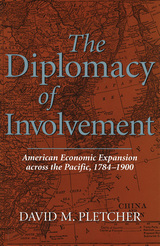
Like its predecessor, this important new work is focused on the connection between trade and investment on the one hand and U.S. foreign policy on the other. David Pletcher describes the trade of the United States with the Far East, the islands of the Pacific, and the northwest coast of North America from 1784 (the year of the first American trading expedition to China) to 1844 (the year of the first trade treaty with China, followed immediately by the U.S. acquisition of Oregon and California). He then traces the growth of trade and investment in Alaska, Hawaii, and the South Pacific from 1844 to 1890 and proceeds to do the same for China, Japan, and Korea. In the ensuing chapters, Pletcher covers the 1890s, including the annexation of Hawaii, the Sino-Japanese War, the acquisition of the Philippines, and the Open Door policy in China.
He concludes that the American expansion across the Pacific and into the Far East was not a deliberate, consistent drive for economic hegemony but a halting, experimental, improvised movement, carried out against determined opposition and indifference and dotted with setbacks and failures. Providing his own judgments about the wisdom and effectiveness of America's new endeavors, Pletcher summarizes the problems and handicaps involved, demonstrating that errors of the twentieth century were at least partly the result of poor preparation in the 1880s and 1890s.
Touching on every place where Americans undertook significant economic activity, The Diplomacy of Involvement will be an important aid for seasoned scholars, as well as an excellent introduction for the novice.
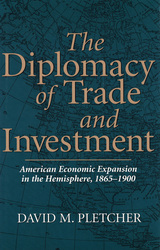
The move to encourage trade with Canada and Mexico during the 1990s, culminating with the negotiation of the North American Free Trade Agreement (NAFTA), has had a long background extending as far back as the late eighteenth century. American trade with both Canada and Latin America rapidly increased during the last third of the nineteenth century as a result of burgeoning industry and agriculture in the United States. The Diplomacy of Trade and Investment is the first detailed examination of the economic and political forces behind this rapid growth and their effect on government policy.
Based on a thorough examination of government documents, congressional debates and reports, private papers of government and business leaders, and newspapers, David M. Pletcher begins this monumental study with a comprehensive survey of U.S. trade following the Civil War. He goes on to outline the problems of building a coherent trade policy toward Canada, Mexico, Central America, the Caribbean, and South America. The study concludes by analyzing a series of abortive trade reform efforts and examining the effects of the Spanish-American War.
Pletcher rejects the long-held belief that American business and government engaged in a deliberate, consistent drive for economic hegemony in the hemisphere during the late 1800s. Instead he finds that the American government improvised and experimented with ways to further trade expansion. But American businessmen were often more interested in domestic trade than in trade with foreign markets. In fact, many of them resisted efforts to lower the American tariff or otherwise encourage American trade abroad.
The combination of traditionalist and revisionist insight with Pletcher's own deep knowledge and research provides the reader with a comprehensive new interpretation of hemispheric trade expansion at the end of the nineteenth century.



When millions of Syrians fled civil war after 2011, international donors and humanitarian organizations mobilized to provide assistance to neighboring countries. Focusing on Jordan—one of the world’s largest refugee hosting states—Disease and Diplomacy investigates how medical aid to refugees operates as an instrument of diplomacy and control within the global refugee system. It argues that health, far from being an apolitical humanitarian good, is a bargaining tool that states commodify to extract resources and concessions.
Drawing on years of field research, interviews, and policy analysis, the book shows how the Jordanian government, international donors, and humanitarian agencies turned healthcare for refugees into a tool for negotiating power, resources, and responsibility. In these cases, refugees, caught within these negotiations, often found their access to care determined not by medical need, but by political calculation. Developing the concept of the weaponization of medical aid, the book extends theories of migration diplomacy and refugee rentierism to show how global power dynamics shape who receives healthcare. The analysis identifies a self-reinforcing “crisis loop” that privileges short-term, highly visible responses while neglecting chronic and long-term needs. Disease and Diplomacy advances an interdisciplinary framework for understanding how humanitarian practices reinforce global inequalities and argues for more equitable approaches to refugee health and responsibility-sharing in the international system.

The Good Neighbor Policy was unique: a great power obligated itself not to use force in its dealings with twenty smaller powers and not to interfere in their domestic politics. It was a policy that lasted, with some perturbations, for twenty years: instituted by President Roosevelt in 1933 and carried out effectively from 1933 to 1943 by word and action, maintained during the Second World War largely as a result of British concern for continuance of Argentine beef exports, codified in the Charter of the Organization of American States in 1948, and reasserted by Truman and Acheson in 1950–51, it was covertly repudiated in Guatemala in 1954 by Eisenhower and the Dulles brothers, and not so secretly by Kennedy in the disastrous Bay of Pigs invasion of 1961. Openly shattered in the Dominican Republic by Johnson in 1965, it has since been completely abandoned in favor of the usual relationships between large and small powers.
Working with documents from the Public Records Office in London and the National Archives, with recently released materials from the U.S. Department of State, and with secondary sources, Bryce Wood describes the temptations laid before the leaders of one powerful state by its occasionally recalcitrant neighbors, and the ways of reacting that were found. Having told half the story in his The Making of the Good Neighbor Policy, Wood now concludes it in the present volume. One of the chief casualties is shown to be the Organization of American States, which since 1954 has found itself badly crippled in its work to promote harmony and continued cooperation among the member states.
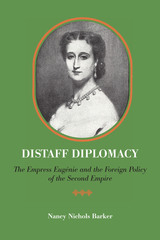
The Empress Eugénie, wife of Napoleon III and one of the most beautiful women ever to grace a throne, was the victim of her own inconstant mind. A daughter of an aristocratic Spanish family, she had a natural reverence for legitimate monarchy; yet her high-spirited temperament and chivalric outlook made her admire instinctively the boldness and aura of glory that she associated with the Napoleonic empire. The incongruous principles of Legitimism and Bonapartism battling within the Empress produced in her a double-mindedness that had tragic consequences.
The Empress has always been a controversial figure. Her enemies have blamed her the fall of the Second Empire and the defeat of France; her admirers have disclaimed for her any part in the mistakes that led to the disastrous Franco-Prussian War of 1870. To determine the actual role that Eugénie played, Barker, using material from public and private European archives and a wide range of published works, examines in Distaff Diplomacy the development of the Empress' views on foreign affairs and ascertains their effect on the formation of the policies of the Second Empire.
Eugénie's influence fluctuated widely over the years. As a bride she was neither interested in nor knowledgable about foreign matters; as a middle-aged woman, in the late years of the Empire, she was discredited by her past errors, but she continued to pull strings outside of normal diplomatic channels. Her most sustained and effective work, from 1861 to 1863, was largely the inspiration for a grand design to remake the map to assure French hegemony in Europe and to establish an empire in Mexico. The success of this design rested on an Austro-French alliance; but the design itself, reflecting the Empress' incoherent thinking, contained the fatal inconsistencies that made Austrian rejection of it inevitable. Since the Mexican expedition and the diplomatic muddle of 1863 were the watershed from which the subsequent troubles of the Empire flowed, the Empress must be held responsible for seriously undermining the foreign policy of the Empire. Despite Eugénie's many fine qualities—her generosity of spirit, her splendid courage, and her moral integrity—her diplomatic efforts, affected as they were by her background, temperament, state of health, and changing moods, did not amount to statesmanship. This first systematic examination of the Empress' influence on foreign policy delves deeply and carefully into the subject.

Goetze describes how the peacebuilding field came into being, how it defines who belongs to it and who does not, and what kind of group culture it has generated. Using an innovative methodology, she investigates the motivations of individuals who become peacebuilders, their professional trajectories and networks, and the “good peacebuilder” as an ideal. For many, working in peacebuilding in various ways—as an aid worker on the ground, as a lawyer at the United Nations, or as an academic in a think tank—has become not merely a livelihood, but also a form of participation in world politics. As a field, peacebuilding has developed techniques for incorporating and training new members, yet its internal politics also create the conditions of exclusion that often result in practical failures of the peacebuilding enterprise.
By providing a critical account of the social mechanisms that make up the peacebuilding field, Goetze offers deep insights into the workings of Western domination and global inequalities.

Winner of the 2024 Society of the Cincinnati Prize from the American Revolution Institute
Winner of the 2023 American Revolution Round Table of Philadelphia book award
In this eye-opening account, Eli Merritt reveals the deep political divisions that almost tore the Union apart during the American Revolution. So fractious were the founders’ political fights that they feared the War of Independence might end in disunion and civil war.
Instead of disbanding into separate regional confederacies, the founders managed to unite for the sake of liberty and self-preservation. In so doing, they succeeded in holding the young nation together. To achieve this, they forged grueling compromises, including Declaration of Independence in 1776, the Mississippi-Fisheries Compromise of 1779, and the ratification of the Articles of Confederation in 1781.
In addition to bringing new insights to the history of the American Revolution, Disunion Among Ourselves has inevitable resonances with our present era of political hyperpolarization and serves as a touchstone for contemporary politics, reminding us that the founders overcame far tougher times than our own through commitment to ethical constitutional democracy and compromise.
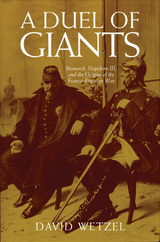
Combining impeccable scholarship and literary elegance, David Wetzel depicts the drama of machinations and passions that exploded in a war that forever changed the face of European history.
READERS
Browse our collection.
PUBLISHERS
See BiblioVault's publisher services.
STUDENT SERVICES
Files for college accessibility offices.
RECENTLY PUBLISHED






UChicago Accessibility Resources
home | accessibility | search | about | contact us
BiblioVault ® 2001 - 2026
The University of Chicago Press