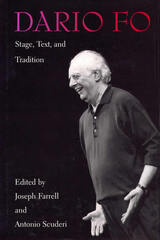
front cover of Dario Fo
Dario Fo
Stage, Text, and Tradition
Edited by Joseph Farrell and Antonio Scuderi
Southern Illinois University Press, 2000

Joseph Farrell and Antonio Scuderi present an international collection of essays reevaluating the multifaceted performance art of Nobel laureate Dario Fo.

The contributors, all of whom either have previously published on Fo or have worked with him, are the major Dario Fo scholars of three continents. Going beyond the Marxist criticism of the 1970s and 1980s, the editors and contributors try to establish an appropriate language in which to debate Fo’s theater. They seek to identify the core of Fo’s work, the material that will be of lasting value. This involves locating Fo in history, examining the nature of his development through successive phases, incorporating his politics into a wider framework of radical dissent, and setting his theatrical achievements in a context and a tradition.

The essays cover every aspect of Dario Fo: as actor, playwright, performer, and songwriter. They also provide the historical background of Fo’s theater, as well as an in-depth analyses of specific works and the contribution of Franca Rame.
[more]

front cover of The Death of the Child Valerio Marcello
The Death of the Child Valerio Marcello
Margaret L. King
University of Chicago Press, 1994
Margaret King shows what the death of a little boy named Valerio Marcello over five hundred years ago can tell us about his time.

This child, scion of a family of power and privilege at Venice's time of greatness, left his father in a state of despair so profound and so public that it occasioned an outpouring of consoling letters, orations, treatises, and poems. In these documents, we find a firsthand account, richly colored by humanist conventions and expectations, of the life of the fifteenth-century boy, the passionate devotion of his father, the feelings of his brothers and sisters, the striking absence of his mother. The father's story is here as well: the career of a Venetian nobleman and scholar, patron and soldier, a participant in Venice's struggle for dominion in the north of Italy.

Through these sources also King traces the cultural trends that made Marcello's century famous. Her work enlarges our view of the literature of consolation, which had a distinctive tradition in Venice, and shifting attitudes toward death from the late Middle Ages onward.

For the depth and acuity of its insights into political, cultural, and private life in fifteenth-century Venice, this book will be essential reading for students of the Renaissance. For the grace and drama of its storytelling, it will be savored by anyone who wishes to look into life and death in a palace, and a city, long ago.
[more]

front cover of The Deeds of Count Roger of Calabria and Sicily and of His Brother Duke Robert Guisc
The Deeds of Count Roger of Calabria and Sicily and of His Brother Duke Robert Guisc
Kenneth Baxter Wolf
University of Michigan Press, 2005

Geoffrey Malaterra's Deeds of Count Roger is the most important extant account of the Norman conquest of Muslim Silicy (1061-91). This volume includes a translation of the Latin original as well as an introduction, notes, and maps.

The Deeds of Count Roger fills a gap in the primary literature pertaining to the earliest phase of Latin Christian expansion at the expense of Islam, since the Norman conquests in Sicily were more or less contemporary with the First Crusade and the beginnings of the Spanish Reconquista. The account also illustrates the complexity of medieval historical writing, with Malaterra on the one hand praising the Normans for their military achievements and on the other subtly criticising the "lust for domination" that inspired them.

Kenneth Baxter Wolf is Professor of History at Pomona College.
[more]

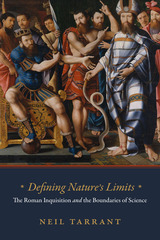
front cover of Defining Nature's Limits
Defining Nature's Limits
The Roman Inquisition and the Boundaries of Science
Neil Tarrant
University of Chicago Press, 2022
A look at the history of censorship, science, and magic from the Middle Ages to the post-Reformation era.
 
Neil Tarrant challenges conventional thinking by looking at the longer history of censorship, considering a five-hundred-year continuity of goals and methods stretching from the late eleventh century to well into the sixteenth.
 
Unlike earlier studies, Defining Nature’s Limits engages the history of both learned and popular magic. Tarrant explains how the church developed a program that sought to codify what was proper belief through confession, inquisition, and punishment and prosecuted what they considered superstition or heresy that stretched beyond the boundaries of religion. These efforts were continued by the Roman Inquisition, established in 1542. Although it was designed primarily to combat Protestantism, from the outset the new institution investigated both practitioners of “illicit” magic and inquiries into natural philosophy, delegitimizing certain practices and thus shaping the development of early modern science. Describing the dynamics of censorship that continued well into the post-Reformation era, Defining Nature's Limits is revisionist history that will interest scholars of the history science, the history of magic, and the history of the church alike.
 
[more]

front cover of Designating Place
Designating Place
Archaeological Perspectives on Built Environments in Ostia and Pompeii
Edited by Hans Kamermans and L. Bouke van der Meer
Leiden University Press, 2020
Spatial analysis on the basis of material culture has always been one of the major topics in archaeological research. Designating Place analyses the urban space of Roman Ostia and Pompeii in different ways, namely via geophysical analysis, spatial analysis, iconographic analysis and epigraphic analysis. This book honors the work of Hanna Stöger, the Leiden scholar who died in 2018. Hanna’s work in Ostia was not finished and this book contains contributions from people who inspired her, people she worked with, people she inspired and people who presented on sessions she organized. The book presents new data on Ostia obtained by techniques such as Space Syntax, high-resolution, shallow seismic reflection survey, the analysis of operational-sequences, linguistic landscape studies and collective memory studies, by scholars from the Netherlands, Canada, Germany, Italy, Japan, Norway, the UK, and the USA. As a bonus a selection of these papers form a hidden book on Roman bathing and water management.
[more]

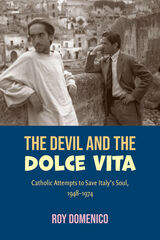
front cover of The Devil and the Dolce Vita
The Devil and the Dolce Vita
Catholic Attempts to Save Italy's Soul, 1948-1974
Roy Domenico
Catholic University of America Press, 2021
Italy’s economic expansion after World War Two triggered significant social and cultural change. Secularization accompanied this development and triggered alarm bells across the nation’s immense Catholic community. The Devil and the Dolce Vita is the story of that community – the church of Popes Pius XII, John XXIII and Paul VI, the lay Catholic Action association, and the Christian Democratic Party – and their efforts in a series of culture wars to preserve a traditional way of life and to engage and tame the challenges of a rapidly modernizing society. Roy Domenico begins this study during the heady days of the April 1948 Christian Democratic electoral triumph and ends when pro-divorce forces dealt the Catholics a defeat in the referendum of May 1974 where their hopes crashed and probably ended. Between those two dates Catholics engaged secularists in a number of battles – many over film and television censorship, encountering such figures as Roberto Rossellini, Luchino Visconti, Federico Fellini, and Pier Paolo Pasolini. The Venice Film Festival became a locus in the fight as did places like Pozzonovo, near Padua, where the Catholics directed their energies against a Communist youth organization; and Prato in Tuscany where the bishop led a fight to preserve church weddings. Concern with proper decorum led to more skirmishes on beaches and at resorts over modest attire and beauty pageants. By the 1960s and 1970s other issues, such as feminism, a new frankness about sexual relations, and the youth rebellion emerged to contribute to a perfect storm that led to the divorce referendum and widespread despair in the Catholic camp.
[more]

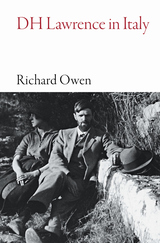
front cover of DH Lawrence in Italy
DH Lawrence in Italy
Richard Owen
Haus Publishing, 2014
November 1925: In search of health and sun, the writer D. H. Lawrence arrives on the Italian Riviera with his wife, Frieda, and is exhilarated by the view of the sparkling Mediterranean from his rented villa, set amid olives and vines. But over the next six months, Frieda will be fatally attracted to their landlord, a dashing Italian army officer. This incident of infidelity influenced Lawrence to write two short stories, “Sun” and “The Virgin and the Gypsy,” in which women are drawn to earthy, muscular men, both of which prefigured his scandalous novel Lady Chatterley’s Lover

In DH Lawrence in Italy, Owen reconstructs the drama leading up to the creation of one of the most controversial novels of all time by drawing on the unpublished letters and diaries of Rina Secker, the Anglo-Italian wife of Lawrence’s publisher. In addition to telling the story of the origins of Lady Chatterley, DH Lawrence in Italy explores Lawrence’s passion for all things Italian, tracking his path to the Riviera from Lake Garda to Lerici, Abruzzo, Capri, Sicily, and Sardinia.
[more]

front cover of Dialogues
Dialogues
Saint Gregory the Great
Catholic University of America Press, 1959
No description available
[more]

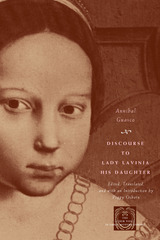
front cover of Discourse to Lady Lavinia His Daughter
Discourse to Lady Lavinia His Daughter
Annibal Guasco
University of Chicago Press, 2003
When eleven-year-old Lavinia Guasca began her new life as a lady-in-waiting at the court of Turin, she brought with her a parting gift from her father Annibal (1540-1619): a detailed guidebook he wrote to help steer her through the many pitfalls of court life. Lavinia had her father's Discourse published in 1586; this English translation is the first version published in any form since that time.

The Discourse displays an incredibly far-sighted view of women's education. Annibal thought gifted young girls should develop their talents and apply them to careers outside the home. In the Discourse, he details the unique and extremely rigorous educational program to which he had subjected Lavinia almost from the cradle with this end in mind. To complete Lavinia's education, Annibal filled the Discourse with advice on spirituality and morality, health and beauty, and how to behave at court—everything a well-bred lady-in-waiting would need to know. This edition also includes an appendix that traces the later events of Lavinia's life through excerpts from her father's letters.
[more]

front cover of Dissonant Heritage in Tourism
Dissonant Heritage in Tourism
Confronting Difficult Pasts in Italy and Beyond
Maria Paola Pasini
Central European University Press, 2026
Interest in dissonant heritage has grown significantly in recent years. Difficult legacies, such as monuments and urban and artistic works, as well as intangible personal and communal experiences are linked to dictatorships, regimes, wars, slavery, and exploitation. In some places, a dissonant heritage creates tension. In other places, difficult histories are cancelled or ignored. But forgetting is not the solution. Critical analysis can help us ‘face the past’ and process it in order to move forward. This applies to tourism as well: ‘Difficult’ places, monuments and experiences become opportunities for gaining and creating knowledge for a public interested in historical issues. At the same time, tourist presence is an incentive for communities to better comprehend their contested past(s). This volume contains contributions by scholars from various countries and different backgrounds, such as historians, architects, and anthropologists, who deal with this topic from different angles. The volume is divided into two parts: the first part concentrates on Italy, while the second part covers other countries in the world.
[more]

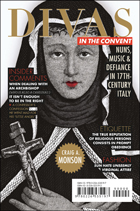
front cover of Divas in the Convent
Divas in the Convent
Nuns, Music, and Defiance in Seventeenth-Century Italy
Craig A. Monson
University of Chicago Press, 2012
When eight-year-old Lucrezia Orsina Vizzana (1590–1662) entered one of the preeminent convents in Bologna in 1598, she had no idea what cloistered life had in store for her. Thanks to clandestine instruction from a local maestro di cappella—and despite the church hierarchy’s vehement opposition to all convent music—Vizzana became the star of the convent, composing works so thoroughly modern and expressive that a recent critic described them as “historical treasures.” But at the very moment when Vizzana’s works appeared in 1623—she would be the only Bolognese nun ever to publish her music—extraordinary troubles beset her and her fellow nuns, as episcopal authorities arrived to investigate anonymous allegations of sisterly improprieties with male members of their order.
           
Craig A. Monson retells the story of Vizzana and the nuns of Santa Cristina to elucidate the role that music played in the lives of these cloistered women. Gifted singers, instrumentalists, and composers, these nuns used music not only to forge links with the community beyond convent walls, but also to challenge and circumvent ecclesiastical authority. Monson explains how the sisters of Santa Cristina—refusing to accept what the church hierarchy called God’s will and what the nuns perceived as a besmirching of their honor—fought back with words and music, and when these proved futile, with bricks, roof tiles, and stones. These women defied one Bolognese archbishop after another, cardinals in Rome, and even the pope himself, until threats of excommunication and abandonment by their families brought them to their knees twenty-five years later. By then, Santa Cristina’s imaginative but frail composer literally had been driven mad by the conflict.
           
Monson’s fascinating narrative relies heavily on the words of its various protagonists, on both sides of the cloister wall, who emerge vividly as imaginative, independent-minded, and not always sympathetic figures. In restoring the musically gifted Lucrezia Orsina Vizzana to history, Monson introduces readers to the full range of captivating characters who played their parts in seventeenth-century convent life.
 
[more]

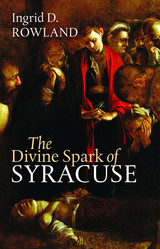
front cover of The Divine Spark of Syracuse
The Divine Spark of Syracuse
Ingrid D. Rowland
Brandeis University Press, 2018
Focusing on the figures of Plato, Archimedes, and Caravaggio, The Divine Spark of Syracuse discloses the role that Syracuse, a Greek cultural outpost in Sicily, played in fueling creative energies. Among the topics this book explores are Plato and the allegory of the cave, and the divine spark mentioned in his Seventh Letter. It also considers the machines of Archimedes, including his famous screw, and the variety of siege and antisiege weapons that he developed for the defense of his hometown during the siege of Syracuse during the Second Punic War, including “the hand” (a giant claw), the “burning mirror,” and the catapult. The final chapter offers a look at the artist and roustabout Caravaggio. On the run after yet another street brawl, Caravaggio traveled to Syracuse, where he painted Burial of St. Lucy (Santa Lucia) in 1608. Typical of his late works, the painting is notable for its subdued tones and emotional and psychological delicacy. This captivating book lends clear insight into the links between the sense of place and inspiration in philosophy, mathematics, and art. Rowland is the most learned tour guide we could ask for.
[more]

front cover of Doctors, Ambassadors, Secretaries
Doctors, Ambassadors, Secretaries
Humanism and Professions in Renaissance Italy
Douglas Biow
University of Chicago Press, 2002
In this book, Douglas Biow traces the role that humanists played in the development of professions and professionalism in Renaissance Italy, and vice versa. For instance, humanists were initially quite hostile to medicine, viewing it as poorly adapted to their program of study. They much preferred the secretarial profession, which they made their own throughout the Renaissance and eventually defined in treatises in the late sixteenth and early seventeenth centuries.

Examining a wide range of treatises, poems, and other works that humanists wrote both as and about doctors, ambassadors, and secretaries, Biow shows how interactions with these professions forced humanists to make their studies relevant to their own times, uniting theory and practice in a way that strengthened humanism. His detailed analyses of writings by familiar and lesser-known figures, from Petrarch, Machiavelli, and Tasso to Maggi, Fracastoro, and Barbaro, will especially interest students of Renaissance Italy, but also anyone concerned with the rise of professionalism during the early modern period.
[more]


Send via email Share on Facebook Share on Twitter