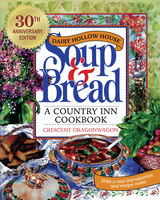
front cover of Dairy Hollow House Soup & Bread
Dairy Hollow House Soup & Bread
Thirtieth Anniversary Edition
Crescent Dragonwagon
University of Arkansas Press, 2021
For nearly two decades, Dairy Hollow House—a country inn and restaurant tucked into the Ozark Mountain resort town of Eureka Springs, Arkansas—welcomed guests from all over the world. Praised by the New York Times, Southern Living, Bon Appetit, and Good Morning America alike, the much-loved inn offered sparklingly fresh, innovative “nouveau’zarks” cuisine—respectful contemporary interpretations of local traditional cooking infused with seasonal ingredients. Although the famed inn is now closed, you can still enjoy the satisfying and life-affirming dishes by the James Beard Award–winning writer/restaurateur Crescent Dragonwagon in this thirtieth-anniversary edition of Dairy Hollow House Soup & Bread, a story rich cookbook as gutsy and distinctive as a steaming bowl of Gumbo Zeb.
[more]

logo for Intellect Books
Dance Studies in China
Selected Writings from the Journal of Beijing Dance Academy
Edited by Deng Youling and Zhang Yanjie
Intellect Books, 2022
Translated journal articles, available in English for the first time.

Officially founded in 1978, the Beijing Dance School was the first professional dance school established after the creation of the People’s Republic of China. In the years since, the Beijing Dance Academy has become the only institution of higher learning for professional dance education in the country, as well as the largest prestigious dance school in the world. It is a full-time institution of higher learning with commitments to developing excellent professional dancers, choreographers, and dance researchers. Dance Studies in China is a collection of articles selected from issues of the Journal of Beijing Dance Academy, the only academic journal of dance studies in China. The collection also includes an interview with Shen Wei, the Chinese American choreographer, painter, and director living in New York.
[more]

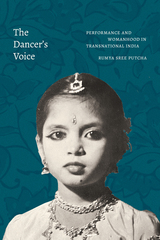
front cover of The Dancer's Voice
The Dancer's Voice
Performance and Womanhood in Transnational India
Rumya Sree Putcha
Duke University Press, 2023
In The Dancer’s Voice Rumya Sree Putcha theorizes how the Indian classical dancer performs the complex dynamics of transnational Indian womanhood. Putcha argues that the public persona of the Indian dancer has come to represent India in the global imagination—a representation that supports caste hierarchies and Hindu ethnonationalism, as well as white supremacist model minority narratives. Generations of Indian women have been encouraged to embody the archetype of the dancer, popularized through film cultures from the 1930s to the present. Through analyses of films, immigration and marriage laws, histories of caste and race, advertising campaigns, and her own family’s heirlooms, photographs, and memories, Putcha reveals how women’s citizenship is based on separating their voices from their bodies. In listening closely to and for the dancer’s voice, she offers a new way to understand the intersections of body, voice, performance, caste, race, gender, and nation.
[more]

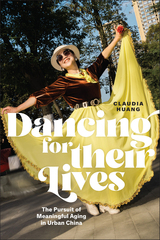
front cover of Dancing for Their Lives
Dancing for Their Lives
The Pursuit of Meaningful Aging in Urban China
Claudia Huang
Rutgers University Press, 2025
Dancing for Their Lives explores the vibrant world of retired Chinese women known as "dancing grannies” who seek fulfillment and companionship amidst societal upheaval. These women, part of China’s “lost generation,” gather in parks and public squares to reclaim their lives through dance in the wake of Chinese economic and cultural transformations. The book challenges prevailing narratives of aging societies, portraying old age as a site of social innovation rather than decline. Based on ethnographic research conducted in Chengdu, China, Dancing for Their Lives reveals how retirees learn to navigate shifting social norms and values while actively creating new models for growing older. The book’s insights resonate beyond Chinese society, offering lessons on resilience and the pursuit of meaning in any aging population. Dancing for Their Lives underscores the human capacity to craft purposeful lives amid uncertainty, transcending geographical boundaries to illuminate the universal quest for fulfillment in later years.
[more]

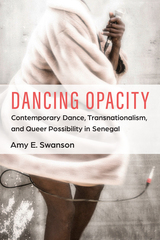
front cover of Dancing Opacity
Dancing Opacity
Contemporary Dance, Transnationalism, and Queer Possibility in Senegal
Amy E. Swanson
University of Michigan Press, 2025
Amy Swanson’s Dancing Opacity chronicles the ways in which contemporary dancers in Senegal navigate the global contemporary dance circuit while challenging heteropatriarchal ideologies at home. A longstanding hub of African performing arts, Senegal was at the forefront of the explosion of contemporary dance across the continent at the turn of the twenty-first century. Drawing on ethnographic and historical research, Swanson demonstrates how Senegalese choreographers and dancers contend with entrenched racialized prejudices about Africa outside the continent, while pushing back against repressive regulations of gender and sexuality within Senegal. Swanson employs the concept of opacity, defined as a refusal to adhere to the colonial logic of transparency for dominant gazes and argues that artists create work with multiple layers of meaning that are not meant to be immediately transparent to all viewers. By doing so, these artists evade cultural norms that govern gender and sexual expression in Senegal, while challenging their international audiences to expand their perceptions of African dance. Dancing Opacity highlights the artists’ accounts of their pedagogies, performances, aesthetics, and lived realities, as well as Africanist conceptions of gender, sexuality, and queerness that have yet to be applied to contemporary dance.
[more]

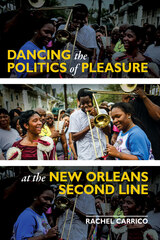
front cover of Dancing the Politics of Pleasure at the New Orleans Second Line
Dancing the Politics of Pleasure at the New Orleans Second Line
Rachel Carrico
University of Illinois Press, 2024

On many Sundays, Black New Orleanians dance through city streets in Second Lines. These processions invite would-be spectators to join in, grooving to an ambulatory brass band for several hours. Though an increasingly popular attraction for tourists, parading provides the second liners themselves with a potent public expression of Black resistance.

Rachel Carrico examines the parading bodies in motion as a form of negotiating and understanding power. Seeing pleasure as a bodily experience, Carrico reveals how second liners’ moves link joy and liberation, self and communal identities, play and dissent, and reclamations of place. As she shows, dancers’ choices allow them to access the pleasure of reclaiming self and city through motion and rhythm while expanding a sense of the possible in the present and for the future.

In-depth and empathetic, Dancing the Politics of Pleasure at the New Orleans Second Line blends analysis with a chorus of Black voices to reveal an indelible facet of Black culture in the Crescent City.
[more]

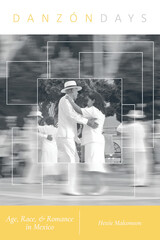
front cover of Danzón Days
Danzón Days
Age, Race, and Romance in Mexico
Hettie Malcomson
University of Illinois Press, 2023

Winner of the 2024 BFE Book Prize (British Forum for Ethnomusicology)

Older people negotiating dance routines, intimacy, and racialized differences provide a focal point for an ethnography of danzón in Veracruz, the Mexican city closely associated with the music-dance genre. Hettie Malcomson draws upon on-site research with semi-professional musicians and amateur dancers to reveal how danzón connects, and does not connect, to blackness, joyousness, nostalgia, ageing, and romance. Challenging pervasive utopian views of danzón, Malcomson uses the idea of ambivalence to explore the frictions and opportunities created by seemingly contrary sentiments, ideas, sensations, and impulses. Interspersed with experimental ethnographic vignettes, her account takes readers into black and mestizo elements of local identity in Veracruz, nostalgic and newer styles of music and dance, and the friendships, romances, and rivalries at the heart of regular danzón performance and its complex social world.

Fine-grained and evocative, Danzón Days journeys to one of the genre’s essential cities to provide new perspectives on aging and romance and new explorations of nostalgia and ambivalence.

[more]

front cover of A Day for the Hunter, a Day for the Prey
A Day for the Hunter, a Day for the Prey
Popular Music and Power in Haiti
Gage Averill
University of Chicago Press, 1997
The history of Haiti throughout the twentieth century has been marked by oppression at the hands of colonial and dictatorial overlords. But set against this "day for the hunter" has been a "day for the prey," a history of resistance, and sometimes of triumph. With keen cultural and historical awareness, Gage Averill shows that Haiti's vibrant and expressive music has been one of the most highly charged instruments in this struggle—one in which power, politics, and resistance are inextricably fused.

Averill explores such diverse genres as Haitian jazz, troubadour traditions, Vodou-jazz, konpa, mini-djaz, new generation, and roots music. He examines the complex interaction of music with power in contexts such as honorific rituals, sponsored street celebrations, Carnival, and social movements that span the political spectrum.

With firsthand accounts by musicians, photos, song texts, and ethnographic descriptions, this book explores the profound manifestations of power and song in the day-to-day efforts of ordinary Haitians to rise above political repression.
[more]

front cover of Defending Rumba in Havana
Defending Rumba in Havana
The Sacred and the Black Corporeal Undercommons
Maya J. Berry
Duke University Press, 2025
In Defending Rumba in Havana, anthropologist and dancer Maya J. Berry examines rumba as a way of knowing the embodied and spiritual dimensions of Black political imagination in post-Fidel Cuba. Historically a Black working-class popular dance, rumba, Berry contends, is a method of Black Cuban struggle that provides the community, accountability, sustenance, and dignity that neither the state nor the expanding private market can. Berry’s feminist theorization builds on the notion of the undercommons to show how rumba creates a space in which its practitioners enact deeply felt and dedicatedly defended choreographies of reciprocity, refusal, sovereignty, devotion, and pleasure, both on stage and in their daily lives. Berry demonstrates that this Black corporeal undercommons emphasizes mutual aid and refuses neoliberal development logics, favoring instead a collective self-determination rooted in African diasporic spiritual practices through which material compensation and gendered power dynamics are negotiated. By centering rumba to analyze how poor Black Cubans navigate gendered and racialized life, Berry helps readers better understand the constraints and yearnings that move diasporic Black struggles to seek refuge beyond the bounds of the nation-state.
[more]

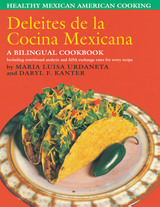
front cover of Deleites de la Cocina Mexicana
Deleites de la Cocina Mexicana
Healthy Mexican American Cooking
By Maria Luisa Urdaneta and Daryl F. Kanter
University of Texas Press, 1996

Mexican food, Tex-Mex, Southwestern cuisine—call it what you will, the foods that originated in Mexico have become everyone's favorites. Yet as we dig into nachos and enchiladas, many people worry about the fats and calories that traditional Mexican food contains.

Deleites de la Cocina Mexicana proves that Mexican cooking can be both delicious and healthy. In this bilingual cookbook, Maria Luisa Urdaneta and Daryl F. Kanter provide over 200 recipes for some of the most popular Mexican dishes-guacamole, frijoles, Spanish rice, chiles rellenos, chile con carne, chalupas, tacos, enchiladas, fajitas, menudo, tamales, and flan-to name only a few. Without sacrificing a bit of flavor, the authors have modified the recipes to increase complex carbohydrates and total dietary fiber, while decreasing saturated and total fats. These modifications make the recipes suitable for people with diabetes-and all those who want to reduce the fats and calories in their diet. Each recipe also includes a nutritional analysis of calories, fats, sodium, etc., and American Diabetic Association exchange rates.

Because diabetes is a growing problem in the Mexican-American community, Deleites de la Cocina Mexicana is vital for all those who need to manage their diet without giving up the foods they love. Let it be your one-stop guide to cooking and eating guilt-free Mexican food.

[more]

front cover of Des Moines Register Cookbook
Des Moines Register Cookbook
Carol Mcgarvey
University of Iowa Press, 1995
The food pages of The Des Moines Register, Iowa's highly regarded newspaper, have long reflected the wide-ranging tastes of Iowa cooks, both adventurous and traditional. Drawings.
[more]

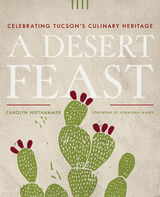
front cover of A Desert Feast
A Desert Feast
Celebrating Tucson's Culinary Heritage
Carolyn Niethammer, Foreword by Johnathan Mabry
University of Arizona Press, 2020

Southwest Book of the Year Award Winner

Pubwest Book Design Award Winner

Drawing on thousands of years of foodways, Tucson cuisine blends the influences of Indigenous, Mexican, mission-era Mediterranean, and ranch-style cowboy food traditions. This book offers a food pilgrimage, where stories and recipes demonstrate why the desert city of Tucson became American’s first UNESCO City of Gastronomy.

Both family supper tables and the city’s trendiest restaurants feature native desert plants and innovative dishes incorporating ancient agricultural staples. Award-winning writer Carolyn Niethammer deliciously shows how the Sonoran Desert’s first farmers grew tasty crops that continue to influence Tucson menus and how the arrival of Roman Catholic missionaries, Spanish soldiers, and Chinese farmers influenced what Tucsonans ate.

White Sonora wheat, tepary beans, and criollo cattle steaks make Tucson’s cuisine unique. In A Desert Feast, you’ll see pictures of kids learning to grow food at school, and you’ll meet the farmers, small-scale food entrepreneurs, and chefs who are dedicated to growing and using heritage foods. It’s fair to say, “Tucson tastes like nowhere else.”
[more]

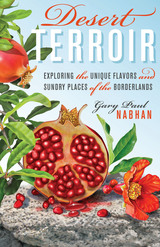
front cover of Desert Terroir
Desert Terroir
Exploring the Unique Flavors and Sundry Places of the Borderlands
By Gary Paul Nabhan
University of Texas Press, 2012

Why does food taste better when you know where it comes from? Because history—ecological, cultural, even personal—flavors every bite we eat. Whether it’s the volatile chemical compounds that a plant absorbs from the soil or the stories and memories of places that are evoked by taste, layers of flavor await those willing to delve into the roots of real food. In this landmark book, Gary Paul Nabhan takes us on a personal trip into the southwestern borderlands to discover the terroir—the “taste of the place”—that makes this desert so delicious.

To savor the terroir of the borderlands, Nabhan presents a cornucopia of local foods—Mexican oregano, mesquite-flour tortillas, grass-fed beef, the popular Mexican dessert capirotada, and corvina (croaker or drum fish) among them—as well as food experiences that range from the foraging of Cabeza de Vaca and his shipwrecked companions to a modern-day camping expedition on the Rio Grande. Nabhan explores everything from the biochemical agents that create taste in these foods to their history and dispersion around the world. Through his field adventures and humorous stories, we learn why Mexican oregano is most potent when gathered at the most arid margins of its range—and why foods found in the remote regions of the borderlands have surprising connections to foods found by his ancestors in the deserts of the Mediterranean and the Middle East. By the end of his movable feast, Nabhan convinces us that the roots of this fascinating terroir must be anchored in our imaginations as well as in our shifting soils.
[more]

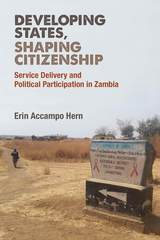
front cover of Developing States, Shaping Citizenship
Developing States, Shaping Citizenship
Service Delivery and Political Participation in Zambia
Erin Accampo Hern
University of Michigan Press, 2019
At the nexus of political science, development studies, and public policy, Developing States, Shaping Citizenship analyzes an overlooked driver of political behavior: citizens’ past experience with the government through service provision. Using evidence from Zambia, this book demonstrates that the quality of citizens’ interactions with the government through service provision sends them important signals about what they can hope to gain from political action. These interactions influence not only formal political behaviors like voting, but also collective behavior, political engagement, and subversive behaviors like tax evasion. Lack of capacity for service delivery not only undermines economic growth and human development, but also citizens’ confidence in the responsiveness of the political system. Absent this confidence, citizens are much less likely to participate in democratic processes, express their preferences, or comply with state revenue collection. Economic development and political development in low-capacity states, Hern argues, are concurrent processes.
 
Erin Accampo Hern draws on original data from an original large-N survey, interviews, Afrobarometer data, and archival materials collected over 12 months in Zambia. The theory underlying this book’s framework is that of policy feedback, which argues that policies, once in place, influence the subsequent political participation of the affected population. This theory has predominantly been applied to advanced industrial democracies, and this book is the first explicit effort to adapt the theory to the developing country context.

[more]

front cover of Dog and Gun
Dog and Gun
A Few Loose Chapters on Shooting, Among Which Will Be Found Some Anecdotes and Incidents
Johnson J. Hooper, with an Introduction by Philip D. Beidler
University of Alabama Press, 1992
The least well known of Johnson Jones Hooper’s works, Dog and Gun was first published as a newspaper series, then appeared in six book editions between 1856 and 1871. Hooper is Alabama’s most celebrated antebellum author, and here he gives insight into the meaning of a culture where every male hunts – and a man who shoots as a gentleman will be assumed a gentleman. Beidler’s introduction to this reprint edition explores the social, literary, and technical dimensions of Dog and Gun, which he sees as an important commentary on class distinctions in the antebellum South, as well as a straightforward treatise on hunting.
 
Although the book is a manual for the hunter, with characteristic humor and a certain disdain, Hooper gives a full picture of the gentlemanly sport of hunting – clearly distinct from hunting for food – in all aspects including hunter, weaponry, and sporting dogs. He takes us back to an autumnal ritual of the hunt, where one is always a boy with his first gun – to the natural mystery of quest, competition, predation, pursuit, survival, bravery, endurance, and eventual defeat, called the mystery of the hunt.
[more]

front cover of A Domestic Cook Book
A Domestic Cook Book
Containing a Careful Selection of Useful Receipts for the Kitchen
Malinda Russell
University of Michigan Press, 2025
A Domestic Cook Book (1866) by Malinda Russell is the oldest known published cookbook written by an African American woman. Born in Tennessee, and descended from Virginia freemen, Russell decided to move to Liberia at the age of 19. When her money for the trip was stolen, she was stranded in Lynchburg, Virginia, and began working as a cook and companion, traveling with women as a nurse. After living in Lynchburg for only four years, Russell’s husband died and she moved with her son to Tennessee where she kept a boarding house and then went on to run a pastry shop. After a second dramatic robbery in 1864, Russell moved to Paw Paw, Michigan, because she had heard it was the “garden of the west” and published a cookbook “with the intention of benefiting the public” as well as supporting herself.

A Domestic Cook Book contains 260 recipes and household tips that draw from Malinda Russell’s twenty years of experience cooking in Southern kitchens, her boarding house, and her pastry shop, and showcase her skills as a pastry chef. This new edition includes a foreword by scholar Rafia Zafar as well as an introduction by the late food historian Janice Bluestein Longone that contextualize Russell’s cookbook. Using the only known copy of the original book housed in the Janice Bluestein Longone Culinary Archive at the University of Michigan Library's Special Collections Research Center, this new edition preserves an important part of Michigan and American history and makes it widely available to readers for the first time.

[more]

front cover of Don't Deny My Name
Don't Deny My Name
Words and Music and the Black Intellectual Tradition
Lorenzo Thomas; Edited and with an Introduction by Aldon Lynn Nielsen
University of Michigan Press, 2008
Black musical forms profoundly influenced the work of American poet and leading literary figure Lorenzo Thomas, and he wrote about them with keen insight---and obvious pleasure. This book, begun by Thomas before his death in 2005, collects more than a dozen of his savvy yet engagingly personal essays that probe the links between African American music, literature, and popular culture, from the Harlem Renaissance to the present. Don't Deny My Name (which takes its title from a blues song by Jelly Roll Morton) begins by laying out the case that the blues is a body of literature that captured the experience of African American migrants to the urban North and newer territories to the West. The essays that follow collectively provide a tour of the movement through classic jazz, bop, and the explosions of the free jazz era, followed by a section on R&B and soul. The penultimate essay is a meditation on rap music that attempts to bring together the extremes of emotion that hip hop elicits, and the collection ends with an unfinished preface to the volume.
[more]


Send via email Share on Facebook Share on Twitter