
 A SCHOLARLY BOOK REPOSITORY
34 start with E start with E

Economic Analysis of the Digital Economy explores the economic impact of digitization, with each chapter identifying a promising new area of research. The Internet is one of the key drivers of growth in digital communication, and the first set of chapters discusses basic supply-and-demand factors related to access. Later chapters discuss new opportunities and challenges created by digital technology and describe some of the most pressing policy issues. As digital technologies continue to gain in momentum and importance, it has become clear that digitization has features that do not fit well into traditional economic models. This suggests a need for a better understanding of the impact of digital technology on economic activity, and Economic Analysis of the Digital Economy brings together leading scholars to explore this emerging area of research.
With all the verve and erudition that have established his earlier books as classics, Richard A. Lanham here traces our epochal move from an economy of things and objects to an economy of attention. According to Lanham, the central commodity in our new age of information is not stuff but style, for style is what competes for our attention amidst the din and deluge of new media. In such a world, intellectual property will become more central to the economy than real property, while the arts and letters will grow to be more crucial than engineering, the physical sciences, and indeed economics as conventionally practiced. For Lanham, the arts and letters are the disciplines that study how human attention is allocated and how cultural capital is created and traded. In an economy of attention, style and substance change places. The new attention economy, therefore, will anoint a new set of moguls in the business world—not the CEOs or fund managers of yesteryear, but new masters of attention with a grounding in the humanities and liberal arts.
Lanham’s The Electronic Word was one of the earliest and most influential books on new electronic culture. The Economics of Attention builds on the best insights of that seminal book to map the new frontier that information technologies have created.

A foundational new collection examining the mechanics of privacy in the digital age.
The falling costs of collecting, storing, and processing data have allowed firms and governments to improve their products and services, but have also created databases with detailed individual-level data that raise privacy concerns. This volume summarizes the research on the economics of privacy and identifies open questions on the value of privacy, the roles of property rights and markets for privacy and data, the relationship between privacy and inequality, and the political economy of privacy regulation.
Several themes emerge across the chapters. One is that it may not be possible to solve privacy concerns by creating a market for the right to privacy, even if property rights are well-defined and transaction costs are low. Another is that it is difficult to measure and value the benefits of privacy, particularly when individuals have an intrinsic preference for privacy. Most previous attempts at valuation have focused only on quantifiable economic outcomes, such as innovation. Finally, defining privacy through an economic lens is challenging. The broader academic and legal literature includes many distinct definitions of privacy, and different definitions may be appropriate in different contexts. The chapters explore a variety of frameworks for examining these questions and provide a range of new perspectives on the role of economics research in understanding the benefits and costs of privacy and of data flows. As the digital economy continues to expand the scope of economic theory and research, The Economics of Privacy provides the most comprehensive survey to date of this field and its next steps.
A thought-provoking examination of how AI might either spur or harm human economic progress.
What happens to an economy when machines can think as well as, or even better than, humans? The Economics of Transformative AI tackles this issue, which is one of the most consequential economic questions of our time. This book brings together sixteen research studies from top economists that look closely at how transformative AI reshapes everything from innovation and market structure to employment, inequality, and human purpose. They explore both opportunities, such as personalized algorithmic assistance, accelerated scientific discovery, and new forms of organization, and profound challenges, including potential labor displacement, rising concentration of power, changes in the information ecosystem, and even possible existential risks to humanity.
The studies in this volume develop economic frameworks for understanding the conditions under which AI might enhance or undermine human flourishing. They offer policymakers, researchers, and business leaders the analytical tools needed to prepare for the potential economic transformations ahead.

This book investigates programs for automatic analysis and production of written human language. These specialized programs use knowledge about the structure and meaning of human language in the form of grammars. Various techniques are proposed which focus on solutions for practical problems in processing of constraint-logic grammars. The solutions are all based on the automatic adaptation or compilation of a grammar rather than a modification of the processing algorithm used. As such they allow the grammar writer to abstract over details of grammar processing and in many cases enable more efficient processing.
Electronic Literature as a Model of Creativity and Innovation in Practice maps electronic literature in Europe and is an essential read for scholars and students in the field. ELMCIP is a three-year (2013) collaborative research project funded by Humanities in the European Research Area (HERA) JRP for Creativity and Innovation.
ELMCIP involved seven European partners investigating how creative communities of practitioners form within a transnational and transcultural context in a globalized and distributed communication environment. Focusing on the electronic literature community in Europe as a model of networked creativity and innovation in practice, ELMCIP studies the formation and interactions of that community and furthers electronic literature research and practice in Europe.
This book includes reflective reports by all of the principal investigators of the project. It details the development of a major digital humanities research database and the publication of the first trans-European anthology of electronic literature, and includes a report on electronic literature publishing venues across Europe and consideration of different forms of creative communities develop around genres of digital practice.

From a do-it-yourself Mount Rushmore to an automated tribute to the devastating annual toll of traffic deaths in the United States, Electronic Monuments describes commemoration as a fundamental experience, joining individual and collective identity, and adapting both to the emerging apparatus of “electracy,” or digital literacy. Concerns about the destruction of civic life caused by the society of the spectacle are refocused on the question of how a collectivity remembers who or what it is.
Ulmer proposes that the Internet makes it possible for monumentality to become a primary site of self-knowledge, one that supports a new politics, ethics, and dimension of education. The Internet thus holds the promise of bringing citizens back into the political equation as witnesses and monitors.
Gregory L. Ulmer is professor of English and media studies at the University of Florida, Gainesville.
Whether people want to play games and download music, engage in social networking and professional collaboration, or view pornography and incite terror, the Internet provides myriad opportunities for people who share common interests to find each other. The contributors to this book argue that these self-selected online groups are best understood as tribes, with many of the same ramifications, both positive and negative, that tribalism has in the non-cyber world.
In Electronic Tribes, the authors of sixteen competitively selected essays provide an up-to-the-minute look at the social uses and occasional abuses of online communication in the new media era. They explore many current Internet subcultures, including MySpace.com, craftster.org, massively multiplayer online role-playing games (MMORPGs) such as World of Warcraft, music downloading, white supremacist and other counterculture groups, and Nigerian e-mail scams. Their research raises compelling questions and some remarkable answers about the real-life social consequences of participating in electronic tribes. Collectively, the contributors to this book capture a profound shift in the way people connect, as communities formed by geographical proximity are giving way to communities—both online and offline—formed around ideas.
This highly acclaimed collection of Richard Lanham's witty, provocative, and engaging essays surveys the effects of electronic text on the arts and letters. Lanham explores how electronic text fulfills the expressive agenda of twentieth-century visual art and music, revolutionizes the curriculum, democratizes the instruments of art, and poses anew the cultural accountability of humanism itself.
Persuading us with uncommon grace and power that the move from book to screen gives cause for optimism, not despair, Lanham proclaims that "electronic expression has come not to destroy the Western arts but to fulfill them."
The Electronic Word is also available as a Chicago Expanded Book for your Macintosh®. This hypertext edition allows readers to move freely through the text, marking "pages," annotating passages, searching words and phrases, and immediately accessing annotations, which have been enhanced for this edition. In a special prefatory essay, Lanham introduces the features of this electronic edition and gives a vividly applied critique of this dynamic new edition.
This translation focuses on publications by Donald E. Knuth, one of the world’s leading computer programmers, that were addressed primarily to a general audience rather than to specialists. These fifteen papers discuss the history of computer science from ancient Babylon to modern times and survey the field of computer science and the nature of algorithms.




ESC takes as its point of departure the CBS Radio adventure series Escape (1947–54). The postwar years saw both a decline in popularity for American radio drama, and the dawn of the Anthropocene era, with human beings emerging as the primary force affecting the earth’s systems.
Jacob Smith considers Escape’s adventure stories from an ecocritical perspective, analyzing the geographic, sociopolitical, and ecological details of the stories to reveal how they are steeped in social and environmental history.
The work of contemporary sound artists and field recordists underscores the relevance of sound in these narratives and demonstrates audio’s potential as a key medium for scholarship. ESC features recordings by some of the most prominent sound artists working in this area, including Daniel Blinkhorn, Peter Cusak, David Dunn, JLIAT, Christina Kubisch, Francisco López, Sally Ann McIntyre, Chris Watson, and Jana Winderen.
ESC makes the urgency of our critical ecological moment audible in a new way. The audio essays articulate what it means to live in an Anthropocene era and posit alternative ways of conceptualizing our historical moment. ESC sharpens our ability to listen and respond to our world with greater ecological awareness.
All publication resources for ESC, including the introductory essay, audio materials, and backmatter, are available on Fulcrum. The audio materials are also available on Apple Podcasts.
The book is aimed at business executives who want to understand the potential of blockchain for solving real-world business problems, and readers with technical knowledge who want to understand the business use cases.
Ethereum for Business covers topics such as:
• Basics of blockchain technology and key components on wallets, tokens, and keys.
• Decentralization in digital marketplaces, smart contracts, privacy, scalability, supply chain management, trade finance, payments and asset transfers, and tokenomics.
• Transforming the world of enterprise computing by enabling companies to model and manage assets, real or digital, that exist off-chain.
• A guide for implementation that contains key success metrics for enterprises considering blockchain-based solutions.
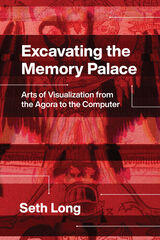
In Excavating the Memory Palace, Seth David Long mines the history of Europe’s arts of memory to find the origins of today’s data visualizations, unearthing how ancient constructions of cognitive pathways paved the way for modern technological interfaces. Looking to techniques like the memory palace, he finds the ways that information has been tied to sensory and visual experience, turning raw data into lucid knowledge. From the icons of smart phone screens to massive network graphs, Long shows us the ancestry of the cyberscape and unveils the history of memory as a creative act.
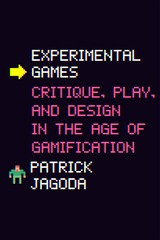
Drawing from his own experience as a game designer, Patrick Jagoda argues that games need not be synonymous with gamification. He studies experimental games that intervene in the neoliberal project from the inside out, examining a broad variety of mainstream and independent games, including StarCraft, Candy Crush Saga, Stardew Valley, Dys4ia, Braid, and Undertale. Beyond a diagnosis of gamification, Jagoda imagines ways that games can be experimental—not only in the sense of problem solving, but also the more nuanced notion of problem making that embraces the complexities of our digital present. The result is a game-changing book on the sociopolitical potential of this form of mass entertainment.
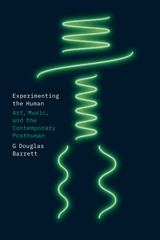
In Experimenting the Human, G Douglas Barrett argues that experimental music speaks to the contemporary posthuman, a condition in which science and technology decenter human agency amid the uneven temporality of postwar global capitalism. Time moves forward for some during this period, while it seems to stand still or even move backward for others. Some say we’re already posthuman, while others endure the extended consequences of never having been considered fully human in the first place. Experimental music reflects on this state, Barrett contends, through its interdisciplinary involvements in postwar science, technology, and art movements.
Rather than pursuing the human's beyond, experimental music addresses the social and technological conditions that support such a pursuit. Barrett locates this tendency of experimentalism throughout its historical entanglements with cybernetics, and in his intimate analysis of Alvin Lucier’s neurofeedback music, Pamela Z’s BodySynth performances, Nam June Paik’s musical robotics, Pauline Oliveros’s experiments with radio astronomy, and work by Laetitia Sonami, Yasunao Tone, and Jerry Hunt. Through a unique meeting of music studies, media theory, and art history, Experimenting the Human provides fresh insights into what it means to be human.

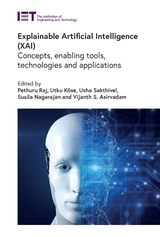

An accessible starting point for those interested in the past, present, and future of digital cultural heritage.
The digitization of cultural heritage has reshaped humanities research and professional practice, though its full impact is still emerging. As more cultural heritage becomes born-digital, new archives and collections introduce complexity, challenges, and shared methods across sectors. Exploring Digital Cultural Heritage examines interpretations, contexts, and uses across four themes—access, use and reuse, value(s), and sustainability—spanning digitized and born-digital materials. Drawing on case studies and practical examples, it provides an overview of the concepts, processes, and technologies shaping digital cultural heritage as well as its future challenges and directions.



Though contributors write from a variety of methodological positions and address themselves to a range of archives, they share the primary conviction that the impact of Web 2.0 on literary practice is far-reaching, far from self-evident, and far more variegated and unpredictable than easy summations of social media’s influence suggest. Expressive Networks asks after poetry’s present and future by examining what poems themselves express about the social make-up of networked platforms.
Edited by Matthew Kilbane with contributions from Cameron Awkward-Rich, Micah Bateman, Andrew Campana, Sumita Chakraborty, Scott Challener, C.R. Grimmer, Tess McNulty, Michael Nardone, Seth Perlow, Anna Preus, Susanna Sacks, Carly Schnitzler, Melanie Walsh, and Samuel Caleb Wee.
READERS
Browse our collection.
PUBLISHERS
See BiblioVault's publisher services.
STUDENT SERVICES
Files for college accessibility offices.
RECENTLY PUBLISHED






UChicago Accessibility Resources
home | accessibility | search | about | contact us
BiblioVault ® 2001 - 2026
The University of Chicago Press