
 A SCHOLARLY BOOK REPOSITORY
23 start with E start with E
Designed as a corrective to colonial literary histories that have excluded Native voices, this anthology brings together a variety of primary texts produced by the Algonquian peoples of New England during the seventeenth, eighteenth, and very early nineteenth centuries. Included among these written materials and objects are letters, signatures, journals, baskets, pictographs, confessions, wills, and petitions, each of which represents a form of authorship. Together they demonstrate the continuing use of traditional forms of memory and communication and the lively engagement of Native peoples with alphabetic literacy during the colonial period. Each primary text is accompanied by an essay that places it in context and explores its significance.
Written by leading scholars in the field, these readings draw on recent trends in literary analysis, history, and anthropology to provide an excellent overview of the field of early Native studies. They are also intended to provoke discussion and open avenues for further exploration by students and other interested readers. Above all, the texts and commentaries gathered in this volume provide an opportunity to see Native American literature as a continuity of expression that reflects choices made long before contact and colonization, rather than as a nineteenth—or even twentieth-century invention.
Contributors include Heidi Bohaker, Heather Bouwman, Joanna Brooks, Kristina Bross, Stephanie Fitzgerald, Sandra Gustafson, Laura Arnold Leibman, Kevin McBride, David Murray, Laura Murray, Jean O'Brien, Ann Marie Plane, Philip Round, Jodi Schorb, David Silverman, and Hilary E. Wyss.
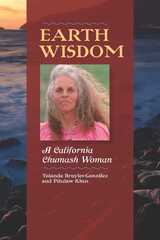
The 1978 Point Conception Occupation was a turning point in Pilulaw Khus’s life. In that year excavation began for a new natural gas facility at Point Conception, near Santa Barbara, California. To the Chumash tribal people of the central California coast, this was desecration of sacred land. In the Chumash cosmology, it was the site of the Western Gate, a passageway for spirits to enter the next world. Frustrated by unfavorable court hearings, the Chumash and their allies mobilized a year-long occupation of the disputed site, eventually forcing the energy company to abandon its plan. The Point Conception Occupation was a landmark event in the cultural revitalization of the Chumash people and a turning point in the life of Pilulaw Khus, the Chumash activist and medicine woman whose firsthand narrations comprise this volume.
Scholar Yolanda Broyles-González provides an extensive introductory analysis of Khus’s narrative. Her analysis explores “re-Indianization” and highlights the newly emergent Chumash research of the last decade.
In the world of book publishing, this volume from a traditional Chumash woman elder is a first. It puts a 20th (and 21st) century face, name, identity, humanity, personality, and living voice on the term Chumash.
A necessary reexamination of Indigenous mounds, demonstrating their sustained vitality and vibrant futurity by centering Native voices
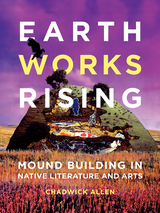
Typically represented as unsolved mysteries or ruins of a tragic past, Indigenous mounds have long been marginalized and misunderstood. In Earthworks Rising, Chadwick Allen issues a compelling corrective, revealing a countertradition based in Indigenous worldviews. Alongside twentieth- and twenty-first-century Native writers, artists, and intellectuals, Allen rebuts colonial discourses and examines the multiple ways these remarkable structures continue to hold ancient knowledge and make new meaning—in the present and for the future.
Earthworks Rising is organized to align with key functional categories for mounds (effigies, platforms, and burials) and with key concepts within mound-building cultures. From the Great Serpent Mound in Ohio to the mound metropolis Cahokia in Illinois to the generative Mother Mound in Mississippi, Allen takes readers deep into some of the most renowned earthworks. He draws on the insights of poets Allison Hedge Coke and Margaret Noodin, novelists LeAnne Howe and Phillip Carroll Morgan, and artists Monique Mojica and Alyssa Hinton, weaving in a personal history of earthwork encounters and productive conversation with fellow researchers.
Spanning literature, art, performance, and built environments, Earthworks Rising engages Indigenous mounds as forms of “land-writing” and as conduits for connections across worlds and generations. Clear and compelling, it provokes greater understanding of the remarkable accomplishments of North America’s diverse mound-building cultures over thousands of years and brings attention to new earthworks rising in the twenty-first century.
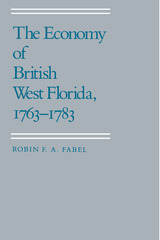
The untold economic story of Britain’s Gulf Coast frontier.
This is the first book-length investigation of the economy of British West Florida and the extent to which it was economically viable given that it had been an economic failure for Spain. In it, author Robin Fabel explores both the territory's economy and history but also analyzes previously neglected but key aspects of British West Florida, including the maritime life of the province, the institution of slavery, and the potentially great immigration scheme sponsored by the Company of Military Adventures.
The British divided Florida into two colonies: East Florida and West Florida. West Florida comprised the area between the Apalachicola, Chattahoochee, and Mississippi rivers, and from the Gulf of Mexico north to thirty-two degrees twenty-eight minutes north latitude, roughly the latitude of modern-day Jackson, MS and Montgomery, AL. In the geographic center of the colony were Mobile, Alabama and Pensacola, Floriday. British West Florida included parts of the states of Alabama, Florida, Louisiana, and Mississippi and existed from 1763 until 1783 at the end of the American Revolutionary War.
Fabel contrasts the founding of Georgia, where slaves were initially excluded, with West Florida, where the slave trade became important economically. The British believed that only enslaved Blacks could labor successfully in the hot climate. Fabel gives an account of how owners employed enslaved people, how rare it was for slaves to be emancipated, and the passage of slave laws for West Florida. Fabel also explores British West Florida’s trade with Native Americans and the Caribbean islands, as well as the colony's relationships with neighboring Spanish and French communities.
Fabel's work offers an engaging and accessible account of the history of an expansive region of colonial North America during a fluid period of colonial history before American independence.
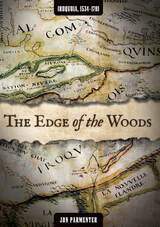
American history demonstrates time and again the price of Manifest Destiny.
"This thoroughly researched volume is highly recommended to anyone—at any level—who is interested in the archaeology of the Southeast." —CHOICE
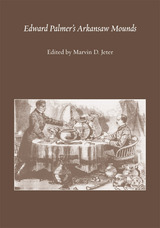
During the 1880s a massive scientific effort was launched by the Smithsonian Institution to discover who had built the prehistoric burial mounds found throughout the United States. Arkansaw Mounds tells the story of this exploration and of Edward Palmer, one of the nineteenth century’s greatest natural historians and archaeologists, who was recruited to lead the research project. Arkansas was unusually rich in prehistoric remains, especially mounds, and became a major focus of the study. Palmer and his team of researchers discovered that the mounds had been built by the ancestors of the historic North American Indians, shattering the then-popular theory that a lost non-Indian race had built them.

El Fin del Mundo presents and synthesizes the archaeological, geological, paleontological, and paleoenvironmental records of an important Clovis site.
Contributors
Joaquín Arroyo-Cabrales
Jordan Bright
James K. Feathers
Edmund P. Gaines
Thanairi Gamez
Gregory W. L. Hodgins
Vance T. Holliday
Susan M. Mentzer
Carmen Isela Ortega-Rosas
Manuel R. Palacios-Fest
Guadalupe Sánchez
Ismael Sánchez-Morales
Kayla B. Worthey
Kristen Wroth
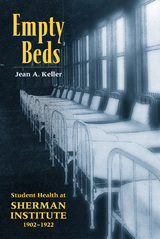
Empty Beds explores the early era of change in Indian education ideology as it pertained to student health at Sherman Institute in Southern California between 1902 and 1922. Beginning with the establishment of Carlisle Indian School in 1879, nonreservation boarding schools earned a reputation for being physically unhealthy environments for Indian children. By the turn of the century, a growing recognition of the importance of student health in Indian education began to emerge throughout the country. Unlike other nonreservation boarding schools, Sherman Institute tried to contain the devastating effects of epidemic diseases, accidents, and illnesses that were common during the early decades of the twentieth century. Strict compliance with new Indian Office preventive health policies and the implementation of school-specific health practices resulted in a relatively healthy student population compared with other nonreservation schools.
The fact that the student population at Sherman Institute during the period between 1902 and 1922 evidenced good health is at odds with widespread perceptions that nonreservation boarding schools essentially functioned as death factories for Native American children. Empty Beds is the first comprehensive study of Indian student health at a nonreservation boarding school. Keller’s exciting and provocative new conclusions will inspire a wide range of scholarship in this hitherto bypassed field of inquiry.

Encounters with Korean Folk Religion is an account of forty-five years of engagement with the cult of goddesses on Eight Peaks Mountain in Korea’s western Kangwŏn Province, the shaman who tended to the goddesses there from 1977 to 2015, and the folk religion of the surrounding village of Eight Peaks. Since the 1980s, South Korea has urbanized and the village of Eight Peaks has been transformed from a remote agricultural village into a rafting and ski resort. While communal worship ceremonies have been dying out in most of Korea, they have only grown on Eight Peaks Mountain, which has been a site of worship since at least the 15th century. What was a small-scale local ceremony in 1977 has grown into a large-scale regional celebration attracting shamans and tourists from far and wide. The manuscript delves in a historically and anthropologically innovative way into the social, religious, and historical reasons for this efflorescence.
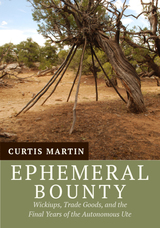
The Colorado Wickiup Project is documenting ephemeral wooden features such as wickiups, tree-platforms, and brush horse corrals that remain scattered throughout the mesas, canyons, and mountains of the state. They date from when European newcomers first arrived with a bounty of new things—horses, metal knives and axes, guns, and brightly colored glass beads—which were readily adopted by the Utes.
The Project is unique in using the techniques of metal detection, historic trade ware analysis, and tree-ring dating of metal ax–cut wickiup poles to distinguish the Ute sites from historic Euro–American ones. Through this analysis, researchers have demonstrated that not all Utes left Colorado for the reservations in Utah during the “final removal” in 1881, as has been generally believed. A significant number remained on their homelands well into the early decades of the twentieth century, building brush shelters and living much as they had for generations, but with new tools and weapons.
Appendix B Form: Aboriginal Wooden Feature Component Form
In 1970 the Nixon administration inaugurated a new era in federal Indian policy. No more would the U.S. government seek to deny and displace Native peoples or dismantle Native governments; from now on federal policy would promote “the Indian’s sense of autonomy without threatening his sense of community.”
In The Erotics of Sovereignty, Mark Rifkin offers a telling perspective on what such a policy of self-determination has meant and looks at how contemporary queer Native writers use representations of sensation to challenge official U.S. accounts of Native identity. Rifkin focuses on four Native writers—Qwo-Li Driskill (Cherokee), Deborah Miranda (Esselen), Greg Sarris (Graton Rachería), and Chrystos (Menominee)—approaching their fiction and poetry as forms of political theory.
Rifkin shows how the work of these queer or two-spirit Native writers affirms the significance of the erotic as an exercise of individual and community sovereignty. In this way, we come to see how their work contests the homophobic, sexist, and exclusivist policies and attitudes of tribal communities as well as those of the nation-state.
This collection of essays, many the result of a seminar hosted by the Charles Redd Center for Western Studies at Brigham Young University, explores the historical and cultural complexities of this narrative from a decolonizing perspective. Essays cover the historical construction of the “Lamanite,” settler colonialism and the Book of Mormon, and connections between the Seneca leader Handsome Lake and Joseph Smith. Authors also address American Indian Mormon tribal identities, Navajo and Mormon participation at the dedication of Glen Canyon Dam, the impact of Mormon Polynesian missionaries in Diné Bikéyah, the ISPP, and other topics. Prominent American Indian Mormon voices lend their creative work and personal experiences to the book.
With the aim of avoiding familiar narrative patterns of settler colonialism, contributors seek to make American Indians the subjects rather than the objects of discussion in relation to Mormons, presenting new ways to explore and reframe these relationships.
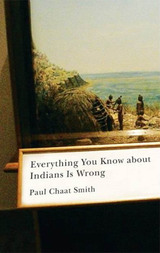
Forceful and eloquent essays on the American Indian in culture and history
In this sweeping work of memoir and commentary, leading cultural critic Paul Chaat Smith illustrates with dry wit and brutal honesty the contradictions of life in “the Indian business.”
Raised in suburban Maryland and Oklahoma, Smith dove head first into the political radicalism of the 1970s, working with the American Indian Movement until it dissolved into dysfunction and infighting. Afterward he lived in New York, the city of choice for political exiles, and eventually arrived in Washington, D.C., at the newly minted National Museum of the American Indian (“a bad idea whose time has come”) as a curator. In his journey from fighting activist to federal employee, Smith tells us he has discovered at least two things: there is no one true representation of the American Indian experience, and even the best intentions sometimes result in catastrophe.
Everything You Know about Indians Is Wrong is a highly entertaining and, at times, searing critique of the deeply disputed role of American Indians in the United States. In “A Place Called Irony,” Smith whizzes through his early life, showing us the ironic pop culture signposts that marked this Native American’s coming of age in suburbia: “We would order Chinese food and slap a favorite video into the machine—the Grammy Awards or a Reagan press conference—and argue about Cyndi Lauper or who should coach the Knicks.” In “Lost in Translation,” Smith explores why American Indians are so often misunderstood and misrepresented in today’s media: “We’re lousy television.” In “Every Picture Tells a Story,” Smith remembers his Comanche grandfather as he muses on the images of American Indians as “a half-remembered presence, both comforting and dangerous, lurking just below the surface.”
Smith walks this tightrope between comforting and dangerous, offering unrepentant skepticism and, ultimately, empathy. “This book is called Everything You Know about Indians Is Wrong, but it’s a book title, folks, not to be taken literally. Of course I don’t mean everything, just most things. And ‘you’ really means we, as in all of us.”
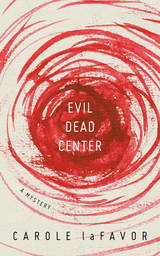
An Ojibwa woman has been found dead on the outskirts of the Minnesota Red Earth Reservation. The coroner ruled the death a suicide, but after an ex-lover comes back into her life saying foul play was involved, Renee LaRoche wants to prove otherwise. As the events begin to unfold, Renee conducts a presumably normal welfare check on a young Ojibwa boy in foster care. After she learns the boy has suffered abuse, Renee finds herself amid an investigation into the foster care system and the deep trauma it has inflicted on the Ojibwa people. As Renee uncovers horrible truths, she must work through her own childhood issues to help shine a light on the dark web she has stumbled into.
"The reprint will come as a blessing to many archaeologists who have sought in vain to obtain a copy of the original volume. It now stands as a body of data easily accessible to all workers, and we look forward to a new phase of synthesis of Hohokam archaeology."—American Antiquity
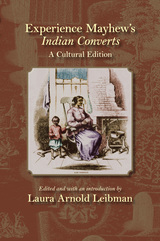
First published in 1727 under the title Indian Converts, or Some account of the lives and dying speeches of a considerable number of the Christianized Indians of Martha's Vineyard, in New-England, Experience Mayhew's history of the Wampanoag Indians on Martha's Vineyard provides a rare look at the lives and culture of four generations of Native Americans in colonial America. Dividing his treatment into four sections—Indian Ministers, Good Men, Religious Women, and Pious Children—Mayhew details the books that different age groups were reading, provides insights into early New England pedagogy and childrearing practices, and describes each individual in terms of genealogy, religious practice, way of life, and place of residence.
In addition to drawing on his own firsthand knowledge of the community and transcriptions of oral testimony he and others collected, Mayhew inserts translations of Wampanoag texts that have since been lost. Although the book has been out of print since the early nineteenth century, scholars have long recognized its importance for understanding the history of New England's Native communities. In an extensive introduction to this new scholarly edition, Laura Arnold Leibman places Indian Converts in a broader cultural context and explores its significance. She shows how Mayhew's biographies illuminate the theological upheavals that rocked early eighteenth-century New England on the eve of the Great Awakening, shifts that altered not only the character of Puritanism but also the landscape of Wampanoag religious and cultural life. An accompanying online archive that includes over 600 images and documents further contextualizes Mayhew's work and provide suggestions for students' investigations of the text.
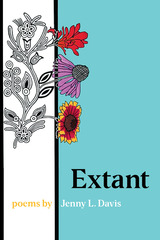
The second poetry collection by award-winning author Jenny L. Davis (Chickasaw), Extant confronts the many ways in which Native Americans continue to be associated with the distant past and imagined, even today, as more animal than human. For more than a century, anthropologists, museum guides, and high school teachers have described Native American bodies, cultures, and languages as “endangered” or “almost extinct.” Through a combination of blackout poems, occasional poems, and free verse, Davis rewrites the narrative of what it means to exist, to live in a present shaped by colonial violence that emphasizes the power of survival. Drawing on online question forums, scientific studies, kitschy decor, and the day-to-day musings of an Indigiqueer Native woman, Extant stages encounters of Native survival within a world full of stars, cicadas, earthworms, and moss.
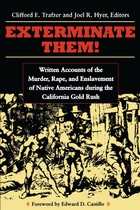
Popular media depict miners as a rough-and-tumble lot who diligently worked the placers along scenic rushing rivers while living in roaring mining camps in the foothills of the Sierra Nevada Mountains. Trafzer and Hyer destroy this mythic image by offering a collection of original newspaper articles that describe in detail the murder, rape, and enslavement perpetrated by those who participated in the infamous gold rush. "It is a mercy to the Red Devils," wrote an editor of the Chico Courier, "to exterminate them." Newspaper accounts of the era depict both the barbarity and the nobility in human nature, but while some protested the inhumane treatment of Native Americans, they were not able to end the violence. Native Americans fought back, resisting the invasion, but they could not stop the tide of white miners and settlers. They became "strangers in a stolen land."
READERS
Browse our collection.
PUBLISHERS
See BiblioVault's publisher services.
STUDENT SERVICES
Files for college accessibility offices.
RECENTLY PUBLISHED




UChicago Accessibility Resources
home | accessibility | search | about | contact us
BiblioVault ® 2001 - 2026
The University of Chicago Press