front cover of Emergency Deep
Emergency Deep
Cold War Missions of a Submarine Commander
Alfred Scott McLaren
University of Alabama Press, 2021
Conveys in dramatic detail the high-risk, covert operations of a nuclear attack submarine during the zenith of the Cold War

Captain Alfred Scott McLaren served as commander of the USS Queenfish (SSN 651) from September 1969 to May 1973, the very height of the Cold War. As commander, McLaren led at least six major clandestine operations, including the first-ever exploration of the entire Siberian Continental Shelf: a perilous voyage detailed in his previous book Unknown Waters.

Emergency Deep: Cold War Missions of a Submarine Commander conveys the entire spectrum of Captain McLaren’s experiences commanding the USS Queenfish, mainly in the waters of the Russian Far East and also off Vietnam. McLaren offers a riveting and deeply human story that illuminates the intensity and pressures of commanding a nuclear attack submarine in some of the most difficult circumstances imaginable.

Relying on his own notes and records, as well as discussions with former officers and shipmates, McLaren focuses on operational matters both great and small. He recounts his unique perspectives on attack-submarine tactics and exploratory techniques in high-risk or uncharted areas, matters of leadership and team-building and the morale of his crews, and the innumerable and often unforeseen ways his philosophy of command played out on a day-to-day basis, with consequences that ran the gamut from the mundane to the dire and life-threatening.

Readers are also treated to significant new information and insight on submarine strategy, maneuvers, and culture. Such details illuminate and bring to life, with both great humor and gravitas, the intensity and pressures on those engaged in covert missions on nuclear attack submarines.
 
[more]

logo for Harvard University Press
Emperor of the Seas
How Khubilai Khan Made China the First Naval Superpower
Jack Weatherford
Harvard University Press

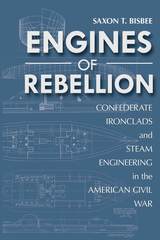
front cover of Engines of Rebellion
Engines of Rebellion
Confederate Ironclads and Steam Engineering in the American Civil War
Saxon T. Bisbee
University of Alabama Press, 2018
A challenge to the prevailing idea that Confederate ironclads were inherently defective
 
The development of steam propulsion machinery in warships during the nineteenth century, in conjunction with iron armor and shell guns, resulted in a technological revolution in the world’s navies. Warships utilizing all of these technologies were built in France and Great Britain in the 1850s, but it was during the American Civil War that large numbers of ironclads powered solely by steam proved themselves to be quite capable warships.  
 
Historians have given little attention to the engineering of Confederate ironclads, although the Confederacy was often quite creative in building and obtaining marine power plants. Engines of Rebellion: Confederate Ironclads and Steam Engineering in the American Civil War focuses exclusively on ships with American built machinery, offering a detailed look at marine steam-engineering practices in both northern and southern industry prior to and during the Civil War.
 
Beginning with a contextual naval history of the Civil War, the creation of the ironclad program, and the advent of various technologies, Saxon T. Bisbee analyzes the armored warships built by the Confederate States of America that represented a style adapted to scarce industrial resources and facilities. This unique historical and archaeological investigation consolidates and expands on the scattered existing information about Confederate ironclad steam engines, boilers, and propulsion systems.
 
Through analysis of steam machinery development during the Civil War, Bisbee assesses steam plants of twenty-seven ironclads by source, type, and performance, among other factors. The wartime role of each vessel is discussed, as well as the stories of the people and establishments that contributed to its completion and operation. Rare engineering diagrams never before published or gathered in one place are included here as a complement to the text.
[more]


Send via email Share on Facebook Share on Twitter