
 A SCHOLARLY BOOK REPOSITORY
7 start with E start with E

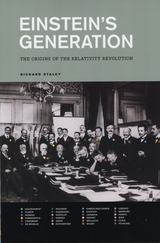
Why do we celebrate Einstein’s era above all other epochs in the history of physics? Much of the history of physics at the beginning of the twentieth century has been written with a sharp focus on a few key figures and a handful of notable events. Einstein’s Generation offers a distinctive new approach to the origins of modern physics by exploring both the material culture that stimulated relativity and the reaction of Einstein’s colleagues to his pioneering work.
Richard Staley weaves together the diverse strands of experimental and theoretical physics, commercial instrument making, and the sociology of physics around 1900 to present the collective efforts of a group whose work helped set the stage for Einstein’s revolutionary theories and the transition from classical to modern physics that followed. Collecting papers, talks, catalogues, conferences, and correspondence, Staley juxtaposes scientists’ views of relativity at the time to modern accounts of its history. Einstein’s Generation tells the story of a group of individuals which produced some of the most significant advances of the twentieth century; and challenges our celebration of Einstein’s era above all others.
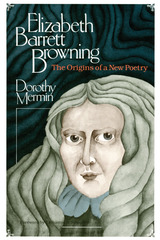
Barrett Browning's place at the wellhead of a new female tradition remains the single most important fact about her in terms of literary history, and it was central to her self-consciousness as a poet. Mermin's study shows that Barrett Browning's anomalous situation was constantly present to her imagination and that questions of gender shaped almost everything she wrote. Mermin argues that Barrett Browning's poetry covertly inspects and dismantles the barriers set in her path by gender and that in her major works—Sonnets from the Portuguese, Aurora Leigh, her best political poems, "A Musical Instrument"—difficulty is turned into triumph, incorporating the author's femininity, her situation as a woman poet, and her increasingly substantial fame.
Mermin skillfully interweaves biography and close readings of the poems to show precisely how Barrett Browning's life as a woman writer is a part of the essential meaning of her art. Both her personal and her literary achievements are exceptionally well documented, especially for her formative years. Mermin makes extensive use of the poet's early essays, a diary covering most of her twenty-sixth year, and the enormous number of letters that have survived. Ranging from her earliest ambitions through her long periods of discouragement and illness to her happy married life with Robert Browning, this comprehensive study of Elizabeth Barrett Browning is essential reading for students of the Victorian period, English literature, and women's studies.
Reveals how Emperor Charles IV’s efforts to secure the imperial coronation of his son intersect with the early stages of the Great Western Schism.
Emperor Otto I the Great made history in the Holy Roman Empire with a significant dynastic achievement: in 967, he persuaded the pope to crown his son co-emperor in Rome. Two centuries later, another renowned emperor, Frederick Barbarossa, attempted a similar feat, negotiating with four different popes for the coronation of his descendant, but ultimately failed. A lesser-known parallel can be found in the life of Emperor Charles IV of the Luxembourg dynasty in the fourteenth century. After the Papal Curia returned to Rome from Avignon in early 1377, Charles made concerted efforts in Italy, France, and Germany to secure the imperial coronation of his son, Wenceslas. However, this bold ambition coincided with an unprecedented crisis in relations between the "French” cardinals and the newly elected Italian pope, Urban VI. Recognizing that the final chapter of Charles IV’s biography is deeply intertwined with the early history of the Great Western Schism offers a fresh perspective on a subject that has long captivated international scholarship.
His breadth of knowledge, his discerning inclusiveness, his clarity of thought, all make _An Entangled Bank_ a stimulating read. Very often in science courses we are presented only with the canonical "state of the science," having to swallow its agglomerated whole free of context. Hagen reveals the wisdom of understanding intellectual foundations. Through study of the origins and development of a science, we may better grasp the received tenets of current scientific understanding. As a young science, ecosystem ecology has a historical context that is relatively accessible to us, if less romantic than a tale of the origins of astronomy might be.
A peek into the labs and offices of botanists, limnologists, and biogeochemists might not seem like the acme of excitement. Hagen inspires us with his insights. He makes his subject meaningful to us. Though it is not pleasure reading by any stretch, its clear-sighted intellectual vigor makes _An Entangled Bank_ pure enjoyment.
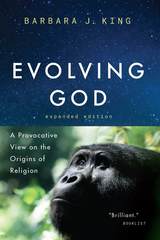
Religion has been a central part of human experience since at least the dawn of recorded history. The gods change, as do the rituals, but the underlying desire remains—a desire to belong to something larger, greater, most lasting than our mortal, finite selves.
But where did that desire come from? Can we explain its emergence through evolution? Yes, says biological anthropologist Barbara J. King—and doing so not only helps us to understand the religious imagination, but also reveals fascinating links to the lives and minds of our primate cousins. Evolving God draws on King’s own fieldwork among primates in Africa and paleoanthropology of our extinct ancestors to offer a new way of thinking about the origins of religion, one that situates it in a deep need for emotional connection with others, a need we share with apes and monkeys. Though her thesis is provocative, and she’s not above thoughtful speculation, King’s argument is strongly rooted in close observation and analysis. She traces an evolutionary path that connects us to other primates, who, like us, display empathy, make meanings through interaction, create social rules, and display imagination—the basic building blocks of the religious imagination. With fresh insights, she responds to recent suggestions that chimpanzees are spiritual—or even religious—beings, and that our ancient humanlike cousins carefully disposed of their dead well before the time of Neandertals.
King writes with a scientist’s appreciation for evidence and argument, leavened with a deep empathy and admiration for the powerful desire to belong, a desire that not only brings us together with other humans, but with our closest animal relations as well.
READERS
Browse our collection.
PUBLISHERS
See BiblioVault's publisher services.
STUDENT SERVICES
Files for college accessibility offices.
RECENTLY PUBLISHED





UChicago Accessibility Resources
home | accessibility | search | about | contact us
BiblioVault ® 2001 - 2026
The University of Chicago Press