
 A SCHOLARLY BOOK REPOSITORY
8 start with E start with E
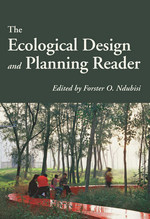
A rich body of literature on the effect of human actions on the natural environment provides a window into what we now refer to as ecological design and planning. The study and practice of ecological design and planning provide a promising way to manage change in the landscape so that human actions are more in tune with natural processes. In The Ecological Design and Planning Reader Professor Ndubisi offers refreshing insights into key themes that shape the theory and practice of ecological design and planning. He has assembled, synthesized, and framed selected seminal published scholarly works in the field from the past one hundred and fifty years——ranging from Ebenezer Howard’s Garden Cities of To-morrow to Anne Whiston Spirn’s, “Ecological Urbanism: A Framework for the Design of Resilient Cities.” The reader ends with a hopeful look forward, which suggests an agenda for future research and analysis in ecological design and planning.
This is the first volume to bring together classic and contemporary writings on the history, evolution, theory, methods, and exemplary practice of ecological design and planning. The collection provides students, scholars, researchers, and practitioners with a solid foundation for understanding the relationship between human systems and our natural environment.

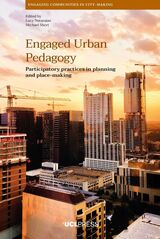
Engaged Urban Pedagogy presents a participatory approach to teaching about the built environment by exploring twelve examples of real-world engagement in urban planning involving people within, and beyond, the university. Starting with curriculum review, course content is analyzed in light of urban pasts, race, queer identity, lived experiences, and the concerns of urban professionals. Case studies then shift to focus on techniques for participatory critical pedagogy, including expanding the classroom with links to live place-making processes, connections made through digital co-design exercises, and student-led podcasting assignments. Finally, the book turns to activities beyond formal university teaching, such as those where school-age children learn about their own participation in urban processes together alongside university students and researchers. Drawing on foundational works of critical pedagogy, the contributors present a distinctly urban praxis that will help those in universities respond to the built environment challenges of today.
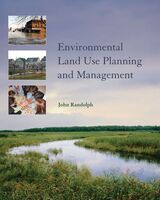
Environmental Land Use Planning and Management is a unique new textbook that presents a diverse, comprehensive, and coordinated approach to issues of land use planning and management and their impacts on the environment. It builds on recent advances in environmental science, engineering, and geospatial information technologies to provide students with the scientific foundation they need to understand both natural land systems and engineering approaches that can mitigate impacts of land use practices. While offering a base of knowledge in planning theory and natural science, its primary emphasis is on describing and explaining emerging approaches, methods, and techniques for environmental land use planning, design, and policy.
The book is divided into two parts. Part I, "Environmental Land Use Management," introduces broad concepts of environmental planning and describes management approaches. Those approaches include collaborative environmental management, land conservation, environmental design, government land use management, natural hazard mitigation, and ecosystem and watershed management. Part II, "Environmental Land Use Principles and Planning Analysis," focuses on land analysis methods, such as geospatial data and geographic information systems (GIS); soils and slope analysis; assessment of stormwater quantity and quality; land use and groundwater protection; ecological assessment for vegetation, wetlands, and habitats; and integrated analytical techniques like land suitability analysis, carrying capacity studies, and environmental impact assessment.
Environmental Land Use Planning and Managementoffers a unique interdisciplinary perspective with an emphasis on application. It is an important new text for advanced undergraduate and graduate courses in environmental planning, landscape architecture, geography, environmental studies, and natural resource management, and a valuable resource for professionals and others concerned with issues of environmental planning and land use.
Organized into three parts, the book provides a clear roadmap for understanding and applying core principles. Part I introduces environmental planning and land use fundamentals, with an emphasis on collaboration and systems thinking. Part II explores tools and topics essential to sustainable land use, including soils and topography, hydrology, stormwater management, biodiversity, and climate change—with a new chapter connecting land use to energy, air quality, and greenhouse gas emissions. Part III offers guidance on managing watersheds, conserving ecosystems, and mitigating natural hazards to support long-term community resilience.
This edition has been thoughtfully revised based on instructor feedback, with reorganized content for improved clarity and usability. Informative sidebars highlight key federal and local policies, real-world problems, and solutions grounded in current practice.
Whether used in the classroom or the field, Environmental Land Use Planning and Management provides the foundation for making informed decisions that protect ecosystems, reduce risk, and support sustainable development.

The Panama Canal's untold history—from the Panamanian point of view. Sleuth and scholar Marixa Lasso recounts how the canal’s American builders displaced 40,000 residents and erased entire towns in the guise of bringing modernity to the tropics.
The Panama Canal set a new course for the modern development of Central America. Cutting a convenient path from the Atlantic to the Pacific oceans, it hastened the currents of trade and migration that were already reshaping the Western hemisphere. Yet the waterway was built at considerable cost to a way of life that had characterized the region for centuries. In Erased, Marixa Lasso recovers the history of the Panamanian cities and towns that once formed the backbone of the republic.
Drawing on vast and previously untapped archival sources and personal recollections, Lasso describes the canal’s displacement of peasants, homeowners, and shop owners, and chronicles the destruction of a centuries-old commercial culture and environment. On completion of the canal, the United States engineered a tropical idyll to replace the lost cities and towns—a space miraculously cleansed of poverty, unemployment, and people—which served as a convenient backdrop to the manicured suburbs built exclusively for Americans. By restoring the sounds, sights, and stories of a world wiped clean by U.S. commerce and political ambition, Lasso compellingly pushes back against a triumphalist narrative that erases the contribution of Latin America to its own history.
Protected areas around the globe national parks, wildlife reserves, biosphere reserves will prosper only if they are supported by the public, the private sector, and the full range of government agencies. Yet such support is unlikely unless society appreciates the importance of protected areas to its own interest, and the protected areas are well-managed and contribute to the national welfare in a cost-effective way.
A crucial foundation for success is full cooperation between individuals and institutions. Based on papers presented at the IVth World Congress on National Parks and Protected Areas, Expanding Partnerships in Conservation explores how new and stronger partnerships can be formed between managers of protected areas and other sectors of society. It describes a range of activities currently underway in many parts of the world that are intended to improve conservation efforts at the international, national, and local levels.
READERS
Browse our collection.
PUBLISHERS
See BiblioVault's publisher services.
STUDENT SERVICES
Files for college accessibility offices.
RECENTLY PUBLISHED






UChicago Accessibility Resources
home | accessibility | search | about | contact us
BiblioVault ® 2001 - 2025
The University of Chicago Press