
 A SCHOLARLY BOOK REPOSITORY
3 start with E start with E
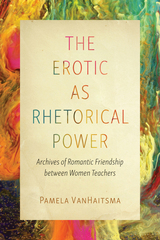
Winner, 2025 Marie Hochmuth Nichols Award from the National Communication Association’s Public Address Division
The Erotic as Rhetorical Power offers a queer feminist history of rhetoric that recovers the civic contributions of women teachers in same-sex romantic friendships. Extending perspectives from ancient rhetoric to nineteenth-century progressivism, from Audre Lorde’s Black lesbian feminist theory to its present-day uptakes, Pamela VanHaitsma conceives of the erotic as an interanimation of desires that, in being passionately shared, becomes imbued with the power to forge connection and foment change.
VanHaitsma’s theory of the erotic as rhetorical power emerges from both historiographic and imaginative engagements with more than twenty archives of romantic friendships between women: Sallie Holley and Caroline Putnam, Irene Leache and Anna Wood, Gertrude Buck and Laura Wylie, and Rebecca Primus and Addie Brown. VanHaitsma considers how even as the erotic in these romantic friendships fueled the women’s rhetorical activities toward transformational ends—whether working toward the abolition of slavery, greater educational access, or voting rights—it also energized rhetorical activities that sometimes challenged but also reinforced troubling power dynamics. The Erotic as Rhetorical Power uncovers the erotic’s significance as a conflicted site of power that is central to rhetorical theory and history as well as feminist and LGBTQ+ studies.
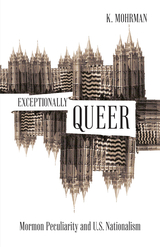
How perceptions of Mormonism from 1830 to the present reveal the exclusionary, racialized practices of the U.S. nation-state
Are Mormons really so weird? Are they potentially queer? These questions occupy the heart of this powerful rethinking of Mormonism and its place in U.S. history, culture, and politics. K. Mohrman argues that Mormon peculiarity is not inherent to the Latter-day Saint faith tradition, as is often assumed, but rather a potent expression of U.S. exceptionalism.
Exceptionally Queer scrutinizes the history of Mormonism starting with its inception in the early 1830s and continuing to the present. Drawing on a wide range of historical texts and moments—from nineteenth-century battles over Mormon plural marriage; to the LDS Church’s emphases on “individual responsibility” and “family values”; to mainstream media’s coverage of the LDS Church’s racist exclusion of Black priesthood holders, its Native assimilation programs, and vehement opposition to the Equal Rights Amendment; and to much more recent legal and cultural battles over same-sex marriage and on-screen Mormon polygamy—Exceptionally Queer evaluates how Mormonism has been used to motivate and rationalize the biased, exclusionary, and colonialist policies and practices of the U.S. nation-state.
Mohrman explains that debates over Mormonism both drew on and shaped racial discourses and, in so doing, delineated the boundaries of whiteness and national belonging, largely through the consolidation of (hetero)normative ideas of sex, marriage, family, and economy. Ultimately, the author shows how discussions of Mormonism in this country have been and continue to be central to ideas of what it means to be American.
READERS
Browse our collection.
PUBLISHERS
See BiblioVault's publisher services.
STUDENT SERVICES
Files for college accessibility offices.
RECENTLY PUBLISHED





UChicago Accessibility Resources
home | accessibility | search | about | contact us
BiblioVault ® 2001 - 2025
The University of Chicago Press