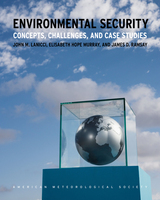
front cover of Environmental Security
Environmental Security
Concepts, Challenges, and Case Studies
Edited by John M. Lanicci, Elisabeth Hope Murray, and James D. Ramsay
American Meteorological Society, 2019
Security threats today are increasingly complex, dynamic, and asymmetric, and can affect environmental factors like energy, water, and food supply. As a result, it is becoming evident that the traditional model of nation-state based security is incomplete, and that purely military capabilities, though necessary, are insufficient to protect the United States and other democracies from the array of threats that challenge liberty and the free flow of people and commerce. A more complete picture of modern national security requires a more complete integration of the question of environmental security.

The purpose of text is to better address the many aspects of environmental security and to represent this major area of academic research in an introductory text format that can be used in the rapidly growing number of homeland security studies programs as well as related degree programs. The concepts, challenges, and case studies in this text vitally extended such curricula, giving students a deeper appreciation for the critical role environmental security plays in overall state security, as well as for our nation, our way of life, and indeed for the human race at large. 

 
[more]

front cover of Exiting the Fragility Trap
Exiting the Fragility Trap
Rethinking Our Approach to the World’s Most Fragile States
David Carment
Ohio University Press, 2019

State fragility is a much-debated yet underinvestigated concept in the development and international security worlds. Based on years of research as part of the Country Indicators for Foreign Policy project at Carleton University, Exiting the Fragility Trap marks a major step toward remedying the lack of research into the so-called fragility trap. In examining the nature and dynamics of state transitions in fragile contexts, with a special emphasis on states that are trapped in fragility, David Carment and Yiagadeesen Samy ask three questions: Why do some states remain stuck in a fragility trap? What lessons can we learn from those states that have successfully transitioned from fragility to stability and resilience? And how can third-party interventions support fragile state transitions toward resilience?

Carment and Samy consider fragility’s evolution in three state types: countries that are trapped, countries that move in and out of fragility, and countries that have exited fragility. Large-sample empirical analysis and six comparative case studies—Pakistan and Yemen (trapped countries), Mali and Laos (in-and-out countries), and Bangladesh and Mozambique (exited countries)—drive their investigation, which breaks ground toward a new understanding of why some countries fail to see sustained progress over time.

[more]


Send via email Share on Facebook Share on Twitter