
 A SCHOLARLY BOOK REPOSITORY
5 start with E start with E
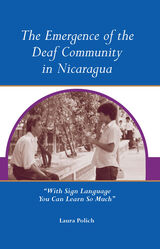
The sudden discovery of Nicaraguan Sign Language (NSL) enthralled scholars worldwide who hoped to witness the evolution of a new language. But controversy erupted regarding the validity of NSL as a genuinely spontaneous language created by young children. Laura Polich’s fascinating book recounts her nine-year study of the Deaf community in Nicaragua and her findings about its formation and that of NSL in its wake.
Polich crafted The Emergence of the Deaf Community in Nicaragua from her copious research in Nicaragua’s National Archives, field observations of deaf pupils in 20 special education schools, polls of the teachers for deaf children about their education and knowledge of deafness, a survey of 225 deaf individuals about their backgrounds and living conditions, and interviews with the oldest members of the National Nicaraguan Association of the Deaf.
Polich found that the use of a “standardized” sign language in Nicaragua did not emerge until there was a community of users meeting on a regular basis, especially beyond childhood. The adoption of NSL did not happen suddenly, but took many years and was fed by multiple influences. She also discovered the process that deaf adolescents used to attain their social agency, which gained them recognition by the larger Nicaraguan hearing society. Her book illustrates tremendous changes during the past 60 years, and the truth in one deaf Nicaraguan’s declaration, “With sign language you can learn so much.”
This is the inaugural volume in the Early Papers in Deaf Studies series, which will consist of reissued works originally published by the Gallaudet University College for Continuing Education but long out of print. The aim of this series is to restore these foundational papers to the scholarly community. Empowerment and Black Deaf Persons is available in both print and open digital formats, ensuring broad access to this important contribution to the literature.
This volume brings together a cadre of world-renowned interpreting educators and researchers who conduct a rich exploration of paradigms, both old and new, in interpreter education. They review existing research, explicate past and current practices, and call for a fresh look at the roots of interpreter education in anticipation of the future. Expert commentary accompanies each chapter to provide a starting point for reflection on and discussion of the growing needs in this discipline.
Volume coeditor Christine Monikowski begins by considering how interpreter educators can balance their responsibilities of teaching, practice, and research. Her chapter is accompanied by commentary about the capacity to “academize” what has been thought of as a semi-profession. Helen Tebble shares research on medical interpreting from an applied linguistic perspective. Terry Janzen follows with the impact of linguistic theory on interpretation research methodology. Barbara Shaffer discusses how interpreting theory shapes the interpreter’s role. Elizabeth A. Winston, also a volume coeditor, rounds out this innovative collection with her chapter on infusing evidence-based teaching practices into interpreting education. Noted interpreter educators and researchers also provide an international range of insights in this collection, including Rico Peterson, Beppie van den Bogaerde, Karen Bontempo, Ian Mason, Ester Leung, David Quinto-Pozos, Lorraine Leeson, Jemina Napier, Christopher Stone, Debra Russell, and Claudia Angelelli.
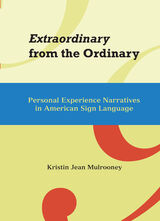
Personal narratives are one way people code their experiences and convey them to others. Given that speakers can simultaneously express information and define a social situation, analyzing how and why people structure the telling of personal narratives can provide insight into the social dimensions of language use. In Extraordinary from the Ordinary: Personal Experience Narratives in American Sign Language, Kristin Jean Mulrooney shows that accounts by Deaf persons expressed in ASL possess the same characteristics and perform the same function as oral personal narratives.
Mulrooney analyses12 personal narratives by ASL signers to determine how they “tell” their stories. She examines the ASL form of textual narration to see how signers use lexical signs to grammatically encode information, and how they also convey perceived narration. In perceived narration, the presenter depicts a past occurrence in the immediate environment that allows the audience to partially witness and interpret the event. Mulrooney determined that ASL narratives reveal a patterned structure consisting of an introduction, a main events section for identifying and describing past events, and a conclusion. They also can include background information, an explication section in which the presenter expands or clarifies an event, and a section that allows the presenter to explain his or her feelings about what happened. Liberally illustrated with photographs from videotaped narratives, Extraordinary from the Ordinary offers an engrossing, expansive view of personal narratives embodying the unique linguistic elements of ASL.
READERS
Browse our collection.
PUBLISHERS
See BiblioVault's publisher services.
STUDENT SERVICES
Files for college accessibility offices.
RECENTLY PUBLISHED




UChicago Accessibility Resources
home | accessibility | search | about | contact us
BiblioVault ® 2001 - 2025
The University of Chicago Press