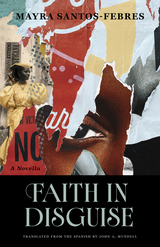
front cover of Faith in Disguise
Faith in Disguise
A Novella
Mayra Santos-Febres; Translated from the Spanish by John A. Mundell
Vanderbilt University Press, 2026
Faith in Disguise follows Martín Tirado, a white Puerto Rican digital historian and research assistant to Fe Verdejo, an Afro-Venezuelan scholar curating an exhibition in Chicago on enslaved and freed Black women in Latin America. As Martín becomes increasingly enmeshed in Fe’s intellectual and erotic orbit, his role as subordinate and interpreter exposes the entanglement of race, power, and desire in the production of historical knowledge. Through the interplay of archival fragments and contemporary encounters, Mayra Santos-Febres illuminates how the afterlives of slavery persist within Latin American racial and sexual imaginaries, and how the erotic, as both method and experience, may gesture toward forms of liberation from them.
[more]

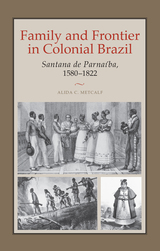
front cover of Family and Frontier in Colonial Brazil
Family and Frontier in Colonial Brazil
Santana de Parnaíba, 1580–1822
By Alida C. Metcalf
University of Texas Press, 2005

Family and Frontier in Colonial Brazil was originally published by the University of California Press in 1992. Alida Metcalf has written a new preface for this first paperback edition.

[more]

front cover of Family Ties
Family Ties
By Clarice Lispector
University of Texas Press, 1972

The silent rage that seizes a matriarch whose family is feting her eighty-ninth year.The tangle of emotions felt by a sophisticated young woman toward her elderly mother. An adolescent girl's obsessive fear of being looked at. The "giddying sense of compassion" that a blind man introduces into a young housewife's settled existence. Of such is made the world of Clarice Lispector, the Brazilian writer whose finest work is acknowledged to be her exquisitely crafted short stories. Here, in these thirteen of Lispector's most brilliantly conceived stories, mysterious and unexpected moments of crisis propel characters to self-discovery or keenly felt intuitions about the human condition. Her characters mirror states of mind. Alienated by their unsettling sense of life's absurdity, they seem at times absorbed in their interior lives and in the passions that dominate and usually defeat them.

Giovanni Pontiero's translation has been lauded by Gregory Rabassa as "magnificent."
[more]

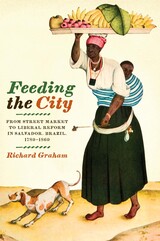
front cover of Feeding the City
Feeding the City
From Street Market to Liberal Reform in Salvador, Brazil, 1780–1860
By Richard Graham
University of Texas Press, 2010

Winner, Bolton-Johnson Prize, Conference on Latin American History, 2011
Murdo J. McLeod Book Prize, 2011

On the eastern coast of Brazil, facing westward across a wide magnificent bay, lies Salvador, a major city in the Americas at the end of the eighteenth century. Those who distributed and sold food, from the poorest street vendors to the most prosperous traders—black and white, male and female, slave and free, Brazilian, Portuguese, and African—were connected in tangled ways to each other and to practically everyone else in the city, and are the subjects of this book. Food traders formed the city's most dynamic social component during the late eighteenth and early nineteenth centuries, constantly negotiating their social place. The boatmen who brought food to the city from across the bay decisively influenced the outcome of the war for Brazilian independence from Portugal by supplying the insurgents and not the colonial army. Richard Graham here shows for the first time that, far from being a city sharply and principally divided into two groups—the rich and powerful or the hapless poor or enslaved—Salvador had a population that included a great many who lived in between and moved up and down.

The day-to-day behavior of those engaged in food marketing leads to questions about the government's role in regulating the economy and thus to notions of justice and equity, questions that directly affected both food traders and the wider consuming public. Their voices significantly shaped the debate still going on between those who support economic liberalization and those who resist it.
[more]

front cover of First World Third Class and Other Tales of the Global Mix
First World Third Class and Other Tales of the Global Mix
By Regina Rheda
University of Texas Press, 2005

Regina Rheda is a contemporary award-winning Brazilian writer whose original voice and style have won her many admirers. First World Third Class and Other Tales of the Global Mix presents some of her finest and most representative work to an English-speaking readership. Stories from the Copan Building consists of eight tales set in a famous residential building in São Paulo. The stories, like the apartment complex, are a microcosm of modern-day urban Brazil. They are witty, consistently caustic, and never predictable.

Also in this volume is the poignant and often hilarious novel First World Third Class. It depicts young middle-class professionals and artists who, as opportunities in Brazil diminished, opted to leave their country, even if it meant taking menial jobs abroad. At the center of the narrative is Rita, a thirty-year-old aspiring filmmaker who migrates to England, and then Italy. She looks for work and love in all the wrong places, moving from city to city and from bed to bed.

The last three stories in this collection also happen to be among the author's most recent. "The Enchanted Princess" is an ironic title for a postfeminist tale of a South American woman being wooed to marry an old-world gentleman who promises to take care of her every need. "The Sanctuary" concerns the living conditions of immigrant workers and farm animals. Equally piquant in nature, "The Front" deals with ecology, labor environments, and gender politics.
[more]

front cover of Flooded
Flooded
Development, Democracy, and Brazil’s Belo Monte Dam
Peter Taylor Klein
Rutgers University Press, 2022
Winner of the 2023 Marysa Navarro Best Book Prize from the New England Council for Latin American studies

In the middle of the twentieth century, governments ignored the negative effects of large-scale infrastructure projects. In recent decades, many democratic countries have continued to use dams to promote growth, but have also introduced accompanying programs to alleviate these harmful consequences of dams for local people, to reduce poverty, and to promote participatory governance. This type of dam building undoubtedly represents a step forward in responsible governing. But have these policies really worked?
 
Flooded provides insights into the little-known effects of these approaches through a close examination of Brazil’s Belo Monte hydroelectric facility. After three decades of controversy over damming the Xingu River, a tributary of the Amazon, the dam was completed in 2019 under the left-of-center Workers’ Party, becoming the world’s fourth largest. Billions of dollars for social welfare programs accompanied construction. Nonetheless, the dam brought extensive social, political, and environmental upheaval to the region. The population soared, cost of living skyrocketed, violence spiked, pollution increased, and already overextended education and healthcare systems were strained. Nearly 40,000 people were displaced and ecosystems were significantly disrupted. Klein tells the stories of dam-affected communities, including activists, social movements, non-governmental organizations, and public defenders and public prosecutors. He details how these groups, as well as government officials and representatives from private companies, negotiated the upheaval through protests, participating in public forums for deliberation, using legal mechanisms to push for protections for the most vulnerable, and engaging in myriad other civic spaces. Flooded provides a rich ethnographic account of democracy and development in the making. In the midst of today’s climate crisis, this book showcases the challenges and opportunities of meeting increasing demands for energy in equitable ways.
[more]

front cover of Forest Lost
Forest Lost
Producing Green Capitalism in the Brazilian Amazon
Maron E. Greenleaf
Duke University Press, 2024
Forest Lost is an ethnography of forest carbon offsets and the wider effort to make the living rainforest valuable in the Brazilian Amazon. Unlike other forest commodities, forest carbon offsets do not involve resource extraction; instead, they require keeping carbon in place through forest protection. Maron E. Greenleaf explores forest carbon offsets to understand green capitalism—the use of capitalist logics and practices to mitigate environmental damage. She traces cultural, environmental, governmental, material, and multispecies relations involved in making forest carbon valuable as well as how forest carbon’s commodification in the Amazon turned it into a source of redistributable public environmental wealth. At the same time, Greenleaf shows how making forest carbon monetarily valuable created an unexpected set of uneven, contingent, and contested social and political relations. While forest carbon in the Amazon demonstrates that green capitalism can be socially inclusive, it also shows that green capitalism can reinforce the marginalization it purportedly seeks to combat. By outlining these complex relations and tensions, Greenleaf elucidates broader efforts to create a capitalism suited to the Anthropocene and those efforts’ alluring promises and vexing failures.
[more]

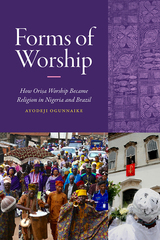
front cover of Forms of Worship
Forms of Worship
How Orisa Worship Became Religion in Nigeria and Brazil
Ayodeji Ogunnaike
Duke University Press, 2026
The worship of Yoruba deities known as oriṣa is commonly understood as an indigenous African religion, but Ayodeji Ogunnaike argues that these traditions initially differed from the modern Western concept of religion. In Forms of Worship, Ogunnaike analyzes how the configuration of oriṣa worship has changed across the Yoruba diaspora and homeland. As the meaning of the Yoruba word ẹsin, usually translated as “religion,” is closer to “form of worship,” he examines how reorienting understandings of oriṣa traditions as multiple forms of worship changes how religious identity, practice, and dynamics can be understood in contemporary and historical perspectives. By developing indigenous models for religious phenomena, Ogunnaike accounts for Yoruba cultural dynamics, including the high degree of religious harmony, syncretism, and interaction prevalent both in Nigeria and Brazil. Furthermore, he tracks the subtle and largely unperceived shift in oriṣa worship toward a more modern, closed, and rigid conception of religion and its resulting complications. Forms of Worship demonstrates how the advent of Western religious rigidity regarding practice and identity has led to rising religious tensions and fragmentation.
[more]

front cover of Francisco de Paula Brito
Francisco de Paula Brito
A Black Publisher in Imperial Brazil
Rodrigo Camargo de Godoi
Vanderbilt University Press, 2020
Francisco de Paula Brito is a biography of a merchant, printer, bookseller, and publisher who lived in Rio de Janeiro from his birth in 1809 until his death in 1861. That period was key to the history of Brazil, because it coincided with the relocation of the Portuguese Court from Lisbon to Rio de Janeiro (1808); the dawning of Brazilian Independence (1822) and the formation of the nation-state; the development of the press and of Brazilian literature; the expansion and elimination of the trans-Atlantic slave trade; and the growth of Rio de Janeiro’s population and the coffee economy. Nevertheless, although it covers five generations of Paula Brito’s family—men and women who left slavery in the eighteenth century—this book focuses on its protagonist’s activities between the 1830s and 1850s.

During that period, Francisco de Paula Brito became one of the central figures in the cultural and political scene in the Imperial capital, particularly through his work as a publisher. Paula Brito’s success was due in part to his ability to forge solid alliances with the Empire’s ruling elite—among them leading politicians responsible for the unification of the vast Brazilian territory and for the maintenance of slavery and the illegal trafficking of Africans. Consequently, through the books and newspapers he published, Francisco de Paula Brito became part of a much larger project.
[more]

front cover of Freedom Sun in the Tropics
Freedom Sun in the Tropics
Ana Maria Machado, Translated by Renata R. M. Wasserman
Tagus Press, 2020
Based upon the author's own experiences of life, exile, and return under the dictatorship that gripped Brazil in the 1960s and 1970s, Freedom Sun in the Tropics follows Lena, a journalist, as she resists violence and political repression, and decides to flee to Paris. Upon her eventual return, Lena soon discovers that the dictatorship's prison walls have enclosed private lives and hold strong even after the collapse of authoritarianism. With friendship, truth, and family broken, she struggles to make the difficult return to freedom and regain a sense of life—and simple decency—on the other side of trauma. Originally published in 1988, Ana Maria Machado's novel vividly captures one of the darkest periods in recent Brazilian history.
[more]

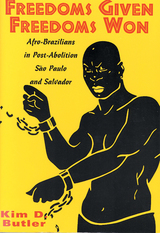
front cover of Freedoms Given, Freedoms Won
Freedoms Given, Freedoms Won
Afro-Brazilians in Post-Abolition São Paolo and Salvador
Butler, Kim D
Rutgers University Press, 1998

Freedoms Given, Freedoms Won explores the ways Afro-Brazilians in two major cities adapted to the new conditions of life after the abolition of slavery and how they confronted limitations placed on their new freedom. The book sets forth new ways of understanding why the abolition of slavery did not yield equitable fruits of citizenship, not only in Brazil, but throughout the Americas and the Caribbean.

Afro-Brazilians in Sao Paulo and Salvador lived out their new freedom in ways that raise issues common to the entire Afro-Atlantic diaspora. In Sao Paulo, they initiated a vocal struggle for inclusion in the creation of the nation's first black civil rights organization and political party, and they appropriated a discriminatory identity that isolated blacks. In contrast, African identity prevaled over black identity in Salvador, where social protest was oriented toward protecting the right of cultural pluralism.

Of all the eras and issues studied in Afro-Brazilian history, post-abolition social and political action has been the most neglected. Butler provides many details of this period for the first time in English and supplements published sources with original oral histories, Afro-Brazilian newspapers, and new state archival documents currently being catalogued in Bahia. Freedoms Given, Freedoms Won sets the Afro-Brazilian experience in a national context as well as situating it within the Afro-Atlantic diaspora through a series of explicit parallels, particularly with Cuba and Jamaica.
[more]

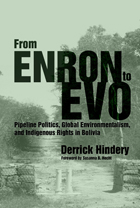
front cover of From Enron to Evo
From Enron to Evo
Pipeline Politics, Global Environmentalism, and Indigenous Rights in Bolivia
Derrick Hindery; Foreword by Susanna B. Hecht
University of Arizona Press, 2013
Throughout the Americas, a boom in oil, gas, and mining development has pushed the extractive frontier deeper into Indigenous territories. Centering on a long-term study of Enron and Shell’s Cuiabá pipeline, From Enron to Evo traces the struggles of Bolivia’s Indigenous peoples for self-determination over their lives and territories. In his analysis of their response to this encroaching development, author Derrick Hindery also sheds light on surprising similarities between neoliberal reform and the policies of the nation’s first Indigenous president, Evo Morales.

Drawing upon extensive interviews and document analysis, Hindery argues that many of the structural conditions created by neoliberal policies—including partial privatization of the oil and gas sector—still persist under Morales. Tactics employed by both Morales and his neoliberal predecessors utilize the rhetoric of environmental protection and Indigenous rights to justify oil, gas, mining, and road development in Indigenous territories and sensitive ecoregions.

Indigenous peoples, while mindful of gains made during Morales’s tenure, are increasingly dissatisfied with the administration’s development model, particularly when it infringes upon their right to self-determination. From Enron to Evo demonstrates their dynamic and pragmatic strategies to cope with development and adversity, while also advancing their own aims.

Offering a critique of both free-market piracy and the dilemmas of resource nationalism, this is a groundbreaking book for scholars, policy-makers, and advocates concerned with Indigenous politics, social movements, environmental justice, and resistance in an era of expanding resource development.
[more]

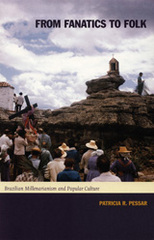
front cover of From Fanatics to Folk
From Fanatics to Folk
Brazilian Millenarianism and Popular Culture
Patricia R. Pessar
Duke University Press, 2004
From Fanatics to Folk rejects conventional understandings of Brazilian millenarianism as exceptional and self-defeating. Considering millenarianism over the long sweep of Brazilian history, Patricia R. Pessar shows it to have been both dominant discourse and popular culture—at different times the inspiration for colonial conquest, for backlanders’ resistance to a modernizing church and state, and for the nostalgic appropriation by today’s elites in pursuit of “traditional” folklore and “authentic” expressions of faith. Pessar focuses on Santa Brígida, a Northeast Brazilian millenarian movement begun in the 1930s. She examines the movement from its founding by Pedro Batista—initially disparaged as a charlatan by the backland elite and later celebrated as a modernizer, patriot, and benefactor—through the contemporary struggles of its followers to maintain their transgressive religious beliefs in the face of increased attention from politicians, clergy, journalists, filmmakers, researchers, and museum curators.

Pessar combines cultural history spanning the colonial period to the present; comparative case studies of the Canudos, Contestado, Juazeiro, and Santa Brígida movements; and three decades of ethnographic research in the Brazilian Northeast. Highlighting the involvement of a broad range of individuals and institutions, the cross-fertilization between movements, contestation and accommodation vis-à-vis the church and state, and matters of spirituality and faith, From Fanatics to Folk reveals Brazilian millenarianism as long-enduring and constantly in flux.
[more]

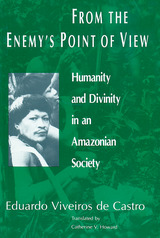
front cover of From the Enemy's Point of View
From the Enemy's Point of View
Humanity and Divinity in an Amazonian Society
Eduardo Viveiros de Castro
University of Chicago Press, 1992
The Araweté are one of the few Amazonian peoples who have maintained their cultural integrity in the face of the destructive forces of European imperialism. In this landmark study, anthropologist Eduardo Viveiros de Castro explains this phenomenon in terms of Araweté social cosmology and ritual order. His analysis of the social and religious life of the Araweté—a Tupi-Guarani people of Eastern Amazonia—focuses on their concepts of personhood, death, and divinity.

Building upon ethnographic description and interpretation, Viveiros de Castro addresses the central aspect of the Arawete's concept of divinity—consumption—showing how its cannibalistic expression differs radically from traditional representations of other Amazonian societies. He situates the Araweté in contemporary anthropology as a people whose vision of the world is complex, tragic, and dynamic, and whose society commands our attention for its extraordinary openness to exteriority and transformation. For the Araweté the person is always in transition, an outlook expressed in the mythology of their gods, whose cannibalistic ways they imitate. From the Enemy's Point of View argues that current concepts of society as a discrete, bounded entity which maintains a difference between "interior" and "exterior" are wholly inappropriate in this and in many other Amazonian societies.

 
[more]

front cover of From the Nation-Building Debate to the Bolsa Família Program
From the Nation-Building Debate to the Bolsa Família Program
Whiteness, Gender, and Poverty in Brazil
Beatriz Junqueira Lage Carbone
Campus Verlag, 2023
An examination of struggles over race and gender in contemporary Brazil, as reflected in conflicts over a national social welfare program.

Bolsa Familia was a social welfare program launched in Brazil in 2003 that made cash payments to poor families, provided they kept their children in school and got them vaccinated. Over time, the program became controversial, intertwined with struggles over race and gender, and President Jair Bolsonaro canceled it in 2021. This book examines the discourse around the program and its effects, illuminating conflicts over national identity and the roles of sexism and racism in Brazil.
[more]

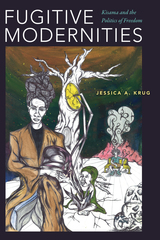
front cover of Fugitive Modernities
Fugitive Modernities
Kisama and the Politics of Freedom
Jessica A. Krug
Duke University Press, 2018
During the early seventeenth century, Kisama emerged in West Central Africa (present-day Angola) as communities and an identity for those fleeing expanding states and the violence of the trans-Atlantic slave trade. The fugitives mounted effective resistance to European colonialism despite—or because of—the absence of centralized authority or a common language. In Fugitive Modernities Jessica A. Krug offers a continent- and century-spanning narrative exploring Kisama's intellectual, political, and social histories. Those who became Kisama forged a transnational reputation for resistance, and by refusing to organize their society around warrior identities, they created viable social and political lives beyond the bounds of states and the ruthless market economy of slavery. Krug follows the idea of Kisama to the Americas, where fugitives in the New Kingdom of Grenada (present-day Colombia) and Brazil used it as a means of articulating politics in fugitive slave communities. By tracing the movement of African ideas, rather than African bodies, Krug models new methods for grappling with politics and the past, while showing how the history of Kisama and its legacy as a global symbol of resistance that has evaded state capture offers essential lessons for those working to build new and just societies.
[more]

front cover of A Future History of Water
A Future History of Water
Andrea Ballestero
Duke University Press, 2019
Based on fieldwork among state officials, NGOs, politicians, and activists in Costa Rica and Brazil, A Future History of Water traces the unspectacular work necessary to make water access a human right and a human right something different from a commodity. Andrea Ballestero shows how these ephemeral distinctions are made through four technolegal devices—formula, index, list and pact. She argues that what is at stake in these devices is not the making of a distinct future but what counts as the future in the first place. A Future History of Water is an ethnographically rich and conceptually charged journey into ant-filled water meters, fantastical water taxonomies, promises captured on slips of paper, and statistical maneuvers that dissolve the human of human rights. Ultimately, Ballestero demonstrates what happens when instead of trying to fix its meaning, we make water’s changing form the precondition of our analyses.
[more]


Send via email Share on Facebook Share on Twitter