
 A SCHOLARLY BOOK REPOSITORY
7 start with F start with F
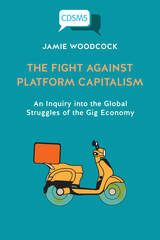
“The book rewards readers with interesting first-hand accounts of protests and pickets that are typically absent from academic discussions of the digital economy.” - https://blogs.lse.ac.uk/lsereviewofbooks/2021/03/17/book-review-the-fight-against-platform-capitalism-an-inquiry-into-the-global-struggles-of-the-gig-economy-by-jamie-woodcock/
So far, platform work has been an important laboratory for capital. Management techniques, like the use of algorithms, are being tested with a view to exporting across the global economy and it is argued that automation is undermining workers’ agency. Although the contractual trick of self-employment has allowed platforms to grow quickly and keep their costs down, yet it has also been the case also that workers have also found they can strike without following the existing regulations.
This book develops a critique of platforms and platform capitalism from the perspective of workers and contributes to the ongoing debates about the future of work and worker organising. It presents an alternative portrait returning to a focus on workers’ experience, focusing on solidarity, drawing out a global picture of new forms of agency. In particular, the book focuses on three dynamics that are driving struggles in the platform economy: the increasing connections between workers who are no longer isolated; the lack of communication and negotiation from platforms, leading to escalating worker action around shared issues; and the internationalisation of platforms, which has laid the basis for new transnational solidarity.
Focusing on transport and courier workers, online workers and freelancers author Jamie Woodcock concludes by considering how workers build power in different situations. Rather than undermining worker agency, platforms have instead provided the technical basis for the emergence of new global struggles against capitalism.


As discussions about the roles played by information in economic, political, and social arenas continue to evolve, the need for an intellectual primer on information ethics that also functions as a solid working casebook for LIS students and professionals has never been more urgent. This text, written by a stellar group of ethics scholars and contributors from around the globe, expertly fills that need. Organized into twelve chapters, making it ideal for use by instructors, this volume from editors Burgess and Knox
- thoroughly covers principles and concepts in information ethics, as well as the history of ethics in the information professions;
- examines human rights, information access, privacy, discourse, intellectual property, censorship, data and cybersecurity ethics, intercultural information ethics, and global digital citizenship and responsibility;
- synthesizes the philosophical underpinnings of these key subjects with abundant primary source material to provide historical context along with timely and relevant case studies;
- features contributions from John M. Budd, Paul T. Jaeger, Rachel Fischer, Margaret Zimmerman, Kathrine A. Henderson, Peter Darch, Michael Zimmer, and Masooda Bashir, among others; and
- offers a special concluding chapter by Amelia Gibson that explores emerging issues in information ethics, including discussions ranging from the ethics of social media and social movements to AI decision making.
This important survey will be a key text for LIS students and an essential reference work for practitioners
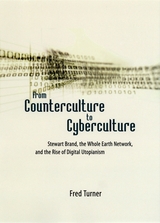
In the early 1960s, computers haunted the American popular imagination. Bleak tools of the cold war, they embodied the rigid organization and mechanical conformity that made the military-industrial complex possible. But by the 1990s—and the dawn of the Internet—computers started to represent a very different kind of world: a collaborative and digital utopia modeled on the communal ideals of the hippies who so vehemently rebelled against the cold war establishment in the first place.
From Counterculture to Cyberculture is the first book to explore this extraordinary and ironic transformation. Fred Turner here traces the previously untold story of a highly influential group of San Francisco Bay–area entrepreneurs: Stewart Brand and the Whole Earth network. Between 1968 and 1998, via such familiar venues as the National Book Award–winning Whole Earth Catalog, the computer conferencing system known as WELL, and, ultimately, the launch of the wildly successful Wired magazine, Brand and his colleagues brokered a long-running collaboration between San Francisco flower power and the emerging technological hub of Silicon Valley. Thanks to their vision, counterculturalists and technologists alike joined together to reimagine computers as tools for personal liberation, the building of virtual and decidedly alternative communities, and the exploration of bold new social frontiers.
Shedding new light on how our networked culture came to be, this fascinating book reminds us that the distance between the Grateful Dead and Google, between Ken Kesey and the computer itself, is not as great as we might think.
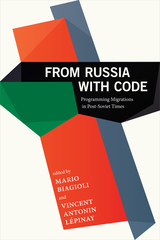
Contributors. Irina Antoschyuk, Mario Biagioli, Ksenia Ermoshina, Marina Fedorova, Andrey Indukaev, Alina Kontareva, Diana Kurkovsky, Vincent Lépinay, Alexandra Masalskaya, Daria Savchenko, Liubava Shatokhina, Alexandra Simonova, Ksenia Tatarchenko, Zinaida Vasilyeva, Dimitrii Zhikharevich

The Harvard University Information Technology Quarterly (formerly Newsletter), from which this collection of articles has been drawn, is highly regarded both for its wide range of exploration and for the depth of its discussion of new and emerging computer-related technologies. Included in this book are articles covering the origin and development of semiconductor technology, the microprocessor, telephony, xerography, electronic typesetting, videodisc technology, computer graphics, artificial intelligence, and robotics.
This book also discusses the impact of information technology on the university and the university library and continues an examination of information technology's role in the educational process. Each of the articles provides historical background and attractive illustrations that enrich the reader's understanding. From Sand to Circuits is both a fascinating compendium of models for understanding information technology and a lucid, highly enjoyable collection of essays.
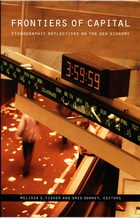
Some contributors highlight how expedited flows of information allow business professionals to develop new knowledge practices. They analyze dynamics ranging from the decision-making processes of the Federal Reserve Board to the legal maneuvering necessary to buttress a nascent Japanese market in over-the-counter derivatives. Others focus on the social consequences of globalization and new modes of communication, evaluating the introduction of new information technologies into African communities and the collaborative practices of open-source computer programmers. Together the essays suggest that social relations, rather than becoming less relevant in the high-tech age, have become more important than ever. This finding dovetails with the thinking of many corporations, which increasingly employ anthropologists to study and explain the “local” cultural practices of their own workers and consumers. Frontiers of Capital signals the wide-ranging role of anthropology in explaining the social and cultural contours of the New Economy.
Contributors. Jean Comaroff, John L. Comaroff, Greg Downey, Melissa S. Fisher, Douglas R. Holmes, George E. Marcus, Siobhán O’Mahony, Aihwa Ong, Annelise Riles, Saskia Sassen, Paul A. Silverstein, AbdouMaliq Simone, Neil Smith, Caitlin Zaloom
READERS
Browse our collection.
PUBLISHERS
See BiblioVault's publisher services.
STUDENT SERVICES
Files for college accessibility offices.
RECENTLY PUBLISHED






UChicago Accessibility Resources
home | accessibility | search | about | contact us
BiblioVault ® 2001 - 2026
The University of Chicago Press