
 A SCHOLARLY BOOK REPOSITORY
5 start with F start with F

If you've ever been to a protest or been involved in a movement for social change, you have likely experienced a local culture, one with slogans, jargon, and shared commitments. Though one might think of a cohort of youthful organizers when imagining protest culture, this powerful ethnography from esteemed sociologist Gary Alan Fine explores the world of senior citizens on the front lines of progressive protests. While seniors are a notoriously important—and historically conservative—political cohort, the group Fine calls “Chicago Seniors Together” is a decidedly leftist organization, inspired by the model of Saul Alinsky. The group advocates for social issues, such as affordable housing and healthcare, that affect all sectors of society but take on a particular urgency in the lives of seniors. Seniors connect and mobilize around their distinct experiences but do so in service of concerns that extend beyond themselves. Not only do these seniors experience social issues as seniors—but they use their age as a dramatic visual in advocating for political change.
In Fair Share, Fine brings readers into the vital world of an overlooked political group, describing how a “tiny public” mobilizes its demands for broad social change. In investigating this process, he shows that senior citizen activists are particularly savvy about using age to their advantage in social movements. After all, what could be more attention-grabbing than a group of passionate older people determinedly shuffling through snowy streets with canes, in wheelchairs, and holding walkers to demand healthcare equity, risking their own health in the process?
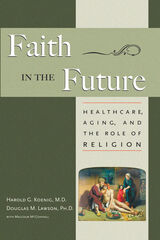
After an interview in Newsweek about his book Spirituality in Patient Care and his research in religion and health, Dr. Harold Koenig became the international voice on spirituality, health, and aging. In this book, Faith in the Future, he is joined by two other experts on aging and human development. They present a compelling look at one of the most severe issues in today’s society: health care in America.
How will we provide quality healthcare to older adults needing it during the next thirty to fifty years? Who will provide this care? How will it be funded? How can we establish systems of care now to be in place as demographic and health-related economic pressures mount?
Alongside the sobering reality of our country’s challenges, there are reasons for optimism. Innovative programs created and maintained by volunteers and religious congregations are emerging as pivotal factors in meeting healthcare needs. Summarizing decades of scientific research and providing numerous inspirational examples and role models, the authors present practical steps that individuals and institutions may emulate for putting faith into action.
<
Through analysis of national data sets and interviews with lower income older adults, Heflin and Harrington Meyer describe why many older adults do not have enough money to afford food and other essentials. As a result of chronic economic disadvantage, food insecure older adults are often forced to make budget trade-offs between food and other expenses. In these trade-offs, food typically ranks below housing and energy costs and competes with other household bills, such as medical costs, transportation, and phone and internet coverage. While finances play a large role, nonfinancial factors, such as poor physical, cognitive, and mental health, access to healthy food, and transportation challenges, also contribute to food insecurity in old age. In the face of these difficulties, food insecure older adults may go hungry, skip meals, or eat unhealthy foods to help make ends meet.
While SNAP and community-based programs, such as food pantries and home delivered meals, are intended to help address the issue of food insecurity, they are typically inadequate to address the needs of food insecure older adults. SNAP has enrollment and maintenance procedures that are particularly difficult for older adults to navigate, pays out an insufficient amount of money to cover food costs, and varies greatly by state. Availability of community programs varies by municipality, often lacks nutritious foods that are complementary to health conditions common among older adults, and can be difficult to access due to a lack of reliable transportation, disability, or cost. Heflin and Harrington Meyer advocate for addressing all the issues that increase older adults’ risk of food insecurity, not just financial barriers. They suggest updating food insecurity screening tools to include these factors, increasing SNAP benefits and income support for older adults, and other policies to help combat food insecurity in older adults.
Food for Thought highlights the increasingly important issue of food insecurity in old age and lays bare the overlooked challenges faced by food insecure older adults.


Frontiers in the Economics in Aging directs attention to four topics: the role of retirement accounts, such as IRAs and 401(k)s in personal saving; the economics of health care; new advances in research methodology; and aging in relation to inequality. Some of the issues analyzed within these topics are the implications of rising personal retirement saving in recent years, how health and health insurance affect labor supply, and the effects of pensions on the distribution of wealth.
David Wise's lucid introduction provides an overview of each paper. In addition to this book's appeal for specialists and microeconomists, it offers immediately practical ideas and methods for shaping public policy. In fact, one of the papers in this volume, "The Taxation of Pensions: A Shelter Can Become a Trap," helped to spur new legislation that reformed laws on pension distribution.
READERS
Browse our collection.
PUBLISHERS
See BiblioVault's publisher services.
STUDENT SERVICES
Files for college accessibility offices.
RECENTLY PUBLISHED







UChicago Accessibility Resources
home | accessibility | search | about | contact us
BiblioVault ® 2001 - 2025
The University of Chicago Press