
 A SCHOLARLY BOOK REPOSITORY
19 start with F start with F

The dual traumas of colonialism and slavery are still felt by Native Americans and African Americans as victims of ongoing violence toward people of color today. In The Feeling of Forgetting, John Corrigan calls attention to the trauma experienced by white Americans as perpetrators of this violence. By tracing memory’s role in American Christianity, Corrigan shows how contemporary white Christian nationalism is motivated by a widespread effort to forget the role race plays in American society. White trauma, Corrigan argues, courses through American culture like an underground river that sometimes bursts forth into brutality, terrorism, and insurrection. Tracing the river to its source is a necessary first step toward healing.

A provocative examination of how religious practices of forgetting drive white Christian nationalism.
The dual traumas of colonialism and slavery are still felt by Native Americans and African Americans as victims of ongoing violence toward people of color today. In The Feeling of Forgetting, John Corrigan calls attention to the trauma experienced by white Americans as perpetrators of this violence. By tracing memory’s role in American Christianity, Corrigan shows how contemporary white Christian nationalism is motivated by a widespread effort to forget the role race plays in American society. White trauma, Corrigan argues, courses through American culture like an underground river that sometimes bursts forth into brutality, terrorism, and insurrection. Tracing the river to its source is a necessary first step toward healing.


***Winner of an English PEN Award 2022***
The mainstream conversation surrounding gender equality is a repertoire of violence: harassment, rape, abuse, femicide. These words suggest a cruel reality. But they also hide another reality: that of gendered violence committed with the complicity of the State.
In this book, Françoise Vergès denounces the carceral turn in the fight against sexism. By focusing on 'violent men', we fail to question the sources of their violence. There is no doubt as to the underlying causes: racial capitalism, ultra-conservative populism, the crushing of the Global South by wars and imperialist looting, the exile of millions and the proliferation of prisons - these all put masculinity in the service of a policy of death.
Against the spirit of the times, Françoise Vergès refuses the punitive obsession of the State in favour of restorative justice.

practice. Stewart Tolnay and E. M. Beck empirically test competing explanations of the causes of lynching, using U.S. Census and historical voting data and a newly constructed inventory of southern lynch victims. Among their surprising findings: lynching responded to fluctuations in the price of cotton, decreasing in frequency when prices rose and increasing when they fell.

This book makes a timely intervention into the question of Castro's historical role and contribution. The author argues that Castro's doctrine of armed struggle is the logical development of his idea of the ethical liberation fighter. At its core is an unremitting emphasis on the ethical use of violence.
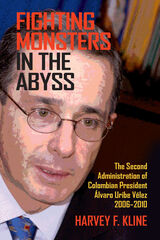
Fighting Monsters in the Abyss offers a deeply insightful analysis of the efforts by the second administration of Colombian President Álvaro Uribe Vélez (2006–2010) to resolve a decades-long Marxist insurgency in one of Latin America’s most important nations. Continuing work from his prior books about earlier Colombian presidents and yet written as a stand-alone study, Colombia expert Harvey F. Kline illuminates the surprising successes and setbacks in Uribe’s response to this existential threat.
In State Building and Conflict Resolution in Colombia, 1986–1994, Kline documented and explained the limited successes of Presidents Virgilio Barco and César Gaviria in putting down the revolutionaries while also confronting challenges from drug dealers and paramilitary groups. The following president Andrés Pastrana then boldly changed course and attempted resolution through negotiations, an effort whose failure Kline examines in Chronicle of a Failure Foretold. In his third book, Showing Teeth to the Dragons, Kline shows how in his first term President Álvaro Uribe Vélez more successfully quelled the insurrection through a combination of negotiated demobilization of paramilitary groups and using US backing to mount more effective military campaigns.
Kline opens Fighting Monsters in the Abyss with a recap of Colombia’s complex political history, the development of Marxist rebels and paramilitary groups and their respective relationships to the narcotics trade, and the attempts of successive Colombian presidents to resolve the crisis. Kline next examines the ability of the Colombian government to reimpose rule in rebel-controlled territories as well as the challenges of administering justice. He recounts the difficulties in the enforcement of the landmark Law of Justice and Peace as well as two significant government scandals, that of the “false positives” (“falsos positivos”) in which innocent civilians were killed by the military to inflate the body counts of dead insurgents and a second scandal related to illegal wiretapping.
In tracing Uribe’s choices, strategies, successes, and failures, Kline also uses the example of Colombia to explore a dimension quite unique in the literature about state building: what happens when some members of a government resort to breaking rules or betraying their societies’ values in well-intentioned efforts to build a stronger state?

First, Do No Harm shows how health care professionals, with the best intentions of providing excellent, holistic health care, can nonetheless perpetuate violence against vulnerable patients. The essays investigate the need to rethink contemporary healthcare practices in ways that can bring the art and science of medicine back into sorely needed balance.
These ground-breaking studies by noted scholars question commonly held assumptions in contemporary healthcare that underlie oppressive power dynamics and even violence for patients and their families. The contributors discuss such topics as women and violence, life-support technologies, and healthcare professionals’ own experiences as patients. First, Do No Harm opens the discourse for reaching new understandings, from reassessing the meaning of "quality of life" to questioning the appropriateness of the very language used by healthcare professionals. It will be welcomed by healthcare workers and by scholars in nursing, medicine, and the allied health sciences.

Between 1875 and 1920, Chicago's homicide rate more than quadrupled, making it the most violent major urban center in the United States--or, in the words of Lincoln Steffens, "first in violence, deepest in dirt." In many ways, however, Chicago became more orderly as it grew. Hundreds of thousands of newcomers poured into the city, yet levels of disorder fell and rates of drunkenness, brawling, and accidental death dropped. But if Chicagoans became less volatile and less impulsive, they also became more homicidal.
Based on an analysis of nearly six thousand homicide cases, First in Violence, Deepest in Dirt examines the ways in which industrialization, immigration, poverty, ethnic and racial conflict, and powerful cultural forces reshaped city life and generated soaring levels of lethal violence. Drawing on suicide notes, deathbed declarations, courtroom testimony, and commutation petitions, Jeffrey Adler reveals the pressures fueling murders in turn-of-the-century Chicago. During this era Chicagoans confronted social and cultural pressures powerful enough to trigger surging levels of spouse killing and fatal robberies. Homicide shifted from the swaggering rituals of plebeian masculinity into family life and then into street life.
From rage killers to the "Baby Bandit Quartet," Adler offers a dramatic portrait of Chicago during a period in which the characteristic elements of modern homicide in America emerged.

This anthology reflects some of Colombia’s finest literary talent, and most of these stories appear here for the first time in English translation. They reveal the contradictions and complexities of the human condition, yet they also offer hope for the future. In their bold revelations of the depths of despair, these writers provide gripping portrayals of humanity’s tenacious resistance to those very depths.

Flows of Violence offers a profound ethnographic exploration of the intricate relationship between violence and water infrastructure in one of Colombia’s most marginalized cities. This groundbreaking work engages with the concept of “infrastructural violence,” revealing how the Colombian state’s neglect and inadequate provision of water services perpetuate inequality and suffering among Buenaventura’s residents. Through extensive fieldwork, Fernández provides rich empirical data and firsthand accounts that bring to light the daily struggles and resilience of the city’s inhabitants.
The book critically examines how everyday crime and state neglect intersect, altering the improvised practices of water storage and access among the population. It also highlights the innovative mechanisms employed by social movements and ordinary citizens to cope with and resist these challenges.
Flows of Violence is an essential read for scholars in anthropology, geography, and Latin American studies, offering valuable insights into the sociopolitical impacts of infrastructure. This timely contribution underscores the urgent need for equitable infrastructure development and social justice, making it a pivotal text for understanding urban poverty and state dynamics in Latin America and beyond.

"A sophisticated and persuasive late-modernist political analysis that consistently draws the reader into the narratives of the author and those of the people of violence in Northern Ireland to whom he talked. . . . Simply put, this book is a feast for the intellect"—Thomas M. Wilson, American Anthropologist
"One of the best books to have been written on Northern Ireland. . . . A highly imagination and significant book. Formations of Violence is an important addition to the literature on political violence."—David E. Schmitt, American Political Science Review

The rich and complex texture of working-class neighborhoods in eighteenth-century Paris comes vibrantly alive in this collage of the experiences of ordinary people—men and women, rich and poor, masters and servants, neighbors and colleagues. Exploring three arenas of conflict and solidarity—the home, the workplace, and the street—Arlette Farge offers the reader an intimate social history, bringing long-dead citizens and vanished social groups back to life with sensitivity and perception.
Fragile Lives reconstructs the rhythms of this population's daily existence, the way they met, formed relationships and broke them off, conducted their affairs in the community, and raised their young. Farge follows them into the factory and describes the ways they organized to improve their working conditions, and how they were controlled by the authorities. She shows how these Parisians behaved in the context of collective events, from festive street spectacles to repressive displays of power by the police. As the author examines interwoven lives as revealed in judicial records, we come to know and understand the criminals and the underworld of the time; the situation of women as lovers, wives, or prostitutes; anxieties about food and drink, and the rules of conduct in a “fragile” society. Elegantly written and skillfully translated, Fragile Lives is a book for the curious general reader and for those interested in social and cultural history.

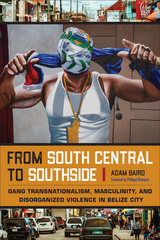
From South Central to Southside charts the genesis and evolution of a transnational gang culture. Baird provides firsthand interviews with gang members and “narco” families and explains the surprising source of Belize City’s severe violence and skyrocketing homicide rates. He identifies gang violence in the U.S. and Belize as stemming from populations blighted by historical, brutal inequality and marginalization. Analyzing the gendered dynamics as young men and women face the temptations, risks, and dangers of gang life, Baird shines a light on “chronic vulnerability" in Belize City.

READERS
Browse our collection.
PUBLISHERS
See BiblioVault's publisher services.
STUDENT SERVICES
Files for college accessibility offices.
RECENTLY PUBLISHED






UChicago Accessibility Resources
home | accessibility | search | about | contact us
BiblioVault ® 2001 - 2025
The University of Chicago Press