
 A SCHOLARLY BOOK REPOSITORY
101 books about Violence against and 7
start with F
101 books about Violence against and 7
101 books about Violence against
7 start with F start with F
7 start with F start with F

Faith and the Fragility of Justice
Responses to Gender-Based Violence in South Africa
Meredith Whitnah
Rutgers University Press, 2025
South Africa has repeatedly made international headlines because of its high rates of gender-based violence. In the midst of a wide range of responses to the problem, an important voice has been largely absent. Why are the religious groups that had famously protested the racial violence of apartheid faltering in their response to gendered violence in the democracy? Faith and the Fragility of Justice answers this question through a deep dive into the public discourse of three Protestant Christian organizations that had been adamant about a theological mandate to challenge apartheid, but have varied in their responses to gender-based violence in the democracy. The central argument of the book is that the organizations’ theological convictions intersect with their posture toward various social groups to shape their actions. In making this argument, Meredith Whitnah demonstrates that religious beliefs are a central dimension of institutional processes that sustain or challenge social inequality and violence.
[more]

A Feminist Theory of Violence
A Decolonial Perspective
Françoise Vergès
Pluto Press, 2022
'A robust, decolonial challenge to carceral feminism' - Angela Y. Davis
***Winner of an English PEN Award 2022***
The mainstream conversation surrounding gender equality is a repertoire of violence: harassment, rape, abuse, femicide. These words suggest a cruel reality. But they also hide another reality: that of gendered violence committed with the complicity of the State.
In this book, Françoise Vergès denounces the carceral turn in the fight against sexism. By focusing on 'violent men', we fail to question the sources of their violence. There is no doubt as to the underlying causes: racial capitalism, ultra-conservative populism, the crushing of the Global South by wars and imperialist looting, the exile of millions and the proliferation of prisons - these all put masculinity in the service of a policy of death.
Against the spirit of the times, Françoise Vergès refuses the punitive obsession of the State in favour of restorative justice.
***Winner of an English PEN Award 2022***
The mainstream conversation surrounding gender equality is a repertoire of violence: harassment, rape, abuse, femicide. These words suggest a cruel reality. But they also hide another reality: that of gendered violence committed with the complicity of the State.
In this book, Françoise Vergès denounces the carceral turn in the fight against sexism. By focusing on 'violent men', we fail to question the sources of their violence. There is no doubt as to the underlying causes: racial capitalism, ultra-conservative populism, the crushing of the Global South by wars and imperialist looting, the exile of millions and the proliferation of prisons - these all put masculinity in the service of a policy of death.
Against the spirit of the times, Françoise Vergès refuses the punitive obsession of the State in favour of restorative justice.
[more]

Flowers for Otello
On the Crimes That Came Out of Jena
Esther Dischereit
Seagull Books, 2022
A powerful performance text that illuminates incidents of anti-immigrant violence in contemporary Germany.
Between 1998 and 2007 a series of killings in Germany, disdainfully styled “doner murders” by the media, were attributed by German police to internecine rivalries among immigrants. The victims included eight citizens of Turkish origin, a Greek citizen, and a German policewoman. Not until 2011 did the German public learn not only that the police had ignored signs pointing to the real perpetrators, a neo-Nazi group called the National Socialist Underground, but also that important files, possibly containing evidence implicating state agencies, had disappeared from the archives of Federal Police and intelligence organizations.
Esther Dischereit, one of the preeminent German-Jewish voices of the post-Holocaust generation, takes that failure of the state to protect its citizens from racist violence as the core of her performance text Flowers for Otello: On the Crimes That Came Out of Jena. Seeking an appropriate language with which to meet the bereaved, she also finds a way to raise the blanket of silence that is used by those who would prefer that we forget. Combining witness testimony, myth, and incidents from a history of violence against minorities, Flowers for Otello, in Iain Galbraith’s translation, refuses chaos, instead revealing the chilling, patterned order of tragedy while bringing a great writer’s humanism to the fore.
Between 1998 and 2007 a series of killings in Germany, disdainfully styled “doner murders” by the media, were attributed by German police to internecine rivalries among immigrants. The victims included eight citizens of Turkish origin, a Greek citizen, and a German policewoman. Not until 2011 did the German public learn not only that the police had ignored signs pointing to the real perpetrators, a neo-Nazi group called the National Socialist Underground, but also that important files, possibly containing evidence implicating state agencies, had disappeared from the archives of Federal Police and intelligence organizations.
Esther Dischereit, one of the preeminent German-Jewish voices of the post-Holocaust generation, takes that failure of the state to protect its citizens from racist violence as the core of her performance text Flowers for Otello: On the Crimes That Came Out of Jena. Seeking an appropriate language with which to meet the bereaved, she also finds a way to raise the blanket of silence that is used by those who would prefer that we forget. Combining witness testimony, myth, and incidents from a history of violence against minorities, Flowers for Otello, in Iain Galbraith’s translation, refuses chaos, instead revealing the chilling, patterned order of tragedy while bringing a great writer’s humanism to the fore.
[more]

The Force of Witness
Contra Feminicide
Rosa-Linda Fregoso
Duke University Press, 2023
In The Force of Witness Rosa-Linda Fregoso examines the contra feminicide movement in Mexico and other feminist efforts to eradicate gender violence. Drawing on interviews, art, documentaries, and her years of activism, Fregoso traces the micro and macro scales of misogyny and the patterns of state complicity with gender violence. She shows how different forms of witnessing—from activist-mothers’ bearing witness to the memories of their daughters and expert witnesses in court cases to communal witnessing and a scholar-activist-citizen witnessing her own actions—are key to resisting feminicidal violence. Fregoso situates these forms of witness in the histories, contexts, structures, bodies, and intersectional struggles they emerge from. By outlining the complexities of feminicidal violence in relation to witnessing processes, Fregoso challenges the notion of witness as an individual or autonomous subject inscribed solely in the legal or religious arenas. Rather, she theorizes witness as a force of collectivity and a constellation of multiple social locations and intersectional practices that work together to abolish feminicidal violence.
[more]

Fractal Repair
Queer Histories of Modern Jamaica
Matthew Chin
Duke University Press, 2024
In Fractal Repair, Matthew Chin investigates queerness in Jamaica from early colonial occupation to the present, critically responding to the island’s global reputation for extreme homophobia and anti-queer violence. Chin advances a theory and method of queer fractals to bring together genealogies of queer and Caribbean formation. Fractals—a kind of geometry in which patterns repeat but never exactly in the same way—make visible shifting accounts of Caribbean queerness in terms of race, gender, and sexual alterity. Drawing on this fractal orientation, Chin assembles and analyzes multigenre archives, ranging from mid-twentieth-century social science studies of the Caribbean to Jamaica’s National Dance Theatre Company to HIV/AIDS organizations, to write reparative histories of queerness. Chin’s proposal of a fractal politics of repair invests in the horizon of difference that repetition materializes, and it extends reparations discourses intent on overcoming the past and calculating economic compensation for survivors of violence.
[more]
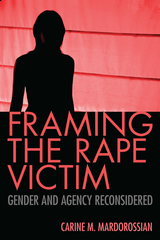
Framing the Rape Victim
Gender and Agency Reconsidered
Mardorossian, Carine M
Rutgers University Press, 2014
Winner of the 2016 Nonfiction Category from The Authors' Zone
In recent years, members of legal, law enforcement, media and academic circles have portrayed rape as a special kind of crime distinct from other forms of violence. In Framing the Rape Victim, Carine M. Mardorossian argues that this differential treatment of rape has exacerbated the ghettoizing of sexual violence along gendered lines and has repeatedly led to women’s being accused of triggering, if not causing, rape through immodest behavior, comportment, passivity, or weakness.
Contesting the notion that rape is the result of deviant behaviors of victims or perpetrators, Mardorossian argues that rape saturates our culture and defines masculinity’s relation to femininity, both of which are structural positions rather than biologically derived ones. Using diverse examples throughout, Mardorossian draws from Hollywood film and popular culture to contemporary women’s fiction and hospitalized birth emphasizing that the position of dominant masculinity can be occupied by men, women, or institutions, while structural femininity is a position that may define and subordinate men, minorities, and other marginalized groups just as effectively as it does women. Highlighting the legacies of the politically correct debates of the 1990s and the terrorist attacks of 9/11, the book illustrates how the framing of the term “victim” has played a fundamental role in constructing notions of agency that valorize autonomy and support exclusionary, especially masculine, models of American selfhood.
The gendering of rape, including by well-meaning, sometimes feminist, voices that claim to have victims’ best interests at heart, ultimately obscures its true role in our culture. Both a critical analysis and a call to action, Framing the Rape Victim shows that rape is not a special interest issue that pertains just to women but a pervasive one that affects our society as a whole.
In recent years, members of legal, law enforcement, media and academic circles have portrayed rape as a special kind of crime distinct from other forms of violence. In Framing the Rape Victim, Carine M. Mardorossian argues that this differential treatment of rape has exacerbated the ghettoizing of sexual violence along gendered lines and has repeatedly led to women’s being accused of triggering, if not causing, rape through immodest behavior, comportment, passivity, or weakness.
Contesting the notion that rape is the result of deviant behaviors of victims or perpetrators, Mardorossian argues that rape saturates our culture and defines masculinity’s relation to femininity, both of which are structural positions rather than biologically derived ones. Using diverse examples throughout, Mardorossian draws from Hollywood film and popular culture to contemporary women’s fiction and hospitalized birth emphasizing that the position of dominant masculinity can be occupied by men, women, or institutions, while structural femininity is a position that may define and subordinate men, minorities, and other marginalized groups just as effectively as it does women. Highlighting the legacies of the politically correct debates of the 1990s and the terrorist attacks of 9/11, the book illustrates how the framing of the term “victim” has played a fundamental role in constructing notions of agency that valorize autonomy and support exclusionary, especially masculine, models of American selfhood.
The gendering of rape, including by well-meaning, sometimes feminist, voices that claim to have victims’ best interests at heart, ultimately obscures its true role in our culture. Both a critical analysis and a call to action, Framing the Rape Victim shows that rape is not a special interest issue that pertains just to women but a pervasive one that affects our society as a whole.
[more]

From Rights to Lives
The Evolution of the Black Freedom Struggle
Edited by Françoise N. Hamlin and Charles W. McKinney Jr.
Vanderbilt University Press, 2024
Broadly speaking, the traditionally conceptualized mid-twentieth-century Civil Rights Movement and the newer #BlackLivesMatter Movement possess some similar qualities. They both represent dynamic, complex moments of possibility and progress. They also share mass-based movement activities, policy/legislative advocacy, grassroots organizing, and targeted media campaigns. Innovation, growth, and dissension—core aspects of movement work—mark them both. Crucially, these moments also engender aggressive, repressive, multilevel responses to these assertions of Black humanity.
From Rights to Lives critically engages the dynamic relationship between these two moments of liberatory possibility on the Black Freedom Struggle timeline. The book’s contributors explore what we can learn when we place these moments of struggle in dialogue with each other. They grapple with how our understanding of the postwar moment shapes our analysis of #BLM and wherein lie the discontinuities, in order to glean lessons for future moments of insurgency.
From Rights to Lives critically engages the dynamic relationship between these two moments of liberatory possibility on the Black Freedom Struggle timeline. The book’s contributors explore what we can learn when we place these moments of struggle in dialogue with each other. They grapple with how our understanding of the postwar moment shapes our analysis of #BLM and wherein lie the discontinuities, in order to glean lessons for future moments of insurgency.
[more]
READERS
Browse our collection.
PUBLISHERS
See BiblioVault's publisher services.
STUDENT SERVICES
Files for college accessibility offices.
RECENTLY PUBLISHED







UChicago Accessibility Resources
home | accessibility | search | about | contact us
BiblioVault ® 2001 - 2026
The University of Chicago Press