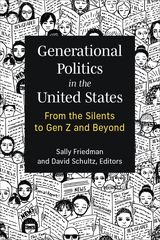
front cover of Generational Politics in the United States
Generational Politics in the United States
From the Silents to Gen Z and Beyond
Sally Friedman and David Schultz, Editors
University of Michigan Press, 2024
The role of generations is an important, yet often overlooked, variable in the study of American politics. A topic of research in sociology, business, and marketing, the focus on generations frequently occurs in American pop culture and journalism. The general public often assumes that different generations have different political leanings and beliefs—that the Silent Generation is all Republican, white, and conservative, or that Millennials are liberal and diverse—but are these assumptions true?

Generational Politics in the United States is the first comprehensive book that examines the concept of generations from a political science perspective. It defines what a generation is and how to sort out the differences between life cycle, cohort, and aging effect. The book then brings together chapters from an array of political science scholars that examine the role of generations in American politics and how it relates to other variables such as age, race, gender, and socioeconomic status. It discusses how politics in the United States are impacted by changes in generations, including how the passing of the Baby Boom generation and rise of the Millennials and Gen Z will change American politics. By examining the differences in political attitudes, engagement, and impact of recent generations, Generational Politics in the United States suggests how generational change will impact American politics in the future.

[more]

front cover of Greek Magic
Greek Magic
Select Texts from the Byzantine Tradition and Beyond
Michael Zellmann-Rohrer
Harvard University Press

Greek Magic collects, edits, and translates a vast number of Greek magical texts—spells, incantations, and related elements incorporated in prayers—from over one hundred manuscripts that date from the tenth through the eighteenth centuries and often preserve much earlier works. The result gives us a new understanding of the nature of belief and worship among medieval Greek-speaking Christians and offers a spellbinding resource for understanding the social world of medieval Byzantium.

These spells bear fresh and direct witness to practical concerns of daily life: their users hoped to protect crops from pests, cure various ailments, catch thieves, and ease childbirth. The rituals in which they are embedded range from the mundane to the spectacular and bizarre. These rites and spells are not, however, relics of antiquity that have simply seeped into the world of medieval Christianity. Instead, they reveal how medieval Christians adapted and remixed practices and techniques from the past and from their neighbors into new and vibrant social practices—now made accessible to modern readers.
[more]

front cover of Growth Policy
Growth Policy
Population, Environment, and Beyond
Kan Chen, Karl F. Lagler, and Mark R. Berg, E. Drannon Buskirk, Jr., Donald H. Gray, Karl Herpolsheimer, T. Jeffrey Jones, George Kral, J.C. Mathes, John McGuire, Donald N. Michael, Stephen M. Pollock, Ruth Rehfus
University of Michigan Press, 1974
A great deal has been said and written about pollution, overpopulation, the depletion of natural resources, and the imminence of an ecological breakdown of catastrophic proportions. The urgent questions are: What can and must be done? How can we organize our knowledge, mobilize our energies, and focus our policy planning so as to create a new relationship between man and the world in which he lives?In Growth Policy a team of experts presents a truly original, interdisciplinary approach to growth policy research from an ecosystem perspective. The authors provide an overall systems framework in which research in population, environment, and social values can be integrated and then expanded to aid the policy-decision process.The authors challenge the conventional wisdom and assumptions that underlie current policy making, and they question the ability of present political and policy-making institutions to coordinate and control the interactions among the environment, population, resource consumption, and technological development. Nor do they subscribe to the facile notion that technology alone will solve the overall problem. Instead, they propose a macrosystems approach to policy research that identifies the issues, classifies and expands the range of possible policies, uses analytical models and computer technology to compare these possible policies in terms of the overall effect desired, and finally, requires the cooperation of policy makers and researchers as well as the public at the national and international levels. This approach has the virtue of developing rational and careful planning decisions without denying the elements of subjectivity and risk involved in such decision making. It also seeks to ensure that considerations of basic human values permeate all responses to the environmental crisis. The authors argue that new concepts of life on earth, of human society and culture, and even of man himself need to be formulated if human society is to enhance
[more]


Send via email Share on Facebook Share on Twitter