
 A SCHOLARLY BOOK REPOSITORY
17 start with G start with G

In Gaming, Alexander Galloway instead considers the video game as a distinct cultural form that demands a new and unique interpretive framework. Drawing on a wide range of disciplines, particularly critical theory and media studies, he analyzes video games as something to be played rather than as texts to be read, and traces in five concise chapters how the “algorithmic culture” created by video games intersects with theories of visuality, realism, allegory, and the avant-garde. If photographs are images and films are moving images, then, Galloway asserts, video games are best defined as actions.
Using examples from more than fifty video games, Galloway constructs a classification system of action in video games, incorporating standard elements of gameplay as well as software crashes, network lags, and the use of cheats and game hacks. In subsequent chapters, he explores the overlap between the conventions of film and video games, the political and cultural implications of gaming practices, the visual environment of video games, and the status of games as an emerging cultural form.
Together, these essays offer a new conception of gaming and, more broadly, of electronic culture as a whole, one that celebrates and does not lament the qualities of the digital age.
Alexander R. Galloway is assistant professor of culture and communication at New York University and author of Protocol: How Control Exists after Decentralization.

At dinnertime: check. At a traffic light: check. In bed at the end of the day: check. In line at the coffee shop: check. In The Geek’s Chihuahua, Ian Bogost addresses the modern love affair of “living with Apple” during the height of the company’s market influence and technology dominance.
The ubiquitous iPhone and its kin saturate our lives, changing everything from our communication to our posture. Bogost contrasts the values of Apple’s massive success in the twenty-first century with those of its rise in the twentieth. And he connects living with Apple with the phenomenon of “hyperemployment”—the constant overwork of today’s technological life that all of us now experience. Bogost also reflects on the new potential function—as well as anxiety and anguish—of devices like the Apple Watch. We are tethered to our devices, and, as Bogost says: that’s just life—anxious, overworked, and utterly networked life.
Forerunners: Ideas First is a thought-in-process series of breakthrough digital publications. Written between fresh ideas and finished books, Forerunners draws on scholarly work initiated in notable blogs, social media, conference plenaries, journal articles, and the synergy of academic exchange. This is gray literature publishing: where intense thinking, change, and speculation take place in scholarship.

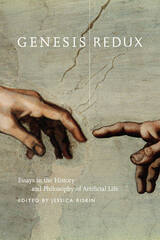
Since antiquity, philosophers and engineers have tried to take life’s measure by reproducing it. Aiming to reenact Creation, at least in part, these experimenters have hoped to understand the links between body and spirit, matter and mind, mechanism and consciousness. Genesis Redux examines moments from this centuries-long experimental tradition: efforts to simulate life in machinery, to synthesize life out of material parts, and to understand living beings by comparison with inanimate mechanisms.
Jessica Riskin collects seventeen essays from distinguished scholars in several fields. These studies offer an unexpected and far-reaching result: attempts to create artificial life have rarely been driven by an impulse to reduce life and mind to machinery. On the contrary, designers of synthetic creatures have generally assumed a role for something nonmechanical. The history of artificial life is thus also a history of theories of soul and intellect.
Taking a historical approach to a modern quandary, Genesis Redux is essential reading for historians and philosophers of science and technology, scientists and engineers working in artificial life and intelligence, and anyone engaged in evaluating these world-changing projects.
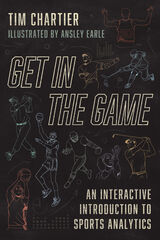
In 2013, NBA point guard Steph Curry wowed crowds when he sunk 11 out of 13 three-pointers for a game total of 54 points—only seven other players, including Michael Jordan and Kobe Bryant, had scored more in a game at Madison Square Garden. Four years later, the University of Connecticut women’s basketball team won its hundredth straight game, defeating South Carolina 66–55. And in 2010, one forecaster—an octopus named Paul—correctly predicted the outcome of all of Germany’s matches in the FIFA World Cup. These are surprising events—but are they truly improbable?
In Get in the Game, mathematician and sports analytics expert Tim Chartier helps us answer that question—condensing complex mathematics down to coin tosses and dice throws to give readers both an introduction to statistics and a new way to enjoy sporting events. With these accessible tools, Chartier leads us through modeling experiments that develop our intuitive sense of the improbable. For example, to see how likely you are to beat Curry’s three-pointer feat, consider his 45.3 percent three-point shooting average in 2012–13. Take a coin and assume heads is making the shot (slightly better than Curry at a fifty percent chance). Can you imagine getting heads eleven out of thirteen times? With engaging exercises and fun, comic book–style illustrations by Ansley Earle, Chartier’s book encourages all readers—including those who have never encountered formal statistics or data simulations, or even heard of sports analytics, but who enjoy watching sports—to get in the game.
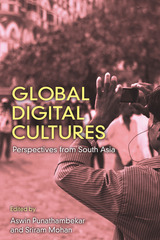
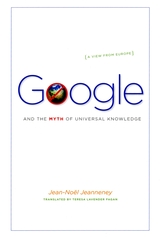
The recent announcement that Google will digitize the holdings of several major libraries sent shock waves through the book industry and academe. Google presented this digital repository as a first step towards a long-dreamed-of universal library, but skeptics were quick to raise a number of concerns about the potential for copyright infringement and unanticipated effects on the business of research and publishing.
Jean-Noël Jeanneney, president of France’s Bibliothèque Nationale, here takes aim at what he sees as a far more troubling aspect of Google’s Library Project: its potential to misrepresent—and even damage—the world’s cultural heritage. In this impassioned work, Jeanneney argues that Google’s unsystematic digitization of books from a few partner libraries and its reliance on works written mostly in English constitute acts of selection that can only extend the dominance of American culture abroad. This danger is made evident by a Google book search the author discusses here—one run on Hugo, Cervantes, Dante, and Goethe that resulted in just one non-English edition, and a German translation of Hugo at that. An archive that can so easily slight the masters of European literature—and whose development is driven by commercial interests—cannot provide the foundation for a universal library.
As a leading librarian, Jeanneney remains enthusiastic about the archival potential of the Web. But he argues that the short-term thinking characterized by Google’s digital repository must be countered by long-term planning on the part of cultural and governmental institutions worldwide—a serious effort to create a truly comprehensive library, one based on the politics of inclusion and multiculturalism.

An in-depth examination of how computer vision in AI is indebted to artistic ideals from the Enlightenment
When Dutch megabank ING launched a 2016 advertising campaign spearheaded by an AI-generated “next Rembrandt,” it demonstrated just how deeply Western assumptions about the history of art had infiltrated fledgling artificial intelligence technologies. Working backward from this computer-generated Old Master painting, Elizabeth C. Mansfield traces the history of computer vision (the branch of AI research concerned with visual perception, recognition, and design) back to Enlightenment fantasies of intelligent machines and artistic automata.
Through her inquiry in eighteenth-century European fascination with art-making machines, Mansfield connects centuries-old automata to contemporary AI systems like DALL-E and Midjourney, showing how the history of art abides as a ghost in the machine of computer vision. She documents the artistic ambitions, aesthetic experiments, commercial pressures, and crises of authenticity that occur during the development of a technology designed to emulate aspects of human visual perception.
An innovative art historical response to computer vision, Ground Truth offers important new directions for a renewed engagement with art’s humanist and digital generation history. At a time when the humanist enterprise is being questioned, Mansfield makes the different worlds of art history and computer vision mutually intelligible in this compelling account of both.
Retail e-book files for this title are screen-reader friendly with images accompanied by short alt text and/or extended descriptions.
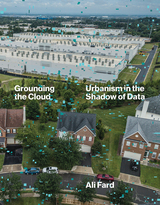
A detailed foray into the material and spatial realities of cloud computing
Since the 1990s, technologists have promoted a vision of the “cloud” as a shapeless and intangible entity. Grounding the Cloud peers through this hazy façade to reveal the earthly material foundations of global computing and data extraction. Tracing the historical and technological development of the cloud computing paradigm, Ali Fard exposes an ever-evolving project in which ideologies, economic models, and marketing images collude to shape our shared urban environments.
Demonstrating how technology’s spatial footprint now stretches to nearly every corner of the globe, Grounding the Cloud analyzes the often-hidden infrastructures that facilitate platform capitalism—from the mines extracting rare earth minerals in remote regions to the vast global network of fiber-optic cables at the bottom of the oceans to the nondescript data centers that sit on the peripheries of major urban areas. Meanwhile, with compelling examples of smart-city initiatives and corporate campuses, Fard shows how the future of urbanism is deeply intertwined with the growing economies of data extraction.
Breaking down the myth of a clean and efficient tech urbanism, this book makes visible the complex material geographies and geopolitics that undergird today’s most powerful and omnipresent corporations. A timely critique of the growing agency of tech platforms in determining the future of urban space, Grounding the Cloud offers an essential framework for understanding the shifting relationship between technology and urbanization.
Retail e-book files for this title are screen-reader friendly with images accompanied by short alt text and/or extended descriptions.

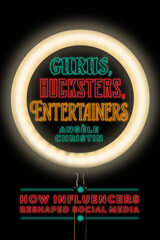
An illuminating investigation of the complex work of social media content creators—their lives, conflicts, and controversies.
In this eye-opening book, digital studies scholar Angèle Christin demystifies the content creator economy, explaining its long history and the pitfalls of its professionalization. Drawing on in-depth fieldwork with digital creators as varied as vegan YouTubers, dads of Instagram, and self-described drama commentators, Christin shows how individuals enter social media creation, how they make money, and how their online environments shape their content.
Aspiring creators often dream of a better life in social media careers. Yet these dreams soon turn into exhaustion as influencers try to meet the contradictory demands of platforms, brands, and audiences. Over time, Christin shows, creators cluster into three types: hucksters, who work on behalf of brands; entertainers, who chase virality and platform payments; and gurus, who monetize the loyalty of their fans. Platform dynamics push entertainers and gurus to create extreme and incendiary content to maintain audience engagement, while brands and marketers nudge hucksters toward repetitive, staid commercial performances. Concerns about algorithmic manipulation and conflicts between creators further lead to reputation-damaging, harassment-laden scandals. Christin reveals how platform labor repeatedly—and structurally—fosters precarity and inequality, destructive drama, and inflammatory content online.
READERS
Browse our collection.
PUBLISHERS
See BiblioVault's publisher services.
STUDENT SERVICES
Files for college accessibility offices.
RECENTLY PUBLISHED



UChicago Accessibility Resources
home | accessibility | search | about | contact us
BiblioVault ® 2001 - 2026
The University of Chicago Press