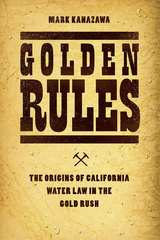
front cover of Golden Rules
Golden Rules
The Origins of California Water Law in the Gold Rush
Mark Kanazawa
University of Chicago Press, 2015
Fresh water has become scarce and will become even more so in the coming years, as continued population growth places ever greater demands on the supply of fresh water. At the same time, options for increasing that supply look to be ever more limited. No longer can we rely on technological solutions to meet growing demand. What we need is better management of the available water supply to ensure it goes further toward meeting basic human needs. But better management requires that we both understand the history underlying our current water regulation regime and think seriously about what changes to the law could be beneficial.

For Golden Rules, Mark Kanazawa draws on previously untapped historical sources to trace the emergence of the current framework for resolving water-rights issues to California in the 1850s, when Gold Rush miners flooded the newly formed state. The need to circumscribe water use on private property in support of broader societal objectives brought to light a number of fundamental issues about how water rights ought to be defined and enforced through a system of laws. Many of these issues reverberate in today’s contentious debates about the relative merits of government and market regulation. By understanding how these laws developed across California’s mining camps and common-law courts, we can also gain a better sense of the challenges associated with adopting new property-rights regimes in the twenty-first century.
[more]

logo for Pluto Press
The Green Economy
Environment, Sustainable Development and the Politics of the Future
Michael Jacobs
Pluto Press, 1992

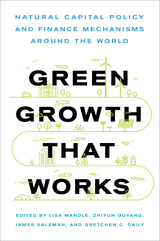
front cover of Green Growth That Works
Green Growth That Works
Natural Capital Policy and Finance Mechanisms Around the World
Edited by Lisa Mandle, Zhiyun Ouyang, James Salzman, and Gretchen C. Daily
Island Press, 2019
Rapid economic development has been a boon to human well-being. It has lifted millions out of poverty, raised standards of living, and increased life expectancies. But economic development comes at a significant cost to natural capital—the fertile soils, forests, coastal marshes, farmland—that support all life on earth, including our own. The dilemma of our times is to figure out how to improve the human condition without destroying nature’s. If ecosystems collapse, so eventually will human civilization. One answer is inclusive green growth—the efficient use of natural resources. Inclusive green growth minimizes pollution and strengthens communities against natural disasters while reducing poverty through improved access to health, education, and services. Its genius lies in working with nature rather than against it.

Green Growth That Works is the first practical guide to bring together pragmatic finance and policy tools that can make investment in natural capital both attractive and commonplace. The authors present six mechanisms that demonstrate a range of approaches used around the globe to conserve and restore earth’s myriad ecosystems, including:
  • Government subsidies
  • Regulatory-driven mitigation
  • Voluntary conservation
  • Water funds
  • Market-based transactions
  • Bilateral and multilateral payments
Through a series of real-world case studies, the book addresses questions such as: How can we channel economic incentives to make conservation and restoration desirable? What approaches have worked best? How can governments, businesses, NGOs, and individuals work together successfully?

Pioneered by leading scholars from the Natural Capital Project, this valuable compendium of proven techniques can guide agencies and organizations eager to make green growth work anywhere in the world.

 
[more]

logo for Harvard University Press
The Greening of Industry
A Risk Management Approach
John D. Graham
Harvard University Press, 1997
Environmentalists often perceive the risk management approach to environmental and public health policy as a tool to block regulation of industrial pollution. In contrast, this book presents six case studies which provide examples of how federal risk-based regulation has encouraged industry’s investment in pollution control. The authors trace the impact of risk management on the regulation of lead in gasoline, ozone-depleting chemicals, and emissions from the dry cleaning, pulp and paper, coke, and municipal waste combustor industries.
[more]


Send via email Share on Facebook Share on Twitter