
 A SCHOLARLY BOOK REPOSITORY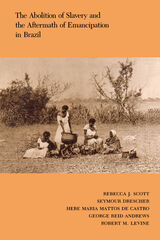
The articles presented here represent a broad scope of scholarly inquiry that covers developments across a wide canvas of Brazilian history and accentuates the importance of formal abolition as a watershed in that nation’s development.
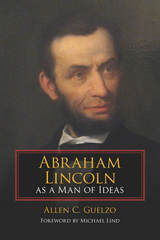
Despite the most meager of formal educations, Lincoln had a tremendous intellectual curiosity that drove him into the circle of Enlightenment philosophy and democratic political ideology. And from these, Lincoln developed a set of political convictions that guided him throughout his life and his presidency. This compilation of ten essays from Lincoln scholar Allen C. Guelzo uncovers the hidden sources of Lincoln’s ideas and examines the beliefs that directed his career and brought an end to slavery and the Civil War.

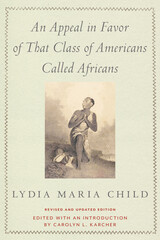
Published in Boston in 1833, Lydia Maria Child’s An Appeal in Favor of That Class of Americans Called Africans provided the abolitionist movement with its first full-scale analysis of race and enslavement. Controversial in its own time, the Appeal surveyed the institution of slavery from historical, political, economic, legal, racial, and moral perspectives and advocated for the immediate emancipation of the enslaved without compensation to their enslavers. By placing American slavery in historical context and demonstrating how slavery impacted—and implicated—Americans of all regions and races, the Appeal became a central text for the abolitionist movement that continues to resonate in the present day.
This revised and updated edition is enhanced by Carolyn L. Karcher’s illuminating introduction, a chronology of Child’s life, and a list of books for further reading.
“Martin Klein has brought together recent work on the abolition of slavery, from Ottoman Turkey to Thailand and from South India to West Africa. This anthology builds on the recent scholarship on both slavery in Asia and Africa and the end of slavery as a world-wide historical phenomenon. Whereas other anthologies have tended to focus on either Africa or Asia, this project brings together in one volume case studies and methodological approaches concerning both regions. Breaking the Chains will be an important part of the relatively sparse literature on emancipation in comparative and global context.”—Richard Roberts, Stanford University
Because the American history of slavery and emancipation tends to be foremost in Western minds, few realize that traditional forms of servitude still exist in a variety of places around the world: children are sold on the streets of Bangkok, bondage persists in India despite official efforts to abolish it, and until 1980 slavery was legal in Mauritania.
Breaking the Chains deals with emancipation in African and Asian societies which were either colonized or came under the domination of European powers in the nineteenth century. In these societies, emancipation involved the imposition on non-European societies of an explicitly European discourse on slavery, and, in most cases, a free labor ideology. Most of the slave masters described in these essays were not European and found European ideas on emancipation difficult to accept.
Against this backdrop, the essayists (many of whom contribute their own non-Western perspective) focus on the transition from slavery (or other forms of bondage) to emancipation. They show that in each case the process involved pressure from European abolition movements, the extension of capitalist relations of production, the concerns and perceptions of the colonial state, and the efforts of non-Western elites to modernize their cultures.
Martin A. Klein argues that the Asian and African experience has much in common with the American experience, particularly in efforts to control labor and family life. The struggle to control the labor of former slaves has often been intense and, he suggests, has had a continuing impact on the social order in former slave societies.
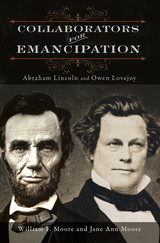
In Collaborators for Emancipation: Abraham Lincoln and Owen Lovejoy, the authors examine the thorny issue of the pragmatism typically ascribed to Lincoln versus the radicalism of Lovejoy, and the role each played in ending slavery. Exploring the men's politics, personal traits, and religious convictions, the book traces their separate paths in life as well as their frequent interactions. Collaborators for Emancipation shows how Lincoln and Lovejoy influenced one another and analyzes the strategies and systems of belief each brought to the epic controversies of slavery versus abolition and union versus disunion.
Moore and Moore, editors of a previous volume of Lovejoy's writings, use their deep knowledge of his words and life to move beyond mere politics to a nuanced perspective on the fabric of religion and personal background that underlay the minister's worldview. Their multifaceted work of history and biography reveals how Lincoln embraced the radical idea of emancipation, and how Lovejoy shaped his own radicalism to wield the pragmatic political tools needed to reach that ultimate goal.
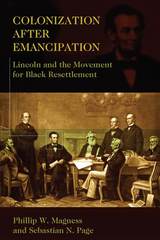
Colonization after Emancipation: Lincoln and the Movement for Black Resettlement explores the previously unknown truth about Lincoln’s attitude toward colonization. Scholars Phillip W. Magness and Sebastian N. Page combed through extensive archival materials, finding evidence, particularly within British Colonial and Foreign Office documents, which exposes what history has neglected to reveal—that Lincoln continued to pursue colonization for close to a year after emancipation. Their research even shows that Lincoln may have been attempting to revive this policy at the time of his assassination.
Using long-forgotten records scattered across three continents—many of them untouched since the Civil War—the authors show that Lincoln continued his search for a freedmen’s colony much longer than previously thought. Colonization after Emancipation reveals Lincoln’s highly secretive negotiations with the British government to find suitable lands for colonization in the West Indies and depicts how the U.S. government worked with British agents and leaders in the free black community to recruit emigrants for the proposed colonies. The book shows that the scheme was never very popular within Lincoln’s administration and even became a subject of subversion when the president’s subordinates began battling for control over a lucrative “colonization fund” established by Congress.
Colonization after Emancipation reveals an unexplored chapter of the emancipation story. A valuable contribution to Lincoln studies and Civil War history, this book unearths the facts about an ill-fated project and illuminates just how complex, and even convoluted, Abraham Lincoln’s ideas about the end of slavery really were.
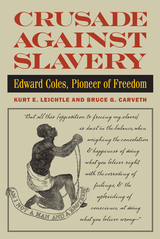
Rejecting slavery from a young age, Coles's early wishes to free his family's slaves initially were stymied by legal, practical, and family barriers. Instead he went to Washington, D.C., where his work in the White House was a life-changing blend of social glitter, secretarial drudge, and distasteful political patronage. Returning home, he researched places where he could live out his ideals. After considerable planning and preparation, he left his family's Virginia tobacco plantation in 1819 and started the long trip west to Edwardsville, Illinois, pausing along the Ohio River on an emotional April morning to free his slaves and offer each family 160 acres of Illinois land of their own. Some continued to work for Coles, while others were left to find work for themselves. This book revisits the lives of the slaves Coles freed, including a noted preacher and contributor to the founding of what is now the second-oldest black Baptist organization in America.
Crusade Against Slavery details Coles's struggles with frontier life and his surprise run and election to the office of Illinois governor as well as his continuing antislavery activities. At great personal cost, he led the effort to block a constitutional convention that would have legalized slavery in the state, which resulted in an acrimonious civil suit brought on by his political enemies, who claimed he violated the law by not issuing a bond of emancipation for his slaves. Although initially convicted by a partisan jury, Coles was vindicated when the Illinois Supreme Court overturned the decisions of the lower courts. Through the story of Coles's moral and legal battles against slavery, Leichtle and Carveth unearth new perspectives on an institution that was on unsure footing yet strongly ingrained in the business interests at the economic base of the fledgling state.
In 1831, after less than a decade in Illinois-and after losing a bid for Congress-Coles left for Philadelphia, where he remained in correspondence with Madison about the issue of slavery. Drawing on previous incomplete treatments of Coles's life, including his own short memoir, Crusade Against Slavery includes the first published analysis of Madison's failure to free his slaves despite his plans to do so through his will and a fascinating exploration of Coles's struggle to understand Madison's inability to live up to the ideals both men shared.
A powerful exposition of how culture shapes social and political change.
"Transition" is the name typically given to the time of radical change following the fall of communism, connoting a shift from planned to market economy, from dictatorship to democracy. Transition is also, in Michael Kennedy’s analysis, a culture in its own right-with its own contentions, repressions, and unrealized potentials. By elaborating transition as a culture of power and viewing it in its complex relation to emancipation, nationalism, and war, Kennedy’s book clarifies the transformations of postcommunism as well as, more generally, the ways in which culture articulates social change. This ambitious work is, in effect, a nuanced critical-cultural sociology of change.
Kennedy examines transition culture’s historical foundation by looking at the relationship among perestroika, Poland, and Hungary, and considers its structure and practice in the following decade across fields and nations. His wide-ranging analysis-of the artifacts of transition culture’s proponents, of interviews with providers and recipients of technical assistance in business across Eastern Europe, and of focus groups assessing the successes and failures of social change in Estonia and Ukraine-suggests a transition culture deeply implicated in nationalism. But this association, Kennedy contends, is not necessarily antithetical to transition’s emancipation. By reconsidering transition culture’s relationship to the Wars of Yugoslav Succession and communism’s negotiated collapse in Poland and Hungary, he shows how transition might be reconceived in terms of solidarity, freedom, and peace. Distinguished by its focus on culture, not only within particular nations but in the transnational community organized around transition, this book will help reframe the debate about postcommunist social change.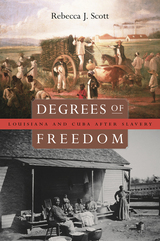
As Louisiana and Cuba emerged from slavery in the late nineteenth century, each faced the question of what rights former slaves could claim. Degrees of Freedom compares and contrasts these two societies in which slavery was destroyed by war, and citizenship was redefined through social and political upheaval. Both Louisiana and Cuba were rich in sugar plantations that depended on an enslaved labor force. After abolition, on both sides of the Gulf of Mexico, ordinary people—cane cutters and cigar workers, laundresses and labor organizers—forged alliances to protect and expand the freedoms they had won. But by the beginning of the twentieth century, Louisiana and Cuba diverged sharply in the meanings attributed to race and color in public life, and in the boundaries placed on citizenship.
Louisiana had taken the path of disenfranchisement and state-mandated racial segregation; Cuba had enacted universal manhood suffrage and had seen the emergence of a transracial conception of the nation. What might explain these differences?
Moving through the cane fields, small farms, and cities of Louisiana and Cuba, Rebecca Scott skillfully observes the people, places, legislation, and leadership that shaped how these societies adjusted to the abolition of slavery. The two distinctive worlds also come together, as Cuban exiles take refuge in New Orleans in the 1880s, and black soldiers from Louisiana garrison small towns in eastern Cuba during the 1899 U.S. military occupation.
Crafting her narrative from the words and deeds of the actors themselves, Scott brings to life the historical drama of race and citizenship in postemancipation societies.

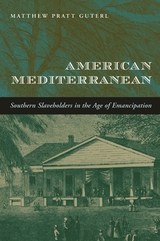
The Dutch Atlantic interrogates the Dutch involvement in Atlantic slavery and assesses the historical consequences of this for contemporary European society.
Kwame Nimako and Glenn Willemsen show how the slave trade and slavery intertwined economic, social and cultural elements, including nation-state formation in the Netherlands and across Europe. They explore the mobilisation of European populations in the implementation of policies that facilitated Atlantic slavery and examine how European countries created and expanded laws that perpetuated colonisation.
Addressing key themes such as the incorporation of the formerly enslaved into post-slavery states and contemporary collective efforts to forget and/or remember slavery and its legacy in the Netherlands, this is an essential text for students of European history and postcolonial studies.
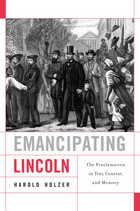
Emancipating Lincoln seeks a new approach to the Emancipation Proclamation, a foundational text of American liberty that in recent years has been subject to woeful misinterpretation. These seventeen hundred words are Lincoln’s most important piece of writing, responsible both for his being hailed as the Great Emancipator and for his being pilloried by those who consider his once-radical effort at emancipation insufficient and half-hearted.
Harold Holzer, an award-winning Lincoln scholar, invites us to examine the impact of Lincoln’s momentous announcement at the moment of its creation, and then as its meaning has changed over time. Using neglected original sources, Holzer uncovers Lincoln’s very modern manipulation of the media—from his promulgation of disinformation to the ways he variously withheld, leaked, and promoted the Proclamation—in order to make his society-altering announcement palatable to America. Examining his agonizing revisions, we learn why a peerless prose writer executed what he regarded as his “greatest act” in leaden language. Turning from word to image, we see the complex responses in American sculpture, painting, and illustration across the past century and a half, as artists sought to criticize, lionize, and profit from Lincoln’s endeavor.
Holzer shows the faults in applying our own standards to Lincoln’s efforts, but also demonstrates how Lincoln’s obfuscations made it nearly impossible to discern his true motives. As we approach the 150th anniversary of the Proclamation, this concise volume is a vivid depiction of the painfully slow march of all Americans—white and black, leaders and constituents—toward freedom.

Captured in this study are the complexity and fascination of one hundred and fifty years of Polish political, cultural, and socioeconmic history. The author traces the course of peasant emancipation in Poland from its beginnings during the Enlightenment to its aftermath in the cultural awakening of the peasantry during the half century prior to World War I and shows how the peasant question played a vital role in the struggle for independence in partitioned Poland.
The book synthesizes, for the first time in any language, the work of leading Polish historians during the present century. It presents a clear analysis of the disintegration of the economic system based on serfdom and compulsory labor prevalent in feudal Poland and traces the emergence of modern capitalist conditions, including wage labor and independent property rights.
Also analyzed is the role of foreign goverments in the emacipation process. The freeing of the serfs took place during a period when all or most of the country was under the rule of Russia, Prussia, or Austria. Although emancipation was due primarily to economic forces withing Poland, it was hastened by peasant resistance and the national struggle for political independence led by Polish patriots who demanded far-reaching social reforms.
This comprehensive study provides valuable information not only to those with a particular interest in Poland but also to scholars concerned with the parallel problems in Russia andother Eastern Eurpean countries, to specialists in agrarian history, and to students of Eastern European history who lack adequate reading materials in English.
One of the first new interpretations of West Virginia’s origins in over a century—and one that corrects previous histories’ tendency to minimize support for slavery in the state’s founding.
Every history of West Virginia’s creation in 1863 explains the event in similar ways: at the start of the Civil War, political, social, cultural, and economic differences with eastern Virginia motivated the northwestern counties to resist secession from the Union and seek their independence from the rest of the state. In The Fifth Border State, Scott A. MacKenzie offers the first new interpretation of the topic in over a century—one that corrects earlier histories’ tendency to minimize support for slavery in the state’s founding.
Employing previously unused sources and reexamining existing ones, MacKenzie argues that West Virginia experienced the Civil War in the same ways as the border states of Missouri, Kentucky, Maryland, and Delaware. Like these northernmost slave states, northwestern Virginia supported the institution of slavery out of proportion to the actual presence of enslavement there. The people who became West Virginians built a new state first to protect slavery, but radical Unionists and escaping slaves forced emancipation on the statehood movement. MacKenzie shows how conservatives and radicals clashed over Black freedom, correcting many myths about West Virginia’s origins and making The Fifth Border State an important addition to the literature in Appalachian and Civil War history.
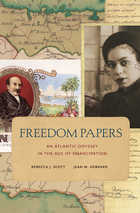
Around 1785, a woman was taken from her home in Senegambia and sent to Saint-Domingue in the Caribbean. Those who enslaved her there named her Rosalie. Her later efforts to escape slavery were the beginning of a family's quest, across five generations and three continents, for lives of dignity and equality. Freedom Papers sets the saga of Rosalie and her descendants against the background of three great antiracist struggles of the nineteenth century: the Haitian Revolution, the French Revolution of 1848, and the Civil War and Reconstruction in the United States.
Freed during the Haitian Revolution, Rosalie and her daughter Elisabeth fled to Cuba in 1803. A few years later, Elisabeth departed for New Orleans, where she married a carpenter, Jacques Tinchant. In the 1830s, with tension rising against free persons of color, they left for France. Subsequent generations of Tinchants fought in the Union Army, argued for equal rights at Louisiana's state constitutional convention, and created a transatlantic tobacco network that turned their Creole past into a commercial asset. Yet the fragility of freedom and security became clear when, a century later, Rosalie's great-great-granddaughter Marie-José was arrested by Nazi forces occupying Belgium.
Freedom Papers follows the Tinchants as each generation tries to use the power and legitimacy of documents to help secure freedom and respect. The strategies they used to overcome the constraints of slavery, war, and colonialism suggest the contours of the lives of people of color across the Atlantic world during this turbulent epoch.
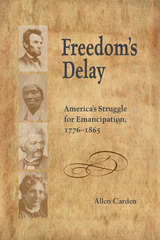
This work fills an important gap in the literature of slavery’s demise. Unlike other authors who focus largely on specific time periods or regional areas, Allen Carden presents a thematically structured national synthesis of emancipation. Freedom’s Delay offers a comprehensive and unique overview of the process of manumission commencing in 1776 when slavery was a national institution, not just the southern experience known historically by most Americans. In this volume, the entire country is examined, and major emancipatory efforts—political, literary, legal, moral, and social—made by black and white, free and enslaved individuals are documented over the years from independence through the ratification of the Thirteenth Amendment.
Freedom’s Delay dispels many of the myths about slavery and abolition, including that racial servitude was of little consequence in the North, and, where it did exist, it ended quickly and easily; that abolition was a white man’s cause and blacks were passive recipients of liberty; that the South seceded primarily to protect states’ rights, not slavery; and that the North fought the Civil War primarily to end the subjugation of African Americans. By putting these misunderstandings aside, this book reveals what actually transpired in the fight for human rights during this critical era. Carden’s inclusion of a cogent preface and epilogue assures that Freedom’s Delay will find a significant place in the literature of American slavery and freedom.
With a compelling preface and epilogue, notes, illustrations and tables, and a detailed bibliography, this volume will be of great value not only in courses on American history and African American history but also to the general reading public.
Allen Carden is professor of history at Fresno Pacific University in Fresno, California. He is the author of Puritan Christianity in America: Religion and Life in Seventeenth-Century Massachusetts.
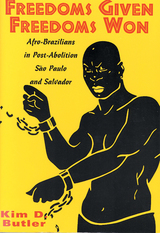
Freedoms Given, Freedoms Won explores the ways Afro-Brazilians in two major cities adapted to the new conditions of life after the abolition of slavery and how they confronted limitations placed on their new freedom. The book sets forth new ways of understanding why the abolition of slavery did not yield equitable fruits of citizenship, not only in Brazil, but throughout the Americas and the Caribbean.
Afro-Brazilians in Sao Paulo and Salvador lived out their new freedom in ways that raise issues common to the entire Afro-Atlantic diaspora. In Sao Paulo, they initiated a vocal struggle for inclusion in the creation of the nation's first black civil rights organization and political party, and they appropriated a discriminatory identity that isolated blacks. In contrast, African identity prevaled over black identity in Salvador, where social protest was oriented toward protecting the right of cultural pluralism.
Of all the eras and issues studied in Afro-Brazilian history, post-abolition social and political action has been the most neglected. Butler provides many details of this period for the first time in English and supplements published sources with original oral histories, Afro-Brazilian newspapers, and new state archival documents currently being catalogued in Bahia. Freedoms Given, Freedoms Won sets the Afro-Brazilian experience in a national context as well as situating it within the Afro-Atlantic diaspora through a series of explicit parallels, particularly with Cuba and Jamaica.
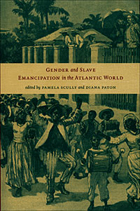
Offering detailed analyses of slave emancipation in specific societies, the contributors discuss all of the diverse actors in emancipation: slaves, abolitionists, free people of color, state officials, and slave owners. Whether considering the construction of a postslavery masculine subjectivity in Jamaica, the work of two white U.S. abolitionist women with the Freedmen’s Bureau after the Civil War, freedwomen’s negotiations of labor rights in Puerto Rico, slave women’s contributions to the slow unraveling of slavery in French West Africa, or the ways that Brazilian abolitionists deployed representations of femininity as virtuous and moral, these essays demonstrate the gains that a gendered approach offers to understanding the complex processes of emancipation. Some chapters also explore theories and methodologies that enable a gendered reading of postslavery archives. The editors’ substantial introduction traces the reasons for and patterns of women’s and men’s different experiences of emancipation throughout the Atlantic world.
Contributors. Martha Abreu, Sheena Boa, Bridget Brereton, Carol Faulkner, Roger Kittleson, Martin Klein, Melanie Newton, Diana Paton, Sue Peabody, Richard Roberts, Ileana M. Rodriguez-Silva, Hannah Rosen, Pamela Scully, Mimi Sheller, Marek Steedman, Michael Zeuske

Robert Hunt examines how Union veterans of the Army of the Cumberland employed the extinction of slavery in the trans-Appalachian South in their memory of the Civil War. Hunt argues that rather than ignoring or belittling emancipation, it became central to veterans’ retrospective understanding of what the war, and their service in it, was all about. The Army of the Cumberland is particularly useful as a subject for this examination because it invaded the South deeply, encountering numerous ex-slaves as fugitives, refugees, laborers on military projects, and new recruits. At the same time, the Cumberlanders were mostly Illinoisans, Ohioans, Indianans, and, significantly, Kentucky Unionists, all from areas suspicious of abolition before the war.
Hunt argues that the collapse of slavery in the trans-Appalachian theater of the Civil War can be usefully understood by exploring the post-war memories of this group of Union veterans. He contends that rather than remembering the war as a crusade against the evils of slavery, the veterans of the Army of the Cumberland saw the end of slavery as a by-product of the necessary defeat of the planter aristocracy that had sundered the Union; a good and necessary outcome, but not necessarily an assertion of equality between the races.
Some of the most provocative discussions about the Civil War in current scholarship are concerned with how memory of the war was used by both the North and the South in Reconstruction, redeemer politics, the imposition of segregation, and the Spanish-American War. This work demonstrates that both the collapse of slavery and the economic and social post-War experience convinced these veterans that they had participated in the construction of the United States as a world power, built on the victory won against corrupt Southern plutocrats who had impeded the rightful development of the country.
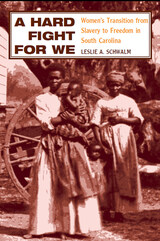
African-American women fought for their freedom with courage and vigor during and after the Civil War. Leslie Schwalm explores the vital roles of enslaved and formerly enslaved women on the rice plantations of lowcountry South Carolina, both in antebellum plantation life and in the wartime collapse of slavery. From there, she chronicles their efforts as freedwomen to recover from the impact of the war while redefining their lives and labor.
Freedwomen asserted their own ideas of what freedom meant and insisted on important changes in the work they performed both for white employers and in their own homes. As Schwalm shows, these women rejected the most unpleasant or demeaning tasks, guarded the prerogatives they gained under the South's slave economy, and defended their hard-won freedoms against unwanted intervention by Northern whites and the efforts of former owners to restore slavery's social and economic relations during Reconstruction. A bold challenge to entrenched notions, A Hard Fight for We places African American women at the center of the South's transition from a slave society.
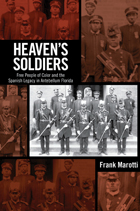
Heaven’s Soldiers chronicles the history of a community of free people of African descent who lived and thrived, while resisting the constraints of legal bondage, in East Florida in the four decades leading up to the Civil War.
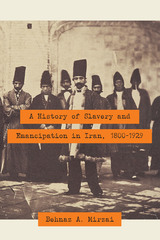
Shortlisted for the 2018 Wallace K. Ferguson Prize, Canadian Historical Association
The leading authority on slavery and the African diaspora in modern Iran presents the first history of slavery in this key Middle Eastern country and shows how slavery helped to shape the nation’s unique character.
Slavery in the Middle East is a growing field of study, but the history of slavery in a key country, Iran, has never before been written. This history extends to Africa in the west and India in the east, to Russia and Turkmenistan in the north, and to the Arab states in the south. As the slave trade between Iran and these regions shifted over time, it transformed the nation and helped forge its unique culture and identity. Thus, a history of Iranian slavery is crucial to understanding the character of the modern nation.
Drawing on extensive archival research in Iran, Tanzania, England, and France, as well as fieldwork and interviews in Iran, Behnaz A. Mirzai offers the first history of slavery in modern Iran from the early nineteenth century to emancipation in the mid-twentieth century. She investigates how foreign military incursion, frontier insecurity, political instability, and economic crisis altered the patterns of enslavement, as well as the ethnicity of the slaves themselves. Mirzai’s interdisciplinary analysis illuminates the complex issues surrounding the history of the slave trade and the process of emancipation in Iran, while also giving voice to social groups that have never been studied—enslaved Africans and Iranians. Her research builds a clear case that the trade in slaves was inexorably linked to the authority of the state. During periods of greater decentralization, slave trading increased, while periods of greater governmental autonomy saw more freedom and peace.
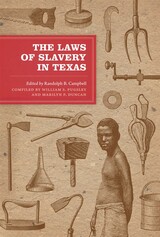
The laws that governed the institution of slavery in early Texas were enacted over a fifty-year period in which Texas moved through incarnations as a Spanish colony, a Mexican state, an independent republic, a part of the United States, and a Confederate state. This unusual legal heritage sets Texas apart from the other slave-holding states and provides a unique opportunity to examine how slave laws were enacted and upheld as political and legal structures changed. The Laws of Slavery in Texas makes that examination possible by combining seminal historical essays with excerpts from key legal documents from the slave period and tying them together with interpretive commentary by the foremost scholar on the subject, Randolph B. Campbell.
Campbell's commentary focuses on an aspect of slave law that was particularly evident in the evolving legal system of early Texas: the dilemma that arose when human beings were treated as property. As Campbell points out, defining slaves as moveable property, or chattel, presented a serious difficulty to those who wrote and interpreted the law because, unlike any other form of property, slaves were sentient beings. They were held responsible for their crimes, and in numerous other ways statute and case law dealing with slavery recognized the humanness of the enslaved. Attempts to protect the property rights of slave owners led to increasingly restrictive laws—including laws concerning free blacks—that were difficult to uphold. The documents in this collection reveal both the roots of the dilemma and its inevitable outcome.
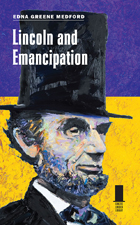
In this succinct study, Edna Greene Medford examines the ideas and events that shaped President Lincoln’s responses to slavery, following the arc of his ideological development from the beginning of the Civil War, when he aimed to pursue a course of noninterference, to his championing of slavery’s destruction before the conflict ended. Throughout, Medford juxtaposes the president’s motivations for advocating freedom with the aspirations of African Americans themselves, restoring African Americans to the center of the story about the struggle for their own liberation.
Lincoln and African Americans, Medford argues, approached emancipation differently, with the president moving slowly and cautiously in order to save the Union while the enslaved and their supporters pressed more urgently for an end to slavery. Despite the differences, an undeclared partnership existed between the president and slaves that led to both preservation of the Union and freedom for those in bondage. Medford chronicles Lincoln’s transition from advocating gradual abolition to campaigning for immediate emancipation for the majority of the enslaved, a change effected by the military and by the efforts of African Americans. The author argues that many players—including the abolitionists and Radical Republicans, War Democrats, and black men and women—participated in the drama through agitation, military support of the Union, and destruction of the institution from within. Medford also addresses differences in the interpretation of freedom: Lincoln and most Americans defined it as the destruction of slavery, but African Americans understood the term to involve equality and full inclusion into American society. An epilogue considers Lincoln’s death, African American efforts to honor him, and the president’s legacy at home and abroad.
Both enslaved and free black people, Medford demonstrates, were fervent participants in the emancipation effort, showing an eagerness to get on with the business of freedom long before the president or the North did. By including African American voices in the emancipation narrative, this insightful volume offers a fresh and welcome perspective on Lincoln’s America.
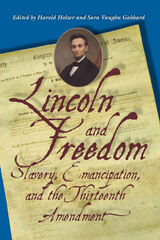
Lincoln’s reelection in 1864 was a pivotal moment in the history of the United States. The Emancipation Proclamation had officially gone into effect on January 1, 1863, and the proposed Thirteenth Amendment had become a campaign issue. Lincoln and Freedom: Slavery, Emancipation, and the Thirteenth Amendment captures these historic times, profiling the individuals, events, and enactments that led to slavery’s abolition. Fifteen leading Lincoln scholars contribute to this collection, covering slavery from its roots in 1619 Jamestown, through the adoption of the Constitution, to Abraham Lincoln’s presidency.
This comprehensive volume, edited by Harold Holzer and Sara Vaughn Gabbard, presents Abraham Lincoln’s response to the issue of slavery as politician, president, writer, orator, and commander-in-chief. Topics include the history of slavery in North America, the Supreme Court’s Dred Scott decision, the evolution of Lincoln’s view of presidential powers, the influence of religion on Lincoln, and the effects of the Emancipation Proclamation.
This collection effectively explores slavery as a Constitutional issue, both from the viewpoint of the original intent of the nation’s founders as they failed to deal with slavery, and as a study of the Constitutional authority of the commander-in-chief as Lincoln interpreted it. Addressed are the timing of Lincoln’s decision for emancipation and its effect on the public, the military, and the slaves themselves.
Other topics covered include the role of the U.S. Colored Troops, the election campaign of 1864, and the legislative debate over the Thirteenth Amendment. The volume concludes with a heavily illustrated essay on the role that iconography played in forming and informing public opinion about emancipation and the amendments that officially granted freedom and civil rights to African Americans.
Lincoln and Freedom provides a comprehensive political history of slavery in America and offers a rare look at how Lincoln’s views, statements, and actions played a vital role in the story of emancipation.
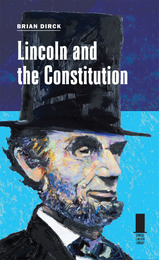
In this highly readable study of Abraham Lincoln’s thoughts and actions concerning the U.S. Constitution, Brian R. Dirck combines extensive primary research and thoughtful, accessible consideration of Lincoln’s views to reveal new insights into Lincoln’s impact on the U.S. Constitution. In the statesman’s roles as a leading antebellum politician, an ardent critic of slavery, and the president of the United States during the Civil War, Lincoln fashioned a strong antislavery constitutional ideology and articulated a constitutional vision of the Civil War that reinforced his determination to restore the Union.
Grounding Lincoln’s constitutionalism in his reading habits and early legal career, Dirck masterfully balances biographical details, Lincoln’s value system, the opinions of his supporters and critics, and key events and ideas to show how his thinking about the U.S. Constitution changed over time. From Lincoln’s deep reverence for the work of the Founding Fathers to his innovative interpretation of presidential war powers, Dirck reveals Lincoln’s understanding of the Constitution to be progressive, emphasizing federal power as a tool to develop the economy, and pragmatic, in that he was often forced to make decisions on the fly during a remarkably volatile period in American history. Lincoln used his conception of presidential war powers to advance the twin causes of Union and emancipation, and Dirck explores the constitutional problems stirred by curbs Lincoln placed on civil liberties, internal security, and freedom of expression during wartime.
More than a straightforward overview of Lincoln’s constitutional views, Lincoln and the Constitution provides a starting point for further inquiry into interpretations and defenses as well as the political, intellectual, and cultural traditions of the founding document of the United States. In the end, Dirck shows, Lincoln viewed the political and legal traditions of the Constitution with optimism, emphasizing
throughout his life the possibilities he believed the document held—always keeping faith in it and swearing to protect it, even as he was awash in a sea of blood and controversy.
Univeristy Press Books for Public and Secondary Schools 2013 edition
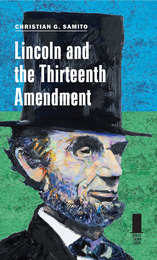
Long before the Civil War, Abraham Lincoln recognized the challenge American slavery posed to the ideals of the Declaration of Independence. A constitutional amendment would be the ideal solution to ending slavery, yet the idea of such an amendment conflicted with several of Lincoln’s long-held positions. In this study, Christian G. Samito examines how Lincoln’s opposition to amending the United States Constitution shaped his political views before he became president, and how constitutional arguments overcame Lincoln’s objections, turning him into a supporter of the Thirteenth Amendment by 1864.
For most of his political career, Samito shows, Lincoln opposed changing the Constitution, even to overturn Supreme Court rulings with which he disagreed. Well into his presidency, he argued that emancipation should take place only on the state level because the federal government had no jurisdiction to control slavery in the states. Between January 1863 and mid-1864, however, Lincoln came to support a constitutional amendment to abolish slavery because it worked within the constitutional structure and preserved key components of American constitutionalism in the face of Radical Republican schemes. Samito relates how Lincoln made the amendment an issue in his 1864 reelection campaign, chronicles lobbying efforts and the final vote in the House on the amendment resolution, and interrogates various charges of corruption and back-room deals. He also considers the Thirteenth Amendment in the context of the Hampton Roads conference, Lincoln’s own thoughts on the meaning of the amendment, and the impact of Lincoln’s assassination on the reading of the amendment. Samito provides the authoritative historical treatment of a story so compelling it was recently dramatized in the movie Lincoln.
Closing with a lively discussion that applies the Thirteenth Amendment to current events, this concise yet comprehensive volume demonstrates how the constitutional change Lincoln helped bring about continues to be relevant today.
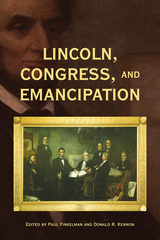
“When Lincoln took office, in March 1861, the national government had no power to touch slavery in the states where it existed. Lincoln understood this, and said as much in his first inaugural address, noting: ‘I have no purpose, directly or indirectly, to interfere with the institution of slavery in the States where it exists.’” How, then, asks Paul Finkelman in the introduction to Lincoln, Congress, and Emancipation, did Lincoln—who personally hated slavery—lead the nation through the Civil War to January 1865, when Congress passed the constitutional amendment that ended slavery outright?
The essays in this book examine the route Lincoln took to achieve emancipation and how it is remembered both in the United States and abroad. The ten contributors—all on the cutting edge of contemporary scholarship on Lincoln and the Civil War—push our understanding of this watershed moment in US history in new directions. They present wide-ranging contributions to Lincoln studies, including a parsing of the sixteenth president’s career in Congress in the 1840s and a brilliant critique of the historical choices made by Steven Spielberg and writer Tony Kushner in the movie Lincoln, about the passage of the Thirteenth Amendment.
As a whole, these classroom-ready readings provide fresh and essential perspectives on Lincoln’s deft navigation of constitutional and political circumstances to move emancipation forward.
Contributors: L. Diane Barnes, Jenny Bourne, Michael Burlingame, Orville Vernon Burton, Seymour Drescher, Paul Finkelman, Amy S. Greenberg, James Oakes, Beverly Wilson Palmer, Matthew Pinsker
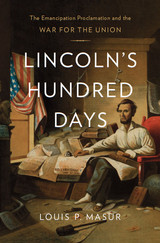
"The time has come now," Abraham Lincoln told his cabinet as he presented the preliminary draft of a "Proclamation of Emancipation." Lincoln's effort to end slavery has been controversial from its inception-when it was denounced by some as an unconstitutional usurpation and by others as an inadequate half-measure-up to the present, as historians have discounted its import and impact. At the sesquicentennial of the Emancipation Proclamation, Louis Masur seeks to restore the document's reputation by exploring its evolution.
Lincoln's Hundred Days is the first book to tell the full story of the critical period between September 22, 1862, when Lincoln issued his preliminary Proclamation, and January 1, 1863, when he signed the final, significantly altered, decree. In those tumultuous hundred days, as battlefield deaths mounted, debate raged. Masur commands vast primary sources to portray the daily struggles and enormous consequences of the president's efforts as Lincoln led a nation through war and toward emancipation. With his deadline looming, Lincoln hesitated and calculated, frustrating friends and foes alike, as he reckoned with the anxieties and expectations of millions. We hear these concerns, from poets, cabinet members and foreign officials, from enlisted men on the front and free blacks as well as slaves.
Masur presents a fresh portrait of Lincoln as a complex figure who worried about, listened to, debated, prayed for, and even joked with his country, and then followed his conviction in directing America toward a terrifying and thrilling unknown.
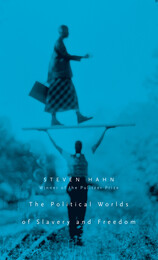
Pulitzer Prize–winner Steven Hahn’s provocative new book challenges deep-rooted views in the writing of American and African-American history. Moving from slave emancipations of the eighteenth century through slave activity during the Civil War and on to the black power movements of the twentieth century, he asks us to rethink African-American history and politics in bolder, more dynamic terms.
Historians have offered important new perspectives and evidence concerning the geographical expanse of slavery in the United States and the protracted process of abolishing it. They have also uncovered a wealth of new material on the political currents running through black communities from enslavement to the present day. Yet their scholarship has failed to dislodge familiar interpretive frameworks that may no longer make much sense of the past.
Based on the Nathan I. Huggins Lectures at Harvard University, The Political Worlds of Slavery and Freedom asks why this may be so and offers sweeping reassessments. It defines new chronological and spatial boundaries for American and African-American politics during the first half of the nineteenth century. It suggests, with historical comparisons, that we may have missed a massive slave rebellion during the Civil War. And it takes a serious look at the development and appeal of Garveyism and the hidden history of black politics it may help to reveal. Throughout, it presents African Americans as central actors in the arenas of American politics, while emphasizing traditions of self-determination, self-governance, and self-defense among them.
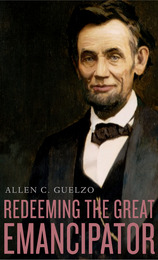
The larger-than-life image Abraham Lincoln projects across the screen of American history owes much to his role as the Great Emancipator during the Civil War. Yet this noble aspect of Lincoln’s identity is precisely the dimension that some historians have cast into doubt. In a vigorous defense of America’s sixteenth president, award-winning historian and Lincoln scholar Allen Guelzo refutes accusations of Lincoln’s racism and political opportunism, while candidly probing the follies of contemporary cynicism and the constraints of today’s unexamined faith in the liberating powers of individual autonomy.
Redeeming the Great Emancipator enumerates Lincoln’s anti-slavery credentials, showing that a deeply held belief in the God-given rights of all people steeled the president in his commitment to emancipation and his hope for racial reconciliation. Emancipation did not achieve complete freedom for American slaves, nor was Lincoln entirely above some of the racial prejudices of his time. Nevertheless, his conscience and moral convictions far outweighed political calculations in ultimately securing freedom for black Americans.
Guelzo clarifies the historical record concerning what the Emancipation Proclamation did and did not accomplish. As a policy it was imperfect, but it was far from ineffectual, as some accounts of African American self-emancipation imply. To achieve liberation required interdependence across barriers of race and status. If we fail to recognize our debt to the sacrifices and ingenuity of all the brave men and women of the past, Guelzo says, then we deny a precious part of the American and, indeed, the human community.
Psychology is meant to help people cope with the afflictions of modern society. But how useful is it? Ian Parker argues that current psychological practice has become part of the problem, rather than the solution.
Ideal for undergraduates, this book deconstructs the discipline to reveal the neoliberal sensitivities that underlie its theory and practice. Psychology focuses on the happiness of 'the individual'. Yet it neglects the fact that the happiness of the individual depends on their social and political surroundings.
Ian Parker argues that a new approach to psychology is needed. He offers an alternative vision, outlining how the discipline can be linked to political practice and how it can help people as part of a wider progressive agenda. This groundbreaking book is at the cutting edge of current thinking on the discipline and should be required reading on all psychology courses.
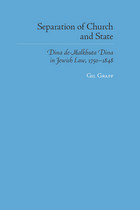
For the Jewish community, the end of the Middle Ages and the emergence of the modern nation-state brought the promise of equal citizenship as well as the possible loss of Jewish corporate identity. The legal maxim dina de-malkhuta dina (the law of the State is law) invoked in Talmidic times to justify the acceptance of the king’s law and qualified in the Middle Ages by Maimonides and Rashbam to include the requirement of consent by the governed underwent further redefinition by Jews in the Napoleonic age. Graff focuses on the struggle between 18th and 19th-century Jewish religious reformers and traditionalists in defining the limits of dina de-malkhuta dina. He traces the motivations of the reformers who, in their zeal to gain equality for the formerly disenfranchised Jewish communities in Western Europe, were prepared to render unto the State compromising authority over Jewish religious life under the rubric of dina de-malkhuta dina was intended to strike a balance between synagogue and state and not to be used as a pretext for the liquidation of the community’s corporate existence.
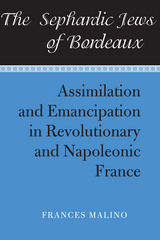
This book focuses on a small community of French Jews, the first in Europe to encounter the requirements of an emerging nation-state and to be recognized by that state as full and equal citizens. The Sephardim of Bordeaux were typical of neither the majority of the Jews of France nor those of Western Europe. They had entered France as Catholics; only after more than a century of public adherence to Catholicism was their community officially recognized as Jewish. Nevertheless, their assimilation and conformity to the standards of French society as well as their commitment to a Judaism fashioned as much by contemporary political and economic concerns as by tradition reveal a legacy bequeathed to French Jewry and an important model for the development of the modern Jew.
Describing the tensions that existed between the Sephardic community of Bordeaux and the Ashkenazic Jews of France, the author also depicts their role in the relation of the Jews with Napoleon and the forming of the Grand Sanhedrin.
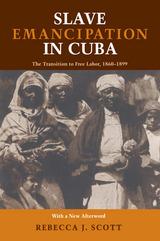
Slave Emancipation in Cuba is the classic study of the end of slavery in Cuba. Rebecca J. Scott explores the dynamics of Cuban emancipation, arguing that slavery was not simply abolished by the metropolitan power of Spain or abandoned because of economic contradictions. Rather, slave emancipation was a prolonged, gradual and conflictive process unfolding through a series of social, legal, and economic transformations.
Scott demonstrates that slaves themselves helped to accelerate the elimination of slavery. Through flight, participation in nationalist insurgency, legal action, and self-purchase, slaves were able to force the issue, helping to dismantle slavery piece by piece. With emancipation, former slaves faced transformed, but still very limited, economic options. By the end of the nineteenth-century, some chose to join a new and ultimately successful rebellion against Spanish power.
In a new afterword, prepared for this edition, the author reflects on the complexities of postemancipation society, and on recent developments in historical methodology that make it possible to address these questions in new ways.
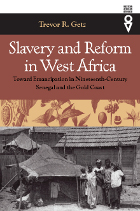
A series of transformations, reforms, and attempted abolitions of slavery form a core narrative of nineteenth-century coastal West Africa. As the region’s role in Atlantic commercial networks underwent a gradual transition from principally that of slave exporter to producer of “legitimate goods” and dependent markets, institutions of slavery became battlegrounds in which European abolitionism, pragmatic colonialism, and indigenous agency clashed.
In Slavery and Reform in West Africa, Trevor Getz demonstrates that it was largely on the anvil of this issue that French and British policy in West Africa was forged. With distant metropoles unable to intervene in daily affairs, local European administrators, striving to balance abolitionist pressures against the resistance of politically and economically powerful local slave owners, sought ways to satisfy the latter while placating or duping the former.
The result was an alliance between colonial officials, company agents, and slave-owning elites that effectively slowed, sidetracked, or undermined serious attempts to reform slave holding. Although slavery was outlawed in both regions, in only a few isolated instances did large-scale emancipations occur. Under the surface, however, slaves used the threat of self-liberation to reach accommodations that transformed the master-slave relationship.
By comparing the strategies of colonial administrators, slave-owners, and slaves across these two regions and throughout the nineteenth century, Slavery and Reform in West Africa reveals not only the causes of the astounding success of slave owners, but also the factors that could, and in some cases did, lead to slave liberations. These findings have serious implications for the wider study of slavery and emancipation and for the history of Africa generally.
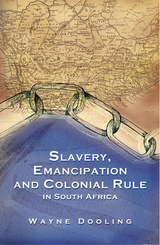
For slaves and slave owners alike, incorporation into the British Empire at the beginning of the nineteenth century brought fruits that were bittersweet. The gentry had initially done well by accepting British rule, but were ultimately faced with the legislated ending of servile labor. To slaves and Khoisan servants, British rule brought freedom, but a freedom that remained limited. The gentry accomplished this feat only with great difficulty. Increasingly, their dominance of the countryside was threatened by English-speaking merchants and money-lenders, a challenge that stimulated early Afrikaner nationalism. The alliances that ensured nineteenth-century colonial stability all but fell apart as the descendants of slaves and Khoisan turned on their erstwhile masters during the South African War of 1899–1902.
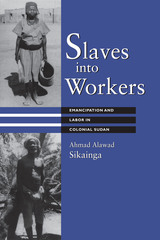
Unlike African slavery in Europe and the Americas, slavery in the Sudan and other parts of Africa persisted well into the twentieth century. Sudanese slaves served Sudanese masters until the region was conquered by the Turks, who practiced slavery on a larger, institutional scale. When the British took over the Sudan in 1898, they officially emancipated the slaves, yet found it impossible to replace their labor in the country’s economy.
This pathfinding study explores the process of emancipation and the development of wage labor in the Sudan under British colonial rule. Ahmad Sikainga focuses on the fate of ex-slaves in Khartoum and on the efforts of the colonial government to transform them into wage laborers. He probes into what colonial rule and city life meant for slaves and ex-slaves and what the city and its people meant for colonial officials.
This investigation sheds new light on the legacy of slavery and the status of former slaves and their descendants. It also reveals how the legacy of slavery underlies the current ethnic and regional conflicts in the Sudan. It will be vital reading for students of race relations and slavery, colonialism and postcolonialism, urbanization, and labor history in Africa and the Middle East.
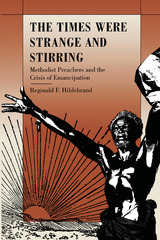
Hildebrand explores the ideas and ideals of missionaries from several branches of Methodism—the African Methodist Episcopal Church, the Colored Methodist Episcopal Church, and the northern-based Methodist Episcopal Church—and the significant and highly charged battle waged between them over the challenge and meaning of freedom. He traces the various strategies and goals pursued by these competing visions and develops a typology of some of the ways in which emancipation was approached and understood.
Focusing on individual church leaders such as Lucius H. Holsey, Richard Harvey Cain, and Gilbert Haven, and with the benefit of extensive research in church archives and newspapers, Hildebrand tells the dramatic and sometimes moving story of how missionaries labored to organize their denominations in the black South, and of how they were overwhelmed at times by the struggles of freedom.
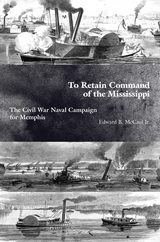
The Battle of Memphis was one such fray waged for control of the Mississippi. It was a major victory for the Union, one that was over almost before it began because of luck and lessons the Union fleet learned at a hard-fought battle with the Confederate River Defense Fleet at Plum Point. Perhaps owing to its swift conclusion, the Battle of Memphis has not received the scholarly attention of other battles, such as Vicksburg and Forts Henry and Donelson. In To Retain Command of the Mississippi, Edward B. McCaul Jr. argues that the Battle of Memphis was pivotal in the Union’s efforts to control the Mississippi River. The Union command, by narrowly escaping defeat at Plum Point, learned invaluable lessons about the Confederate River Defense Fleet and masterfully enacted those lessons in decisively defeating the Confederate fleet at Memphis. With the Confederacy’s river forces severely crippled after the Battle of Memphis, the Union fleets pushed onward to eventual victory at Vicksburg.
McCaul brings this pivotal river battle back into the American Civil War discussion by highlighting the Union gains and Confederate losses that led up to the Battle of Memphis and maintaining that had the battle gone differently, Grant’s plans for taking Vicksburg would have been drastically altered
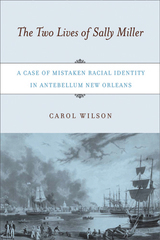
In 1843, the Louisiana Supreme Court heard the case of a slave named Sally Miller, who claimed to have been born a free white person in Germany. Sally, a very light-skinned slave girl working in a New Orleans caf, might not have known she had a case were it not for a woman who recognized her as Salom Muller, with whom she had emigrated from Germany over twenty years earlier. Sally decided to sue for her freedom, and was ultimately freed, despite strong evidence contrary to her claim.
In The Two Lives of Sally Miller, Carol Wilson explores this fascinating legal case and its reflection on broader questions about race, society, and law in the antebellum South. Why did a court system known for its extreme bias against African Americans help to free a woman who was believed by many to be a black slave? Wilson explains that while the notion of white enslavement was shocking, it was easier for society to acknowledge that possibility than the alternative-an African slave who deceived whites and triumphed over the system.
Winner of the George Washington Prize
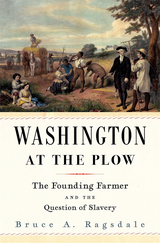
A fresh, original look at George Washington as an innovative land manager whose singular passion for farming would unexpectedly lead him to reject slavery.
George Washington spent more of his working life farming than he did at war or in political office. For over forty years, he devoted himself to the improvement of agriculture, which he saw as the means by which the American people would attain the “respectability & importance which we ought to hold in the world.”
Washington at the Plow depicts the “first farmer of America” as a leading practitioner of the New Husbandry, a transatlantic movement that spearheaded advancements in crop rotation. A tireless experimentalist, Washington pulled up his tobacco and switched to wheat production, leading the way for the rest of the country. He filled his library with the latest agricultural treatises and pioneered land-management techniques that he hoped would guide small farmers, strengthen agrarian society, and ensure the prosperity of the nation.
Slavery was a key part of Washington’s pursuits. He saw enslaved field workers and artisans as means of agricultural development and tried repeatedly to adapt slave labor to new kinds of farming. To this end, he devised an original and exacting system of slave supervision. But Washington eventually found that forced labor could not achieve the productivity he desired. His inability to reconcile ideals of scientific farming and rural order with race-based slavery led him to reconsider the traditional foundations of the Virginia plantation. As Bruce Ragsdale shows, it was the inefficacy of chattel slavery, as much as moral revulsion at the practice, that informed Washington’s famous decision to free his slaves after his death.
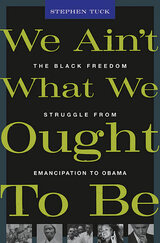
In this exciting revisionist history, Stephen Tuck traces the black freedom struggle in all its diversity, from the first years of freedom during the Civil War to President Obama’s inauguration. As it moves from popular culture to high politics, from the Deep South to New England, the West Coast, and abroad, Tuck weaves gripping stories of ordinary black people—as well as celebrated figures—into the sweep of racial protest and social change. The drama unfolds from an armed march of longshoremen in post–Civil War Baltimore to Booker T. Washington’s founding of Tuskegee Institute; from the race riots following Jack Johnson’s “fight of the century” to Rosa Parks’ refusal to move to the back of a Montgomery bus; and from the rise of hip hop to the journey of a black Louisiana grandmother to plead with the Tokyo directors of a multinational company to stop the dumping of toxic waste near her home.
We Ain’t What We Ought To Be rejects the traditional narrative that identifies the Southern non-violent civil rights movement as the focal point of the black freedom struggle. Instead, it explores the dynamic relationships between those seeking new freedoms and those looking to preserve racial hierarchies, and between grassroots activists and national leaders. As Tuck shows, strategies were ultimately contingent on the power of activists to protest amidst shifting economic and political circumstances in the U.S. and abroad. This book captures an extraordinary journey that speaks to all Americans—both past and future.
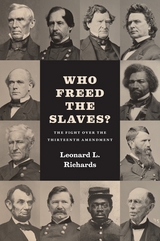
The real story, however, is much more complicated—and dramatic—than that. With Who Freed the Slaves?, distinguished historian Leonard L. Richards tells the little-known story of the battle over the Thirteenth Amendment, and of James Ashley, the unsung Ohio congressman who proposed the amendment and steered it to passage. Taking readers to the floor of Congress and the back rooms where deals were made, Richards brings to life the messy process of legislation—a process made all the more complicated by the bloody war and the deep-rooted fear of black emancipation. We watch as Ashley proposes, fine-tunes, and pushes the amendment even as Lincoln drags his feet, only coming aboard and providing crucial support at the last minute. Even as emancipation became the law of the land, Richards shows, its opponents were already regrouping, beginning what would become a decades-long—and largely successful—fight to limit the amendment’s impact.
Who Freed the Slaves? is a masterwork of American history, presenting a surprising, nuanced portrayal of a crucial moment for the nation, one whose effects are still being felt today.
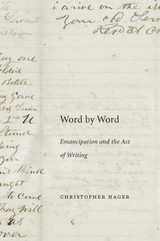
One of the cruelest abuses of slavery in America was that slaves were forbidden to read and write. Consigned to illiteracy, they left no records of their thoughts and feelings apart from the few exceptional narratives of Frederick Douglass and others who escaped to the North—or so we have long believed. But as Christopher Hager reveals, a few enslaved African Americans managed to become literate in spite of all prohibitions, and during the halting years of emancipation thousands more seized the chance to learn. The letters and diaries of these novice writers, unpolished and hesitant yet rich with voice, show ordinary black men and women across the South using pen and paper to make sense of their experiences.
Through an unprecedented gathering of these forgotten writings—from letters by individuals sold away from their families, to petitions from freedmen in the army to their new leaders, to a New Orleans man’s transcription of the Constitution—Word by Word rewrites the history of emancipation. The idiosyncrasies of these untutored authors, Hager argues, reveal the enormous difficulty of straddling the border between slave and free.
These unusual texts, composed by people with a unique perspective on the written word, force us to rethink the relationship between literacy and freedom. For African Americans at the end of slavery, learning to write could be liberating and empowering, but putting their hard-won skill to use often proved arduous and daunting—a portent of the tenuousness of the freedom to come.
READERS
Browse our collection.
PUBLISHERS
See BiblioVault's publisher services.
STUDENT SERVICES
Files for college accessibility offices.
RECENTLY PUBLISHED





UChicago Accessibility Resources
home | accessibility | search | about | contact us
BiblioVault ® 2001 - 2024
The University of Chicago Press