
 A SCHOLARLY BOOK REPOSITORY
5 start with G start with G
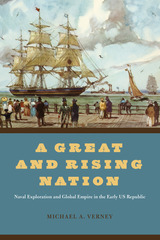
Conventional wisdom holds that, until the Spanish-American War of 1898, the United States was a feeble player on the world stage, with an international presence rooted in commerce rather than military might. Michael A. Verney’s A Great and Rising Nation flips this notion on its head, arguing that early US naval expeditions, often characterized as merely scientific, were in fact deeply imperialist. Circling the globe from the Mediterranean to South America and the Arctic, these voyages reflected the diverse imperial aspirations of the new republic, including commercial dominance in the Pacific World, religious empire in the Holy Land, proslavery expansion in South America, and diplomatic prestige in Europe. As Verney makes clear, the United States had global imperial aspirations far earlier than is commonly thought.
A Great and Rising Nation illuminates the unexplored early decades of the United States’ imperialist naval aspirations.
Conventional wisdom holds that, until the Spanish-American War of 1898, the United States was a feeble player on the world stage, with an international presence rooted in commerce rather than military might. Michael A. Verney’s A Great and Rising Nation flips this notion on its head, arguing that early US naval expeditions, often characterized as merely scientific, were in fact deeply imperialist. Circling the globe from the Mediterranean to South America and the Arctic, these voyages reflected the diverse imperial aspirations of the new republic, including commercial dominance in the Pacific World, religious empire in the Holy Land, proslavery expansion in South America, and diplomatic prestige in Europe. As Verney makes clear, the United States had global imperial aspirations far earlier than is commonly thought.
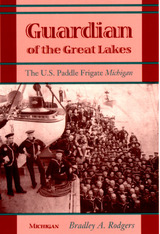
Guardian of the Great Lakes is the saga of the USS Michigan, an archetype iron-hulled war steamer launched in 1843. Its mission was to patrol the ofttimes volatile Great Lakes region, quelling port town civil disturbances, while at the same time rescuing both Canadian and American ships in distress.
The Michigan found itself unavoidably attracted to calamity, leaving in its wake a collection of eyewitness accounts to these momentous yet largely forgotten occurences. Incidents such as the timber rebellion of the 1850s, which occurred in Wisconsin, Illinois, and Michigan, are documented for the first time. Other episodes such as the assassination of "king" Strang on Beaver Island and the destruction of the community there are studied under the light of newly discovered sources. Still other chapters reveal the chaos created by the Civil War on the lakes, the destructive mining strikes of Michigan's Upper Peninsula, and the tragic, bloody, Fenian invasion of Canada.
Between major calamities lay the vagaries of maritime life on the Great Lakes detailed in the records of the Michigan's crew. From their social and community life in Erie, Pennsylvania to storms, shipwrecks, and sickness, the records kept by the men and officers of the USS Michigan have helped to produce in this book an accurate and detailed narrative of naval and maritime life on the Great Lakes during this important period.
Bradley A. Rodgers is Assistant Professor, Program in Maritime History and Nautical Archaeology, East Carolina University.
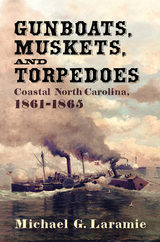
From the first shots at Cape Hatteras in the summer of 1861 to the fall of Fort Fisher in early 1865, the contest for coastal North Carolina during the American Civil War was crucial to the Union victory. With a clear naval superiority over the South, the North conducted blockading and amphibious operations from Virginia to Texas, including the three-hundred-mile seacoast of North Carolina. With its Pamlico and Albemarle Sounds—fed by navigable rivers that reached deep into the interior—and major Confederate port of Wilmington, the Carolina coast was essential for the distribution of foreign goods and supplies to Confederate forces in Virginia and elsewhere. If the Union was able to capture Wilmington or advance on the interior waters, they would cripple the South’s war efforts.
In Gunboats, Muskets, and Torpedoes: Coastal North Carolina, 1861–1865, award-winning historian Michael G. Laramie chronicles both the battle over supplying the South by sea as well as the ways this region proved to be a fertile ground for the application of new technologies. With the advent of steam propulsion, the telegraph, rifled cannon, repeating firearms, ironclads, and naval mines, the methods and tactics of the old wooden walls soon fell to those of this first major conflict of the industrial age. Soldiers and sailors could fire farther and faster than ever before. With rail transportation available, marches were no longer weeks but days or even hours, allowing commanders to quickly shift men and materials to meet an oncoming threat or exploit an enemy weakness. Fortifications changed to meet the challenges imposed by improved artillery, while the telegraph stretched the battlefield even further. Yet for all the technological changes, many of which would be harbingers of greater conflicts to come, the real story of this strategic coast is found in the words and actions of the soldiers and sailors who vied for this region for nearly four years. It is here, where the choices made—whether good or bad, misinformed, or not made at all—intersected with logistical hurdles, geography, valor, and fear to shape the conflict; a conflict thatwould ultimately set the postwar nation on track to becoming a modern naval power.
READERS
Browse our collection.
PUBLISHERS
See BiblioVault's publisher services.
STUDENT SERVICES
Files for college accessibility offices.
RECENTLY PUBLISHED






UChicago Accessibility Resources
home | accessibility | search | about | contact us
BiblioVault ® 2001 - 2025
The University of Chicago Press