
 A SCHOLARLY BOOK REPOSITORY
6 start with G start with G
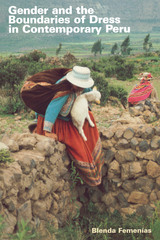
Set in Arequipa during Peru's recent years of crisis, this ethnography reveals how dress creates gendered bodies. It explores why people wear clothes, why people make art, and why those things matter in a war-torn land. Blenda Femenías argues that women's clothes are key symbols of gender identity and resistance to racism.
Moving between metropolitan Arequipa and rural Caylloma Province, the central characters are the Quechua- and Spanish-speaking maize farmers and alpaca herders of the Colca Valley. Their identification as Indians, whites, and mestizos emerges through locally produced garments called bordados. Because the artists who create these beautiful objects are also producers who carve an economic foothold, family workshops are vital in a nation where jobs are as scarce as peace. But ambiguity permeates all practices shaping bordados' significance. Femenías traces contemporary political and ritual applications, not only Caylloma's long-standing and violent ethnic conflicts, to the historical importance of cloth since Inca times.
This is the only book about expressive culture in an Andean nation that centers on gender. In this feminist contribution to ethnography, based on twenty years' experience with Peru, including two years of intensive fieldwork, Femenías reflects on the ways gender shapes relationships among subjects, research, and representation.

Book 1 covers both the history of the Inca Empire and the first forty years of the Spanish occupation, up to and including the fall of Vilcabamba in 1572. While the J. Paul Getty Museum produced a digital facsimile of Murúa’s full Historia in 2008, it remained underused and, until now, untranslated. This translation revitalizes the momentous early volume with an introduction offering a window into Murúa’s life and the writing of his Historia, and extensive footnotes that provide the scholarly context of Murúa’s work.
This edition of The General History of Peru: Book 1 provides long-awaited access to Murúa’s contribution to Indigenous Andean history and early colonial Peru. The book is valuable for English-speaking students and scholars of pre-Hispanic Andean history, especially those interested in the ancient Andean world and colonial Peru’s literary production.
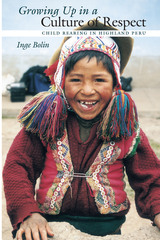
Far from the mainstream of society, the pastoral community of Chillihuani in the high Peruvian Andes rears children who are well-adjusted, creative, and curious. They exhibit superior social and cognitive skills and maintain an attitude of respect for all life as they progress smoothly from childhood to adulthood without a troubled adolescence. What makes such child-rearing success even more remarkable is that "childhood" is not recognized as a distinct phase of life. Instead, children assume adult rights and responsibilities at an early age in order to help the community survive in a rugged natural environment and utter material poverty.
This beautifully written ethnography provides the first full account of child-rearing practices in the high Peruvian Andes. Inge Bolin traces children's lives from birth to adulthood and finds truly amazing strategies of child rearing, as well as impressive ways of living that allow teenagers to enjoy the adolescent stage of their lives while contributing significantly to the welfare of their families and the community. Throughout her discussion, Bolin demonstrates that traditional practices of respect, whose roots reach back to pre-Columbian times, are what enable the children of the high Andes to mature into dignified, resilient, and caring adults.

A deep ethnography on children who work in Lima, Peru, and a critique of the global anti-child labor effort..
Children juggling at traffic lights and selling candy from car to car are ubiquitous in Lima, Peru’s capital, making the country a hotspot for child labor reformers. Even when the intentions behind the anti-child labor movement are benevolent, in practice this effort affects children and their families in unexpected and often harmful ways.
Anthropologist Leigh Campoamor argues that the concept of child labor is stuck in an industrial-era framing, which fails to capture the reality of working youth in the global south today. Following children who work on Lima’s streets through their daily routines, Campoamor shows how poor, racialized youth become subjects of intervention by state institutions, NGOs, and the general public. Indeed, some remedies promoted by officials and NGOs punish families—especially mothers—laboring to survive the immiserating demands of neoliberal capitalism. Arguing that reformers are reinforcing hierarchies of race, class, gender, and age in the name of children’s rights, Growing Up Working draws on feminist critiques of social reproduction to develop a new vision of “public childhood,” showing how working youth assert agency and achieve dignity while also performing invisible caring and affective labor that doesn’t count as work. Campoamor follows the children at the center of her ethnography into adulthood, providing an intimate and dynamic portrait of their lives while critiquing the ways anti–child labor discourses imagine working children’s futures.
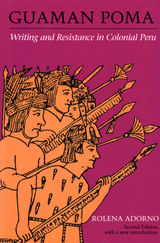
In the midst of native people's discontent following Spanish conquest, a native Andean born after the fall of the Incas took up the pen to protest Spanish rule. Felipe Guaman Poma de Ayala wrote his Nueva corónica y buen gobierno to inform Philip III of Spain about the evils of colonialism and the need for governmental and societal reform. By examining Guaman Poma's verbal and visual engagement with the institutions of Western art and culture, Rolena Adorno shows how he performed a comprehensive critique of the colonialist discourse of religion, political theory, and history. She argues that Guaman Poma's work chronicles the emergence of a uniquely Latin American voice, characterized by the articulation of literary art and politics.
Following the initial appearance of Guaman Poma: Writing and Resistance in Colonial Peru, the 1990s witnessed the creation of a range of new studies that underscore the key role of the Nueva corónica y buen gobierno in facilitating our understanding of the Andean and Spanish colonial pasts. At the same time, the documentary record testifying to Guaman Poma's life and work has expanded dramatically, thanks to the publication of long-known but previously inaccessible drawings and documents. In a new, lengthy introduction to this second edition, Adorno shows how recent scholarship from a variety of disciplinary perspectives sheds new light on Guaman Poma and his work, and she offers an important new assessment of his biography in relation to the creation of the Nueva corónica y buen gobierno.
READERS
Browse our collection.
PUBLISHERS
See BiblioVault's publisher services.
STUDENT SERVICES
Files for college accessibility offices.
RECENTLY PUBLISHED


UChicago Accessibility Resources
home | accessibility | search | about | contact us
BiblioVault ® 2001 - 2026
The University of Chicago Press