
 A SCHOLARLY BOOK REPOSITORY
15 start with H start with H
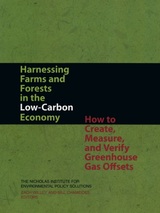
This guide is the first comprehensive technical publication providing direction to landowners for sequestering carbon and information for traders and others who will need to verify the sequestration. It will provide invaluable direction to farmers, foresters, land managers, consultants, brokers, investors, regulators, and others interested in creating consistent, credible greenhouse gas offsets as a tradable commodity in the United States.
The guide contains a non-technical section detailing methodologies for scoping of the costs and benefits of a proposed project, quantifying offsets of various sorts under a range of situations and conditions, and verifying and registering the offsets. The technical section provides specific information for quantifying, verifying, and regulating offsets from agricultural and forestry practices.
Visit the Nicholas Institute for Environmental Policy Solutions website for audio from the press conference announcing the book.
Read the press release announcing the book.
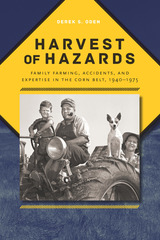
In this study of the farm safety movement in the Corn Belt, historian Derek Oden examines why agriculture was so dangerous and why improvements were so difficult to achieve. Because farmers were self-employed business owners whose employees were mainly family members; because they lived far from aid such as hospitals and fire stations; and because they had to manage such a diverse array of new technologies, they could not easily adopt the workplace safety and public health reforms designed for factories and urban settings. In response, beginning in the 1940s, farmers and a new breed of farm safety specialists relied upon an increasingly elaborate educational campaign to lessen injuries and illnesses on the farm.
Several government, business, and nonprofit organizations—from the US Department of Agriculture to the National Safety Council and 4-H and the Future Farmers of America—worked together to publicize both the dangers of farming and the information farmers needed to stay safe while driving tractors, applying anhydrous ammonia, or repairing machinery. By the 1960s, however, the partnership began to break down, and by the 1970s the safety movement became increasingly contested as professional and policy divisions emerged. This groundbreaking study incorporates agriculture into the histories of occupational safety and public health.
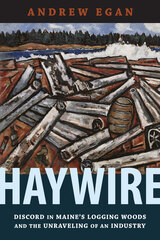
Logging in the northern forest has been romanticized, with images of log drives, plaid shirts, and bunkhouses in wide circulation. Increasingly dismissed as a quaint, rural pastime, logging remains one of the most dangerous jobs in the United States, with loggers occupying a precarious position amid unstable markets, expanding global competition, and growing labor discord. Examining a time of transition and decline in Maine’s forest economy, Andrew Egan traces pathways for understanding the challenges that have faced Maine’s logging community and, by extension, the state’s forestry sector, from the postwar period through today.
Seeking greater profits, logging companies turned their crews loose at midcentury, creating a workforce of independent contractors who were forced to purchase expensive equipment and compete for contracts with the mills. Drawing on his own experience with the region’s forest products industry, interviews with Maine loggers, media coverage, and court documents, Egan follows the troubled recent history of the industry and its battle for survival.
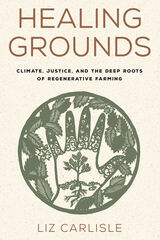
In Healing Grounds, Liz Carlisle tells the stories of Indigenous, Black, Latinx, and Asian American farmers who are reviving their ancestors’ methods of growing food—techniques long suppressed by the industrial food system. These farmers are restoring native prairies, nurturing beneficial fungi, and enriching soil health. While feeding their communities and revitalizing cultural ties to land, they are steadily stitching ecosystems back together and repairing the natural carbon cycle. This, Carlisle shows, is the true regenerative agriculture – not merely a set of technical tricks for storing CO2 in the ground, but a holistic approach that values diversity in both plants and people.
Cultivating this kind of regenerative farming will require reckoning with our nation’s agricultural history—a history marked by discrimination and displacement. And it will ultimately require dismantling power structures that have blocked many farmers of color from owning land or building wealth.
The task is great, but so is its promise. By coming together to restore these farmlands, we can not only heal our planet, we can heal our communities and ourselves.

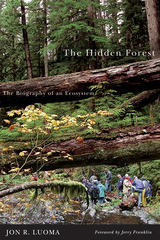
The tallest species of spruce, hemlock, fir, cedar, and pine trees on earth coexist in the old growth of the H. J. Andrews Experimental Forest in Oregon’s Cascade Range. Set aside as a living laboratory by the U.S. Forest Service in 1948, the 16,000 acres represent a vital scientific endeavor: the long-term study of a single contained ecosystem. Here, for the first time, researchers from an enormous range of disciplines—forest scientists, botanists, entomologists, wildlife ecologists, soil biologists, and others—have assembled to examine the role of every working element in the life of a forest.
In The Hidden Forest, veteran science writer Jon Luoma offers an absorbing account of how these scientists came to recognize the importance of natural forest ecosystems and how their research is revolutionizing forest management.
Luoma takes readers into the hidden forest where researchers have discovered a host of species previously unknown to science, and interactions in the forest ecosystem that no one previously imagined. He describes projects dealing with the forest canopy, rotting logs, insects, fungi, wildlife, streams, and the effects of flood, fire, clear cutting, and volcanic eruption. And he tells the human story behind the research, capturing the shared excitement and wonder of scientific discovery. Along the way, Luoma provides a short course in such complex issues as forest succession, biodiversity, and the politics of forestry.
In a new foreword, Jerry Franklin discusses the importance of dedicated, long-term research sites and comments on new discoveries that have emerged from forest ecosystem research since The Hidden Forest was first published.

There is a stubborn myth that has persisted for almost two centuries: the narrative of the abandoned farm in the rural American northeast. In Hill Farms, historian Dona Brown confronts this myth of rural decline with a focus on Jamaica, Vermont, a small town in the hills west of Brattleboro. Through this town’s history, she reveals a more complex economic and environmental narrative, a story of the continued use of traditional farm methods despite the growing power of modernization and demands for increased efficiencies.
Brown examines the records of a 1930 study by the University of Vermont’s now infamous Eugenics Survey, part of a flood of problematic investigations of Vermont rural life at the time, wherein eugenicists interviewed residents in every Jamaica household about crops, incomes, and housing conditions. These researchers from various disciplines saw in Jamaica and towns like it poverty and ignorance rather than a commitment to farming as a modest but sustainable way of life. Extensive handwritten notes from the Eugenics Survey provide a remarkable glimpse into the daily lives and practices of these upland farmers, revealing the value in maintaining older, less intensive farming practices and shedding new light on the social and environmental history of the time. As debates around farming and rural life intensified during the Great Depression, advocates beyond Vermont rose to the defense of traditional farms. Though industrialized agriculture ultimately prevailed, the old farming strategies cultivated by these upcountry residents continue to attract adherents in the face of new challenges to traditional farming in our own times.
Farmers, who own or rent most of the private land in America, hold the key not only to the nation's food supply, but also to managing community growth, maintaining an attractive landscape, and protecting water and wildlife resources.
While the issue of protecting farmland and open space is not new, the intensity of the challenge has increased. Farmers are harder pressed to make a living, and rural and suburban communities are struggling to accommodate increasing populations and the development that comes with them. Holding Our Ground can help landowners and communities devise and implement effective strategies for protecting farmland. The book:
- discusses the reasons for protecting farmland and how to make those reasons widely known and understood
- describes the business of farming, federal government farm programs, and the role of land in farmers's decisions
- analyzes federal, state, and local farmland protection efforts and techniques
- explores a variety of land protection options including purchase of development rights; transfer of development rights; private land trusts; and financial, tax, and estate planning
- reviews the strengths and weaknesses of the farmland protection tools available
Holding Our Ground provides citizens, elected officials, planners, and landowners with a solid basis for understanding the issues behind farmland protection, and will be an invaluable resource in developing techniques and programs for achieving long-term protection goals.
This new edition, thoroughly revised, updated, and streamlined, explains the planning procedures described in Holistic Management, and offers step-by-step instructions for running a ranch or farm using a holistic management approach. Butterfield and her coauthors describe how to use the handbook in conjunction with the textbook to tailor a management plan for your unique combination of land, livestock, and finances. Their mantra is “plan, monitor, control, and replan.” Using a four-part approach, the authors walk readers through basic concepts and techniques, help them put a plan onto paper, monitor the results, and adjust the details as needed. Appendixes provide updated worksheets, checklists, planning and monitoring forms, and detailed examples of typical scenarios a user might encounter. The handbook includes a comprehensive glossary of terms.
Ranchers, farmers, pastoralists, social entrepreneurs, government agencies, and NGOs working to address global environmental degradation will find this comprehensive handbook an indispensable guide to putting the holistic management concept into action with tangible results they can take to the bank.
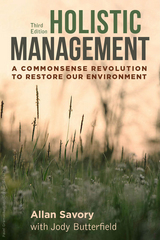
Holistic management is a systems-thinking approach for managing resources developed by Savory decades ago after observing the devastation of desertification in his native Southern Rhodesia (now Zimbabwe). Properly managed livestock are key to restoring the world’s grassland soils, the major sink for atmospheric carbon, and minimizing the most damaging impacts on humans and the natural world. This book updates Savory's paradigm-changing vision for reversing desertification, stemming the loss of biodiversity, eliminating fundamental causes of human impoverishment throughout the world, and climate change. Reorganized chapters make it easier for readers to understand the framework for Holistic Management and the four key insights that underlie it. New color photographs showcase before-and-after examples of land restored by livestock.
This long-anticipated new edition is written for new generations of ranchers, farmers, eco- and social entrepreneurs, and development professionals working to address global environmental and social degradation. It offers new hope that a sustainable future for humankind and the world we depend on is within reach.

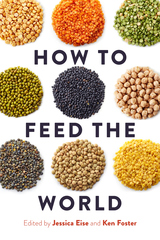
How to Feed the World unites contributors from different perspectives and academic disciplines, ranging from agronomy and hydrology to agricultural economy and communication. Hailing from Germany, the Philippines, the U.S., Ecuador, and beyond, the contributors weave their own life experiences into their chapters, connecting global issues to our tangible, day-to-day existence. Across every chapter, a similar theme emerges: these are not simple problems, yet we can overcome them. Doing so will require cooperation between farmers, scientists, policy makers, consumers, and many others.
The resulting collection is an accessible but wide-ranging look at the modern food system. Readers will not only get a solid grounding in key issues, but be challenged to investigate further and contribute to the paramount effort to feed the world.
READERS
Browse our collection.
PUBLISHERS
See BiblioVault's publisher services.
STUDENT SERVICES
Files for college accessibility offices.
RECENTLY PUBLISHED






UChicago Accessibility Resources
home | accessibility | search | about | contact us
BiblioVault ® 2001 - 2026
The University of Chicago Press