
 A SCHOLARLY BOOK REPOSITORY
108 books about Comparative Religion and 5
start with H
108 books about Comparative Religion and 5
108 books about Comparative Religion
5 start with H start with H
5 start with H start with H

Healing Ableism
Stories About Disability and Religious Life
Darla Schumm
Rutgers University Press, 2026
Most people encounter disability at some point in their lives, either in their own bodies or through a friend or loved one. Faith leaders, sacred texts, and members of religious communities frequently offer religious teachings and metaphors as explanation for the presence of disability, but rarely do we hear the voices of people living with disabilities reflecting on their experiences of God, faith, or religious life. In Healing Ableism: Stories about Disability and Religious Life, Darla Schumm explores the extraordinary stories of people with disabilities who struggle with the ordinary human challenges of faith and doubt, exclusion and inclusion, and injustice and justice. Blending candid story-telling, cultural critique, and theory, Schumm invites readers to reflect on the experiences of people with disabilities in religious communities and organizations. Schumm argues that it’s not disability that needs healing, it’s ableism that needs healing. In the final chapter, Schumm offers accessible love as one avenue for healing ableism.
[more]
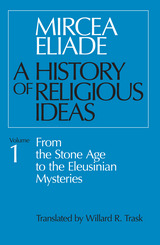
A History of Religious Ideas, Volume 1
From the Stone Age to the Eleusinian Mysteries
Mircea Eliade
University of Chicago Press, 1978
"No one has done so much as Mr. Eliade to inform literature students in the West about 'primitive' and Oriental religions. . . . Everyone who cares about the human adventure will find new information and new angles of vision."—Martin E. Marty, New York Times Book Review
[more]
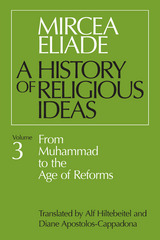
History of Religious Ideas, Volume 3
From Muhammad to the Age of Reforms
Mircea Eliade
University of Chicago Press, 1985
This volume completes the immensely learned three-volume A History of Religious Ideas. Eliade examines the movement of Jewish thought out of ancient Eurasia, the Christian transformation of the Mediterranean area and Europe, and the rise and diffusion of Islam from approximately the sixth through the seventeenth centuries. Eliade's vast knowledge of past and present scholarship provides a synthesis that is unparalleled. In addition to reviewing recent interpretations of the individual traditions, he explores the interactions of the three religions and shows their continuing mutual influence to be subtle but unmistakable.
As in his previous work, Eliade pays particular attention to heresies, folk beliefs, and cults of secret wisdom, such as alchemy and sorcery, and continues the discussion, begun in earlier volumes, of pre-Christian shamanistic practices in northern Europe and the syncretistic tradition of Tibetan Buddhism. These subcultures, he maintains, are as important as the better-known orthodoxies to a full understanding of Judaism, Christianity, and Islam.
As in his previous work, Eliade pays particular attention to heresies, folk beliefs, and cults of secret wisdom, such as alchemy and sorcery, and continues the discussion, begun in earlier volumes, of pre-Christian shamanistic practices in northern Europe and the syncretistic tradition of Tibetan Buddhism. These subcultures, he maintains, are as important as the better-known orthodoxies to a full understanding of Judaism, Christianity, and Islam.
[more]
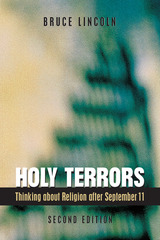
Holy Terrors, Second Edition
Thinking About Religion After September 11
Bruce Lincoln
University of Chicago Press, 2006
It is tempting to regard the perpetrators of the September 11th terrorist attacks as evil incarnate. But their motives, as Bruce Lincoln’s acclaimed Holy Terrors makes clear, were profoundly and intensely religious. Thus what we need after the events of 9/11, Lincoln argues, is greater clarity about what we take religion to be.
Holy Terrors begins with a gripping dissection of the instruction manual given to each of the 9/11 hijackers. In their evocation of passages from the Quran, we learn how the terrorists justified acts of destruction and mass murder “in the name of God, the most merciful, the most compassionate.” Lincoln then offers a provocative comparison of President Bush’s October 7, 2001 speech announcing U.S. military action in Afghanistan alongside the videotaped speech released by Osama bin Laden just a few hours later. As Lincoln authoritatively demonstrates, a close analysis of the rhetoric used by leaders as different as George W. Bush and Osama bin Laden—as well as Mohamed Atta and even Jerry Falwell—betrays startling similarities. These commonalities have considerable implications for our understanding of religion and its interrelationships with politics and culture in a postcolonial world, implications that Lincoln draws out with skill and sensitivity.
With a chapter new to this edition, “Theses on Religion and Violence,” Holy Terrors remains one of the essential books on September 11 and a classic study on the character of religion.
Holy Terrors begins with a gripping dissection of the instruction manual given to each of the 9/11 hijackers. In their evocation of passages from the Quran, we learn how the terrorists justified acts of destruction and mass murder “in the name of God, the most merciful, the most compassionate.” Lincoln then offers a provocative comparison of President Bush’s October 7, 2001 speech announcing U.S. military action in Afghanistan alongside the videotaped speech released by Osama bin Laden just a few hours later. As Lincoln authoritatively demonstrates, a close analysis of the rhetoric used by leaders as different as George W. Bush and Osama bin Laden—as well as Mohamed Atta and even Jerry Falwell—betrays startling similarities. These commonalities have considerable implications for our understanding of religion and its interrelationships with politics and culture in a postcolonial world, implications that Lincoln draws out with skill and sensitivity.
With a chapter new to this edition, “Theses on Religion and Violence,” Holy Terrors remains one of the essential books on September 11 and a classic study on the character of religion.
“Modernity has ended twice: in its Marxist form in 1989 Berlin, and in its liberal form on September 11, 2001. In order to understand such major historical changes we need both large-scale and focused analyses—a combination seldom to be found in one volume. But here Bruce Lincoln . . . has given us just such a mix of discrete and large-picture analysis.”—Stephen Healey, Christian Century
“From time to time there appears a work . . . that serves to focus the wide-ranging, often contentious discussion of religion’s significance within broader cultural dynamics. Bruce Lincoln’s Holy Terrors is one such text. . . . Anyone still struggling toward a more nuanced comprehension of 9/11 would do well to spend time with this book.”—Theodore Pulcini, Middle East Journal
“From time to time there appears a work . . . that serves to focus the wide-ranging, often contentious discussion of religion’s significance within broader cultural dynamics. Bruce Lincoln’s Holy Terrors is one such text. . . . Anyone still struggling toward a more nuanced comprehension of 9/11 would do well to spend time with this book.”—Theodore Pulcini, Middle East Journal
[more]

The Hungry God
Hindu Tales of Filicide and Devotion
David Shulman
University of Chicago Press, 1993
India's folklore and classical literature abound with stories of parents who sacrifice their children. In The Hungry God, David Shulman examines one set of such tales—Hindu texts that bear similarities to the biblical aqedah, the account of Abraham's near-sacrifice of Isaac. In all the stories that Shulman explores, the sacrifice proceeds from a divine command and has no utilitarian explanation or rationale.
[more]
READERS
Browse our collection.
PUBLISHERS
See BiblioVault's publisher services.
STUDENT SERVICES
Files for college accessibility offices.
RECENTLY PUBLISHED


UChicago Accessibility Resources
home | accessibility | search | about | contact us
BiblioVault ® 2001 - 2026
The University of Chicago Press