
 A SCHOLARLY BOOK REPOSITORY
3 start with H start with H

Democracy—its aspirations, its dangers—is what, most fundamentally, our Constitution is about. The question, Richard Parker argues in this powerful book, is how to imagine our democracy. Provocative in style and substance, this manifesto challenges orthodoxies of constitutional legal studies, particularly the idea that constitutionalism and populist democracy stand opposed. Parker presents a populist argument. He contends that the mission of constitutional law should be to promote, not limit, the expression of ordinary political energy—thus to extend, rather than constrain, majority rule.
At the root of the matter, Parker finds a question of “sensibility”—assumptions and attitudes about the political energy of ordinary people. He approaches this sensibility in a novel way, through a work of fiction about politics, Thomas Mann’s Mario and the Magician. Offering two “takes” on the story, Parker shows how it evokes—and elucidates—our deepest, most problematic attitudes about popular political energy in our own democracy. He goes on to elaborate these attitudes within our practice of constitutional argument. This is a book about the people, and for the people, a reimagination of constitutional law’s populist potential. It will disorient—then reorient—the thinking of everyone who is concerned about democracy and the Constitution.

This book is a demonstration of how social reformers and politicians have used the amendment process to achieve favorable political results even as their proposed amendments have failed to be adopted. For example, the ERA "failed" in the sense that it was never ratified, but the mobilization to ratify the ERA helped build the feminist movement (and also sparked a countermobilization). Similarly, the Supreme Court's ban on compulsory school prayer led to a barrage of proposed amendments to reverse the Court. They failed to achieve the requisite two-thirds support from Congress, but nevertheless had an impact on the political landscape. The definition of the relationship between Congress and the President in the conduct of foreign policy can also be traced directly to failed efforts to amend the Constitution during the Cold War.
Roger Hartley examines familiar examples like the ERA, balanced budget amendment proposals, and pro-life attempts to overturn Roe v. Wade, but also takes the reader on a three-century tour of lesser-known amendments. He explains how often the mere threat of calling a constitutional convention (at which anything could happen) effected political change.
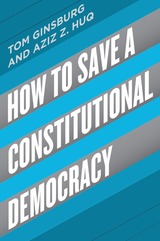
How to Save a Constitutional Democracy mounts an urgent argument that we can no longer afford to be complacent. Drawing on a rich array of other countries’ experiences with democratic backsliding, Tom Ginsburg and Aziz Z. Huq show how constitutional rules can both hinder and hasten the decline of democratic institutions. The checks and balances of the federal government, a robust civil society and media, and individual rights—such as those enshrined in the First Amendment—often fail as bulwarks against democratic decline. The sobering reality for the United States, Ginsburg and Huq contend, is that the Constitution’s design makes democratic erosion more, not less, likely. Its structural rigidity has had unforeseen consequence—leaving the presidency weakly regulated and empowering the Supreme Court conjure up doctrines that ultimately facilitate rather than inhibit rights violations. Even the bright spots in the Constitution—the First Amendment, for example—may have perverse consequences in the hands of a deft communicator who can degrade the public sphere by wielding hateful language banned in many other democracies. We—and the rest of the world—can do better. The authors conclude by laying out practical steps for how laws and constitutional design can play a more positive role in managing the risk of democratic decline.
READERS
Browse our collection.
PUBLISHERS
See BiblioVault's publisher services.
STUDENT SERVICES
Files for college accessibility offices.
RECENTLY PUBLISHED




UChicago Accessibility Resources
home | accessibility | search | about | contact us
BiblioVault ® 2001 - 2025
The University of Chicago Press