
 A SCHOLARLY BOOK REPOSITORY
336 books about Design and 7
start with H
336 books about Design and 7
336 books about Design
7 start with H start with H
7 start with H start with H

Handbook of Ventilation Technology for the Built Environment
Design, control and testing
Shi-Jie Cao
The Institution of Engineering and Technology, 2022
The general purpose of ventilation in buildings is to provide healthy air for breathing by both diluting the pollutants originating in the building and removing the pollutants from it. Building ventilation plays a strong role for the good health, comfort, security and productivity of inhabitants, workers and visitors. Many new challenges with energy and pollution implications have arisen, including the identification and control of contaminant sources, fast building design requirements, online demand, sustainability and climate change adaptation.
[more]
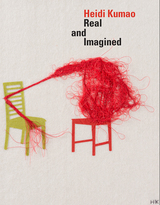
Heidi Kumao
Real and Imagined
Heidi Kumao
Michigan Publishing Services, 2022
Heidi Kumao: Real and Imagined documents and contextualizes narrative fabric works and animations from Kumao’s 2020 solo exhibition at the University of Michigan’s Stamps Gallery. Using fabric cutouts and stitching of everyday objects, Kumao invents a tactile visual vocabulary that distills unspoken aspects of ordinary exchanges into accessible narrative images. Weaving in her experiences as an Asian American woman, artist, and educator, Kumao creates poetic and playful open-ended visual haikus, generating a range of associations to current events, gender roles, and institutional power structures. Captured midstream, interactions from intimate relationships, medical procedures, the workplace, and the political sphere are suspended in time within felt film stills. Real and Imagined presents the reader with an opportunity to experience this remarkable oeuvre of over thirty fabric works and video animations.
For over thirty years, Kumao has developed an expanded art practice that includes animations, video installations, photographs, machine art, and fabric works that give physical form to the intangible parts of our lives: our emotions, psychological states, memories, thinking patterns. Her hybrid artworks have included electromechanical girl’s legs that “misbehave,” video installations about surviving confinement, surreal, experimental stop motion puppet animations, performative staged photographs, and hand crafted cinema machines.
She has exhibited her award-winning artwork in solo and group exhibitions nationally and internationally including the Art Science Museum Singapore, Centre de Cultura Contemporània de Barcelona, the Museum of Image and Sound (São Paulo) and the Museum of Modern Art in Buenos Aires. Her work is in permanent and private collections including the Houston Museum of Fine Arts, Arizona State University Art Museum, the Philadelphia Museum of Art and the Exploratorium in San Francisco. She has received fellowships and grants from the Guggenheim Foundation, the Creative Capital Foundation, and the National Endowment for the Arts. She is a professor at the Stamps School of Art & Design at the University of Michigan, Ann Arbor.
This exhibition catalogue marks the first significant publication on Kumao’s work and includes a selection of works from across her career. It includes written contributions by: Srimoyee Mitra, curator and Director of the Stamps Gallery and NYC-based art critic; Wendy Vogel; an interview between the artist and writer Lynn Love; and poems by the Ruth Lilly Poetry Prize Award winner Marilyn Chin.
[more]

Heroic Works
Catalogue for Designer Bookbinders International Competition 2017
Edited by Jeanette Koch
Bodleian Library Publishing, 2017
Designer Bookbinders is one of the foremost bookbinding societies and its International Bookbinding Competition in association with Mark Getty and the Bodleian Library continues to attract top binders from around the world. For 2017, the theme of the competition was myths, heroes, and legends. Throughout the ages, every culture has created myths and legends that recount the great deeds of its heroes. This year’s entries reflect a remarkable range of styles, materials, and approaches to great classics of world literature, as well as modern texts.
Heroic Works collects the full 184 entries from the 2017 competition, highlighting the twenty-eight winning bindings and offering a veritable showcase for the creativity and craftsmanship of the international bookbinding community. As beautifully designed as many of the bindings it displays, this showcase of the best in modern bookbinding will become a collector’s item among aficionados of bookbinding—as well as a handsome addition to any personal library.
Heroic Works collects the full 184 entries from the 2017 competition, highlighting the twenty-eight winning bindings and offering a veritable showcase for the creativity and craftsmanship of the international bookbinding community. As beautifully designed as many of the bindings it displays, this showcase of the best in modern bookbinding will become a collector’s item among aficionados of bookbinding—as well as a handsome addition to any personal library.
[more]
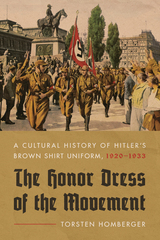
The Honor Dress of the Movement
A Cultural History of Hitler’s Brown Shirt Uniform, 1920–1933
Torsten Homberger
University of Massachusetts Press, 2021
During the era of the Weimar Republic, Germany was characterized by deep contradictions and polarizations. New, progressive social mores and artistic developments mixed uneasily with growing reactionary politics. When the 1929 stock market crash produced a severe economic shock, voters began to shift their allegiances from the parties of the center to radicals on both the left and the right. By 1933, amidst crisis and chaos, the Nazis had taken over.
In The Honor Dress of the Movement, Torsten Homberger contends that the brown-shirted Stormtrooper uniform was central to Hitler's rise to power. By analyzing its design and marketing, he investigates how Nazi leaders used it to project a distinct political and military persona that was simultaneously violent and orderly, retrograde and modern—a dual image that proved popular with the German people and was key to the Nazis' political success. Based on a wealth of sources that includes literature, films, and newspapers of the era, Homberger exhibits how the Nazis shaped and used material culture to destroy democracy.
In The Honor Dress of the Movement, Torsten Homberger contends that the brown-shirted Stormtrooper uniform was central to Hitler's rise to power. By analyzing its design and marketing, he investigates how Nazi leaders used it to project a distinct political and military persona that was simultaneously violent and orderly, retrograde and modern—a dual image that proved popular with the German people and was key to the Nazis' political success. Based on a wealth of sources that includes literature, films, and newspapers of the era, Homberger exhibits how the Nazis shaped and used material culture to destroy democracy.
[more]
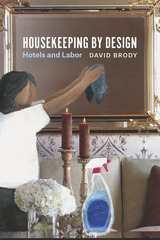
Housekeeping by Design
Hotels and Labor
David Brody
University of Chicago Press, 2016
One of the great pleasures of staying in a hotel is spending time in a spotless, neat, and organized space that you don’t have to clean. That doesn’t, however, mean the work disappears—when we’re not looking, someone else is doing it.
With Housekeeping by Design, David Brody introduces us to those people—the housekeepers whose labor keeps the rooms clean and the guests happy. Through unprecedented access to staff at several hotels, Brody shows us just how much work goes on behind the scenes—and how much management goes out of its way to make sure that labor stays hidden. We see the incredible amount of hard physical work that is involved in cleaning and preparing a room, how spaces, furniture, and other objects are designed to facilitate a smooth flow of hidden labor, and, crucially, how that design could be improved for workers and management alike if front-line staff were involved in the design process. After reading this fascinating exposé of the ways hotels work—or don’t for housekeepers—one thing is certain: checking in will never be the same again.
With Housekeeping by Design, David Brody introduces us to those people—the housekeepers whose labor keeps the rooms clean and the guests happy. Through unprecedented access to staff at several hotels, Brody shows us just how much work goes on behind the scenes—and how much management goes out of its way to make sure that labor stays hidden. We see the incredible amount of hard physical work that is involved in cleaning and preparing a room, how spaces, furniture, and other objects are designed to facilitate a smooth flow of hidden labor, and, crucially, how that design could be improved for workers and management alike if front-line staff were involved in the design process. After reading this fascinating exposé of the ways hotels work—or don’t for housekeepers—one thing is certain: checking in will never be the same again.
[more]
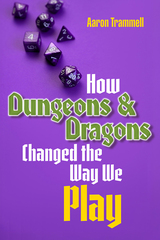
How Dungeons & Dragons Changed the Way We Play
Aaron Trammell
Duke University Press, 2026
First released in 1974, Dungeons & Dragons revolutionized game design and interactive media by allowing players to create and perform their own fictional characters in a fantasy world as expansive as their imaginations would allow. That freedom, and the rules that governed it, weren’t a creative coincidence. In How Dungeons & Dragons Changed the Way We Play, Aaron Trammell excavates the game as an artifact of a burgeoning counterculture obsessed with individualism as well as quantification. Mapping the world onto a grid, building characters whose every trait is assigned a point value, and advancing the game’s narrative through dice throws—countless core mechanics are tied to numbers. Putting the game design of D&D into dialogue with the social and political tensions of the 1970s and 80s, Trammell illuminates how the integrated quantification in the game design led to reductionism, reinforced oppressive gender and racial norms, and accustomed generations of players to the bigoted, xenophobic mores of the Cold War era. He delivers a history of both how games can shape players and how players, united by their own shared values, can shape games in turn.
[more]

How to Create a Universe
Jakob Ion Wille, Simon Jon Andreasen, and Gunnar Wille
University of Westminster Press, 2025
How to Create a Universe helps you create and understand the universes that you love from books, films, TV series and games. Through ideas, reflections, drawings, conversations, theories and first-hand examples, the book takes the mystery out of universe building and provides new knowledge and methods for understanding and creating content for fictional universes. You can use the methods in the book to develop, conceptualize and devise universes whether you are a game creator, film producer, writer, TV series showrunner, designer, theatre director, artist, researcher, student or educator – or simply enjoy being a curious explorer wishing to understand the creative process of building a fictional universe. The book follows a similar approach to design research by focusing on methods and tools and, not least, interdisciplinary collaboration. Combining approaches from art research and the humanities with media studies and development processes, the book draws on extensive studies of works across different media, including film, TV series, games, computer games, theatre, literature and oral lore. We are inspired by explanations from narrative theory and biological evolution of the human urge to create and delve into fiction and fictive universes. Furthermore, we share the interest in methods, tools and collaboration models that characterizes design thinking.The book’s nine chapters contain insights into the process of universe building from idea to publication; interviews with some of the world’s leading universe thinkers and builders; practical exercises for developing universes across traditional, new and future media formats; and more than 200 drawings and illustrations of models and examples to provide support and inspiration. The authors draw on knowledge and information collected around the world over several years. In the book, you will meet people who have been involved in creating and developing the universes for Squid Game, Fight Club, The Terminal, Minority Report, Your Name, Suzume, Black Mirror, Mr. Turner, Wallace and Gromit, Pandemic Legacy, Dead of Winter, Dark, Lego, El Tigre, Avatar, Spiderman, Halo, Quirky Circuits, End of Night, The Guilty and Enforcement.
[more]
READERS
Browse our collection.
PUBLISHERS
See BiblioVault's publisher services.
STUDENT SERVICES
Files for college accessibility offices.
RECENTLY PUBLISHED





UChicago Accessibility Resources
home | accessibility | search | about | contact us
BiblioVault ® 2001 - 2026
The University of Chicago Press