
 A SCHOLARLY BOOK REPOSITORY
22 start with H start with H
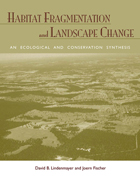
- synthesizes a large body of information from the scientific literature
- considers key theoretical principles for examining and predicting effects
- examines the range of effects that can arise
- explores ways of mitigating impacts
- reviews approaches to studying the problem
- discusses knowledge gaps and future areas for research and management
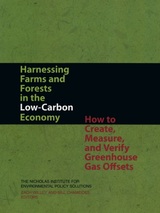
This guide is the first comprehensive technical publication providing direction to landowners for sequestering carbon and information for traders and others who will need to verify the sequestration. It will provide invaluable direction to farmers, foresters, land managers, consultants, brokers, investors, regulators, and others interested in creating consistent, credible greenhouse gas offsets as a tradable commodity in the United States.
The guide contains a non-technical section detailing methodologies for scoping of the costs and benefits of a proposed project, quantifying offsets of various sorts under a range of situations and conditions, and verifying and registering the offsets. The technical section provides specific information for quantifying, verifying, and regulating offsets from agricultural and forestry practices.
Visit the Nicholas Institute for Environmental Policy Solutions website for audio from the press conference announcing the book.
Read the press release announcing the book.

This comprehensive and authoritative handbook, written by scientists, identifies many hazards that parents tend to overlook. It translates technical, scientific information into an accessible how-to guide to help parents protect children from even the most toxic substances.

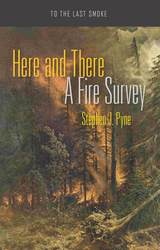
In this collection of essays, historian and renowned fire expert Stephen J. Pyne offers his reflections on national and global wildland fire management. Pyne distills the long saga of fire on Earth and its role in underwriting an Anthropocene that might equally be called a Pyrocene.
Presented through a mixture of journalism, history, and literary imagination, Here and There moves the discussion of fire beyond the usual formations of science and policy within a national narrative to one of thoughtful interpretation, analysis, and commentary. Centered on the unique complexities of fire management in a global world, Here and There offers a punctuation point to our understanding of wildfire.
Included in this volume:
- How fire policy has changed within the United States
- How policy in the United States differs from that in other countries
- The history of one of the most famous fire paintings of all time
- Suggested next steps for the future of fire research
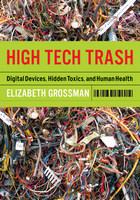
High Tech Trash is a wake-up call to the importance of the e-waste issue and the health hazards involved. Americans alone own more than two billion pieces of high tech electronics and discard five to seven million tons each year. As a result, electronic waste already makes up more than two-thirds of the heavy metals and 40 percent of the lead found in our landfills. But the problem goes far beyond American shores, most tragically to the cities in China and India where shiploads of discarded electronics arrive daily. There, they are "recycled"-picked apart by hand, exposing thousands of workers and community residents to toxics.
As Grossman notes, "This is a story in which we all play a part, whether we know it or not. If you sit at a desk in an office, talk to friends on your cell phone, watch television, listen to music on headphones, are a child in Guangdong, or a native of the Arctic, you are part of this story."
The answers lie in changing how we design, manufacture, and dispose of high tech electronics. Europe has led the way in regulating materials used in electronic devices and in e-waste recycling. But in the United States many have yet to recognize the persistent human health and environmental effects of the toxics in high tech devices. If Silent Spring brought national attention to the dangers of DDT and other pesticides, High Tech Trash could do the same for a new generation of technology's products.
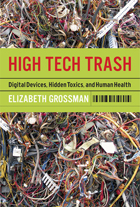
High Tech Trash is a wake-up call to the importance of the e-waste issue and the health hazards involved. Americans alone own more than two billion pieces of high tech electronics and discard five to seven million tons each year. As a result, electronic waste already makes up more than two-thirds of the heavy metals and 40 percent of the lead found in our landfills. But the problem goes far beyond American shores, most tragically to the cities in China and India where shiploads of discarded electronics arrive daily. There, they are "recycled"-picked apart by hand, exposing thousands of workers and community residents to toxics.
As Grossman notes, "This is a story in which we all play a part, whether we know it or not. If you sit at a desk in an office, talk to friends on your cell phone, watch television, listen to music on headphones, are a child in Guangdong, or a native of the Arctic, you are part of this story."
The answers lie in changing how we design, manufacture, and dispose of high tech electronics. Europe has led the way in regulating materials used in electronic devices and in e-waste recycling. But in the United States many have yet to recognize the persistent human health and environmental effects of the toxics in high tech devices. If Silent Spring brought national attention to the dangers of DDT and other pesticides, High Tech Trash could do the same for a new generation of technology's products.
This new edition, thoroughly revised, updated, and streamlined, explains the planning procedures described in Holistic Management, and offers step-by-step instructions for running a ranch or farm using a holistic management approach. Butterfield and her coauthors describe how to use the handbook in conjunction with the textbook to tailor a management plan for your unique combination of land, livestock, and finances. Their mantra is “plan, monitor, control, and replan.” Using a four-part approach, the authors walk readers through basic concepts and techniques, help them put a plan onto paper, monitor the results, and adjust the details as needed. Appendixes provide updated worksheets, checklists, planning and monitoring forms, and detailed examples of typical scenarios a user might encounter. The handbook includes a comprehensive glossary of terms.
Ranchers, farmers, pastoralists, social entrepreneurs, government agencies, and NGOs working to address global environmental degradation will find this comprehensive handbook an indispensable guide to putting the holistic management concept into action with tangible results they can take to the bank.
Musil draws on personal experience and compelling data in this practical and rigorous analysis of the causes and cures for global warming. The book presents all the players in the most pressing challenge facing society today, from the massive fossil fuel lobby to the enlightened corporations that are joining the movement to "go green." Musil thoroughly explains the tremendous potential of renewable energy sources-wind, solar, and biofuel-and the startling conclusions of experts who say society can do away entirely with fossil fuels. He tells readers about the engaged politicians, activists, religious groups, and students who are already working together against climate change.
But the future depends, Musil insists, on what changes ordinary citizens make. Through personal choices and political engagement, he shows how readers can cut carbon emissions and create green communities where they live. With practical and realistic solutions, Hope for a Heated Planet inspires readers to be accountable and enables them to usher in an age of sustainability for future generations.
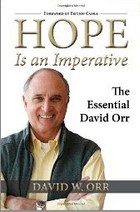
Hope Is an Imperative brings together in a single volume Professor Orr’s most important works. These include classics such as “What Is Education For?,” one of the most widely reprinted essays in the environmental literature, “The Campus and the Biosphere,” which helped launch the green campus movement,and “Loving Children: A Design Problem,” which renowned theologian and philosopher Thomas Berry called “the most remarkable essay I’ve read in my whole life.”
The book features thirty-three essays, along with an introductory section that considers the evolution of environmentalism, section introductions that place the essays into a larger context, and a foreword by physicist and author Fritjof Capra.
Hope Is an Imperative is a comprehensive collection of works by one of the most important thinkers and writers of our time. It offers a complete introduction to the writings of David Orr for readers new to the field, and represents a welcome compendium of key essays for longtime fans. The book is a must-have volume for every environmentalist’s bookshelf.
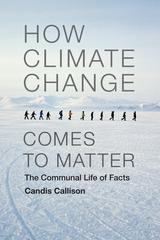
The disparate efforts of these groups illuminate the challenge of maintaining fidelity to scientific facts while transforming them into ethical and moral calls to action. Callison investigates the different vernaculars through which we understand and articulate our worlds, as well as the nuanced and pluralistic understandings of climate change evident in different forms of advocacy. As she demonstrates, climate change offers an opportunity to look deeply at how issues and problems that begin in a scientific context come to matter to wide publics, and to rethink emerging interactions among different kinds of knowledge and experience, evolving media landscapes, and claims to authority and expertise.

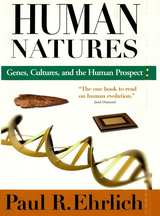
The Bell Curve, The Moral Animal, The Selfish Gene -- these and a host of other books and articles have made a seemingly overwhelming case that our genes determine our behavior. Now, in a new book that is sure to stir controversy, one of the world's leading evolutionary biologists shows why most of those claims of genetic destiny cannot be true, and explains how the arguments often stem from a fundamental misunderstanding of evolution itself.
"You can't change human nature," the saying goes. But you can, Stanford biologist Paul Ehrlich shows us in Human Natures, and in fact, evolution is the story of those changing natures. He makes a compelling case that "human nature" is not a single, unitary entity, but is as diverse as humanity itself, and that changes in culture and other environmental variations play as much of a role in human evolution as genetic changes. We simply don't have enough genes to specify behavior at the level that is often asserted.
Never has knowledge of our evolutionary past been more important to our future. Developing intelligent strategies for antibiotic use, pest control, biodiversity protection -- and even for establishing more equitable social arrangements -- all depend on understanding evolution and how it works. A hallmark of Human Natures is the author's ability to convey lucidly that understanding in the course of presenting an engrossing history of our species. Using personal anecdote, vivid example, and stimulating narrative, Ehrlich guides us through the thicket of controversies over what science can and cannot say about the influence of our evolutionary past on everything from race to religion, from sexual orientation to economic development.
A major work of synthesis and scholarship, Human Natures gives us the fruit of a lifetime's thought and research on evolution and environment by a modern master of scientific understanding. Ehrlich's innovative vision lights the way to a fresh view of human nature and evolution, bringing insight and clarity to urgent questions of where we are as a species, and where we may be headed.
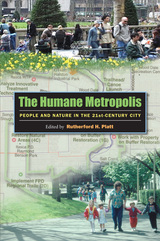
Four-fifths of Americans now live in the nation's sprawling metropolitan areas, and half of the world's population is now classified as “urban.” As cities become the dominant living environment for humans, there is growing concern about how to make such places more habitable, more healthy and safe, more ecological, and more equitable—in short, more “humane.”
This book explores the prospects for a more humane metropolis through a series of essays and case studies that consider why and how urban places can be made greener and more amenable. Its point of departure is the legacy of William H. Whyte (1917-1999), one of America's most admired urban thinkers. From his eyrie high above Manhattan in the offices of the Rockefeller Brothers Fund, Whyte laid the foundation for today's “smart growth” and “new urbanist” movements with books such as The Last Landscape (1968). His passion for improving the habitability of cities and suburbs is reflected in the diverse grassroots urban design and regreening strategies discussed in this volume.
Topics examined in this book include urban and regional greenspaces, urban ecological restoration, social equity, and green design. Some of the contributors are recognized academic experts, while others offer direct practical knowledge of particular problems and initiatives. The editor's introduction and epilogue set the individual chapters in a broader context and suggest how the strategies described, if widely replicated, may help create more humane urban environments.
In addition to Rutherford H. Platt, contributors to the volume include Carl Anthony, Thomas Balsley, Timothy Beatley, Eugenie L. Birch, Edward J. Blakely, Colin M. Cathcart, Steven E. Clemants, Christopher A. De Sousa, Steven N. Handel, Peter Harnik, Michael C. Houck, Jerold S. Kayden, Albert LaFarge, Andrew Light, Charles E. Little, Anne C. Lusk, Thalya Parilla, Deborah E. Popper, Frank J. Popper, Mary V. Rickel, Cynthia Rosenzweig, Robert L. Ryan, Laurin N. Sievert, Andrew G. Wiley-Schwartz, and Ann Louise Strong.
Included in the back of the book is a DVD of a 22-minute film created by Ted White, which serves as a companion to the text.
Contributors. Hester Blum, Brandi Bushman, Jeremy Chow, Margaret Cohen, Elizabeth DeLoughrey, Harris Feinsod, Isabel Hofmeyr, Charne Lavery, Nicole Rizzuto, Meg Samuelson, Allison Shelton, Teresa Shewry, Maxwell Uphaus
Not so fast, says Joseph Romm. In The Hype about Hydrogen, he explains why hydrogen isn't the quick technological fix it's cracked up to be, and why cheering for fuel cells to sweep the market is not a viable strategy for combating climate change. Buildings and factories powered by fuel cells may indeed become common after 2010, Joseph Romm argues, but when it comes to transportation, the biggest source of greenhouse-gas emissions, hydrogen is unlikely to have a significant impact before 2050.
The Hype about Hydrogen offers a hype-free explanation of hydrogen and fuel cell technologies, takes a hard look at the practical difficulties of transitioning to a hydrogen economy, and reveals why, given increasingly strong evidence of the gravity of climate change, neither government policy nor business investment should be based on the belief that hydrogen cars will have meaningful commercial success in the near or medium term. Romm, who helped run the federal government's program on hydrogen and fuel cells during the Clinton administration, provides a provocative primer on the politics, business, and technology of hydrogen and climate protection.
READERS
Browse our collection.
PUBLISHERS
See BiblioVault's publisher services.
STUDENT SERVICES
Files for college accessibility offices.
RECENTLY PUBLISHED



UChicago Accessibility Resources
home | accessibility | search | about | contact us
BiblioVault ® 2001 - 2026
The University of Chicago Press