
 A SCHOLARLY BOOK REPOSITORY
7 start with H start with H
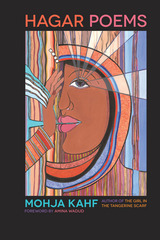
“Mohja Kahf ’s Hagar Poems is brilliantly original in its conception, thrillingly artful in its execution. Its range is immense, its spiritual depth is profound, it negotiates its shifts between archaic and the contemporary with utmost skill. There’s lyricism, there’s satire, there’s comedy, there’s theology of a high order in this book.”
—Alicia Ostriker, author of For the Love of God: The Bible as an Open Book
“Hagar/ Hajar the immigrant/exile/outcast/refugee mother of a people is given multiple voices and significance in Mohja Kahf’s new book of dramatic monologues, which also reinvents Pharaoh’s daughter, Zuleika, Aïsha, and Mary in poems that are at once lively and learned, agnostic and devout. The sequence on an American mosque, and the poet’s ambivalent love for what it represents, is unique in American poetry.”
—Marilyn Hacker, author of A Stranger’s Mirror
“‘Where have all the goddesses gone,’ writes Mohja Kahf, ‘I tracked down Isis / incognito on Cyprus. /She told me Ishtar / lived under the radar / in southern Iraq. . . .’ In Hagar Poems, Mohja Kahf’s hallmark qualities—irreverence, imagination, wit, poignancy—are all exuberantly in evidence. A wonderful read.”
—Leila Ahmed, author of A Quiet Revolution: The Veil’s Resurgence, from the Middle East to America
“This brilliant collection captures all the ‘patient threading of relationship’ between Hagar and Sarah as between women, and then between women and men, between human and God. . . . At every turn of the page [Kahf] refuses complacency and circumstance but opts instead for exposing the tenuousness of threads that tie and bind and then come loose before our eyes.”
—From the foreword by Amina Wadud
The central matter of this daring new collection is the story of Hagar, Abraham, and Sarah—the ancestral feuding family of Judaism, Christianity, and Islam.
These poems delve into the Hajar story in Islam. They explore other figures from the Near Eastern heritage, such as Mary and Moses, and touch on figures from early Islam, such as Fatima and Aisha. Throughout, there is artful reconfiguring. Readers will find sequels and prequels to the traditional narratives, along with modernized figures claimed for contemporary conflicts.
Hagar Poems is a compelling shakeup of not only Hagar’s story but also of current roles of all kinds of women in all kinds of relationships.

"Hezbollah is perhaps the world's most capable group. Terrorism expert Matthew Levitt offers a comprehensive and fascinating assessment of Hezbollah's network outside the Lebanese theater, exposing its operations and fundraising apparatus in Asia, Latin America, Europe, and even the United States." -- Daniel Byman, professor, Center for Security Studies, Georgetown University
"Matthew Levitt is a recognized authority on Hezbollah and its activities, both in the Levant and globally.... Hezbollah: The Global Footprint of Lebanon's Party of God fills a vital gap in understanding the international dimensions of Hezbollah, its reach, and its capacities for terrorism worldwide." -- Charles Allen, former assistant director of the central intelligence for collection, CIA
"Matthew Levitt has made a significant contribution to public understanding of Hezbollah's worldwide operations. He has shone a bright light into some of the darkest corners of the group's activities overseas." -- Richard Barrett, former head of MI6/SIS/British Intelligence's Counter Terrorism Department and coordinator of the United Nations Al-Qaeda-Taliban Monitoring Team
"This book tells the sinister story of a highly sophisticated organization that for more than thirty years has been an archetype of world-wide illicit activities. Hezbollah effectively combines its overt social and political activities with covert criminal and terrorist operations on a global scale. Matthew Levitt's painstaking collection of a rich array of data provides uncomfortable evidence of ' The Global Footprint of Lebanon's Party of God'. This book is essential reading for policy-makers and the international intelligence community." -- Uri Rosenthal, Former Minister of Foreign Affairs, the Netherlands
"In Hezbollah: The Global Footprint of Lebanon's Party of God, Matthew Levitt, through adept storytelling and impressive attention to historical detail, manages to teach even long-time students of the Middle East a great deal about Hezbollah. The book leaves little doubt as to the increasing importance, danger, and international reach of Hezbollah. It will be an important resource for serious scholars of the Middle East and a great read for anyone interested in better understanding the region." -- Andy Liepman, Senior Policy Analyst, RAND Corporation; former Principal Deputy Director, National Counterterrorism Center
"This book on Lebanese Hezbollah is a unique incisive insight into its global terror tentacles around the globe. Noone has catalogued these terrorist connections and plots in such forensic detail as Matthew Levitt, especially how the terror nexus between Hezbollah and Iran has continually evolved. It systematically lays bare Hezbollah's operational capability and its multiple intersections with Iranian intelligence architecture. This should be required reading for every intelligence analyst and terrorism researcher." -- Magnus Ranstrop, research director, Centre for Asymmetric Threat Studies at the Swedish National Defence College
"Matthew Levitt's book touches a key point of the growing debate on Hezbollah: the European approach to the phenomenon. It is a reminder for us Europeans that there are threats that might seem distant geographically, but could nevertheless have a strong impact politically on the continent as well." -- Franco Frattini, Justice and Chamber President of the Italian Conseil d'Etat (Supreme Administrative Court); President of the Italian Society for International Organization (SIOI); former Italian Foreign Minister (2002-2004 and 2008-2011)
"Richard Armitage, then Deputy Secretary of State, once described Hezbollah as the 'A team' of international terror. In his extraordinary new book, Matthew Levitt explains why Hezbollah is seen as such a global threat. Levitt paints a compelling picture of Hezbollah's terror activities not just in the Middle East but throughout Europe, Asia, Africa, and North and South America. While Western intelligence and law enforcement agencies have tracked and disrupted Hezbollah's global activities for years, this highly unsettling story has been largely unknown to wider publics. Thanks to Levitt's meticulous and well-written book that should no longer be the case." -- Ambassador Dennis Ross, counselor at the Washington Institute; former special assistant to President Obama and senior director for the Central Region at the National Security Council
"Matthew Levitt has laid out a timely and relevant history of Hezbollah, a global terrorist organization often referred to as the 'A Team' of terror. This book comes at the right time as Hezbollah continues its decades-long war against the United States, Israel, and our allies around the globe while it attempts to consolidate political power in Lebanon -- on its behalf and for the Iranian regime." -- Juan Zarate, former Deputy National Security Advisor for Combatting Terrorism and author of the forthcoming book, Treasury's War
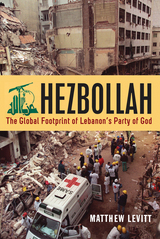
Hezbollah: The Global Footprint of Lebanon's Party of God is the first thorough examination of Hezbollah’s covert activities beyond Lebanon’s borders, including its financial and logistical support networks and its criminal and terrorist operations worldwide.
Hezbollah—Lebanon’s "Party of God"—is a multifaceted organization: It is a powerful political party in Lebanon, a Shia Islam religious and social movement, Lebanon’s largest militia, a close ally of Iran, and a terrorist organization. Drawing on a wide range of sources, including recently declassified government documents, court records, and personal interviews with intelligence and law enforcement officials around the world, Matthew Levitt examines Hezbollah’s beginnings, its first violent forays in Lebanon, and then its terrorist activities and criminal enterprises abroad in Europe, the Middle East, South America, Southeast Asia, Africa, and finally in North America. Levitt also describes Hezbollah’s unit dedicated to supporting Palestinian militant groups and Hezbollah’s involvement in training and supporting insurgents who fought US troops in post-Saddam Iraq. The book concludes with a look at Hezbollah’s integral, ongoing role in Iran’s shadow war with Israel and the West, including plots targeting civilians around the world.
Levitt shows convincingly that Hezbollah’s willingness to use violence at home and abroad, its global reach, and its proxy-patron relationship with the Iranian regime should be of serious concern. Hezbollah is an important book for scholars, policymakers, students, and the general public interested in international security, terrorism, international criminal organizations, and Middle East studies.
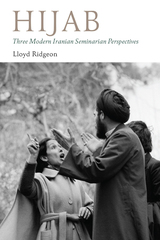
Ḥijāb addresses the differences of opinion among seminarians on the hijab in the Islamic Republic of Iran, focusing on three representative thinkers: Murtaza Mutahhari who held veiling to be compulsory, Ahmad Qabil who argued for the desirability of the hijab, and Muhsin Kadivar who considers it neither necessary nor desirable. In the first chapter, the views of these three scholars are contextualized within the framework known as ‘new religious thinking’ among the seminarians. Comprehending the hermeneutics of this new religious thinking is key to appreciating how and why the younger generation of scholars have offered divergent judgements about the hijab. Following the first chapter, the book is divided into three parallel sections, each devoted to one of the three seminarians. These present a chronological approach, and each scholar’s position on the hijab is assessed with reference to historical specificity and their own general jurisprudential perspective. Extensive examples of the writings of the three scholars on the hijab are also provided.

The reader sees war, diaspora, and immigration, and hears the marginalized voices of women of color. The poems use lyrical diction and striking imagery to evoke the weight of an emotional and visceral journey. They grow and build in length and form, reflecting the gains the women in the poems make in re-creating selfhood through endurance and strength.
In prose, narrative, and confessional-style poems, Alyan reflects on how physical space is refashioned, transmitted, and remembered. Her voice is distinct, fresh, relevant, and welcoming.
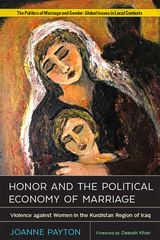
Honor and the Political Economy of Marriage provides a description of ‘honor’-based violence that focuses upon the structure of the family rather than the perpetrator’s culture. The author, Joanne Payton, argues that within societies primarily organized by familial and marital connections, women’s ‘honor’ is a form of symbolic capital within a ‘political economy’ in which marriage organizes intergroup connections.
Drawing on statistical analysis of original data contextualized with historical and anthropological readings, Payton explores forms of marriage and their relationship to ‘honor’, sketching changing norms around the familial control of women from agrarian/pastoral roots to the contemporary era.
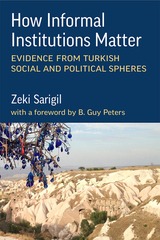
In How Informal Institutions Matter, Zeki Sarigil examines the role of informal institutions in sociopolitical life and addresses the following questions: Why and how do informal institutions emerge? To ask this differently, why do agents still create or resort to informal institutions despite the presence of formal institutional rules and regulations? How do informal institutions matter? What roles do they play in sociopolitical life? How can we classify informal institutions? What novel types of informal institutions can we identify and explain? How do informal institutions interact with formal institutions? How do they shape formal institutional rules, mechanisms, and outcomes? Finally, how do existing informal institutions change? What factors might trigger informal institutional change? In order to answer these questions, Sarigil examines several empirical cases of informal institution as derived from various issue areas in the Turkish sociopolitical context (i.e., civil law, conflict resolution, minority rights, and local governance) and from multiple levels (i.e., national and local).
READERS
Browse our collection.
PUBLISHERS
See BiblioVault's publisher services.
STUDENT SERVICES
Files for college accessibility offices.
RECENTLY PUBLISHED




UChicago Accessibility Resources
home | accessibility | search | about | contact us
BiblioVault ® 2001 - 2026
The University of Chicago Press