
 A SCHOLARLY BOOK REPOSITORY
126 books about People with disabilities and 6
start with H
126 books about People with disabilities and 6
126 books about People with disabilities
6 start with H start with H
6 start with H start with H

Healing Ableism
Stories About Disability and Religious Life
Darla Schumm
Rutgers University Press, 2026
Most people encounter disability at some point in their lives, either in their own bodies or through a friend or loved one. Faith leaders, sacred texts, and members of religious communities frequently offer religious teachings and metaphors as explanation for the presence of disability, but rarely do we hear the voices of people living with disabilities reflecting on their experiences of God, faith, or religious life. In Healing Ableism: Stories about Disability and Religious Life, Darla Schumm explores the extraordinary stories of people with disabilities who struggle with the ordinary human challenges of faith and doubt, exclusion and inclusion, and injustice and justice. Blending candid story-telling, cultural critique, and theory, Schumm invites readers to reflect on the experiences of people with disabilities in religious communities and organizations. Schumm argues that it’s not disability that needs healing, it’s ableism that needs healing. In the final chapter, Schumm offers accessible love as one avenue for healing ableism.
[more]

Health Policy and the Disadvantaged
Lawrence D. Brown, ed.
Duke University Press, 1991
This important collection of essays, originating in a 1989 conference on the disadvantaged in American health care, provides incisive commentary on U.S. health care policy and politics. Examining public responses to health crises and analyzing the political logic of the American community, this volume charts the immobility of U.S. health policy in recent years and points to its disastrous consequences for the 1990s.
Focusing on the particular needs of disadvantaged groups—the elderly, children, people with AIDS, the mentally ill, the chemically dependent, the homeless, the hungry, the medically uninsured—these essays develop strong policy statements. The authors describe the growth in U.S. health care programs, from Kerr-Mills to Medicare, Medicaid, and subsequent revisions, and stress the serious omissions resulting from incremental policy expansion, both in identifying disadvantaged groups and in implementing programs. They report the weakness of the U.S. health care system compared to systems of other technologically developed countries.
Focusing on the particular needs of disadvantaged groups—the elderly, children, people with AIDS, the mentally ill, the chemically dependent, the homeless, the hungry, the medically uninsured—these essays develop strong policy statements. The authors describe the growth in U.S. health care programs, from Kerr-Mills to Medicare, Medicaid, and subsequent revisions, and stress the serious omissions resulting from incremental policy expansion, both in identifying disadvantaged groups and in implementing programs. They report the weakness of the U.S. health care system compared to systems of other technologically developed countries.
Contributors. Deborah A. Stone and Theodore R. Marmor, Judith Feder, Alice Sardell, Bruce C. Vladeck, Michael Lipsky and Marc A. Thibodeau, Daniel M. Fox, William E. McAuliffe, M. Gregg Bloche and Francine Cournos, Lawrence D. Brown, James A. Morrone
[more]
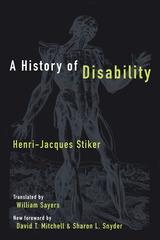
A History of Disability
Henri-Jacques Stiker
University of Michigan Press, 2019
The first book to attempt to provide a framework for analyzing disability through the ages, Henri-Jacques Stiker's now classic A History of Disability traces the history of western cultural responses to disability, from ancient times to the present. The sweep of the volume is broad; from a rereading and reinterpretation of the Oedipus myth to legislation regarding disability, Stiker proposes an analytical history that demonstrates how societies reveal themselves through their attitudes towards disability in unexpected ways. Through this history, Stiker examines a fundamental issue in contemporary Western discourse on disability: the cultural assumption that equality/sameness/similarity is always desired by those in society. He highlights the consequences of such a mindset, illustrating the intolerance of diversity and individualism that arises from placing such importance on equality. Working against this thinking, Stiker argues that difference is not only acceptable, but that it is desirable, and necessary.
This new edition of the classic volume features a new foreword by David T. Mitchell and Sharon L. Snyder that assesses the impact of Stiker’s history on Disability Studies and beyond, twenty years after the book’s translation into English. The book will be of interest to scholars of disability, historians, social scientists, cultural anthropologists, and those who are intrigued by the role that culture plays in the development of language and thought surrounding people with disabilities.
This new edition of the classic volume features a new foreword by David T. Mitchell and Sharon L. Snyder that assesses the impact of Stiker’s history on Disability Studies and beyond, twenty years after the book’s translation into English. The book will be of interest to scholars of disability, historians, social scientists, cultural anthropologists, and those who are intrigued by the role that culture plays in the development of language and thought surrounding people with disabilities.
[more]

A History of Disability
Henri-Jacques Stiker
University of Michigan Press, 2000
The increasing numbers of scholars, policy-makers, and political activists who are concerned with questions of physical and cognitive disability will warmly welcome Henri-Jacques Stiker's book, the first to attempt to provide a framework for analyzing disability through the ages. Published in 1997 in France as Corps infirmes et sociétés and available now in an excellent English translation, the book traces the history of western cultural responses to disability, from ancient times to the present.
In this volume, Stiker examines a fundamental issue in contemporary Western discourse on disability: the cultural assumption that equality/sameness/similarity is always desired by those in society. He highlights the consequences of such a mindset, illustrating the intolerance of diversity and individualism that arises from placing such importance on equality. Importantly, Stiker does not hesitate to assert his own stance on the issues he discusses: that difference is not only acceptable, but that it is desirable, that it is necessary.
The author goes beyond anecdotal history to traverse a little known history, penetrating to the heart of collective attitudes and reflecting on elements of policy. The sweep is broad; from a rereading and reinterpretation of the Oedipus myth to current legislation regarding disablity, he proposes an analytical history that demonstrates how societies reveal themselves through their attitudes towards disability, at times in unexpected ways, since the study of detail is often the best entry into the whole of a culture. The book will be of interest to scholars of disability, historians, social scientists, cultural anthropologists, and those who are intrigued by the role that culture plays in the development of language and thought surrounding the disabled.
[more]

The History of Special Education
From Isolation to Integration
Margret A. Winzer
Gallaudet University Press, 1993
This comprehensive volume examines the facts, characters, and events that shaped this field in Western Europe, Canada, and the United States. From the first efforts to teach disabled people in early Christian and Medieval eras to such current mandates as Public Law 94-142, this study breaks new ground in assessing the development of special education as a formal discipline.
The History of Special Education presents a four-part narrative that traces its emergence in fascinating detail from 16th-century Spain through the Age of Enlightenment in 17th-century France and England to 18th-century issues in Europe and North America of placement, curriculum, and early intervention. The status of teachers in the 19th century and social trends and the movement toward integration in 20th century programs are considered as well.
[more]
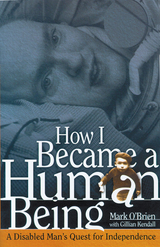
How I Became a Human Being
A Disabled Man’s Quest for Independence
Mark O’Brien, with Gillian Kendall
University of Wisconsin Press, 2003
In September 1955 six-year-old Mark O’Brien moved his arms and legs for the last time. He came out of a coma to find himself enclosed from the neck down in an iron lung, the machine in which he would live for much of the rest of his life.
For the first time in paperback, How I Became a Human Being is O’Brien’s account of his struggles to lead an independent life despite a lifelong disability. In 1955 he contracted polio and became permanently paralyzed from the neck down. O’Brien describes growing up without the use of his limbs, his adolescence struggling with physical rehabilitation and suffering the bureaucracy of hospitals and institutions, and his adult life as an independent student and writer. Despite his physical limitations, O’Brien crafts a narrative that is as rich and vivid as the life he led.
For the first time in paperback, How I Became a Human Being is O’Brien’s account of his struggles to lead an independent life despite a lifelong disability. In 1955 he contracted polio and became permanently paralyzed from the neck down. O’Brien describes growing up without the use of his limbs, his adolescence struggling with physical rehabilitation and suffering the bureaucracy of hospitals and institutions, and his adult life as an independent student and writer. Despite his physical limitations, O’Brien crafts a narrative that is as rich and vivid as the life he led.
[more]
READERS
Browse our collection.
PUBLISHERS
See BiblioVault's publisher services.
STUDENT SERVICES
Files for college accessibility offices.
RECENTLY PUBLISHED






UChicago Accessibility Resources
home | accessibility | search | about | contact us
BiblioVault ® 2001 - 2026
The University of Chicago Press