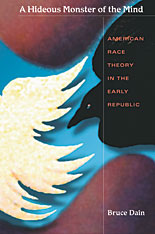
front cover of A Hideous Monster of the Mind
A Hideous Monster of the Mind
American Race Theory in the Early Republic
Bruce Dain
Harvard University Press, 2002

The intellectual history of race, one of the most pernicious and enduring ideas in American history, has remained segregated into studies of black or white traditions. Bruce Dain breaks this separatist pattern with an integrated account of the emergence of modern racial consciousness in the United States from the Revolution to the Civil War. A Hideous Monster of the Mind reveals that ideas on race crossed racial boundaries in a process that produced not only well-known theories of biological racism but also countertheories that were early expressions of cultural relativism, cultural pluralism, and latter-day Afrocentrism.

From 1800 to 1830 in particular, race took on a new reality as Americans, black and white, reacted to postrevolutionary disillusionment, the events of the Haitian Revolution, the rise of cotton culture, and the entrenchment of slavery. Dain examines not only major white figures like Thomas Jefferson and Samuel Stanhope Smith, but also the first self-consciously "black" African-American writers. These various thinkers transformed late-eighteenth-century European environmentalist "natural history" into race theories that combined culture and biology and set the terms for later controversies over slavery and abolition. In those debates, the ethnology of Samuel George Morton and Josiah Nott intertwined conceptually with important writing by black authors who have been largely forgotten, like Hosea Easton and James McCune Smith. Scientific racism and the idea of races as cultural constructions were thus interrelated aspects of the same effort to explain human differences.

In retrieving neglected African-American thinkers, reestablishing the European intellectual background to American racial theory, and demonstrating the deep confusion "race" caused for thinkers black and white, A Hideous Monster of the Mind offers an engaging and enlightening new perspective on modern American racial thought.

[more]

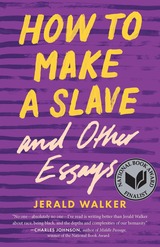
front cover of How to Make a Slave and Other Essays
How to Make a Slave and Other Essays
Jerald Walker
The Ohio State University Press, 2020
Finalist, National Book Award in Nonfiction
Winner, Massachusetts Book Award

A Book of the Year pick from Kirkus, BuzzFeed, and Literary Hub

“The essays in this collection are restless, brilliant and short.…The brevity suits not just Walker’s style but his worldview, too.…Keeping things quick gives him the freedom to move; he can alight on a truth without pinning it into place.” —Jennifer Szalai, the New York Times

For the black community, Jerald Walker asserts in How to Make a Slave, “anger is often a prelude to a joke, as there is broad understanding that the triumph over this destructive emotion lay in finding its punchline.” It is on the knife’s edge between fury and farce that the essays in this exquisite collection balance. Whether confronting the medical profession’s racial biases, considering the complicated legacy of Michael Jackson, paying homage to his writing mentor James Alan McPherson, or attempting to break free of personal and societal stereotypes, Walker elegantly blends personal revelation and cultural critique. The result is a bracing and often humorous examination by one of America’s most acclaimed essayists of what it is to grow, parent, write, and exist as a black American male. Walker refuses to lull his readers; instead his missives urge them to do better as they consider, through his eyes, how to be a good citizen, how to be a good father, how to live, and how to love.
 
[more]


Send via email Share on Facebook Share on Twitter