
 A SCHOLARLY BOOK REPOSITORY
164 books about Social Theory and 7
start with H
164 books about Social Theory and 7
164 books about Social Theory
7 start with H start with H
7 start with H start with H
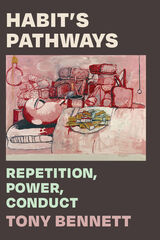
Habit's Pathways
Repetition, Power, Conduct
Tony Bennett
Duke University Press, 2023
Habit has long preoccupied a wide range of theologians, philosophers, sociologists, psychologists, and neuroscientists. In Habit’s Pathways Tony Bennett explores the political consequences of the varied ways in which habit’s repetitions have been acted on to guide or direct conduct. Bennett considers habit’s uses and effects across the monastic regimens of medieval Europe, in plantation slavery and the factory system, through colonial forms of rule, and within a range of medicalized pathologies. He brings these episodes in habit’s political histories to bear on contemporary debates ranging from its role in relation to the politics of white supremacy to the digital harvesting of habits in practices of algorithmic governance. Throughout, Bennett tracks how habit’s repetitions have been articulated differently across divisions of class, race, and gender, demonstrating that although habit serves as an apparatus for achieving success, self-fulfillment, and freedom for the powerful, it has simultaneously served as a means of control over women, racialized peoples, and subordinate classes.
[more]
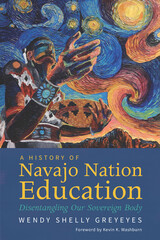
A History of Navajo Nation Education
Disentangling Our Sovereign Body
Wendy Shelly Greyeyes; Foreword by Kevin K. Washburn
University of Arizona Press, 2022
A History of Navajo Nation Education: Disentangling Our Sovereign Body unravels the tangle of federal and state education programs that have been imposed on Navajo people and illuminates the ongoing efforts by tribal communities to transfer state authority over Diné education to the Navajo Nation.
On the heels of the fiftieth anniversary of the founding of the Department of Diné Education, this important education history explains how the current Navajo educational system is a complex terrain of power relationships, competing agendas, and jurisdictional battles influenced by colonial pressures and tribal resistance. An iron grip of colonial domination over Navajo education remains, thus inhibiting a unified path toward educational sovereignty. In providing the historical roots to today’s challenges, Wendy Shelly Greyeyes clears the path and provides a go-to reference to move discussions forward.
On the heels of the fiftieth anniversary of the founding of the Department of Diné Education, this important education history explains how the current Navajo educational system is a complex terrain of power relationships, competing agendas, and jurisdictional battles influenced by colonial pressures and tribal resistance. An iron grip of colonial domination over Navajo education remains, thus inhibiting a unified path toward educational sovereignty. In providing the historical roots to today’s challenges, Wendy Shelly Greyeyes clears the path and provides a go-to reference to move discussions forward.
[more]

Homeplaces
Dwelling and Habitability in Critical Times
João Biehl and Federico Neiburg, editors
Duke University Press, 2026
A home is dismantled to make another home habitable. This is where Homeplaces begins. Spanning continents, this landmark volume brings together leading anthropologists to chart “house-ing,” the unrelenting, reciprocal process of people making houses and houses making people amid ongoing calamity. Their oikographies—vivid, writerly ethnographies of home as sense and action—blow open the fantasy of the private domicile and reveal houses as live forms: porous, incomplete, bleeding into neighborhoods, economies, ecologies, and the dead. They detonate philosophical abstractions about dwelling and technocratic assumptions about homemaking, revealing why home plays such a vital role in worldmaking. Refusing end-times thinking, Homeplaces reveals incompleteness as generative drive. The dissolution of forms, bodies, and buildings becomes the material from which people craft shelter, dignity, and transcendence. As war, climate catastrophe, and toxic landscapes dehouse the planet, Homeplaces captures the stubborn human insistence on dwelling—provisional, fierce, and alive.
[more]

The Human Condition
Second Edition
Hannah Arendt
University of Chicago Press, 2018
A classic work of political thought, more relevant today than ever
The twenty-first century has seen a resurgence of interest in the political thinker Hannah Arendt, “the theorist of beginnings,” whose work probes the logics underlying unexpected transformations—from totalitarianism to revolution.
A work of striking originality, The Human Condition is in many respects more relevant now than when it first appeared in 1958. In her study of the state of modern humanity, Hannah Arendt considers humankind from the perspective of the actions of which it is capable. The problems Arendt identified then—diminishing human agency and political freedom, the paradox that as human powers increase through technological and humanistic inquiry, we are less equipped to control the consequences of our actions—continue to confront us today. This new edition, published to coincide with the sixtieth anniversary of its original publication, contains Margaret Canovan’s 1998 introduction and a new foreword by Danielle Allen.
A classic in political and social theory, The Human Condition is a work that has proved both timeless and perpetually timely.
The twenty-first century has seen a resurgence of interest in the political thinker Hannah Arendt, “the theorist of beginnings,” whose work probes the logics underlying unexpected transformations—from totalitarianism to revolution.
A work of striking originality, The Human Condition is in many respects more relevant now than when it first appeared in 1958. In her study of the state of modern humanity, Hannah Arendt considers humankind from the perspective of the actions of which it is capable. The problems Arendt identified then—diminishing human agency and political freedom, the paradox that as human powers increase through technological and humanistic inquiry, we are less equipped to control the consequences of our actions—continue to confront us today. This new edition, published to coincide with the sixtieth anniversary of its original publication, contains Margaret Canovan’s 1998 introduction and a new foreword by Danielle Allen.
A classic in political and social theory, The Human Condition is a work that has proved both timeless and perpetually timely.
[more]

Human Nature Debate
Social Theory, Social Policy and the Caring Professions
Harry Cowen
Pluto Press, 1994
The idea of human nature is centuries old. Yet epithets like 'human greed', 'natural inequalities' and 'you can’t change the world' still underpin discussion in everyday life as well as in the academic arena.
Human Nature Debate challenges the fixity of such notions and argues that the manifestations of the human nature idea are socially and politically - rather than philosophically - grounded. The book’s scope is wide, spanning the social science disciplines and, unlike other texts in the field, incorporates everyday social and political examples into the academic.
Cowen demonstrates how theories of human nature must be related to their intellectual, historical and social roots by analysing biological, psychological and social models, assessing the impacts of Freudianism, behaviourism, existentialism and Marxism upon social theory, policy and caring professions, and evaluating the political significance of racist and sexist accounts. The book covers the issues of women and human nature and feminist critiques and acquaints the reader with a variety of social thinkers.
Human Nature Debate challenges the fixity of such notions and argues that the manifestations of the human nature idea are socially and politically - rather than philosophically - grounded. The book’s scope is wide, spanning the social science disciplines and, unlike other texts in the field, incorporates everyday social and political examples into the academic.
Cowen demonstrates how theories of human nature must be related to their intellectual, historical and social roots by analysing biological, psychological and social models, assessing the impacts of Freudianism, behaviourism, existentialism and Marxism upon social theory, policy and caring professions, and evaluating the political significance of racist and sexist accounts. The book covers the issues of women and human nature and feminist critiques and acquaints the reader with a variety of social thinkers.
[more]
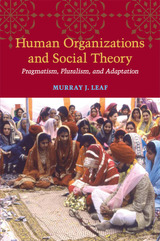
Human Organizations and Social Theory
Pragmatism, Pluralism, and Adaptation
Murray J. Leaf
University of Illinois Press, 2008
In the 1930s, George Herbert Mead and other leading social scientists established the modern empirical analysis of social interaction and communication, enabling theories of cognitive development, language acquisition, interaction, government, law and legal processes, and the social construction of the self. However, they could not provide a comparably empirical analysis of human organization. The theory in this book fills in the missing analysis of organizations and specifies more precisely the pragmatic analysis of communication with an adaptation of information theory to ordinary unmediated communications. The study also provides the theoretical basis for understanding the success of pragmatically grounded public policies, from the New Deal through the postwar reconstruction of Europe and Japan to the ongoing development of the European Union, in contrast to the persistent failure of positivistic and Marxist policies and programs.
[more]

Humanity's Last Stand
Confronting Global Catastrophe
Mark Schuller
Rutgers University Press, 2021
Are we as a species headed towards extinction? As our economic system renders our planet increasingly inhospitable to human life, powerful individuals fight over limited resources, and racist reaction to migration strains the social fabric of many countries. How can we retain our humanity in the midst of these life-and-death struggles?
Humanity’s Last Stand dares to ask these big questions, exploring the interconnections between climate change, global capitalism, xenophobia, and white supremacy. As it unearths how capitalism was born from plantation slavery and the slaughter of Indigenous people, it also invites us to imagine life after capitalism. The book teaches its readers how to cultivate an anthropological imagination, a mindset that remains attentive to local differences even as it identifies global patterns of inequality and racism.
Surveying the struggles of disenfranchised peoples around the globe from frontline communities affected by climate change, to #BlackLivesMatter activists, to Indigenous water protectors, to migrant communities facing increasing hostility, anthropologist Mark Schuller argues that we must develop radical empathy in order to move beyond simply identifying as “allies” and start acting as “accomplices.” Bringing together the insights of anthropologists and activists from many cultures, this timely study shows us how to stand together and work toward a more inclusive vision of humanity before it’s too late.
More information and instructor resources (https://humanityslaststand.org)
Humanity’s Last Stand dares to ask these big questions, exploring the interconnections between climate change, global capitalism, xenophobia, and white supremacy. As it unearths how capitalism was born from plantation slavery and the slaughter of Indigenous people, it also invites us to imagine life after capitalism. The book teaches its readers how to cultivate an anthropological imagination, a mindset that remains attentive to local differences even as it identifies global patterns of inequality and racism.
Surveying the struggles of disenfranchised peoples around the globe from frontline communities affected by climate change, to #BlackLivesMatter activists, to Indigenous water protectors, to migrant communities facing increasing hostility, anthropologist Mark Schuller argues that we must develop radical empathy in order to move beyond simply identifying as “allies” and start acting as “accomplices.” Bringing together the insights of anthropologists and activists from many cultures, this timely study shows us how to stand together and work toward a more inclusive vision of humanity before it’s too late.
More information and instructor resources (https://humanityslaststand.org)
[more]
READERS
Browse our collection.
PUBLISHERS
See BiblioVault's publisher services.
STUDENT SERVICES
Files for college accessibility offices.
RECENTLY PUBLISHED




UChicago Accessibility Resources
home | accessibility | search | about | contact us
BiblioVault ® 2001 - 2026
The University of Chicago Press