
 A SCHOLARLY BOOK REPOSITORY
3 start with H start with H

While this volume focuses on Hasidism, it wrestles with a core set of questions that permeate modern Jewish thought and religious thought more generally: What is the relationship between God and the world? What is the relationship between God and the human being? But Hasidic thought is cast with mystical, psychological, and even magical accents, and offers radically different answers to core issues of modern concern. The editors draw selections from an array of genres including women’s supplications; sermons and homilies; personal diaries and memoirs; correspondence; stories; polemics; legal codes; and rabbinic response. These selections consciously move between everyday lived experience and the most ineffable mystical secrets, reflecting the multidimensional nature of this unusual religious and social movement. The editors include canonical texts from the first generation of Hasidic leaders up through present-day ultra-orthodox, as well as neo-Hasidic voices and, in so doing, demonstrate the unfolding of a rich and complex phenomenon that continues to evolve today.
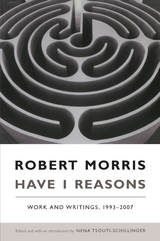
The writings are arranged chronologically, beginning with “Indiana Street,” a vivid autobiographical account of the artist’s early years in Kansas City, Missouri. Have I Reasons includes reflections on Morris’s own site-specific installations; transcripts of seminars he conducted in conjunction with exhibitions; and the textual element of The Birthday Boy, the two-screen video-and-sound piece he installed at the Galleria dell’Accademia in Florence, Italy, on the occasion of the five hundredth anniversary of Michelangelo’s David. Essays range from original interpretations of Cézanne’s Mont Sainte-Victoire paintings and Jasper Johns’ early work to engagements with one of Morris’s most significant interlocutors, the philosopher Donald Davidson. Have I Reasons conveys not only Morris’s enduring deep interest in philosophy and issues of resemblance and representation but also his more recent turn toward directly addressing contemporary social and political issues such as corporate excess and preemptive belligerence.

Hermann Cohen (1842–1918) was among the most accomplished Jewish philosophers of modern times—if not the single most significant. But his work has not yet received the attention it deserves. This newly translated collection of his writings—most of which are appearing in English for the first time—illuminates his achievements for student readers and rectifies lapses in his intellectual reception by prior generations. It presents chapters from Cohen’s Ethics of Pure Will, conflicting interpretations of Cohen by Franz Rosenzweig and Alexander Altmann, and finally the eulogy to Cohen delivered at graveside by Ernst Cassirer. Containing full annotations and selections that concentrate both on the philosophical core of Cohen’s writings and the politics of interpretation of his work at the time of his death and after, Hermann Cohen truly brings to light all of Cohen’s accomplishments.
READERS
Browse our collection.
PUBLISHERS
See BiblioVault's publisher services.
STUDENT SERVICES
Files for college accessibility offices.
RECENTLY PUBLISHED





UChicago Accessibility Resources
home | accessibility | search | about | contact us
BiblioVault ® 2001 - 2026
The University of Chicago Press