
 A SCHOLARLY BOOK REPOSITORY
15 start with I start with I

“[An] extraordinary book.” —New Republic
Fusing high scholarship with high drama, Anthony Grafton and Joanna Weinberg uncover a secret and extraordinary aspect of a legendary Renaissance scholar’s already celebrated achievement. The French Protestant Isaac Casaubon (1559–1614) is known to us through his pedantic namesake in George Eliot’s Middlemarch. But in this book, the real Casaubon emerges as a genuine literary hero, an intrepid explorer in the world of books. With a flair for storytelling reminiscent of Umberto Eco, Grafton and Weinberg follow Casaubon as he unearths the lost continent of Hebrew learning—and adds this ancient lore to the well-known Renaissance revival of Latin and Greek.
The mystery begins with Mark Pattison’s nineteenth-century biography of Casaubon. Here we encounter the Protestant Casaubon embroiled in intellectual quarrels with the Italian and Catholic orator Cesare Baronio. Setting out to understand the nature of this imbroglio, Grafton and Weinberg discover Casaubon’s knowledge of Hebrew. Close reading and sedulous inquiry were Casaubon’s tools in recapturing the lost learning of the ancients—and these are the tools that serve Grafton and Weinberg as they pore through pre-1600 books in Hebrew, and through Casaubon’s own manuscript notebooks. Their search takes them from Oxford to Cambridge, from Dublin to Cambridge, Massachusetts, as they reveal how the scholar discovered the learning of the Hebrews—and at what cost.
Making use of examples as apparently diverse and exotic as the Maori cults in nineteenth-century New Zealand and the events of Jonestown, Smith shows that religion must be construed as conventional, anthropological, historical, and as an exercise of imagination. In his analyses, religion emerges as the product of historically and geographically situated human ingenuity, cognition, and curiosity—simply put, as the result of human labor, one of the decisive but wholly ordinary ways human beings create the worlds in which they live and make sense of them.
"These seven essays . . . display the critical intelligence, creativity, and sheer common sense that make Smith one of the most methodologically sophisticated and suggestive historians of religion writing today. . . . Smith scrutinizes the fundamental problems of taxonomy and comparison in religious studies, suggestively redescribes such basic categories as canon and ritual, and shows how frequently studied myths may more likely reflect situational incongruities than vaunted mimetic congruities. His final essay, on Jonestown, demonstrates the interpretive power of the historian of religion to render intelligible that in our own day which seems most bizarre."—Richard S. Sarason, Religious Studies Review
Silver medal: Independent Publisher Book Award (Religion category)

Leavened with compassion, common sense, and a readable style, this introduction to complicated bioethical issues from both Jewish and Catholic perspectives is as informative as it is undaunting. Aaron Mackler takes the reader through methodology in Roman Catholic moral theology and compares and contrasts it with methodology as it is practiced in Jewish ethics. He then skillfully wends his way through many topics foremost on the contemporary ethical agenda for both Jewish and Catholic ethicists: euthanasia and assisted suicide, end-of-life decisions, abortion, in vitro fertilization, and the ever-growing problem of justice regarding access to health care and medical resources. A concluding chapter summarizes general tendencies in the comparison of the two traditions, and addresses the significance of convergence and divergence between these traditions for moral thinkers within each faith community, and generally in western democracies such as the United States.
As Mackler overviews these issues, he points out the divergences and the commonalities between the two traditions—clarifying each position and outlining the structure of thinking that supports them. At the heart of both Catholic and Jewish perspectives on bioethics is a life-affirming core, and while there may be differences in the "why" of those ethical divergences, and in the "how" each arrived at varying—or the same—conclusions, both traditions, in the words of James McCartney as quoted in the introduction, "are guided by the principle that life is precious; that we are bidden to preserve and guard our health; that we are bidden to intervene in nature to raise the human estate; and that our lives are not our own, but are part of the legacy bequeathed to us by the Creator." This book has been carefully crafted in that spirit.
The visionary voice who helped shape American Judaism—and Charleston’s cultural soul.
Isaac Harby of Charleston, 1788–1828 is a richly detailed biography that brings to life one of early America’s most fascinating and underappreciated Jewish intellectuals. Gary Phillip Zola offers a compelling portrait of Harby—a playwright, newspaper editor, drama critic, educator, and religious reformer—who emerged as a central figure in Charleston’s vibrant cultural scene during the early 19th century. At a time when Charleston was experiencing both economic prosperity and cultural efflorescence, Harby stood at the crossroads of literary ambition and religious innovation.
A descendant of Sephardic Jews, Harby was deeply engaged in the intellectual and civic life of his city. He founded a literary journal at just eighteen, established a private academy, and wrote prolifically on politics, education, and religion. But his most enduring legacy lies in his role as a pioneer of Reform Judaism in America. As a founding member of the Reformed Society of Israelites in 1825, Harby advocated for a rational, modernized approach to Jewish worship—one that emphasized universal ethics and intellectual engagement over ritual formalism. His efforts, though controversial in his time, laid the groundwork for the broader Reform movement that would flourish later in the century.
Drawing on newly uncovered archival materials, including Harby’s personal library and writings, Zola’s biography not only illuminates Harby’s life and thought but also offers a window into the broader cultural, religious, and political transformations of the early American republic. This book is essential reading for anyone interested in American Jewish history, Southern intellectual life, and the roots of religious reform in the United States.
Israel has changed. The country was born in Europe’s shadow, haunted by the Holocaust and inspired by the Enlightenment. But for Israelis today, Europe is hardly relevant, and the country’s ties to the broader West, even to America, are fraying. Where is Israel heading? How do citizens of an increasingly diverse nation see themselves globally and historically?
In this revealing portrait of the new Israel, Diana Pinto presents a country simultaneously moving forward and backward, looking outward and turning in on itself. In business, Israel is forging new links with the giants of Asia, and its booming science and technology sectors are helping define the future for the entire world. But in politics and religion, Israelis are increasingly self-absorbed, building literal and metaphorical walls against hostile neighbors and turning to ancient religious precepts for guidance here and now.
Pinto captures the new moods and mindsets, the anxieties and hopes of Israelis today in sharply drawn sketches of symbolically charged settings. She takes us on the roads to Jerusalem, to border control at Ben Gurion Airport, to a major Israeli conference in Jerusalem, to a hill overlooking the Dome of the Rock and Temple Mount, to the heart of Israel’s high-tech economy, and to sparkling new malls and restaurants where people of different identities share nothing more than a desire to ignore one another.
Vivid and passionate but underpinned by deep analysis, this is a profound and sometimes unsettling account of a country that is no longer where we might think.
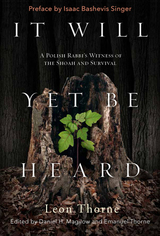
Rabbi Thorne composed his memoir under extraordinary conditions, confined to a small underground bunker below a Polish peasant’s pigsty. But, It Will Yet Be Heard is remarkable not only for the story of its composition, but also for its moral clarity and complexity. A deeply religious man, Rabbi Thorne bore witness to forced labor camps, human degradation, and the murders of entire communities. And once he emerged from hiding, he grappled not only with survivor’s guilt, but also with the lingering antisemitism and anti-Jewish violence in Poland even after the war ended. Harrowing, moving, and deeply insightful, Rabbi Thorne’s firsthand account offers a rediscovered perspective on the twentieth century’s greatest tragedy.
READERS
Browse our collection.
PUBLISHERS
See BiblioVault's publisher services.
STUDENT SERVICES
Files for college accessibility offices.
RECENTLY PUBLISHED



UChicago Accessibility Resources
home | accessibility | search | about | contact us
BiblioVault ® 2001 - 2025
The University of Chicago Press