
 A SCHOLARLY BOOK REPOSITORY
26 start with I start with I
A powerful argument that the failure of ideology has created political disconnection and apathy
Political institutions increasingly fail to provide representations where citizens can recognize, identify, and imagine themselves as part of the institutions’ democratic project. Robin Truth Goodman argues that this disconnection is because ideology itself has gotten interrupted. Reversing Louis Althusser’s famous formulation of ideology as “calling” to citizens who, in response, turn toward the call, she argues that citizens now feel that ideology has turned away from them and stopped calling, endangering the most basic processes of modern democracies.
Deconstructing the widespread failure of democratic institutions to connect with individuals, Goodman examines recent works by authors such as Claire Vaye Watkins, Colson Whitehead, Ling Ma, Han Kang, and Ruth Ozeki that interrogate subjective agency within three different sites of social struggle: eco-catastrophe, pandemic, and food insecurity. She shows the themes that emerge from the novels reflecting and extending how the privatization and technologization of political decision-making have effectively cut off politicians and political institutions from the people they are supposed to serve.
Basing her study in the political philosophy of Judith Butler, Hannah Arendt, Julia Kristeva, and other prominent feminists, Goodman draws parallels with gender theory and argues that precarity in democratic societies has prevented citizens from finding points of engagement within politics. Diagnosing this widespread inability to translate private struggles into collective responses, Ideology, Interrupted is a powerful and inspiring call for new forms of societal bonds and political engagement to rejuvenate our democratic systems.
Retail e-book files for this title are screen-reader friendly.
This collection brings together innovative new ideas and data sources in order to provide more satisfying alternatives to the trade versus technology debate and to assess directly the specific impact of international trade on U.S. wages. This timely volume offers a thorough appraisal of the wage distribution predicament, examining the continued effects of technology and globalization on the labor market.

In Defense of Monopoly offers an unconventional but empirically grounded argument in favor of market monopolies. Authors McKenzie and Lee claim that conventional, static models exaggerate the harm done by real-world monopolies, and they show why some degree of monopoly presence is necessary to maximize the improvement of human welfare over time.
Inspired by Joseph Schumpeter's suggestion that market imperfections can drive an economy's long-term progress, In Defense of Monopoly defies conventional assumptions to show readers why an economic system's failure to efficiently allocate its resources is actually a necessary precondition for maximizing the system's long-term performance: the perfectly fluid, competitive economy idealized by most economists is decidedly inferior to one characterized by market entry and exit restrictions or costs.
An economy is not a board game in which players compete for a limited number of properties, nor is it much like the kind of blackboard games that economists use to develop their monopoly models. As McKenzie and Lee demonstrate, the creation of goods and services in the real world requires not only competition but the prospect of gains beyond a normal competitive rate of return.
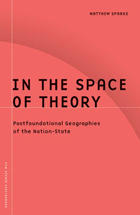
In the Space of Theory details the territorial implications of the Iraq war, NAFTA, welfare reform, constitutional reform, cross-border regional development, and the legal battles of First Nations. In using antiessentialist arguments to elucidate the complexity of these developments, Sparke seeks to ground and critique postfoundational theory itself. He shows how the postfoundational arguments of Homi Bhabha, Arjun Appadurai, Timothy Mitchell, Ernesto Laclau, Chantal Mouffe, Michael Hardt, and Antonio Negri obscure politically important processes of reterritorialization at the same time they deterritorialize diverse theoretical assumptions about the nation-state. Engaged with theory and grounded in close study of cultural, political, and economic change, In the Space of Theory explores the geographies of struggle that at once underlie and undermine the hyphen in contemporary nation-states.
Matthew Sparke is associate professor of geography and international studies at the University of Washington.
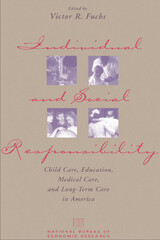
Four in-depth studies of human-service sectors—child care, education, medical care, and long-term care for the elderly—are followed by six cross-sector studies that stimulate new ways of thinking about human services through the application of economic theory, institutional analysis, and the history of social policy.
The contributors include Kenneth J. Arrow, Martin Feldstein, Victor Fuchs, Alan M. Garber, Eric A. Hanushek, Christopher Jencks, Seymour Martin Lipset, Glenn Loury, Roger G. Noll, Paul M. Romer, Amartya Sen, and Theda Skocpol.
This timely study sheds important light on the tension between individual and social responsibility, and will appeal to economists and other social scientists and policymakers concerned with social policy issues.
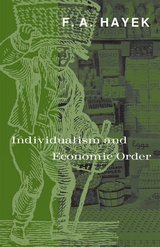
In this influential collection of writings, Nobel laureate Friedrich A. Hayek discusses topics from moral philosophy and the methods of the social sciences to economic theory as different aspects of the same central issue: free markets versus socialist planned economies. First published in the 1930s and '40s, these essays continue to illuminate the problems faced by economists, planners, government officials, and citizens in the changing, globalized economy of today.

In this collection of writings, Nobel laureate Friedrich A. Hayek discusses topics from moral philosophy and the methods of the social sciences to economic theory as different aspects of the same central issue: free markets versus socialist planned economies. First published in the 1930s and 40s, these essays continue to illuminate the problems faced by developing and formerly socialist countries.
F. A. Hayek, recipient of the Medal of Freedom in 1991 and winner of the Nobel Memorial Prize in Economics in 1974, taught at the University of Chicago, the University of London, and the University of Freiburg. Among his other works published by the University of Chicago Press is The Road to Serfdom, now available in a special fiftieth anniversary edition.
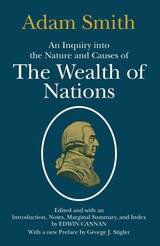
Adam Smith's The Wealth of Nations was recognized as a landmark of immediately upon publication in 1776. As the first serious, data-driven argument for the principles of political economy, it is the point of departure for all subsequent economic thought. Smith's argument that human self-interest is the primary driver of economic activity, and that in aggregate that self-interest--acting through a market freed from government intervention-guides markets and economies toward the best outcomes for business and society, remains foundational for contemporary free-market economics.
This edition presents the definitive 1904 version of The Wealth of Nations, painstakingly edited by Edwin Cannan and featuring Cannan's illuminating introduction, and notes, as well as a a full index. An additional preface by distinguished economist George J. Stigler places Smith's book and thought in a contemporary context. The result is the best edition of this classic for students and general readers alike.
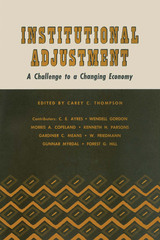
This collection of essays presents a stimulating and challenging examination of the nature of institutional adjustment, its history and its future, its problems and its purposes. The focus is on the pioneer work done by the late Clarence Ayres, of the University of Texas, in the study of the processes of change and growth and the nature of modern industrialized economies. The opening essay, a provocative discussion of “The Theory of Institutional Adjustment,” is Ayres’s contribution.
The succeeding essays examine several aspects of institutional adjustment:
- Kenneth H. Parsons discusses “The Institutional Basis of a Progressive Approach to Economic Development.”
- Wendell Gordon considers “Orthodox Economics and Institutionalized Behavior.”
- Gunnar Myrdal brings the breadth of his knowledge of many different economies and the institutional contexts within which they operate to a study of the “Adjustment of Economic Institutions in Contemporary America.”
- Forest Hill provides a historical survey of the process of growth and change in his essay “The Government and Institutional Adjustment: The American Experience.”
- Wolfgang Friedmann discusses some legal aspects of the subject in “Creative Legal Interpretation and the Process of Institutional Adjustment.”
- Rounding out this collection of essays, Morris A. Copeland and Gardiner C. Means offer proposals for guiding adjustment and change in specific areas: “Implementing the Objective of Full Employment in Our Free Enterprise System” and “Monetary Institutions to Serve the Modern Economy.”
These essays were originally read at a conference sponsored by the Department of Economics of the University of Texas at Austin in April and May of 1965.
Wendell Gordon presents the philosophy of economic institutionalism clearly and evocatively, in the tradition of the pragmatism of Peirce, James, and Dewey. In Gordon's view, the institutionalism of Veblen and Ayres, the only indigenous American school of economic thought, offered the most hope for understanding and solving the economic problems of the twentieth century.
The institutional approach—long known as the Texas School—looks at social order as ongoing process. The effort to explain how our attitudes have developed and how they are changed is central to this approach. Gordon argues that the dynamics of technical change, the institutionalism of behavior norms, human biology, and the resource endowment of the universe interact to create and change these attitudes.
Gordon thoroughly analyzes both orthodox and Marxist economic approaches with regard to institutional economics. He also examines such other radical approaches as underconsumption and the single tax. There is a discussion of the procedures and problems involved in testing for the validity of institutional theory and the analysis of economic problems in the institutional frame of reference. In addition, inflation, energy, multinationals, property rights, business organization, unemployment, and other issues are considered from an institutional perspective.
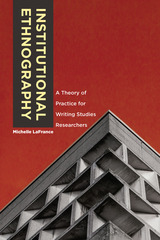
In this book, Michelle LaFrance introduces the theories, rhetorical frames, and methods that ground and animate institutional ethnography. Three case studies illustrate key aspects of the methodology in action, tracing the work of writing assignment design in a linked gateway course, the ways annual reviews coordinate the work of faculty and writing center administrators and staff, and how the key term “information literacy” socially organizes teaching in a first-year English program. Through these explorations of the practice of ethnography within sites of writing and writing instruction, LaFrance shows that IE is a methodology keenly attuned to the material relations and conditions of work in twenty-first-century writing studies contexts, ideal for both practiced and novice ethnographers who seek to understand the actualities of social organization and lived experience in the sites they study.
Institutional Ethnography expands the field’s repertoire of research methodologies and offers the grounding necessary for work with the IE framework. It will be invaluable to writing researchers and students and scholars of writing studies across the spectrum—composition and rhetoric, literacy studies, and education—as well as those working in fields such as sociology and cultural studies.
Benito Arruñada aims to avoid such failures by deepening our understanding of both the value of registries and the organizational requirements for constructing them. Presenting a theory of how registries strengthen property rights and reduce transaction costs, he analyzes the major trade-offs and proposes principles for successfully building registries in countries at different stages of development. Arruñada focuses on land and company registries, explaining the difficulties they face, including current challenges like the subprime mortgage crisis in the United States and the dubious efforts made in developing countries toward universal land titling. Broadening the account, he extends his analytical framework to other registries, including intellectual property and organized exchanges of financial derivatives. With its nuanced presentation of the theoretical and practical implications, Institutional Foundations of Impersonal Exchange significantly expands our understanding of how public registries facilitate economic growth.
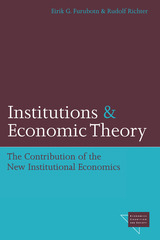
This second edition assesses some of the major refinements, extensions, and useful applications that have developed in neoinstitutionalist thought in recent years. More attention is given to the overlap between the New Institutional Economics and developments in economic history and political science. In addition to updated references, new material includes analysis of parallel developments in the field of economic sociology and its attacks on representatives of the NIE as well as an explanation of the institution-as-an-equilibrium-of-game approach.
Already an international best seller, Institutions and Economic Theory is essential reading for economists and students attracted to the NIE approach. Scholars from such disciplines as political science, sociology, and law will find the work useful as the NIE continues to gain wide academic acceptance. A useful glossary for students is included.
Eirik Furubotn is Honorary Professor of Economics, Co-Director of the Center for New Institutional Economics, University of Saarland, Germany and Research Fellow, Private Enterprise Research Center, Texas A&M University.
Rudolph Richter is Professor Emeritus of Economics and Director of the Center for New Institutional Economics, University of Saarland, Germany.

Shows how musical instruments and the sounds they produce are not incidental, but an integral part of music theory.
Many musicians dread music theory: its rules and diagrams can feel stern and lifeless, far removed from the sounds that make music so thrilling. In this book, Alexander Rehding looks at music theory from a different angle. He argues that the sound of the instruments on which music theory is demonstrated—starting with the piano in the music classroom—plays a much more active role than we usually notice. They are “instruments” in a double sense: musical noisemakers, but also tools in a kind of scientific experiment. Rehding strips these devices down to their sound-generating mechanisms to show us how to read musical instruments for their theoretical content.
Instruments of Music Theory turns our attention to instruments such as multiphonic sirens, tuning forks, Chladni plates, Aeolian harps, and Wheatstone concertinas—these devices generated sounds that called for new ways of listening, measuring, and thinking about music. Bringing together music theory, critical organology, and media theory, this book can be read as a user’s manual for how to put sound back into music theory. Rehding shows us how instruments do not only produce sound—they produce knowledge about music. Through the lens of these new instruments, Instruments of Music Theory recasts fundamental musical ideas such as pitch, harmony, form, and scale from the ground up to give new meaning to the stuff we call music.
"Two impressive features of this book are its clarity of purpose and the breadth of disciplinary resources to which it appeals."
---Geoffrey Brennan, Professor of Economics, Australian National University
"Facing massive evidence that people do not act generally as self-regarding payoff maximizers, economists have become increasingly interested in issues of cooperation, altruism, identity, and morality. Lanse Minkler's contribution is particularly important because of his powerful argument that the evidence of cooperation cannot be explained adequately by a more complicated preference function. A disposition for honesty is not simply a matter of preference---it is an issue of personal integrity, identity, and commitment. This has major implications. In particular we have to reconstruct the theory of the firm from first principles. No economist committed to the pursuit of truth should ignore this volume."
---Geoffrey Hodgson, Research Professor in Business Studies, University of Hertfordshire, United Kingdom, and Editor in Chief of the Journal of Institutional Economics
"This is an interesting account of the role of integrity---preference-integrity and commitment-integrity---on economic behavior. While drawing knowledge from traditional subfields of economics, it also includes insights gleaned from psychology and philosophy, showing their effects in varied areas such as political behavior, the employment relation, religion, and human rights. In this exciting volume Lanse Minkler does an excellent job of incorporating various newer concepts of fairness and integrity into economic analysis."
---Ernst Fehr, Professor and Head of the Chair of Microeconomics and Experimental Economic Research and Director of the Institute for Empirical Research in Economics, University of Zurich
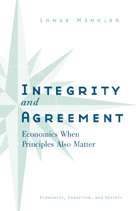
Social scientists who treat humans as rational beings driven exclusively by self-interest ignore a key factor shaping human behavior: the influence of moral principles. Starting with the elementary principle "lying is wrong," economic theorist Lanse Minkler examines the ways in which a sense of morality guides real-life decision making.
Whether one feels committed to specific or general moral principles, Minkler explains, integrity demands consistently acting on that commitment. Because truthfulness is the most basic moral principle, integrity means honesty. And honesty extends beyond truth-telling. It requires good faith when entering an agreement and then standing by one's word. From this premise, Minkler explores the implications of integrity for contracts between buyers and sellers and understandings between employers and employees. He also finds a role for integrity in an individual's religious vows, an elected official's accountability to constituents, and a community's obligation to human rights.
Integrity and Agreement reintroduces morality as a factor for economists, sociologists, psychologists, and political scientists to consider in their efforts to comprehend human behavior.
Lanse Minkler is Associate Professor of Economics at the University of Connecticut.
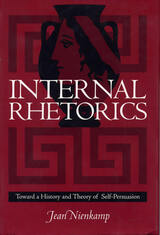
Since its early history in Greek culture, traditional rhetorical study has focused primarily on persuasive language used in the public sphere. There has been little study, however, of what Jean Nienkamp calls internal rhetoric, which “occurs between one aspect of the self and another” inside one’s mind. Nienkamp opens the study of internal rhetoric by discussing how the concept developed alongside traditional classical and modern rhetorical theory.
Nienkamp shows how we talk to ourselves, or more specifically, how we talk ourselves into things: justifications, actions, opinions, theories. She explains that just because we see ourselves as divided, as torn in different directions by conflicting desires, duties, and social mores, it does not mean that we are fragmented, nor does it mean that we are split into discrete identities that neither interrelate nor interact.
In this groundbreaking study, Nienkamp identifies two major aspects of internal rhetoric: “the conscious ‘art’ of cultivated internal rhetoric” and “the unconscious ‘nature’ of primary internal rhetoric.” Selecting a small number of figures from the history of rhetoric—including Isocrates, Plato, Aristotle, Francis Bacon, Lord Shaftesbury, Richard Whately, Kenneth Burke, Chaim Perelman and Lucie Olbrechts-Tyteca, George Herbert Mead, and Lev Vygotsky—Nienkamp argues for a “version of the rhetorical self that takes into account both the ways we are formed by and formulate internal and external rhetorics and the ways our physical bodies act as a contributing scene—an agora—for internal rhetoric.”

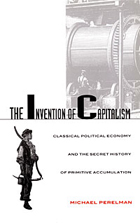
Clearly, they did not go willingly. As Michael Perelman shows, they were forced into the factories with the active support of the same economists who were making theoretical claims for capitalism as a self-correcting mechanism that thrived without needing government intervention. Directly contradicting the laissez-faire principles they claimed to espouse, these men advocated government policies that deprived the peasantry of the means for self-provision in order to coerce these small farmers into wage labor. To show how Adam Smith and the other classical economists appear to have deliberately obscured the nature of the control of labor and how policies attacking the economic independence of the rural peasantry were essentially conceived to foster primitive accumulation, Perelman examines diaries, letters, and the more practical writings of the classical economists. He argues that these private and practical writings reveal the real intentions and goals of classical political economy—to separate a rural peasantry from their access to land.
This rereading of the history of classical political economy sheds important light on the rise of capitalism to its present state of world dominance. Historians of political economy and Marxist thought will find that this book broadens their understanding of how capitalism took hold in the industrial age.
Chapter 10 is available Open Access here (https://www.ncbi.nlm.nih.gov/books/NBK395883)

An appeal for the importance of theory, utopia, and close consideration of our contemporary dark times
What does any particular theory allow us to do? What is the value of doing so? And who benefits? In Invoking Hope, Phillip E. Wegner argues for the undiminished importance of the practices of theory, utopia, and a deep and critical reading of our current situation of what Bertolt Brecht refers to as finsteren Zeiten, or dark times.
Invoking Hope was written in response to three events that occurred in 2016: the five hundredth anniversary of the publication of Thomas More’s Utopia; the one hundredth anniversary of the founding text in theory, Ferdinand de Saussure’s Course in General Linguistics; and the rise of the right-wing populism that culminated in the election of Donald Trump. Wegner offers original readings of major interventions in theory alongside dazzling utopian imaginaries developed from classical Greece to our global present—from Theodor Adorno, Ernst Bloch, Alain Badiou, Jacques Derrida, Fredric Jameson, Sarah Ahmed, Susan Buck-Morss, and Jacques Lacan to such works as Plato’s Republic, W. E. B. Du Bois’s John Brown, Isak Dinesen’s “Babette’s Feast,” Kim Stanley Robinson’s 2312, and more. Wegner comments on an expansive array of modernist and contemporary literature, film, theory, and popular culture.
With Invoking Hope, Wegner provides an innovative lens for considering the rise of right-wing populism and the current crisis in democracy. He discusses challenges in the humanities and higher education and develops strategies of creative critical reading and hope against the grain of current trends in scholarship.
This book compares Islamic and Western political formulations, highlighting areas of agreement and disparity. Building on this analysis, the author goes on to show that political Islam offers a serious alternative to the dominant political system and ideology of the West.
Sabet argues that rather than leading to a "Clash of Civlizations" or the assimilation of Islam into the Western system, a positive process of interactive self-reflection between Islam and liberal democracy is the best way forward.
Beginning this process, Sabet highlights key concepts of Islamic political thought and brings them into dialogue with Western modernity. The resulting synthesis is essential reading for advanced undergraduate and graduate students of Islamic and Middle Eastern politics, political theory, comparative politics and international relations.
This collection offers new insights into the kinds of economic opportunities and outcomes that immigrant populations might expect for themselves and future generations.
READERS
Browse our collection.
PUBLISHERS
See BiblioVault's publisher services.
STUDENT SERVICES
Files for college accessibility offices.
RECENTLY PUBLISHED




UChicago Accessibility Resources
home | accessibility | search | about | contact us
BiblioVault ® 2001 - 2026
The University of Chicago Press