
 A SCHOLARLY BOOK REPOSITORY
12 start with J start with J
Jairus’s Daughter and the Female Body in Mark demonstrates that ubiquitous and significant depictions of children in the literature and material culture of the first century CE shaped the mindsets of the Gospel of Mark’s original audience. Through a detailed analysis of the story of Jairus’s daughter in Mark 5 and of the archaeological remains depicting female children, Janine E. Luttick reveals how ancient hearers of this story encountered an image of a female child that communicated ideas of hope to Jesus’s followers and in turn how readers today can understand the authority of Jesus, the domestic structures of early Christianity, and the suffering and loss experienced by some early Christians.
A fresh interpretation of the nature, purpose, and date of Jerome’s Epistle 106
In this volume of the Writings from the Greco-Roman World series, Michael Graves offers the first accessible English translation and commentary on Jerome’s Epistle 106, an important work of patristic biblical interpretation. In his treatise Jerome discusses different textual and exegetical options according to various Greek and Latin copies of the Psalms with input from the Hebrew. Epistle 106 provides insightful commentary on the Gallican Psalter, Jerome’s translation of Origen’s hexaplaric edition. Jerome’s work offers a unique window into the complex textual state of the Psalter in the late fourth century and serves as an outstanding example of ancient philological scholarship on the Bible. Graves’s translation and commentary is an essential resource for scholars and students of patristic exegesis, biblical textual criticism, and late antique Christianity.
Explore the diverse character of emerging Christian narratives
This book presents essays that show how prophetic and priestly emphases in Luke and Acts, and emphasis on Jesus’s existence prior to creation in the Gospel of John, are reworked in some second- and third-century Christian literature. Early Christians interpreted and expressed the storylines of Jesus, Mary, and other important figures in ways that created new images and stories. Contributors show the effect of including rhetography, the rhetoric of a text that prompts images and pictures in the mind of a hearer or reader, in interpretation of texts.
Features:
- Readings that attempt to account for the development of richly creative and complicated early Christian traditions
- Essays bridging New Testament studies and interpretation of Early Christian literature
- Interpretations that integrate social and rhetorical interpretations
A window into early Judaism and Christianity
The Gospel of John was written during the period of the emergence of Christianity and its separation from Judaism and bears witness to their contested relationship. This volume contains eighteen cutting-edge essays written by an international group of scholars who interpret for students and general readers what the book tells us about first-century Judaism, the separation of the church from Judaism, and how John's anti-Jewish references are being interpreted today.
Features:
- A debate over the process that led to the separation of the church from Judaism, and John's place in that process
- A review of recent interpretations of John's anti-Jewish references
- An assessment of the current status of Jewish Christian relations

A readily accessible text and translation for scholars and students of Paul, ancient Christian history, and biblical reception.
In this new volume in the Writings from the Greco-Roman World series, Margaret M. Mitchell collects twenty-five of John Chrysostom's lesser-known sermons on Pauline passages as well as some that focus on Paul himself. Mitchell presents the Greek text and an original translation of each of these fascinating sermons in a fresh, engaging style that seeks to recapture the vibrancy and dynamism of the live oratory behind the homilies. Extensive notes to each homily evaluate how Chrysostom dealt with some of the ethical, theological, historical, political, and literary problems present in Paul's writings. Mitchell's work on Chrysostom offers a model for scholars to explore and understand how ancient Christian interpreters found in Paul’s letters a legacy that was as problematic as it was precious.

This groundbreaking volume draws together an international group of leading biblical scholars to consider one of the most controversial religious topics in the modern era: Is the Gospel of John—the most theological and distinctive among the four canonical Gospels—historical or not? If not, why does John alone among the Gospels claim eyewitness connections to Jesus? If so, why is so much of John’s material unique to John? Using various methodologies and addressing key historical issues in John, these essays advance the critical inquiry into Gospel historiography and John’s place within it, leading to an impressive consensus and convergences along the way. The contributors are Paul N. Anderson; Mark Appold; Richard Bauckham; Helen K. Bond; Richard A. Burridge; James H. Charlesworth; Jaime Clark-Soles; Mary Coloe; R. Alan Culpepper; Craig A. Evans; Sean Freyne; Jeffrey Paul Garcia; Brian D. Johnson; Peter J. Judge; Felix Just, S.J.; Craig S. Keener; Edward W. Klink III; Craig R. Koester; Michael Labahn; Mark A. Matson; James F. McGrath; Susan Miller; Gail R. O’Day; Bas van Os; Tom Thatcher; Derek M. H. Tovey; Urban C. von Wahlde; and Ben Witherington III.
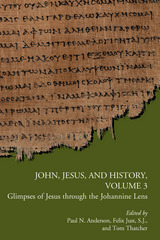
A critical analysis of the historicity of the Gospel of John
Since it began in 2002, the John, Jesus, and History Project has assessed critically the modern disparaging of John's historicity and has found this bias wanting. In this third volume, an international group of experts demonstrate over two dozen ways in which John contributes to an enhanced historical understanding of Jesus and his ministry. This volume does not simply argue for a more inclusive quest for Jesus—one that embraces John instead of programmatically excluding it. It shows that such a quest has already indeed begun. Contributors include Paul N. Anderson, Jo-Ann A. Brant, Peder Borgen, Gary M. Burge, Warren Carter, R. Alan Culpepper, James D. G. Dunn, Robert T. Fortna, Jörg Frey, Steven A. Graham, Colin J. Humphreys, Craig Keener, Andreas Köstenberger, Tim Ling, William Loader, Linda McKinnish Bridges, James S. McLaren, Annette Merz, Wendy E. S. North, Benjamin E. Reynolds, Udo Schnelle, Donald Senior, C.P., Tom Thatcher, Michael Theobald, Jan van der Watt, Robert Webb, Stephen Witetscheck, and Jean Zumstein.
Features
- A state-of-the-art analysis of John’s contributions to the quest for the historical Jesus, including evaluative responses by leading Jesus scholars
- •An overview of paradigm shifts in Jesus scholarship and recent approaches to the Johannine riddles
- Detailed charts that illuminates John's similarities and differences form the Synoptic Gospels as well as the gospel's contributions to the historical Jesus research

John, Jesus, and History, Volume 4: Jesus Remembered in the Johannine Situation addresses the narrative development of the Johannine corpus over as many as seven decades. Contributors connect how Jesus is presented in the Fourth Gospel to how the memory of his ministry is developed in Palestine during the earliest period (30–70 CE), in Asia Minor in the later first century (70–100 CE), and in the main and alternative streams of post-Johannine early Christianity (100 CE and later). Contributors include Paul N. Anderson, Harold W. Attridge, Giovanni Bazzana, Jonathan Bernier, Sherri Brown, Rex D. Butler, Andrew J. Byers, Stephen C. Carlson, Warren Carter, Amber M. Dillon, Jonathan A. Draper, Musa W. Dube, Charles E. Hill, Karen L. King, Peter T. Lanfer, Kasper Bro Larsen, Ian N. Mills, Alicia D. Myers, Reinhard Pummer, Tuomas Rasimus, David Rensberger, Clare K. Rothschild, Geoffrey Smith, Travis D. Trost, Meredith J. C. Warren, Kenneth L. Waters Sr., and Lorne R. Zelyck. The collection pushes Johannine, Jesus, and early Christian history studies in new directions, raising possibilities for future research.
READERS
Browse our collection.
PUBLISHERS
See BiblioVault's publisher services.
STUDENT SERVICES
Files for college accessibility offices.
RECENTLY PUBLISHED


UChicago Accessibility Resources
home | accessibility | search | about | contact us
BiblioVault ® 2001 - 2026
The University of Chicago Press