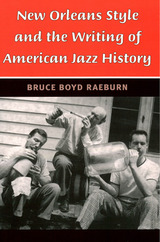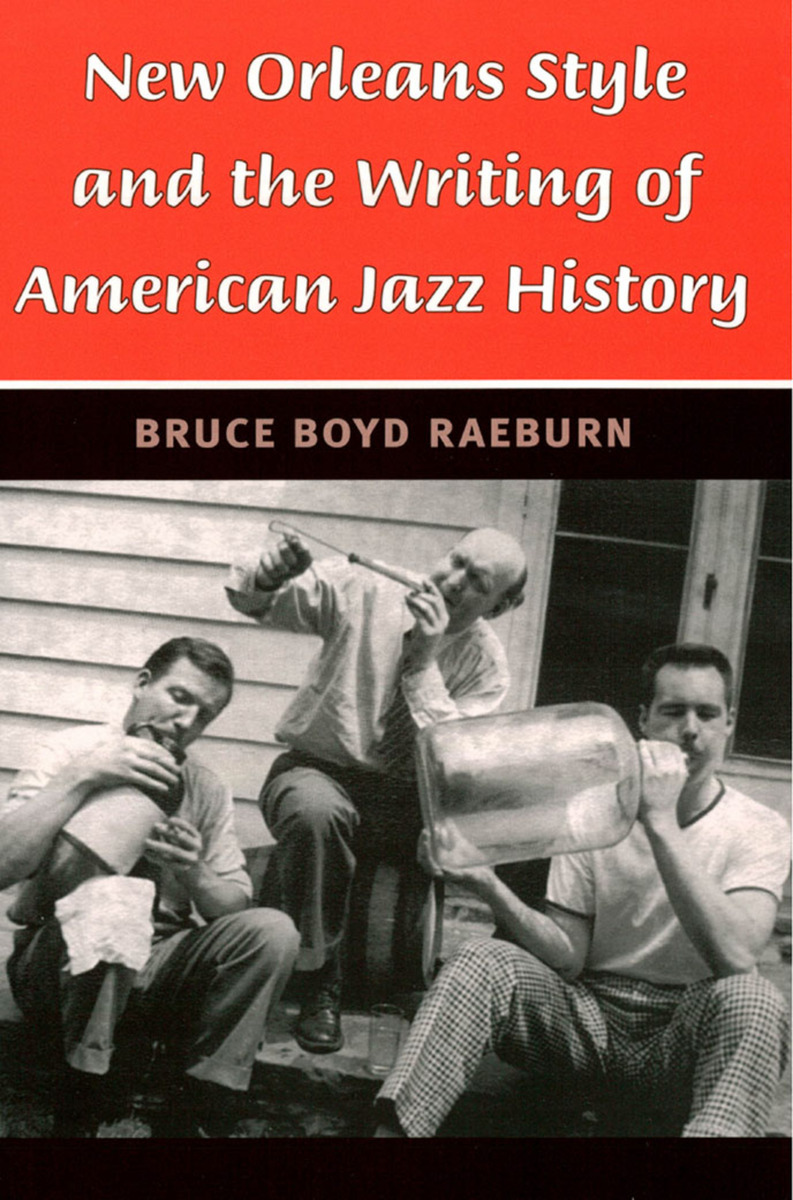
New Orleans Style and the Writing of American Jazz History
by Bruce Boyd Raeburn
University of Michigan Press, 2009 Cloth: 978-0-472-11675-1 | Paper: 978-0-472-03321-8 | eISBN: 978-0-472-22561-3 (standard) Library of Congress Classification ML3508.8.N48R34 2009 Dewey Decimal Classification 781.653
ABOUT THIS BOOK | AUTHOR BIOGRAPHY | REVIEWS | REQUEST ACCESSIBLE FILE
ABOUT THIS BOOK
New Orleans Style tells the tale of the recognition of New Orleans jazz as a discrete style and how that recognition affected the writing of American jazz history. The men and women who participated in the awakening of American jazz scholarship were partisans of a community of "hot" record collectors, whose interest in the origins of jazz was a foregone conclusion. As an international network of these collectors took shape between the 1920s and 1934, they provided a mechanism for the circulation of historical information on jazz, which then became the basis for the emergence of a jazz literati writing for magazines such as Down Beat, Esquire, the New Republic, and Jazz Information. It was not until later that writers like Charles Edward Smith and William Russell, inspired by their love for the music and emphasizing "New Orleans style," explained in works such as Jazzmen (1939) and The Jazz Record Book (1942) that jazz was "born in New Orleans." Raeburn traces the conceptualization of jazz history derived from Jazzmen to jazz's ultimate refuge in New Orleans and its integration into the cultures which it celebrated. The result is an essential work of jazz criticism that will fill a major gap in the field's literature.
AUTHOR BIOGRAPHY
Bruce Boyd Raeburn is Curator of the Hogan Jazz Archive, Tulane University.
REVIEWS
"A fascinating, exceptionally well-written study of the origins of American jazz criticism and scholarship, both of which turn out to be rooted in the emergence in the early Thirties of the idea of 'authenticity' as a criterion for excellence in jazz. Raeburn, the curator of Tulane University's Hogan Jazz Archive, has probed deeply into the work of the enthusiastic amateur scholars who first sought to document the beginnings of jazz in New Orleans, and his thoughtful account of what they wrought is destined to become one of the standard works in the field."
---Terry Teachout, author of Pops: A Life of Louis Armstrong
— -
"A fascinating, exceptionally well-written study of the origins of American jazz criticism and scholarship, both of which turn out to be rooted in the emergence in the early Thirties of the idea of 'authenticity' as a criterion for excellence in jazz. Raeburn, the curator of Tulane University's Hogan Jazz Archive, has probed deeply into the work of the enthusiastic amateur scholars who first sought to document the beginnings of jazz in New Orleans, and his thoughtful account of what they wrought is destined to become one of the standard works in the field."
---Terry Teachout, author of Pops: A Life of Louis Armstrong
— -
"A fascinating, exceptionally well-written study of the origins of American jazz criticism and scholarship, both of which turn out to be rooted in the emergence in the early Thirties of the idea of 'authenticity' as a criterion for excellence in jazz. Raeburn, the curator of Tulane University's Hogan Jazz Archive, has probed deeply into the work of the enthusiastic amateur scholars who first sought to document the beginnings of jazz in New Orleans, and his thoughtful account of what they wrought is destined to become one of the standard works in the field."
---Terry Teachout, author of Pops: A Life of Louis Armstrong
— -
REQUEST ACCESSIBLE FILE
If you are a student who cannot use this book in printed form, BiblioVault may be able to supply you
with an electronic file for alternative access.
Please have the accessibility coordinator at your school fill out this form.