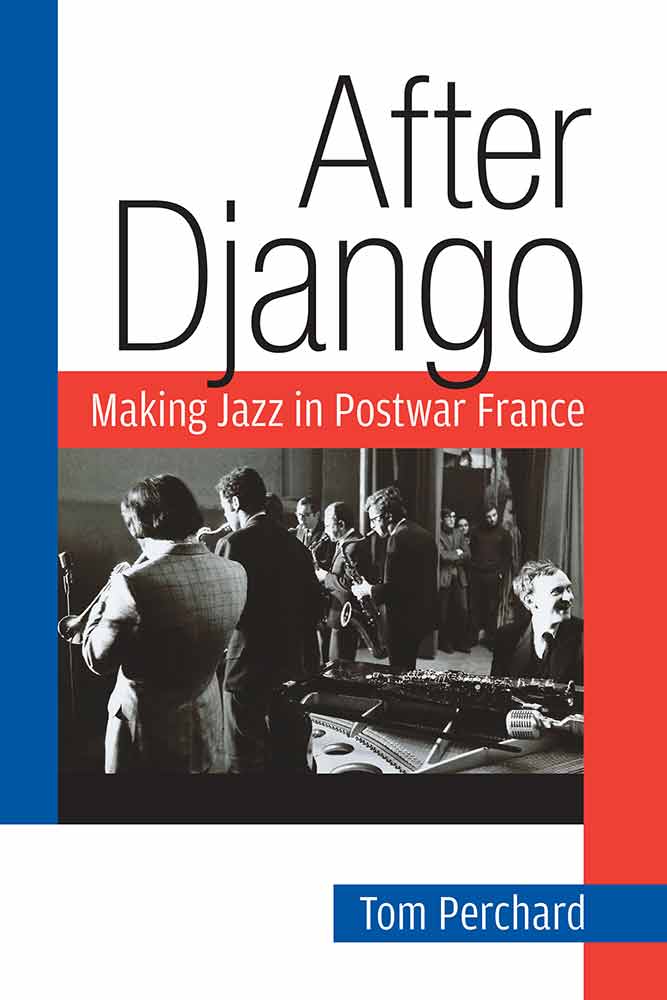
“Perchard significantly advances our understanding of jazz in post–WWII France by giving us a deep and sophisticated analysis of the music’s intersection with some of the larger issues of the day, including national identity, political tension, and evolving definitions of artistic culture. He provides a very rich picture of how jazz functioned locally within a global context. In addition, he makes a significant historiographical intervention by asking jazz historians and French historians to rethink their assumptions about how jazz became ‘assimilated’ into French culture. I know of no other comparable book.”
—Jeffrey Jackson, Rhodes College
— -
“After Django is a vital contribution to the ongoing expanded scholarly account of jazz in its global dimension, written by an author who knows his stuff inside and out, and has consistently illuminating points to make about the Francophone scene that are transferable to a broader perspective on jazz as such, re-configuring many basic assumptions about a music all too preemptively conceived as authentically American.”
—Jed Rasula, University of Georgia
— -
“France looms large in the history of jazz performance and criticism. Tom Perchard’s After Django is the most comprehensive study in English of French understandings of jazz, the music’s influence in French intellectual life and entertainment, and the impact of Francophone discourses on jazz cultures in the United States and elsewhere. The music itself remains front and center in the narrative, which will surely captivate jazzophile readers.”
—E. Taylor Atkins, Northern Illinois University
“In the rich but eminently readable After Django, Tom Perchard’s subject matter and approach offer a refreshing challenge to jazz scholarship. Perchard masterfully draws on a range of relevant theory and concepts to produce a nuanced understanding of jazz practices within a fascinating period in French cultural history.”
—Catherine Tackley, The Open University
“The way Perchard writes about music in After Django is tremendous. The balance the author strikes between history and criticism is exemplary, as good as anything I've read in recent years. This is a remarkable book that is bound to make a huge contribution.”
—Eric Drott, University of Texas at Austin
— -
"After Django" advances our understanding of jazz in post-war France, through a sophisticated analysis of jazz's relationships with national identity, politics and cultural aesthetics. It shows Perchard to be a really first-class jazz historian and critic."
--Andy Hamilton, Jazz Journal International
— Andy Hamilton, Jazz Journal International
"As well as being a carefully argued study of such weighty philosophical/sociological concerns, Perchard’s book also contains fascinating details about individual jazz lives, intersections between new wave French cinema and jazz, and interplay between momentous political changes and the music. After Django, in short, is essential reading for anyone interested in the process of jazz’s assimilation into French culture in particular, and into European culture in general."
--Chris Parker, London Jazz News
— Chris Parker, London Jazz News
After Django presents a crisp, sometimes wry and ably supported picture of the evolution of art and ideas in postwar France. This is exactly the kind of heft that, even if not always at play, is worth lining ones's quiver with in any serious artistic or experiential endeavor."
--New York City Jazz Record
— Clifford Allen, New York City Jazz Record
"The ambiguity of France’s attraction to Afro-America was surely what James Baldwin had in mind when, in 1960, he suggested that 'someone, some day, should do a study in depth of the role of the American Negro in the mind and life of Europe, and the extraordinary perils, different from those of America but not less grave, which the American Negro encounters in the Old World.' Baldwin’s challenge has been taken up in recent years by a group of jazz historians working on France. Tom Perchard’s After Django is the latest addition to an impressive body of scholarship ... [an] lluminating study."
---New York Review of Books
— Adam Shatz, New York Review of Books
"After Django offers a much-needed English-language study of an area that historical (American) narratives on jazz generally only treat in passing."
--Notes: Quarterly Journal of the Music Library Association
— Maristella Feustle, Notes: Quarterly Journal of the Music Library Association
"[After Django is] a very important examination of jazz in France."
--Roundup, W. Royal Stokes
— W Royal Stokes, Roundup
"Taking in the entire period from pre-war France up to the early 1980s, this is an extraordinarily detailed and compelling account of a musical subculture within its native setting, tracing the intricacies and roots of the ideas and individuals who populated, and much of the time orchestrated, the era’s institutions and politics. By concentrating on the writers and intellectuals who were not only the critics but also the tastemakers, rather than (as is usual) simply the musicians, Perchard makes the connection of the music to the fabric and tumult of a changing society wonderfully vivid and utterly enthralling. This is a must-have for serious cultural historians."
---Times Higher Education
— Les Gofton, Times Higher Education
"Perchard's ability to deal with the nuances of cultural and intellectual history while also making sense of music and how it manifested itself in different media makes this book a standout performance."
--Twentieth-Century Music
— Matt Jordan, Twentieth-Century Music
"An important contribution to institutional history of jazz in France."
--Volume!
— Volume!