
 A SCHOLARLY BOOK REPOSITORY
12 start with J start with J
Jairus’s Daughter and the Female Body in Mark demonstrates that ubiquitous and significant depictions of children in the literature and material culture of the first century CE shaped the mindsets of the Gospel of Mark’s original audience. Through a detailed analysis of the story of Jairus’s daughter in Mark 5 and of the archaeological remains depicting female children, Janine E. Luttick reveals how ancient hearers of this story encountered an image of a female child that communicated ideas of hope to Jesus’s followers and in turn how readers today can understand the authority of Jesus, the domestic structures of early Christianity, and the suffering and loss experienced by some early Christians.

Explore the diverse character of emerging Christian narratives
This book presents essays that show how prophetic and priestly emphases in Luke and Acts, and emphasis on Jesus’s existence prior to creation in the Gospel of John, are reworked in some second- and third-century Christian literature. Early Christians interpreted and expressed the storylines of Jesus, Mary, and other important figures in ways that created new images and stories. Contributors show the effect of including rhetography, the rhetoric of a text that prompts images and pictures in the mind of a hearer or reader, in interpretation of texts.
Features:
- Readings that attempt to account for the development of richly creative and complicated early Christian traditions
- Essays bridging New Testament studies and interpretation of Early Christian literature
- Interpretations that integrate social and rhetorical interpretations
Not a Jew marginally, but centrally
In this book, LaCocque presents the case that Jesus was totally and unquestionably a Jew. He lived as a Jew, thought as a Jew, debated as a Jew, acted as a Jew and died as a Jew. He had no intention of creating a new religion; rather, he was a reformer of the Judaism of his day. True, his critique went far beyond an intellectual subversion. In fact, Jesus progressively thought of himself as the “Son of Man” inaugurating the advent of the Kingdom of God on earth.
Features:
- Focused attention given to the historical Jesus and not Christianity or Christology
- Addresses restricted sources, namely, the Synoptic Gospels
- Close examination of Jesus’s way of thinking, teaching, and behaving
Rebecca K. Esterson explores how Christian methods of biblical interpretation shifted during the eighteenth century, producing a rhetorical rejection of allegory while embracing literalism. Under the influence of Enlightenment concepts of human reason and advances in the experimental sciences, Christian interpreters began casting Jewish biblical interpretation as allegorical, while presenting Christian interpretation as literal. This shift in self-understanding allowed Christians to portray their own interpretations as scientifically, philosophically, and historically superior, resulting in a new way of othering the Jewish people. This study of biblical exegesis, theology, philosophy, and the arts in English, Swedish, and German contexts is an essential resource for scholars interested in biblical reception history and the history of Jewish-Christian relations.
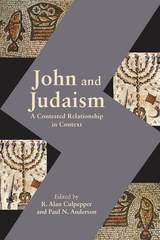
A window into early Judaism and Christianity
The Gospel of John was written during the period of the emergence of Christianity and its separation from Judaism and bears witness to their contested relationship. This volume contains eighteen cutting-edge essays written by an international group of scholars who interpret for students and general readers what the book tells us about first-century Judaism, the separation of the church from Judaism, and how John's anti-Jewish references are being interpreted today.
Features:
- A debate over the process that led to the separation of the church from Judaism, and John's place in that process
- A review of recent interpretations of John's anti-Jewish references
- An assessment of the current status of Jewish Christian relations

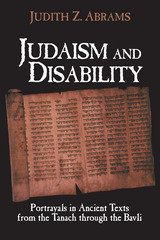
In Judaism and Disability, the archaic portrayals of mentally ill, mentally retarded, physically affected, deaf, blind, and other disabled people reflect the sharp contrast they presented compared to the unchanging Judaic ideal of the “perfect priest.” All of these sources describe this perfection as embodied in a person who is male, free, unblemished, with da’at (cognition that can be communicated), preferably learned, and a priest. The failure to have da’at stigmatized disabled individuals, who were also compromised by the treatment they received from nondisabled people, who were directing and constraining.
As the Judaic ideal transformed from the bodily perfection of the priest in the cult to intellectual prowess in the Diaspora, a parallel change of attitudes toward disabled persons gradually occurred. The reduced emphasis upon physical perfection as a prerequisite for a relationship with God eventually enabled the enfranchisement of some disabled people and other minorities. Scholars, students, and other readers will find the engrossing process disclosed in Judaism and Disability one that they can apply to a variety of other disciplines.
READERS
Browse our collection.
PUBLISHERS
See BiblioVault's publisher services.
STUDENT SERVICES
Files for college accessibility offices.
RECENTLY PUBLISHED



UChicago Accessibility Resources
home | accessibility | search | about | contact us
BiblioVault ® 2001 - 2026
The University of Chicago Press